
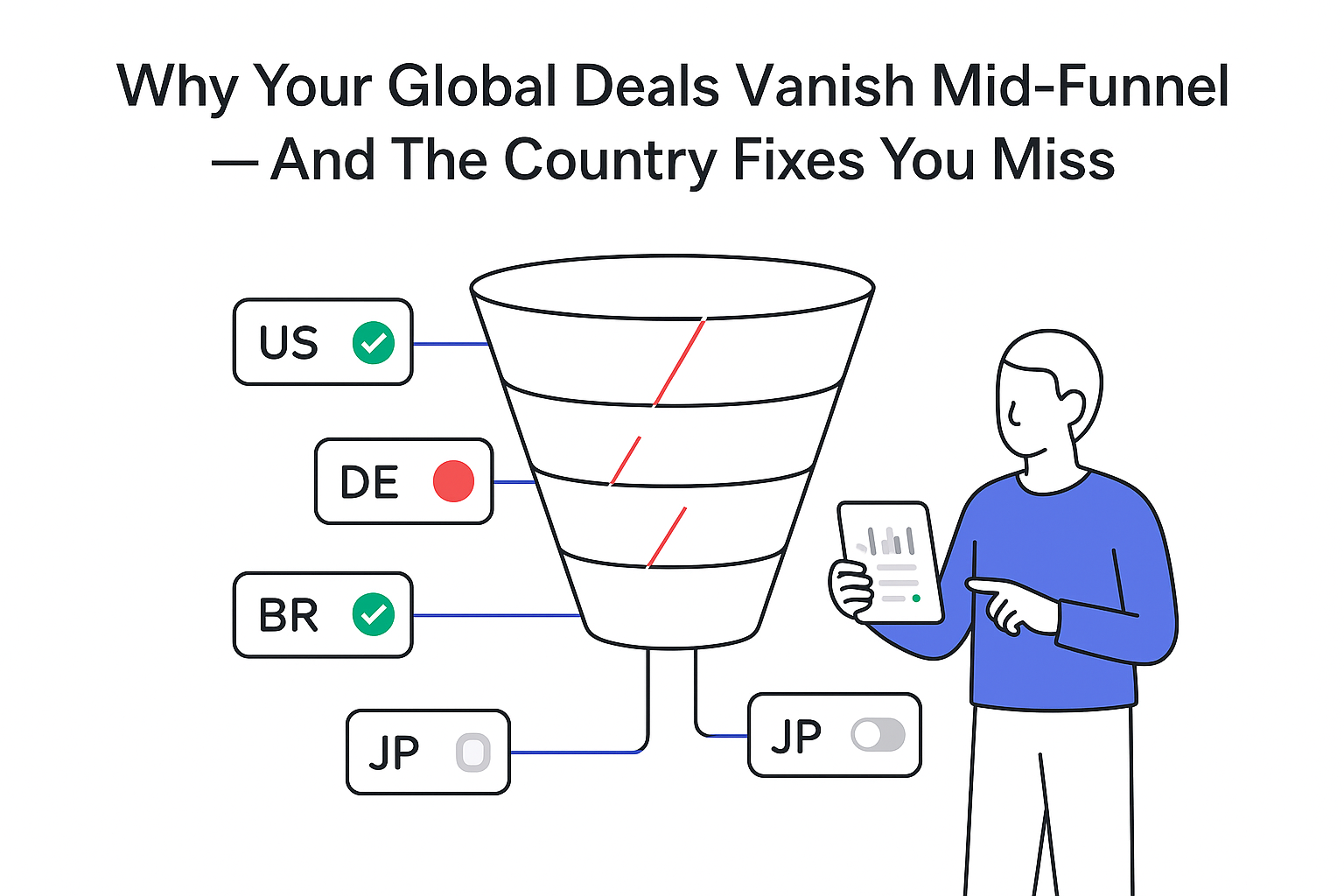
If your domestic marketing engine hums along but global results feel random, I see that pattern all the time. Many B2B service CEOs assume a strong home playbook plus translation equals international growth. Then reality shows up as weak pipeline from new regions, higher acquisition costs, and sales teams quietly avoiding “international” because it feels like a different game.
The gap is rarely effort or intent. It’s usually structure. When I build (or audit) a global marketing strategy for a service business, it has to be country-specific, sales-driven, and brutally honest about where the company actually deserves to win. Below are the most common breakdowns - and what I do to fix them in a way your pipeline data can confirm.
You didn’t choose the right audience for your global marketing strategy
The fastest stress test I know is simple: I look at the ICP by country, not by industry alone. If you need a refresher on getting the foundations right, start with B2B SaaS keyword-to-ICP alignment and apply the same discipline market by market.
For B2B service companies, three filters tend to matter more than anything else:
- ICP fit by country: Industry, company size, and buying committee structure vary by market. “Mid-market tech in Germany” and “public sector in the UK” may look similar on paper, but they buy differently and evaluate risk differently.
- Problem intensity: I ask whether the pain you solve is urgent in that country or merely “worth addressing later.” A challenge that’s non-negotiable in one region can be optional in another.
- Ability to buy remotely: I pressure-test whether your current sales motion works across time zones and expectations, or whether the market effectively demands local presence, in-language meetings, or on-site delivery.
Too many global expansion plans start with “Let’s add Spanish, French, and German” instead of “Where does my ICP line up with how I already sell?” That’s when a global marketing strategy turns into expensive noise.
Country ICP scoring (so you don’t pick with vibes)
Before I see teams pour budget into multi-country marketing, I like to compare markets with a simple scoring approach. It doesn’t need to be perfect; it just needs to reduce wishful thinking and make trade-offs visible.
| Factor | Question to ask | Score 1-5 |
|---|---|---|
| TAM | Is there enough ICP volume to matter this year? | |
| Urgency | How painful is the problem for them right now? | |
| Deal size | Is average contract value equal to or higher than home market? | |
| Sales motion fit | Can my current sales process work without heavy reinvention? | |
| CAC risk | How likely am I to overspend to win early traction? |
I score each target country roughly, then rank them. The point isn’t accuracy down to decimals - it’s making the selection logic explicit.
Validating markets with real pipeline data (not opinions)
A good international strategy starts as a hypothesis, but I don’t trust it until it survives contact with your actual numbers and sales conversations.
First, I pull performance by country or region for the last 12-24 months wherever it exists: win rate, sales cycle length, and deal size. Even if you’ve never “targeted” a market, most companies have some inbound, partner, or referral activity. That background noise is often the first signal.
Next, I run narrowly scoped tests in the top one or two candidate markets that mirror the company’s proven segment and message. I make sure leads are clearly labeled by country and by campaign, and I ask sales to log objections consistently (pricing, proof, legal, delivery fit, and so on). If lead quality is a recurring problem in your current funnel, align definitions first with From MQL to SQL: Fixing Lead Quality With Intent-Based Forms.
Finally, I review a small sample of won and lost opportunities by country with revenue leadership. I’m looking for repeating patterns: what blocks trust, what triggers urgency, and what buyers expect to see before they move forward. When the data, the tests, and the sales feedback point in the same direction, I’m no longer guessing - I’m choosing markets where the company has earned the right to compete.
You localized for the language, not the region
Translating landing pages is better than nothing, but in services, language rarely closes the deal by itself. Region-specific positioning, proof, and commercial expectations do. That’s why “translation-first” approaches often underperform, even when the execution is clean.
Even within the same language, I see companies miss the mark. The UK, US, and Australia can all share English and still respond to different cues - what terminology feels “normal,” what proof is persuasive, and what risks buyers want addressed up front. If the strategy treats them as one block, conversion rates usually sink quietly rather than fail loudly.
When I think about localization, I go beyond words on the page and map what changes by region:
- Positioning: What problem leads the story - compliance, revenue, risk, cost, or speed?
- Proof points: What evidence carries weight in that market (and what simply looks irrelevant)? If you need a tighter format sales will actually use, adapt The Anti-Fluff B2B Case Study Template Buyers Actually Read for each region.
- Compliance and risk: What local standards, contracting expectations, or data/security concerns buyers assume you understand.
- Pricing expectations: Currency, how pricing is expressed, and how buyers compare providers.
- Terminology and tone: Titles, spelling conventions, and the “native” way buyers describe the work.
- Competitor landscape: Whether you’re being compared to global brands, local boutiques, or in-house teams.
I like to capture those inputs in a simple grid - one column per country, one row per element - before translating anything. That way, translation follows strategy instead of replacing it. If you’re evaluating vendors or internal workflows for scaling this work, TextMaster is an example of a localization provider in this space.
You didn’t adapt your SEO
Strong domestic SEO doesn’t automatically travel. I’ve seen international SEO choices determine not just traffic volume, but lead quality - and whether sales trusts what marketing is sending.
International SEO basics that decide outcomes
The unglamorous decisions are where many strategies fail:
- Site structure: Whether you separate markets by country folders, subdomains, or country-specific domains has consequences for operations and visibility. For many service firms, the simplest operational path is the one that avoids fragmenting authority and content governance.
- Hreflang configuration: If search engines can’t confidently match the right country/language page to the right searcher, users land on the wrong version and performance looks “mysteriously” weak.
- Local search intent: The same phrase can imply different needs by market. In one country, buyers may want comparisons; in another, they may expect vendor pages; in another, they may reward educational content. For a practical way to structure this, see B2B search intent taxonomy.
- Keyword discovery by market: I avoid translating keywords and instead start from how people in that market actually search for the service. Literal translation is one of the easiest ways to rank for the wrong intent.
- Localized authority signals: Search engines and buyers both respond to relevance. When credibility is anchored only in the home market, international pages can look thin even if the service is strong.
Operationally, I keep keyword mapping simple: define core service lines, build market-specific keyword sets for each, map them to the right page types (service, comparison, insight), and then track conversions by country so rankings don’t become a vanity project. If your current mapping is messy or disconnected from revenue conversations, use The B2B Keyword Map That Aligns Marketing and Sales Conversations as the baseline.
A few recurring mistakes are worth calling out because they create long, avoidable clean-up work:
| Mistake | Why it hurts |
|---|---|
| Auto-translating large sections of the site | Low trust and weak conversion, even if traffic increases |
| Using one generic page for many countries | Diluted relevance for users and search engines |
| Duplicate content with no hreflang | Pages compete with each other and rankings become unstable |
| Wrong or missing hreflang configuration | Users land on the wrong market version |
| Ignoring intent differences by country | You attract traffic that doesn’t match how buyers purchase |
International SEO should feel like a natural extension of the go-to-market strategy, not a parallel project running in its own lane.
You’re not consistent
Inconsistent messaging doesn’t just look messy. In my experience, it stretches sales cycles, lowers conversion rates, and makes teams doubt the entire international plan. The failure mode is usually a mismatch across touchpoints: an ad promises one outcome, the landing page frames a different problem, and the sales conversation focuses on something else entirely.
By the proposal stage, nobody is sure what’s actually being sold or why the buyer should pick you. Message match is fixable, but only if you treat it as a system - not copy polish. A useful reference point is B2B landing page message match, then applying the same discipline to region-specific variations.
To prevent drift, I use a simple “messaging spine” per ICP and per region, then make sure every channel references the same core idea.
| Layer | Question it answers | Example (region-specific) |
|---|---|---|
| Problem | What pain do I name first? | Paid channels stalling above target CAC |
| Promise | What outcome do I put on the table? | Improve efficiency while keeping SQLs up |
| Proof | Why should they believe it? | Local case study, metrics, trusted logos |
| Next step | What happens after interest is created? | Clear evaluation path and buying steps |
I keep the structure stable globally and tune the details per market. Consistency is also a measurement issue: I prefer one reporting view that can be filtered by country, so I can compare session quality, lead progression, opportunity creation, and win rate without turning every market into its own disconnected narrative.
You thought it was a one-time deal
Global expansion isn’t a campaign. I treat it more like an operating layer you add on top of an existing go-to-market motion. If the mindset is “we localized the site, job done,” early mistakes become permanent.
Each market needs a rhythm - not a heavy one, just a reliable one. I usually manage that rhythm across three tracks: regular market reviews (pipeline and sales feedback), ongoing conversion improvements on key pages, and continuous credibility building that sales can use (examples, references, region-specific objections handled directly).
A 90-day stabilization rhythm
When I launch or reset a country, I aim for a practical 90-day cadence that forces learning quickly.
| Timing | What I focus on |
|---|---|
| Month 1 | Finalize positioning for the country; publish the core localized pages; align lead qualification and routing with sales |
| Month 2 | Launch initial campaigns; monitor lead quality; capture objections from sales conversations; remove obvious friction in the buyer journey |
| Month 3 | Add one or two region-relevant proof assets; adjust targeting and messaging based on results; review early opportunities and patterns with revenue leadership |
A 6-12 month scaling rhythm
Once a market shows healthy signs, I expand depth before I expand breadth: more content where intent is high, more market-specific credibility signals, and tighter enablement so sales doesn’t have to “freestyle” region by region.
While revenue is ramping, I watch leading indicators that correlate with eventual pipeline health in services: improvement on high-intent queries by country, consistent inbound from ICP companies, evidence that region content assists later conversions, and a rising sales acceptance rate for leads tagged to that market. If those indicators move in the right direction, I’m usually looking at a strategy that’s working - even if revenue lags behind what the home market delivered in its best months.
One country or multiple markets
The uncomfortable question I always end up answering is whether to focus everything on one country first or spread expansion across several markets.
Both can work. Both can fail. The right choice depends on how the service is sold and delivered.
How I decide: focus vs spread
If the sales motion requires heavy localization, frequent meetings, and customized delivery, I usually prefer a single-country focus - provided the country is chosen deliberately. If delivery is largely remote, differentiation travels well, and the buyer is comfortable purchasing across borders, then a multi-market approach can be realistic. If you want a deeper methodology for territory selection, this guide is a solid companion: How-to-select marketing-territories-in-b2b-software-companies(lead).
| Approach | Speed to first wins | Risk level | Learning loops | Cost profile | Operational complexity |
|---|---|---|---|---|---|
| Single-country focus | Slower at first, then sharper | Lower if well chosen | Deep, easier to apply | Concentrated spending | Easier to coordinate |
| Several markets at once | Faster reach, uneven wins | Higher, more unknowns | Shallow per market, broader but noisier | Thinner per country, more overhead | More moving parts |
If the home-market motion is still being figured out, spreading across five countries tends to amplify chaos. If the process is tight and delivery is genuinely border-friendly, a slightly wider strategy can surface pockets of demand you wouldn’t have predicted.
What to check before committing
To decide where to focus, I start by mapping where demand already exists using the data the business already has: country-level organic traffic and queries, country breakdowns in paid performance reports (even if you thought you were “only targeting” one place), and credible estimates of market interest around your core topics. If a market is already sending high-intent visits or producing occasional inbound, I treat that as a signal worth investigating.
I also sanity-check resources. A global strategy fails quickly when each new country gets “whatever is left” of the budget and attention. I’d rather see a small number of markets funded to a minimum viable level - content and localization effort, authority-building work, paid testing, and sales enablement - than many markets run as side projects with no accountable owner. If budgeting turns into internal friction, align on the split with Demand Capture vs Demand Creation: Budgeting Without Internal Wars.
Competition assessment needs nuance, too. Generic difficulty metrics help, but they don’t capture relationship-driven incumbents. In each country, I look for what buyers treat as trust signals (local proof, visible expertise, association credibility), where competitors show up prominently (directories, review ecosystems, publications), and whether partnerships or ecosystems shape shortlists. Only then do I decide how to stand out - often by narrowing the story instead of broadening it.
Finally, I match target markets to the sales motion the company already knows how to run. If the current process is mid-market, mostly remote, and relatively fast, jumping into heavily regulated enterprise deals in a new country can be painful. Time zones, contracting norms, data/security expectations, and the need for in-person work can turn “international growth” into operational drag if it isn’t chosen deliberately.
When I pick markets where the existing sales process lines up reasonably well with how buyers expect to purchase, the global marketing strategy amplifies a working motion instead of forcing a reinvention in every country. If you’re still unsure whether the organization is set up to execute, use International Marketing Readiness as a practical checkpoint.
For additional international marketing and localization insights, you can also browse Content Is King.



.svg)

.svg)
.svg)