
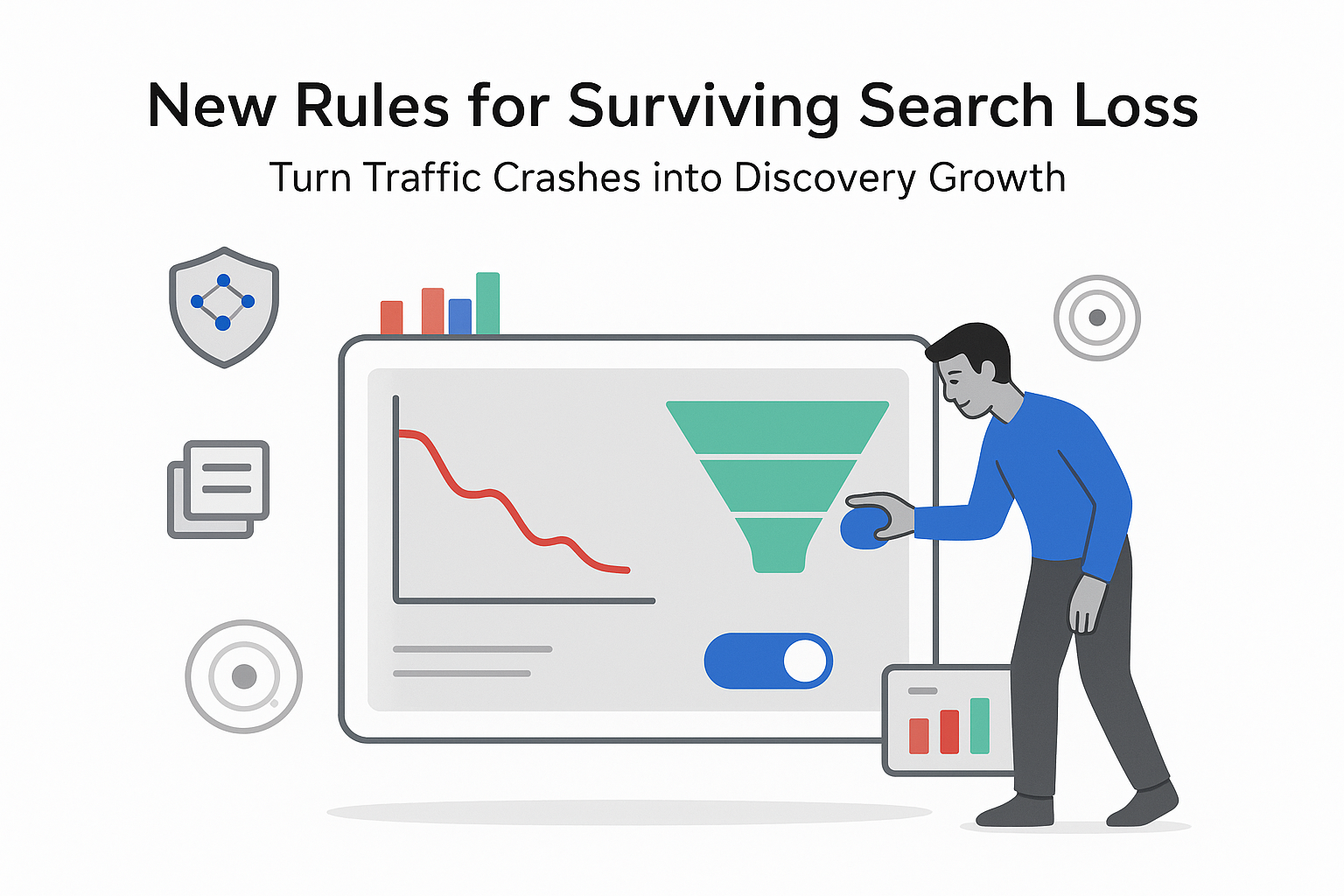
How The Washington Post Traffic Strategy Reprices Content, Audience Signals, And Risk For Marketers
The core question is what the Washington Post's "win back traffic" plan signals for how brands should think about search, content, and audience in a post-search environment - and which parts of that plan translate into practical moves for non-news businesses.

Key Takeaways
- Treat "search decline" as a structural change, not a temporary dip. The Post's roughly 50% drop in organic search over three years [S1] shows that relying on Google as the main growth engine is now a concentration risk, not a growth strategy. Marketers should reset channel assumptions and build plans where search is one of several feeders, not the primary one.
- The three pillars - content must matter, have a defined audience, and be practically useful - are a workable filter for any content portfolio. Applied rigorously, they will shrink total content volume but raise the share of pages that generate engagement, conversions, and direct visits.
- A "build a base, then adapt" plan acknowledges that there are no proven playbooks for post-search traffic. The operational shift is from static roadmaps to test-and-learn cycles: smaller, clearly framed bets with telemetry around audience signals, repeated frequently.
- Narrowing coverage to what readers "signal" they want raises the risk of hollowing out differentiation. Brands that cut too aggressively to chase short-term engagement can erode long-term brand value and pricing power.
- For performance marketers, the signal is clear: invest in content and formats that create reasons for users to seek you out directly (subscriptions, shows, tools, utilities) so paid and organic search become amplifiers of a relationship, not the only way people find you.
Situation Snapshot
The trigger for this analysis is the Washington Post's internal memo and leadership comments about restructuring the newsroom and its strategy, summarized in Roger Montti's Search Engine Journal article "7 Insights From Washington Post's Strategy To Win Back Traffic" [S1].
Key facts that are not in dispute:
- The Washington Post reports its organic search traffic has fallen by nearly 50% in the last three years [S1][S2].
- Drivers cited: the decline of traditional search referrals, early-stage AI search and chat reshaping user journeys, and fragmented content consumption across video, audio, creators, and social platforms [S1][S2].
- Management's stated goals: attract readers, create content that leads to subscriptions, and increase engagement [S2].
- They position the current plan as a foundation, not a proven solution: test, measure, and adapt based on outcomes [S1][S2].
- Editorial leadership emphasizes "reader signals" as a central guide - what readers consume, linger on, subscribe for, and share [S1][S3].
- The content strategy boils down to three checks: every piece should (1) matter, (2) have an identifiable audience, and (3) provide understanding that is applicable in real life [S1][S2].
Breakdown & Mechanics
At a high level, the mechanics look like this:
Search decline + AI/chat + fragmented attention
→ Structural drop in passive, intent-driven traffic
→ Economics of long-tail, undifferentiated content collapse
→ Need to concentrate resources on content that can win direct loyalty and repeat attention
Macro forces
- Search weakening as a referral engine: The Post's "nearly half" loss in organic search in three years [S1][S2] is consistent with broader publisher complaints post-core updates and as Google experiments with AI overviews. Even without exact industry-wide numbers, the direction is clear: fewer free, high-intent clicks.
- AI/chat absorbing informational queries: When users ask chatbots for answers instead of typing structured queries, the traditional keyword → SERP → click path shrinks. That compresses opportunities for commodity informational content.
- Audience fragmentation: Podcasts, YouTube and TikTok shows, newsletters, creator channels, and messaging apps all pull time and attention away from open web sessions that used to start from Google or a homepage.
Washington Post's structural response
The Post's plan can be read as a shift from "maximize pageviews from search" to "maximize the share of audience attention we own directly".
-
Define content pillars around indispensability
- Content must matter by solving a felt problem or curiosity.
- It must have a clearly defined audience.
- It must not only explain but also help readers act or navigate [S1][S2].
Mechanically, this acts as a filter on pitch approval and resourcing: topics without a clear "who cares and how does this help them?" case get cut or deprioritized.
-
Operationalize reader signals
- Inputs include page-level engagement, subscription events, recirculation, topic-level loyalty, and format preference (text vs. video vs. podcast).
- Process: reader behavior → editorial and strategy interpretation → changes in beats, formats, and investment → new reader behavior data.
This moves editorial planning from "supply-led" (what the newsroom wants to publish) toward "demand-informed" (what readers actually use and return for).
-
Foundation-then-adapt model
- Management explicitly frames this as laying a base (clear goals, content criteria, multi-format capabilities) and then iterating based on what works [S1][S2][S3].
- Operationally, this is a portfolio management approach: expect a portion of bets to fail, but keep the cycle fast and inexpensive enough that winners can be identified and scaled quickly.
For marketers, the mechanics translate to: audience need + clear who/why → content and format selection → signal tracking (engagement, conversion, repeat visits) → ruthless pruning and doubling down → gradual shift from "search-dependent" to "audience-dependent" growth.
Impact Assessment
Organic search and content marketing
Direction and scale:
- Short term (0–12 months): Less total content, more focus on high-need, high-utility pieces. For most brands, this looks like:
- Killing or consolidating thin, low-engagement pages that only exist because they once ranked.
- Building deeper, more practically useful pieces that answer "what now?" instead of just "what is?".
- Medium term (12–36 months):
- A smaller but stronger set of pages becomes the core of search traffic and internal linking.
- As AI and chat absorb shallow queries, content that helps users decide, choose, and act will account for a higher share of organic conversions.
Winners:
- Brands that map content topics directly to specific audiences and jobs-to-be-done (for example, "first-time small-business owner comparing payroll options" rather than "payroll software keyword cluster").
- Sites that invest in practical detail - measurement guides, use cases, calculators, and context - rather than just long-form text.
Losers:
- Portfolios built on hundreds or thousands of near-duplicate, low-intent pages whose only value was to catch stray queries.
- Teams that keep planning primarily from keyword tools rather than real usage data and customer interviews.
Actions and watchpoints:
- Define "content that matters" in your own context: tie each key page or series to a specific audience segment and problem, then check whether engagement and revenue data support that story.
- Shift SEO planning inputs from only keyword volume to a mix of search data, on-site behavior, sales and support feedback, and subscriber data where available.
- Implement regular pruning and updating cycles so pages that fail on engagement and usefulness are reworked or retired.
Paid media and channel mix
Direction and scale: As organic becomes less predictable, paid channels often fill the gap, but their role should change: from pure acquisition to also seeding "indispensable" content and formats.
Winners:
- Brands that run campaigns to promote recurring value assets - newsletters, tools, live streams, community spaces - where they can keep engaging users without continuous spend.
- Advertisers who treat search and social ads as ways to introduce people to high-utility content, not just as last-click conversion channels.
Losers:
- Strategies that keep pouring budget into high-CPC, late-funnel keywords without building parallel assets that grow direct, email, or app traffic.
Actions and watchpoints:
- Rebalance budgets so a defined portion of spend promotes relationship-building assets (shows, utilities, guides) that create reasons for direct return visits.
- Test more creative formats - short videos, carousels, interactive units - that mirror where attention has shifted while still linking back to useful owned experiences.
Product, brand, and operations
Direction and scale: The Post's aggressive cutting of lower-performing topics and teams signals a willingness to shrink to a core promise and rebuild. For non-media brands, the parallel is trimming product lines or content segments that add complexity but do not build loyalty or margin.
Winners:
- Organizations that can measure where their differentiation actually lies - verticals, formats, or features that users would miss if they vanished - and concentrate staff, budget, and experimentation there.
- Teams that can rewire workflows to respond faster to user signals: shorter planning cycles, clearer scorecards, and cross-functional squads around audiences or journeys, not channels.
Losers:
- Companies that over-index on short-term engagement signals and cut "low-click but high-brand" elements (for example, thought leadership, cultural coverage, quirky features) that contribute to long-term brand strength.
Actions and watchpoints:
- Segment content and product areas by both current performance and strategic value: what directly drives revenue now, what builds brand and pricing power, and what is neither. Resource accordingly.
- Invest in measurement capability that links content consumption to trial, conversion, retention, and expansion, not just pageviews or opens.
Scenarios & Probabilities
Base case - reader-signal-driven focus improves unit economics, but growth is modest (Likely)
The Post stabilizes traffic and subscriptions by concentrating on a narrower, high-need set of topics and multi-format franchises.
Overall reach stays below prior peaks, but revenue per engaged user improves. For marketers, this reinforces a "fewer, better, more useful" content model with realistic expectations that organic volume may not return to 2019 levels, but profitability per acquired user can.
Upside - indispensability framing creates new premium properties and brand strength (Possible)
By focusing on "indispensable where we compete", the Post could develop franchises (for example, in politics, investigations, or service journalism) that become must-consume brands across text, audio, and video.
Direct traffic, app use, and subscriptions would need to grow enough to offset or exceed search losses. Marketers would gain a proof point that deep, applied content plus clear audience definition can support higher pricing, lower churn, and more forgiving acquisition costs.
Downside - over-pruning erodes differentiation and long-term brand value (Edge)
Heavy reliance on near-term reader signals could lead to cuts in areas that do not spike engagement but do contribute to brand identity and discovery.
The publication could become narrower, easier to substitute, and more vulnerable to competitors or creators that cover the "long tail" topics it abandoned. For brands, this is a warning: treating only click and subscription data as the guide can push you toward generic, hyper-optimized content at the expense of distinctiveness.
Risks, Unknowns, Limitations
- Unknown performance of the new strategy: As the memo and Montti stress, this is an unproven plan [S1][S2]. Outcomes will depend heavily on execution quality, not just the framework.
- Reader signals vs. silent needs: Metrics capture what users do, not necessarily what they value long term. There is real risk of under-investing in content that shapes trust, category authority, or serendipitous discovery because it does not spike short-term metrics.
- Attribution challenges: Connecting specific content or formats to revenue can be messy, especially when users move across search, social, direct, and offline touchpoints. Mis-attributed value could push teams to overcut or overinvest in the wrong areas.
- Generalization to non-media businesses: A news publisher's economics and user behavior differ from SaaS, retail, or B2B services. The high-level ideas travel well (audience definition, applied usefulness, reader signals), but the specific mix of channels and formats will differ.
- AI and search policy volatility: Changes in how search engines display AI answers, links, and ads can still move traffic significantly in either direction, which could partly mask the effects of strategic changes.
Sources
- [S1] Search Engine Journal / Roger Montti, 2026 - article: "7 Insights From Washington Post's Strategy To Win Back Traffic."
- [S2] The Washington Post, 2026 - internal memo excerpts as quoted in [S1].
- [S3] Spotify - podcast interview with Matt Murray, Executive Editor of The Washington Post, as summarized and quoted in [S1] (link to Spotify).
- [S4] Reuters Institute for the Study of Journalism, 2023 - report: "Digital News Report 2023" (for broader trends on news consumption and platform shifts).
- [S5] Google, 2023 - product communications on Search Generative Experience and AI overviews.
Validation: This analysis defines a clear thesis, explains the drivers and mechanics of the Post's plan, contrasts short- and long-term implications, and maps them to concrete actions across organic, paid, brand, and operations, while clearly flagging uncertainties and source limits.





.svg)

.svg)
.svg)