
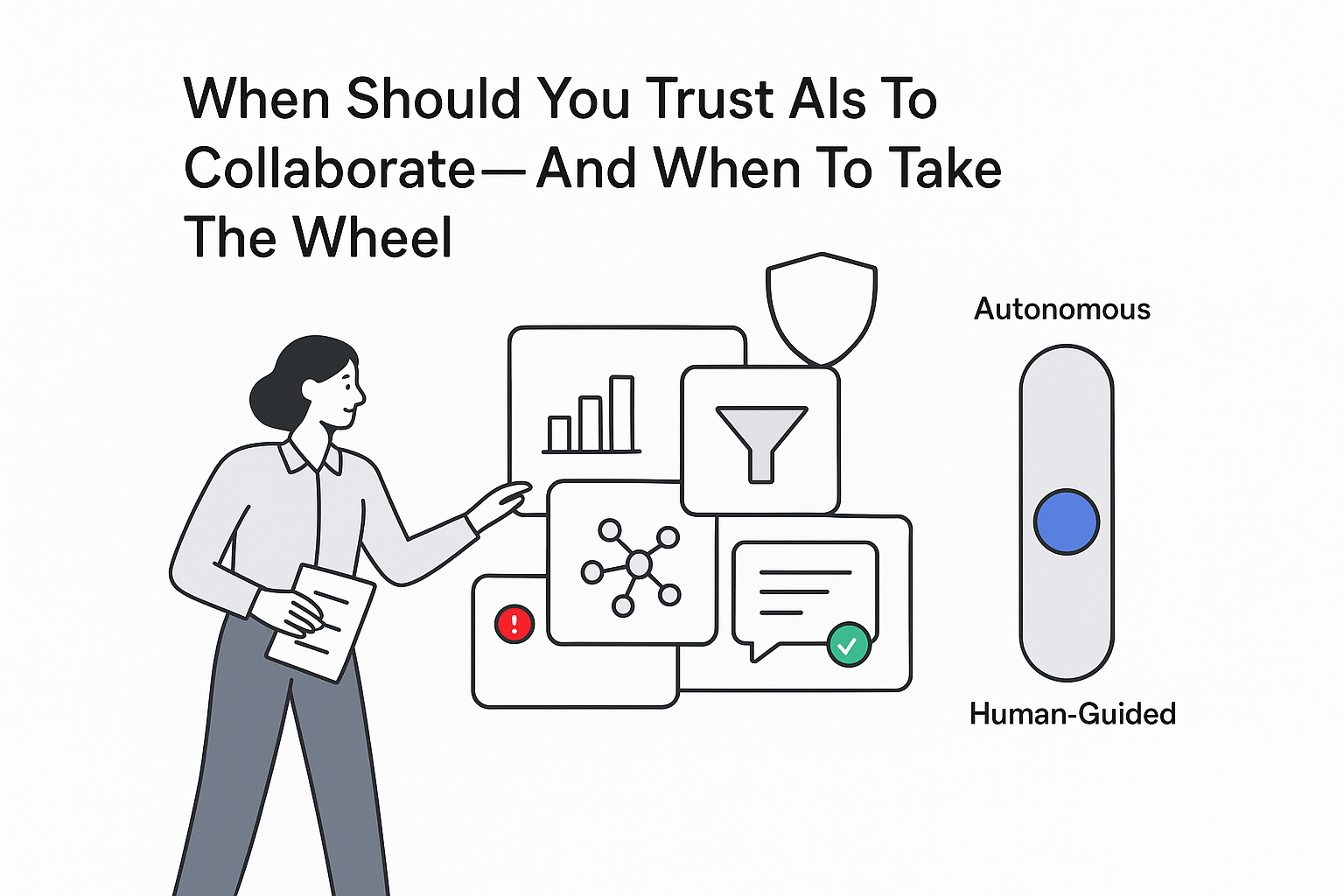
Group conversation with AI is moving from research to practical tooling. Google’s DialogLab prototype shows how multi-agent LLM conversations can be scripted, simulated, and analyzed with a mix of automation and human control. This report extracts the core data and design patterns from Google’s write-up so marketing and product teams can judge where group AI simulations are credible enough for training, research, and experience design.
DialogLab metrics for dynamic human-AI group conversations
DialogLab is an open-source framework from Google XR that lets designers configure agent personas, group structures, turn-taking rules, and the balance between scripted and improvised AI dialogue in multi-party settings such as panels, Q&A sessions, or debates [S1]. It separates who is present and how they relate (group dynamics) from how the conversation unfolds over time (conversation flow dynamics) [S1].
The tool supports an author-test-verify loop: visual authoring of scenes, live simulation with options for human intervention in AI responses, and post-hoc analytics such as turn-taking distribution and sentiment over time [S1]. Teams can also inspect the DialogLab code for implementation details.
In a small study with 14 participants from game design, education, and social science, Google compared three simulation modes - human-controlled, autonomous, and reactive - using a 5-point Likert scale for ratings of ease of use, engagement, effectiveness, and realism [S1]. Participants rated the human-controlled mode as significantly more engaging and generally more effective and realistic than the other two modes [S1].
Executive snapshot
- DialogLab structures conversations with “groups,” “parties,” and “elements” on the social side, and “snippets” with explicit turn-taking and interruption rules on the temporal side [S1].
- The framework supports three main testing modes: human control (designer approves or edits AI responses), autonomous (agents act on predefined orders), and reactive (agents only respond when directly addressed) [S1].
- In a 14-person study, the human control mode was rated as significantly more engaging and was perceived as more effective and realistic than autonomous or reactive modes across 5-point Likert measures [S1].
- Participants highlighted the drag-and-drop scene authoring, AI-assisted prompt generation, and analytics dashboard as helpful for rapid iteration [S1].
Implication for marketers: AI group simulations are more credible and usable when a human moderator can steer and edit agent behavior instead of leaving conversations entirely to autonomous models [S1].
Method and source notes for the DialogLab study
The main public description comes from Google’s research blog post “Beyond one-on-one: Authoring, simulating, and testing dynamic human-AI group conversations,” published February 10, 2026 [S1]. The system and study were accepted at ACM UIST 2025 under the paper titled “DialogLab: Authoring, Simulating, and Testing Dynamic Human-AI Group Conversations” (Paper) [S1][S2]. A short Video demonstration illustrates the authoring and simulation workflow.
What was measured [S1]:
- Tool capabilities: configuration of group structures, personas, snippets, and turn-taking; live simulation; analytics dashboards.
- Usability and perceived quality of different AI behavior modes: human control, autonomous, and reactive.
- Qualitative feedback on ease of use, flexibility, realism, and the utility of the analytics view.
Study design and sample [S1]:
- Participants: 14 domain experts and end users from game design, education, and social science research.
- Tasks:
- Design an academic social event using DialogLab.
- Test a group discussion with AI agents under three modes (human control, autonomous, reactive).
- Measurement: 5-point Likert ratings on ease of use, engagement, effectiveness, and realism for each mode, plus qualitative feedback.
Key limitations [S1]:
- Small sample (n = 14) limits generalization.
- Participant pool is specialized (designers and researchers), not general business users.
- Outcomes are subjective ratings; no task performance or behavioral metrics are reported in the blog.
- The blog notes “significantly more engaging” for human control mode but does not provide test statistics or effect sizes.
Key findings on AI group conversation design and control modes
1. Structured modeling of group interactions
DialogLab separates social setup from temporal flow [S1]:
- Social setup:
- Groups represent the overall context (for example, “conference social event”).
- Parties are sub-groups with roles (for example, “presenters” vs “audience”).
- Elements include human or AI participants and shared content like slides.
- Temporal flow:
- Snippets capture distinct phases (for example, opening, debate, consensus).
- Each snippet defines participating parties, turn sequences, style (collaborative vs argumentative), and rules for interruptions and backchanneling.
This structure makes it possible to reuse group definitions across multiple flows and swap out snippets while keeping the same cast of participants [S1].
2. Author-test-verify workflow
The tool centers on a three-stage workflow [S1]:
- Author:
- Drag-and-drop canvas to arrange avatars and shared content.
- Inspector panels for persona attributes and conversation rules.
- Auto-generated prompts for conversation snippets, which can be edited to align with scenario goals.
- Test:
- Live transcript view.
- “Human control” mode where suggested AI responses appear in an audit panel; the designer can edit, accept, or reject them before they enter the conversation.
- Verify:
- Analytics dashboard visualizing turn-taking distribution and sentiment over time.
- Timeline view to inspect conversation phases without reading full transcripts.
Participants described this workflow as intuitive, flexible, and time-efficient for shaping multi-agent exchanges [S1].
3. Human control vs autonomous vs reactive modes
Google compared three simulation configurations in the user study [S1]:
- Human control:
- Designer can prompt agents to “shift topic,” produce a “new perspective,” ask a “probe question,” or generate an “emotional response.”
- AI suggestions are surfaced for review before they are committed to the transcript.
- Autonomous:
- AI agents speak based on predefined turn orders (random or one-by-one).
- Topic shifts and emotional responses are generated automatically.
- Reactive:
- AI agent only replies when directly mentioned, similar to traditional single-agent chat behavior.
Findings reported [S1]:
- Human control mode scored significantly higher for engagement on a 5-point Likert scale than the other two modes.
- Participants generally rated human control as more effective and realistic for simulating real-world conversations.
- Autonomous and reactive modes were seen as less engaging and less realistic, though exact numeric scores are not published in the blog.
4. Perceived strengths of the system
Qualitative feedback highlighted [S1]:
- Ease of use and engagement - participants found the drag-and-drop interface intuitive and enjoyable to work with.
- Balance of automation and control - users liked combining auto-generated prompts with granular editing and the option to model different moderation strategies.
- Realism through human-guided AI - human control mode gave users a stronger sense of agency and immersion and was preferred for realistic simulations.
- Analytics value - the verification dashboard helped participants understand who spoke when and how sentiment evolved without scanning long transcripts.
5. Proposed applications
The authors propose applications in [S1]:
- Education and skills practice: public speaking with simulated audiences, rehearsal for job interviews or difficult conversations.
- Game design and storytelling: more believable non-player characters that talk with each other and with players.
- Social science: controlled experiments on group dynamics without assembling large human groups.
They also outline future steps such as richer non-verbal behaviors, photorealistic avatars, and 3D environments integrated with tools like ChatDirector and the XR Blocks framework [S1].
Interpretation and implications for marketers and product teams
Status: Likely, based on reported data and typical marketing use cases.
For marketing teams, the DialogLab work suggests that multi-agent AI simulations are most reliable when a human moderator stays in the loop, at least for now [S1]. Fully autonomous agents produced less engaging and less realistic experiences for expert users in the study, which aligns with practical experience: unsupervised LLMs can drift, fixate on minor topics, or exhibit tone mismatches.
Likely implications [S1]:
- Customer-facing group experiences - if you are experimenting with AI-assisted webinars, multi-agent support bots, or live Q&A simulators, plan for human approval or editing of key AI interventions. Purely autonomous multi-agent setups are more risky for brand-sensitive environments.
- Training and role-play - dialog-style simulations for sales calls, crisis communication, or panel Q&A can benefit from a design workflow similar to DialogLab’s: scripted skeletons plus controlled AI improvisation, with analytics on participation and sentiment.
- Research and insight generation - for concept testing or message framing experiments using synthetic focus groups, tools that mirror DialogLab’s group/party/snippet structure can help you vary who is present, how they interact, and where AI is allowed to improvise, while still keeping the session auditable.
- Content operations - the clear separation of social roles from time-based snippets is a practical pattern for any team building reusable conversation templates across campaigns (for example, consistent “host,” “expert,” and “skeptic” personas across webinars or chat experiences).
Overall, the evidence supports a human-guided multi-agent approach for early marketing and CX deployments, rather than full autonomy.
Contradictions, gaps, and open questions in group AI conversation research
Status: Tentative, based on what is not reported in the blog.
Key gaps [S1]:
- Limited sample and scope - with only 14 participants and tasks focused on academic events and research-style group discussions, it is unclear how results generalize to marketing use cases such as sales simulations, customer support swarms, or community moderation.
- No quantitative learning or business outcomes - the study reports perceived engagement, realism, and effectiveness, but not training outcomes (for example, improved performance after practice) or business metrics (for example, higher satisfaction or conversion when AI group tools are used).
- No comparison to single-agent systems - the blog compares different multi-agent modes but does not report how DialogLab simulations compare to more traditional one-to-one AI interactions for the same tasks.
- LLM configuration and safety not detailed - there is no public information on the underlying language model version, guardrails, latency, or cost profiles, which matter for production marketing systems.
Open questions for marketers (speculative):
- How stable are these group simulations across multiple runs, and can they approximate real customer distributions of sentiment or objections?
- What level of human moderation is necessary to keep tone, compliance, and factual accuracy within acceptable limits for regulated sectors?
- How do users respond when AI agents are visible as such, versus when they are blended into experiences as “characters” or “attendees”?
Data appendix: DialogLab conditions and setup
Summary of DialogLab structures and study conditions from Google’s report [S1]:
Conversation model components
- Group - overall setting (for example, “academic social event”).
- Parties - sub-groups with roles (for example, “demo presenters,” “Q&A audience”).
- Elements - individual human or AI agents and shared artifacts (for example, slides).
- Snippets - phases of the conversation (for example, “opening,” “debate,” “consensus”), each with:
- Participating parties.
- Turn order and rules (for example, random, round-robin).
- Interaction style (collaborative vs argumentative).
- Rules for interruptions and backchanneling.
Evaluation modes
- Human control: designer triggers topic shifts, new perspectives, probes, or emotional responses and approves AI utterances before sending them.
- Autonomous: AI agents speak based on predefined orders and generate topic shifts and emotional responses themselves.
- Reactive: AI agent only replies when directly addressed, approximating classic turn-taking.
Primary sources:
- [S1] Google Research Blog (2026), “Beyond one-on-one: Authoring, simulating, and testing dynamic human-AI group conversations.”
- [S2] Hu et al. (2025), “DialogLab: Authoring, Simulating, and Testing Dynamic Human-AI Group Conversations,” ACM UIST 2025. DOI: DialogLab.
- Supplementary video demonstration of the DialogLab prototype.




.svg)

.svg)
.svg)