
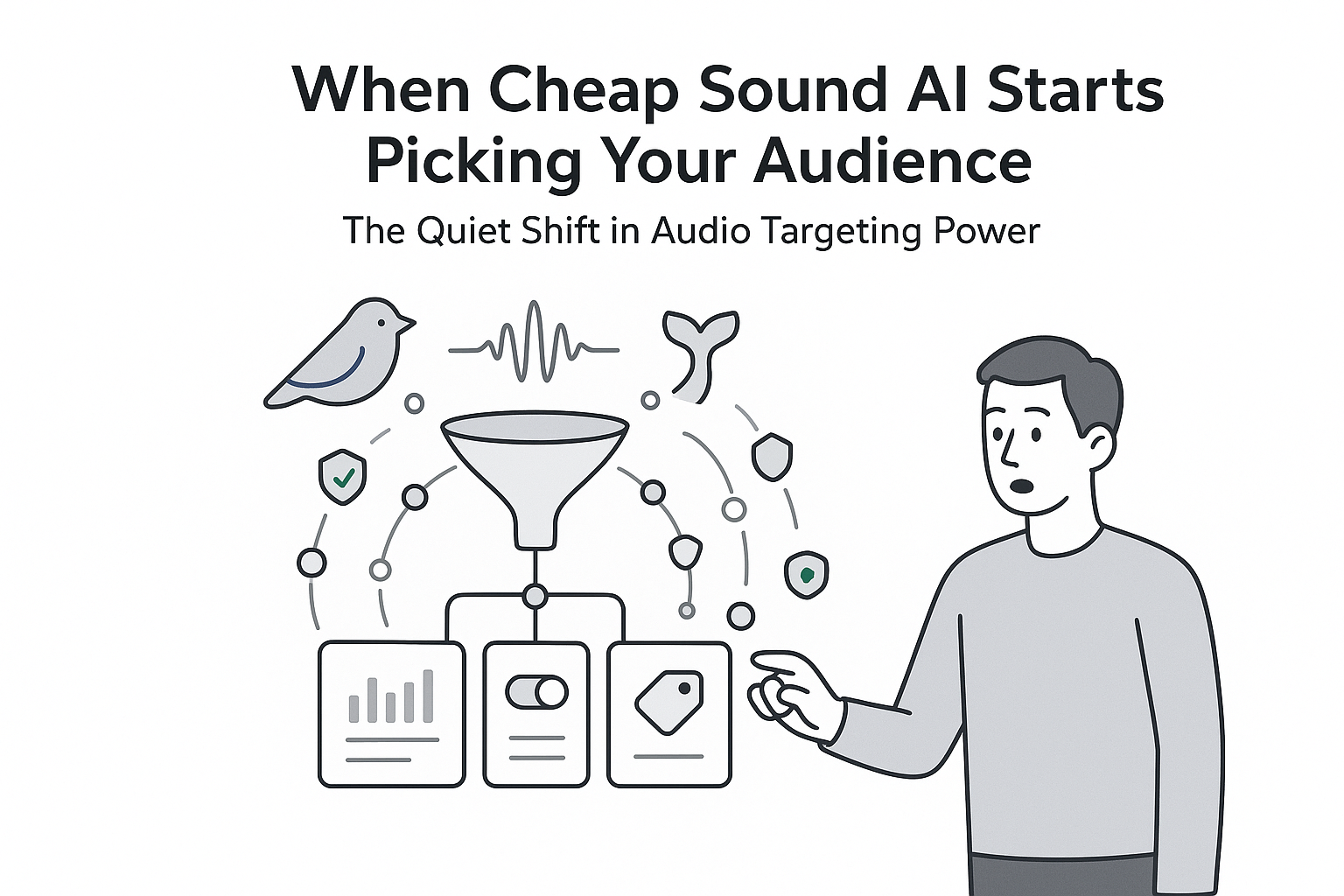
Google's Perch 2.0 result - a bird-trained model performing strongly on whale sounds - is less about whales and more about a signal: large audio foundation models can generalize across very different sound domains, which should lower the data and cost barriers for custom audio AI. The core question for marketers is how this shift in audio modeling changes the economics of measurement, targeting, and creative analysis.
How Google's Perch 2.0 Bioacoustics Model Points to Cheaper, Faster Custom Audio AI for Marketers
The Perch 2.0 bioacoustics model shows that a single, bird-focused foundation model can produce high-performing classifiers for underwater whale calls with only a handful of labeled examples per class [S1]. That is a strong proof of concept that similar audio embeddings could support brand, content, and customer-audio classifiers in commercial settings without deep custom model training.
Key Takeaways
- Foundation audio models will cut labeled data needs: Perch 2.0 achieves top or near-top performance on multiple marine datasets using as few as 4-32 labeled examples per class [S1]. For marketers, that points to future audio tools where a small, hand-labeled set of calls, podcasts, or UGC clips is enough to build useful classifiers, instead of large annotation projects.
- Google is building an audio-AI pipeline, not a one-off model: The combination of Perch 2.0, the Perch Hoplite tooling, Kaggle-hosted models, and NOAA datasets on Google Cloud shows a full workflow from raw audio → embeddings → simple classifier [S1][S4][S5]. The same pattern can underpin future Ads, YouTube, and Cloud products that automatically score and segment audio content, likely using techniques related to transfer learning.
- Cross-domain generalization boosts contextual and brand-safety signals: A model trained on birds that then adapts well to whales suggests future audio models trained on one domain (for example, speech or music) will still perform well on others (ambient sound, UGC, in-store audio). That increases the likelihood that Google and others will rely more on audio embeddings for contextual targeting and brand-suitability decisions.
- Short-term impact is indirect, long-term impact is structural: Right now, this work mainly improves scientific monitoring. Over the next 2-5 years, the same techniques are likely to make audio understanding a standard background capability in marketing platforms, changing how podcasts, videos, and calls are scored, indexed, and monetized.
- Early movers in audio data will gain an analytical edge: Brands and agencies that start curating and labeling their own audio (customer calls, podcast mentions, store recordings) will be better placed to plug that data into general-purpose audio embeddings once they are productized, ahead of competitors who only track text and click data.
Situation Snapshot
Google Research and Google DeepMind released a new Paper and blog post describing how Perch 2.0, a bioacoustics foundation model trained mainly on bird and terrestrial animal vocalizations, transfers effectively to underwater and whale-focused tasks without any underwater audio in its training set [S1][S2]. The work is presented at NeurIPS 2025 in the AI for Non-Human Animal Communications workshop.
Key facts from the release and related work:
- Model: Perch 2.0 is a large bioacoustics foundation model trained primarily on bird and other land animal sounds, previously introduced as a Perch foundational bioacoustics model by Google DeepMind in August 2025 [S2]. The full technical description of Perch 2.0 details training data, architecture, and scale.
- Task: The new study, Perch 2.0 transfers "whale" to underwater tasks, evaluates Perch 2.0 as an embedding model for marine acoustic tasks, including classification of baleen whale species and killer whale ecotypes [S1].
- Data: Evaluations use three major datasets - NOAA PIPAN, ReefSet, and DCLDE (specifically DCLDE 2026) - covering multiple whale species, reef sounds, and killer whale ecotypes [S1]. ReefSet is built from reef audio collected in the Google Arts and Culture project "Calling in Our Corals" [S4], described further in Calling in Our Corals. The work builds on earlier research that used AI to analyze the mysterious "biotwang" sound, later attributed to the elusive Bryde’s whales [S3].
- Method: The authors compare Perch 2.0 with several pre-trained models - Perch 1.0, SurfPerch, a multispecies whale model, AVES-bird, AVES-bio, and BirdNET v2.3 - to generate embeddings. On top of these embeddings they train simple multi-class logistic regression models using only 4, 8, 16, or 32 labeled examples per class ("few-shot linear probe") [S1][S7][S8]. The Perch baselines are available as Perch 1.0 and Perch 2.0 on Kaggle, alongside the multi-species whale model and SurfPerch.
- Results: Perch 2.0 is consistently the best or second-best performer across datasets and sample sizes, including settings with very few labeled examples per class [S1]. Performance is reported using the area under the receiver-operating characteristic curve (AUC-ROC), where a score closer to 1 indicates better separation between classes.
- Ecosystem: Google provides a Colab demo and an agile modeling approach that pulls audio from the NOAA NCEI Passive Acoustic Data Archive hosted on Google Cloud, uses Perch 2.0 embeddings, and trains custom classifiers within hours [S1][S4][S5]. The end-to-end demo for working with the NOAA data extends our prior tutorials on Perch-style modeling.
The official framing emphasizes conservation and scientific monitoring, not commercial use. However, the technical choices - foundation embeddings, few-shot classifiers, and Cloud-hosted data and tooling - are the same ingredients common in commercial AI products.
Breakdown & Mechanics
At a systems level, Perch 2.0 demonstrates the following pattern:
-
Large-scale audio pre-training
Train a large model on millions of bird and terrestrial animal vocalizations. The objective is to learn general acoustic patterns (frequency shapes, temporal dynamics, harmonics) that are not limited to any one species or environment [S2]. This follows the broader trend, supported by prior research, that bigger models trained on more data tend to generalize better. -
Embeddings as universal features
For any input audio, Perch 2.0 outputs a fixed-length embedding vector per window of sound [S1]. These embeddings condense complex audio into a compact representation that ideally makes different types of sounds linearly separable for downstream classifiers. -
Few-shot classifier on top of embeddings
For a new task, such as distinguishing humpback vs. blue vs. "unknown," they feed labeled audio into Perch 2.0 to get embeddings, then train a multi-class logistic regression model on these embeddings using only 4-32 examples per class [S1]. This is a straightforward instance of transfer learning and avoids training a deep network from scratch. Only the small logistic regression layer is fitted, which is far cheaper in computation and faster to iterate [S1]. -
Performance measurement and generalization
They evaluate models using AUC-ROC, with higher scores indicating better class separation. Across NOAA PIPAN, ReefSet, and DCLDE 2026, Perch 2.0 is consistently at or near the top for all sample sizes, with especially strong performance at very low labeled counts on ReefSet [S1]. -
Why a bird model works on whales
The paper offers several evidence-based explanations:- Larger models trained on extensive data tend to generalize better across tasks [S1][S6], consistent with prior research.
- Learning to distinguish very similar bird calls - the "bittern lesson" described in Perch 2.0 - forces the model to capture fine-grained acoustic features that transfer to other kinds of bioacoustic signals [S2].
- Birds and marine mammals have evolved similar means of sound production at a physical level, so some learned feature dimensions carry over [S1].
For marketers, the important mechanics are:
- Embeddings-first workflow: Train one large model, then reuse its embeddings across many downstream tasks.
- Few-shot customization: New classifiers can be built with tens of labeled examples per class, not thousands.
- Tooling and hosting: Cloud platforms expose embeddings and reference datasets through APIs, notebooks, and packages such as Perch Hoplite, making experimentation possible beyond core research teams [S1][S4][S5].
This is the same workflow already common in text (for example, BERT plus logistic regression for classification) and images (for example, CLIP plus a linear probe), now maturing for audio.
Speculation: The reuse of this pattern across Google Research, DeepMind, Kaggle, and Google Cloud increases the chance that similar audio-embedding infrastructure is, or will be, wired into YouTube, Ads, and Search products, even if Perch 2.0 itself remains positioned as a conservation tool.
Impact Assessment
Paid Search & Performance Media
Direction & scale: Indirect and small in the short term; potentially moderate in the long term.
In the near term, this work is not directly wired into Google Ads auctions. However, it shows that high-quality audio classifiers can be built with small labeled datasets, which is attractive for:
- Contextual and brand-safety scoring of YouTube and audio inventory: better recognition of background audio (for example, marine, urban, conflict-related sounds) even when metadata is limited.
- New content signals for Performance Max: audio mood or environment could become another internal signal feeding automated campaign optimization.
Beneficiaries: large advertisers and agencies that invest in brand safety and contextual placement, and Google itself (better content understanding improves the platform).
Disadvantaged: independent ad-tech vendors whose contextual models are harder to maintain if Google's built-in classifiers become more capable and opaque.
Watchpoints:
- New YouTube or Audio Ads documentation hinting at sound-based suitability or mood signals.
- Google Cloud audio APIs that offer embedding access, which often foreshadow ad stack capabilities.
Organic Search & Content Discovery
Direction & scale: Slow, moderate upside, especially for audio-first content.
Improved audio embeddings can:
- Make podcasts and videos easier to categorize beyond transcript text (for example, detecting nature, music genres, crowd noise).
- Support sound-focused search features, where queries might match particular soundscapes (ASMR, ocean ambience) rather than just titles and descriptions.
Beneficiaries: publishers producing rich audio content; SEO teams working with podcasts and video-heavy catalogs.
Risks: more weight on black-box audio features could make it harder to explain why certain audio content ranks or is recommended.
Practical actions now:
- Ensure audio content has clear, accurate transcripts and metadata, since those will remain primary signals.
- Start cataloging the types of sounds your content includes (for example, environment, music styles), so you can align with any future "sound category" reporting.
Creative & Brand Strategy
Direction & scale: Medium, especially for brands with strong sonic identities or heavy use of audio channels.
The Perch-style workflow implies future tools where a brand can:
- Train a classifier to detect its own sonic logo, voice style, or product sounds using a relatively small labeled set.
- Track how often these sounds appear in UGC, reviews, or partner content, creating a new dimension of brand presence measurement.
Perch 2.0 itself is tuned for wildlife, not human brands, but the pattern is transferable: foundation embeddings plus a simple classifier.
Beneficiaries: brands investing in audio branding (jingles, recurring sounds, podcast sponsorships).
Risks:
- Overconfidence in automated detection of subtle brand elements (for example, misidentifying a similar jingle).
- Legal and contractual questions if sound-based detection is used in compliance audits or sponsorship verification.
Practical near-term move: begin storing high-quality examples of your key sonic elements and associated context; this dataset becomes raw material for future classifiers.
Analytics, Customer Voice, and Operations
Direction & scale: Potentially high over a 3-5 year horizon, but dependent on tooling maturity.
The agile modeling approach - turning NOAA's passive acoustic data into task-specific classifiers in hours - is a template that can carry over to:
- Contact center analytics: classifying moments of frustration, silence, or overlapping speech using embeddings plus a lean classifier (though a different pre-trained model would be required).
- In-store or environmental audio: categorizing soundscapes in physical locations (busy vs. quiet, music vs. chatter) without massive labeled datasets.
Beneficiaries: organizations with dedicated analytics teams and substantial audio (calls, in-store recordings, user content).
Constraints:
- Strong privacy, consent, and retention requirements for human-centric audio.
- Need for internal ML skills to avoid misuse of scientific models on commercial data.
Action points:
- Audit what audio the business already collects and whether it is legally and ethically usable.
- Pilot small-scale projects using existing open audio-embedding models to test feasibility before committing to larger programs.
Partnerships & CSR-Linked Marketing
Direction & scale: Niche but positive for certain brands.
Google's collaboration with the National Oceanic and Atmospheric Administration [S1][S5] opens room for:
- Co-branded initiatives where marketers support marine monitoring projects while gaining access to unique data stories or sponsorship inventory.
- Content marketing around soundscapes (for example, interactive experiences featuring whale calls), potentially informed by these models.
This is most relevant for brands active in sustainability or ocean-related themes.
Scenarios & Probabilities
Base Scenario - Audio embeddings become a quiet infrastructure layer (Likely)
Over the next 2-4 years, audio foundation models similar to Perch 2.0 become standard inside Google Cloud and YouTube content-understanding pipelines. Marketers experience the impact through:
- Gradual improvements in content classification, brand safety, and contextual targeting.
- New reporting fields (for example, content sound categories or "environment" tags) in some platforms.
Few teams train their own models; instead, they rely on built-in classifiers and limited APIs.
Upside Scenario - Custom audio AI moves into mainstream marketing stacks (Possible)
Cloud providers productize generic audio embeddings with simple interfaces for custom labeling, modeled on the Perch agile workflow [S4]. Marketing teams routinely:
- Train lightweight classifiers on tens of labeled clips to tag incoming audio (UGC, calls, podcasts) for campaigns and analytics.
- Combine audio-derived segments (for example, "customer is outdoors" or "content includes specific brand sounds") with existing CRM and ad platform audiences.
Audio understanding becomes as routine as text classification is today, widening the gap between organizations with strong analytics teams and those without.
Downside Scenario - Cross-domain generalization proves fragile for commercial audio (Edge)
Models trained on wildlife and similar data do not transfer well to messy human audio (overlapping speech, music, noise), and domain-specific models are required. Regulatory scrutiny and public opinion make large-scale audio analysis of customers risky, especially in contact centers and smart devices.
In this case, Perch-style work remains mostly in conservation and research, and marketers see only marginal changes in ad and analytics products.
Risks, Unknowns, Limitations
- Domain gap to commercial audio: Perch 2.0 is optimized for bioacoustics, not human speech, music, or store environments. Its performance on typical marketing audio workloads is unknown and may be significantly lower than on whales and birds.
- Deployment into Ads and Search is speculative: The paper focuses on scientific use cases. Whether and how similar models feed into YouTube, Ads, or Search backends is not publicly documented. Any link to ad auction mechanics is inference, not stated fact.
- Data efficiency relative to scratch training: The work shows strong performance with 4-32 examples per class, and notes efficiency gains for researcher time and compute [S1]. It does not publish direct comparisons against fully trained task-specific deep models on the same hardware budgets, so cost and performance trade-offs remain approximate.
- Bias and misclassification: The t-SNE plots show good separation for some killer whale ecotypes but not all species in all models [S1]. When applied to commercial settings, similar blind spots may exist (for example, underperforming for certain languages, music genres, or recording conditions).
- Privacy, consent, and regulation: Using audio embeddings on customer calls, in-store recordings, or user-submitted UGC introduces legal constraints that are not present in wildlife monitoring. Future regulation could sharply limit large-scale commercial audio analysis.
- Overinterpretation risk for marketers: The conservation focus and specialized data may give a misleading sense of readiness for business use. A careful pilot on representative data is needed before assuming similar performance in marketing analytics.
Evidence that could invalidate parts of this analysis would include:
- Public benchmarks showing that Perch-like embeddings underperform simple baselines on human commercial audio tasks.
- Clear statements from Google that bioacoustics models are siloed and share no infrastructure with their media and ad products.
- Strong regulatory moves that classify most audio content analysis as highly sensitive, sharply limiting its deployment in marketing.
Sources
- [S1] Harrell, L., 2026, Google Research blog and arXiv preprint - "How AI trained on birds is surfacing underwater mysteries / Perch 2.0 transfers 'whale' to underwater tasks." Core source for the whale-transfer experiments and the end-to-end demo for working with the NOAA data.
- [S2] Google DeepMind, 2025, blog and Perch 2.0 arXiv paper - "Perch foundational bioacoustics model: how AI is helping advance the science of bioacoustics to save endangered species," including the "bittern lesson" discussion.
- [S3] Google Research, 2024, blog - "Whistles, songs, boings, and biotwangs: recognizing whale vocalizations with AI" and associated multi-species whale model, including analysis of the mysterious "biotwang" sound later attributed to the elusive Bryde’s whales.
- [S4] Google Research, 2025, GitHub - Perch Hoplite repository for agile modeling and transfer learning with bioacoustic embeddings, as well as the Colab demo showcasing the agile workflow.
- [S5] NOAA National Centers for Environmental Information (NCEI), product docs - NOAA NCEI Passive Acoustic Data Archive and NOAA PIPAN annotated subset, accessible via Google Cloud.
- [S6] Unknown authors, 2020, arXiv 2001.08361 - prior research on how larger models with more data show improved generalization in audio-related tasks, cited to support Perch 2.0's scaling behavior.
- [S7] AVES-bird and AVES-bio transformer bioacoustics models from the Earth Species Project, used as comparison baselines.
- [S8] K. Lisa Yang Center for Conservation Bioacoustics, Cornell Lab of Ornithology - BirdNET v2.3 model documentation, providing another strong comparator in the evaluation.
- Additional references cited in context: ReefSet dataset paper; DCLDE 2026 dataset paper; transfer learning overview; have evolved similar means of sound production (birds and marine mammals); and implementation references for sci-kit learn PCA and tSNE.
Validation: This analysis states a clear thesis, explains the technical mechanics and incentives, contrasts official and inferred perspectives, assesses likely marketing impacts by area, outlines scenarios with probabilities, and documents key risks and assumptions with cited sources.





.svg)

.svg)
.svg)