
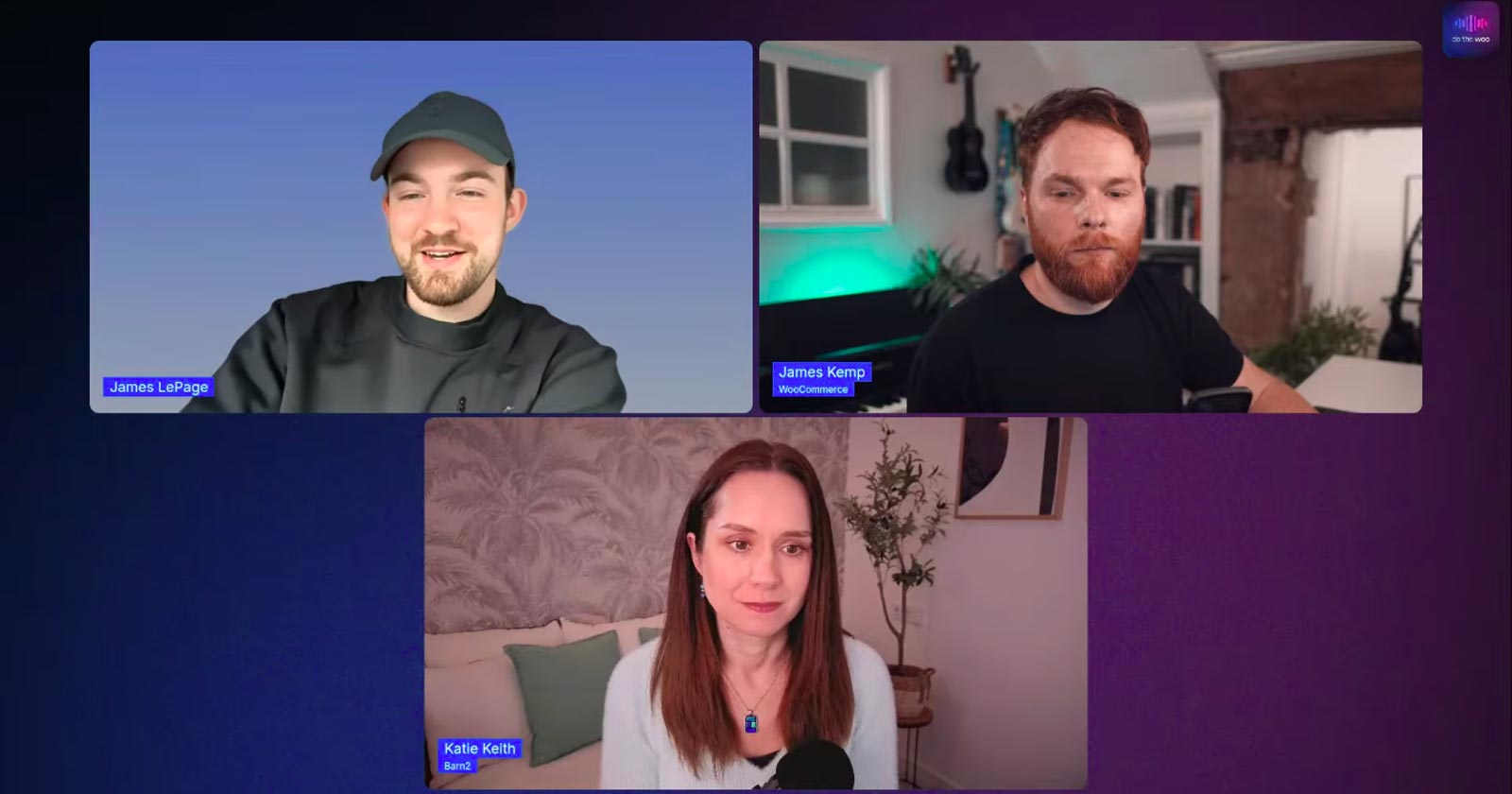
Automattic's Director of Engineering, AI, James LePage, outlined upcoming AI features for WooCommerce on a recent Do the Woo podcast episode. He described Sidekick-style assistance delivered through extensions and how WooCommerce could connect with multiple AI systems across channels.
Key details on WooCommerce AI extensions
LePage said Automattic plans to ship WooCommerce version 7 with new AI building blocks in the core software. According to him, this release is scheduled for April 9, 2026. These components are intended to support advanced AI extensions, including a Sidekick-type interface for store management tasks.
- The Sidekick-style experience will most likely ship as an Automattic extension rather than as WooCommerce core.
- WooCommerce 7 core will include the technical components that such an extension requires to function.
- The planned extension could plug into WooCommerce Analytics and other workflows for catalog and product optimization.
- The same extension may handle analytics support and large-scale number crunching using connected AI services.
- Current WooCommerce AI work is focused on developer-facing infrastructure rather than packaged features for every merchant.
- Merchants seeking extensive automation today usually need a developer or agency to assemble and connect available components.
- Some existing plugins already deliver specific AI functions without custom development work.
Background on Model Context Protocol and commerce standards
WooCommerce is an open source plugin that adds store features to WordPress websites. It supports extensions through plugins and APIs, and now through the Model Context Protocol (MCP), according to LePage. He described WooCommerce as a coordination layer that can sit between merchants, AI agents, and payment systems.
LePage outlined MCP as an open standard linking platforms like WooCommerce with AI systems. He contrasted MCP with traditional APIs that process fixed request types between software components. According to LePage, MCP lets AI tools access a wider set of actions without separate integrations for each model.
He said the Agentic Commerce Protocol (ACP), created by OpenAI and Stripe, allows AI agents to manage discovery, checkout, and payments. This can happen inside chat interfaces such as ChatGPT. According to LePage, the Universal Commerce Protocol (UCP), developed by Shopify and Google, supports buy buttons across Google's AI and Search products and Anthropic's Claude. He explained that developers can connect WooCommerce to these standards by building a UCP-compliant MCP server.
LePage said WooCommerce sits between ACP and UCP, where integrations from those standards meet. He described WooCommerce as an orchestration layer that directs and coordinates multiple services, tools, and data sources.
Source citations and statements referenced
This report is based on James LePage's comments during a Do the Woo podcast episode about AI and WooCommerce. Hosts Katie Keith and James Kemp interviewed LePage about upcoming AI features and technical standards.
Additional context on LePage's remarks comes from reporting by Roger Montti for Search Engine Journal. Montti also publishes at Martinibuster.com. Descriptions of ACP, UCP, and MCP reflect how LePage summarized work by OpenAI, Stripe, Shopify, Google, and Anthropic. General product details about WooCommerce are available on the official site at WooCommerce.com.




.svg)

.svg)
.svg)