
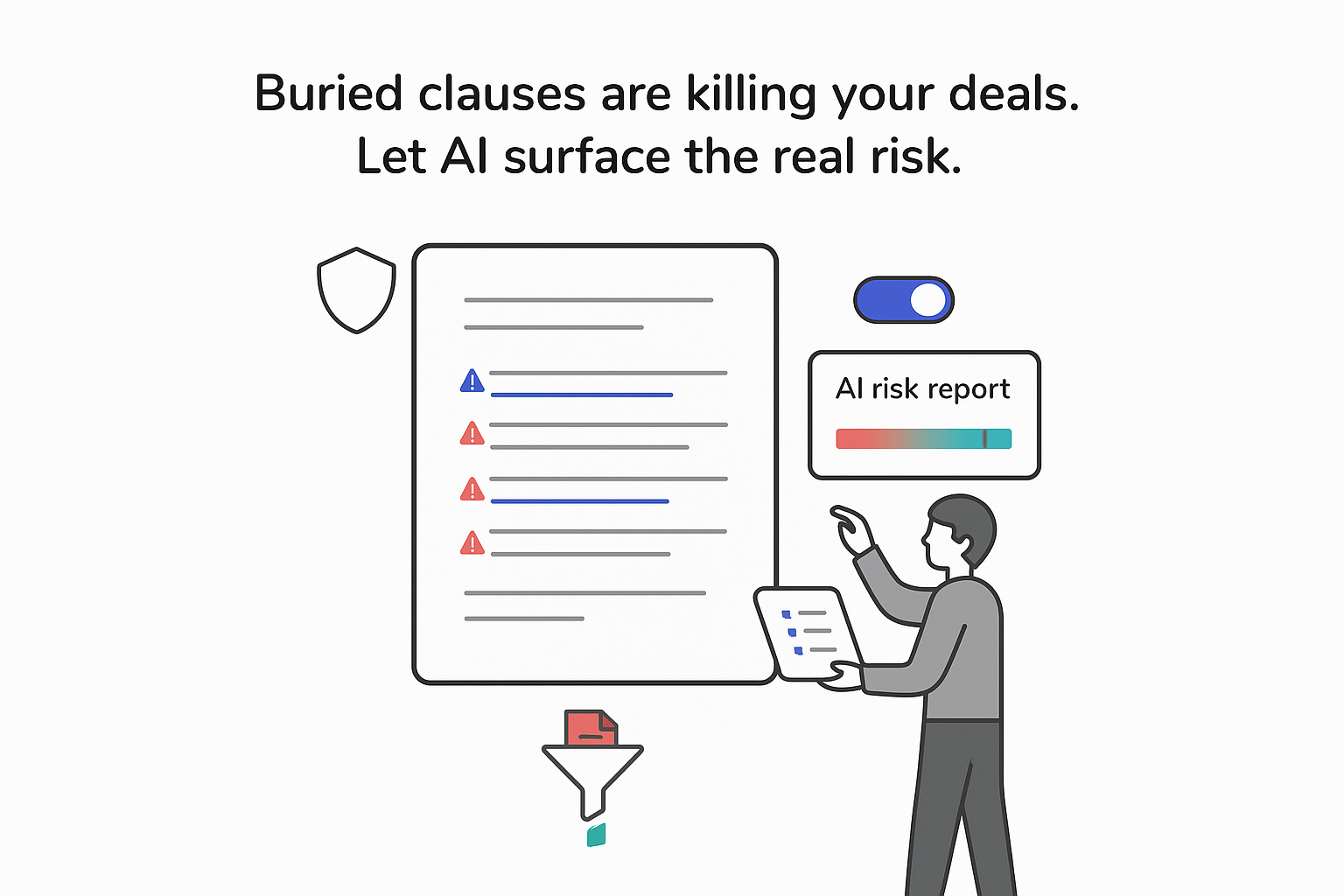
Contracts keep a B2B service business running, but they also introduce quiet, compounding risk. When every new MSA or SOW requires days of manual review, deals slow down, legal costs rise, and it is hard to be confident nothing was missed that turns expensive later. An AI risk assessment agent changes the workflow by making review more consistent and faster, while still leaving final judgment with humans.
What an AI risk assessment agent does for B2B service contracts
An AI risk assessment agent is a system that reads B2B service agreements (MSAs, SOWs, NDAs, SLAs, partner agreements, and vendor contracts) and flags clauses that deviate from a defined “acceptable” position. I think of it as an analyst that triages risk: it finds where I should spend attention, explains why something looks risky, and suggests a safer fallback aligned with an internal playbook.
In practice, it helps most when the same issues repeat across contracts - liability caps, indemnities, IP ownership, service levels, payment mechanics, termination rights - because those are exactly the areas where volume creates fatigue and fatigue creates mistakes. If you want a deeper look at adjacent workflows (clause extraction, summaries, and red-flagging), see the AI Contract Review Agent.
It is also useful for documents that are not “fully legal” but still create obligations once accepted, such as proposals with embedded terms, pricing schedules, technical appendices, and change orders.
How it finds risk (from ingestion to scoring)
Most AI risk assessment agents follow a fairly standard pipeline, and understanding it helps me set realistic expectations about accuracy and limits. Many tools also layer in summarization so reviewers can orient quickly before drilling into exceptions. (For a vendor example of how summaries are produced, see Document Summarization.)
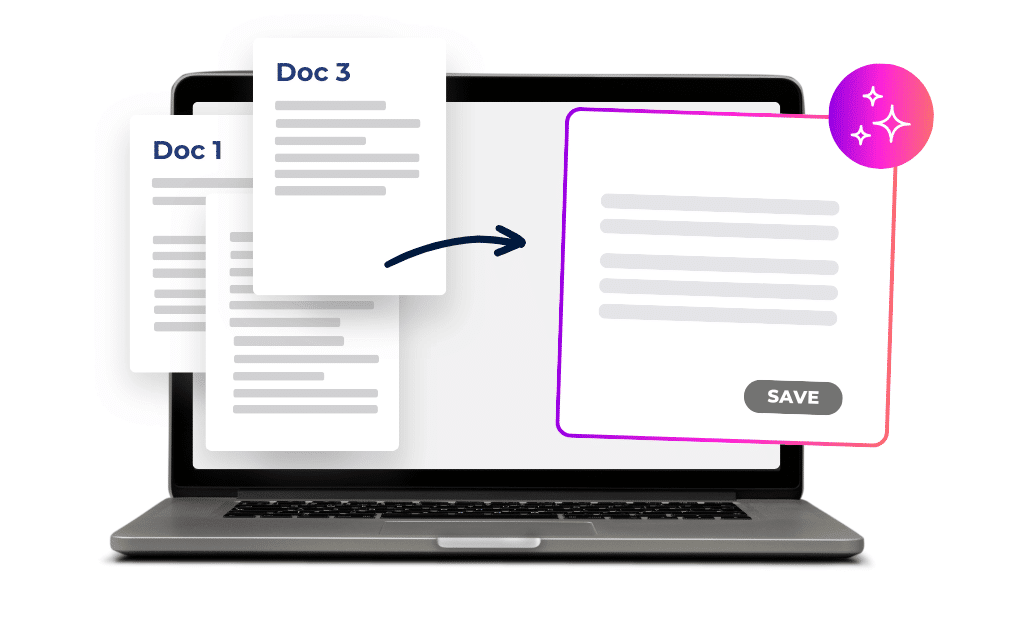
- Ingest and normalize the document: The system converts Word/PDF (and often scans via OCR) into structured text while preserving sections, tables, and exhibits.
- Detect and label clauses: It segments the contract and identifies clause types (for example: limitation of liability, indemnity, IP, confidentiality, data protection, SLA/credits, governing law, term/renewal).
- Compare against a playbook: Each clause is evaluated against predefined positions, thresholds, and non-negotiables. This is where your standard matters more than generic best practices.
- Explain and score risk: The output typically includes clause-level risk ratings plus an overall agreement score, with plain-language reasoning so a non-lawyer can triage.
- Suggest fallbacks: Many systems propose alternative language based on approved clause libraries - useful for speed, but something I treat as drafting assistance, not final guidance.
The biggest difference versus keyword search is context. A good agent does not just look for the word “liability”; it tries to infer whether liability is capped, what it is capped to (fees paid, a multiple of fees, or uncapped), whether exclusions swallow the cap, and how indemnity obligations interact with that cap.
The contract risks it surfaces most often in B2B services
For agencies, consultancies, IT services, and managed service providers, the same risk categories show up over and over. When I review AI output, these are the areas I expect to be flagged first:
- Liability exposure: uncapped liability, caps that exceed the economics of the deal, or caps undermined by broad carve-outs
- Indemnity imbalance: one-sided third-party claims coverage, overly broad IP indemnity, or indemnities that do not align with what I can actually control
- IP and work product ownership: language that unintentionally assigns background IP, tools, or reusable assets to the client
- SLA and remedy mismatch: strict uptime/response commitments paired with punitive credits, penalties, or ambiguous acceptance criteria
- Commercial friction: payment terms that create cash-flow risk, unclear change control, or acceptance language that enables delayed sign-off
- Renewal/termination traps: auto-renewal mechanics, termination for convenience granted only to one side, or survival clauses that keep risk alive longer than intended
- Data protection and security commitments: obligations that exceed current controls, or cross-border/data residency terms I cannot operationalize
I have also found it valuable for vendor and SaaS agreements, where auto-renewals, audit rights, data usage clauses, and limitation-of-liability asymmetry can create long-term operational cost or exposure.
Playbooks, scoring, and collaboration (keeping review consistent)
The quality of review depends less on “how smart the model is” and more on how clearly risk appetite is encoded. If I want consistent decisions across sales, delivery, procurement, and legal, I need a playbook that defines what is acceptable, what triggers escalation, and what fallback language is preferred. This is also why clause libraries matter in practice - they turn “preferred positions” into reusable building blocks that speed negotiation and reduce drift.
If you are building that muscle, it helps to connect playbooks to upstream documents too, like statements of work. A practical companion workflow is Auto-drafting statements of work with clause libraries and AI.
With a playbook in place, scoring becomes useful as triage rather than a false promise of certainty: a “high risk” flag should mean “someone senior should look,” not “the contract is bad.”
Collaboration matters too. The agent’s value drops if comments cannot be routed to the right owner (legal for liability and indemnity, finance for payment terms, delivery leadership for SLA feasibility). I try to treat the AI output as a structured first pass that makes human review more focused, not as a replacement for negotiation judgment.
Reporting and a practical way to estimate ROI
I am careful with ROI claims because results vary by contract complexity, negotiation intensity, and how mature the current process is. That said, I can estimate value with a simple model that ties directly to time and avoidable escalation. If your team already uses scoring in other areas, a related pattern is Marketing risk registers powered by AI impact and likelihood scoring - the same “triage first, investigate next” logic applies.
Here are the inputs I use to quantify impact:
- monthly contract volume (by type: client MSAs/SOWs, vendor, renewals)
- average human review time today (and who performs it)
- percentage of contracts that currently require external counsel
- internal hourly cost (blended) and external counsel rates
- frequency and cost of “avoidable” contract issues (disputes, write-offs, service credits, rework)
In many organizations, the most immediate gain is cycle time: even if total legal scrutiny does not change for high-stakes deals, routine agreements often move from “full manual read” to targeted review of flagged sections. Reporting also helps me spot patterns, such as which client template consistently produces the highest risk, or which clause types cause the most negotiation churn. That is actionable because it informs enablement (better redlines, clearer fallback positions) rather than treating every contract as a brand-new problem.
Security, privacy, and model limitations
Because contracts contain pricing, liabilities, and sensitive client data, security controls are not optional. At a minimum, I look for encryption in transit and at rest, role-based access, audit logs, retention controls, and clear data residency options. If the tool is used across teams, permissioning becomes especially important so commercial teams can see what they need without exposing everything. For a practical approach to testing tools safely, see Secure AI sandboxes and data access patterns for marketers.
Just as important: limitations. AI systems can misclassify clauses, miss nuance in heavily customized language, or misunderstand cross-references (especially in long agreements with many exhibits). OCR errors can also change meaning in scanned documents. For that reason, I treat the agent as a risk-triage layer and drafting assistant, not a source of legal advice, and I keep human review for any deal where the downside is material.
If you want broader context on how these capabilities typically fit into legal operations, Contract Lifecycle Management: The Complete Guide is a useful overview. For adjacent checks against regulatory requirements and policy controls, the AI Regulatory Compliance Agent is a natural complement.
How I’d approach implementation in a lean rollout
I have seen implementations succeed when they start narrow, prove value, and then expand based on real usage rather than ambition. If you want an example of document-heavy diligence work tied to legal and financial risk, Read the full story.
A lean rollout usually follows this sequence:
- Scope a pilot: pick one contract stream with high volume (often inbound client MSAs/SOWs or vendor renewals) and define what “better” means (cycle time, escalations, fewer missed issues).
- Codify the playbook: document current positions and escalation rules before trying to automate them.
- Run parallel review briefly: compare AI output to existing review for a set of real contracts to calibrate strictness and reduce noise.
- Operationalize ownership: define who resolves what (legal, finance, delivery, procurement) so flags do not become another inbox.
- Expand gradually: add more contract types, integrate with the systems already used to store contracts, and standardize reporting.
If I keep the goal simple - faster, more consistent identification of legal and commercial risk - an AI risk assessment agent can reduce bottlenecks without lowering standards. The best outcome is not “contracts reviewed by AI”; it is fewer surprises after signature because the riskiest terms were surfaced early, understood clearly, and negotiated intentionally.
For readers evaluating different approaches and feature sets, vendor overviews like DiliTrust’s AI can help clarify what is automation, what is summarization, and what is true playbook-based risk analysis.



.svg)

.svg)
.svg)