
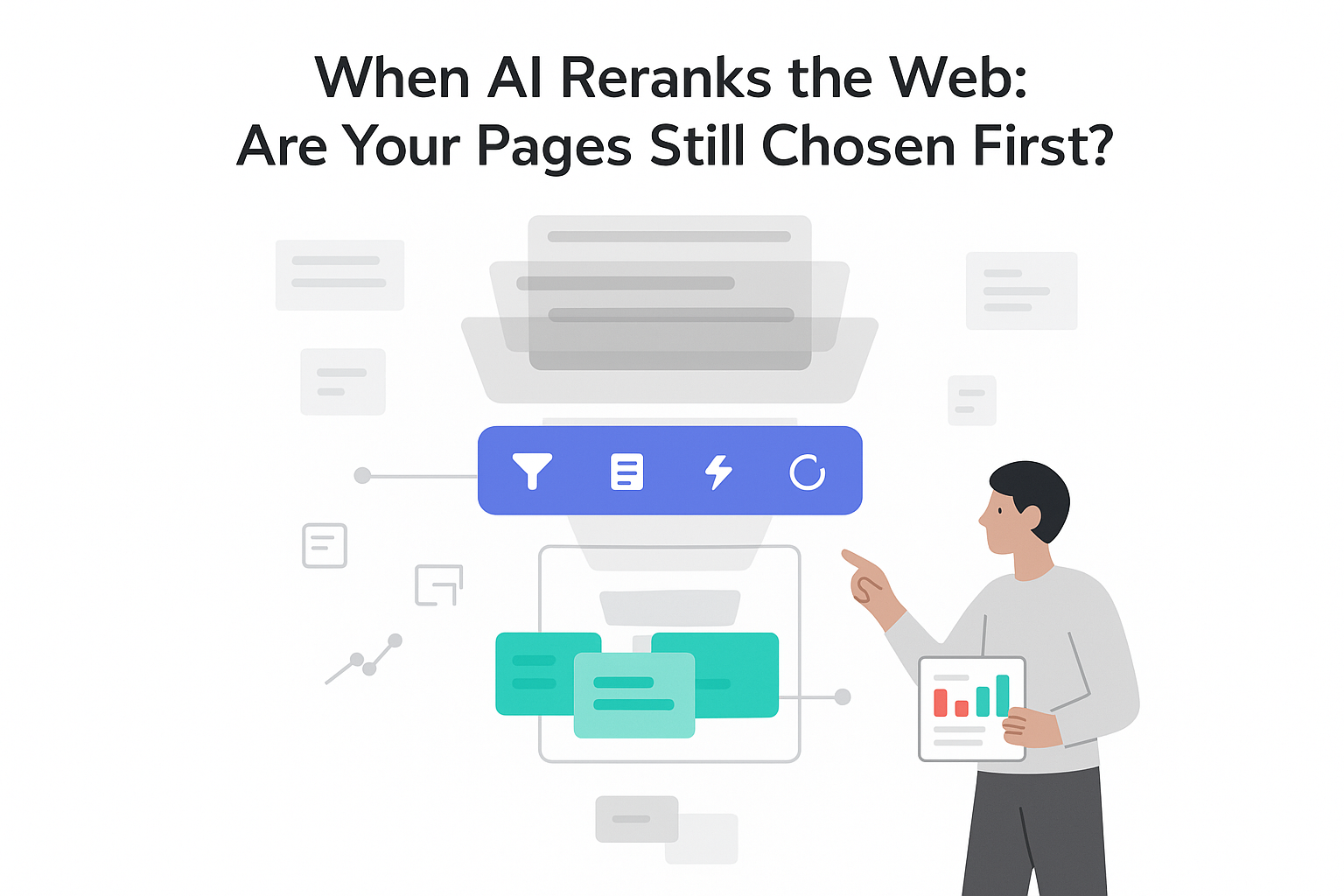
Google's decision to put Gemini 3 Flash at the center of Search's AI Mode is not a short-term performance tweak. It signals a medium-term architecture where fast, distilled models sit on top of a traditional retrieval stack. The core question: how does a latency- and cost-optimized Gemini 3 Flash, paired with staged retrieval, reshape the economics of visibility for marketers in AI-infused Google Search?
How Google Gemini 3 Flash reshapes AI search strategy
With Gemini 3 Flash as the production engine for AI Mode, AI search continues to follow a familiar path: crawl → index → rank → retrieve, then have Gemini 3 Flash synthesize results. For marketers, the gatekeepers remain Google's retrieval and ranking systems, not the language model's internal memory.
Key Takeaways
For marketing and search teams, the main implications of Google Gemini 3 Flash in Search AI are:
- Retrieval remains the bottleneck you can influence: AI Mode and AI Overviews sit on top of Google's existing retrieval and ranking. If your page is not a strong candidate in classic results, it is unlikely to be a source document for AI answers. SEO fundamentals remain the entry ticket to AI exposure.
- Flash prioritizes speed and cost over deep reasoning: Gemini 3 Flash is built to respond quickly at search scale, not to perform maximal multi-step reasoning on every query [S1][S2]. Expect strong summarization of retrieved pages, but limited "think for 30 seconds" style analysis. This favors clear, well-structured content that can be summarized reliably.
- Distillation raises the bar on thin content each generation: Google's pipeline - frontier Gemini → distilled Flash - means AI reading comprehension improves without a big cost spike [S1]. Over time, the model will more easily compress generic content and highlight unique, specific information. Thin, derivative pages are at higher risk of being ignored in AI answers.
- Staged retrieval is here for the medium term: Because attention mechanisms scale poorly with longer contexts, Search must keep narrowing the web to a small set of documents before generation [S1][S4]. Competing to be in that small set for your priority queries is more important than chasing long-context "feed the model everything" ideas.
- Automatic model selection will segment query types: With Flash as default and Pro reserved for complex queries [S1], some categories (for example, research-heavy B2B, health, finance) may see deeper AI reasoning and more on-SERP resolution. That will shift how much traffic flows back to sites versus being satisfied on the SERP.
Situation Snapshot
This analysis is prompted by Google Chief Scientist Jeff Dean's interview on the Latent Space podcast, summarized by Search Engine Journal, where he explains why Gemini 3 Flash is the production tier for Search's AI Mode and how retrieval shapes AI search [S1][S2].
Key, relatively uncontested facts:
-
Model choices:
- Gemini 3 Flash is now the default model for Google's AI Mode in Search; Gemini 3 is the default for AI Overviews globally [S1].
- Flash is described as the "production tier" model for Search because of its low latency and lower per-query cost [S1][S2].
-
Architecture pattern:
- Google trains larger, more capable "frontier" models, then distills them into Flash variants; each new Flash aims to match or beat the previous generation's Pro-level performance at lower cost [S1][S2].
- This frontier → distillation → Flash pipeline is presented as the long-term pattern for Search, not a temporary stopgap [S1].
-
Retrieval stance:
- Dean states that using model parameters to store obscure facts is a poor use of capacity; those facts should be retrieved from external content [S1].
- Retrieval from the web is framed as an intentional design choice, not a workaround.
-
Technical constraints:
- Current attention mechanisms scale quadratically with context length; Dean notes that "a million tokens" already pushes current methods, and scaling to billions or trillions requires new techniques [S1][S4].
- As a result, Search must use staged retrieval - narrowing from a large corpus to a small set of documents - before the model generates an answer [S1].
Breakdown & Mechanics
At a high level, Google Search with AI Mode now looks like:
User query
→ Classic retrieval (index lookup, ranking, filters)
→ Shortlist of high-scoring documents
→ Gemini 3 Flash reads that shortlist
→ AI summary or answer, plus links and ads.
Why Gemini 3 Flash wins as the production tier
Business constraints:
- Latency: Web search operates under tight latency budgets; even hundreds of milliseconds can reduce engagement and revenue at Google's scale [S3]. A heavy model on every query would slow result pages and hurt both user satisfaction and ad performance.
- Cost: Running frontier-scale models on billions of daily queries is extremely expensive. Smaller distilled models reduce compute per token, improving unit economics per search.
Technical pattern: frontier → distillation → Flash
- Google uses large frontier models (Gemini Pro or Ultra) as "teachers."
- Through distillation, they transfer useful capabilities into a smaller Flash model.
- Dean claims the new Flash can match or outperform the previous generation's Pro while remaining cheap enough to run as the default [S1].
Mechanically:
Frontier Gemini (train for capability)
→ Distillation (compress skills into a smaller network)
→ Gemini 3 Flash (deploy at search scale).
For marketers, that means:
- AI Mode quality will jump in steps as each new frontier model is distilled.
- Those jumps will not necessarily come with visible latency changes; instead, the AI will simply read and synthesize your content better.
Retrieval vs. memorization: why your content still matters
Dean argues that model parameters are better spent on skills (reasoning, composition) than facts (named entities, product specs, niche data) that can be looked up [S1]. In practice:
- The model issues retrieval calls into Google's index.
- It then reasons over those results instead of relying on memorized text fragments.
This supports several marketing-relevant outcomes:
- Freshness: Facts updated on your site can surface in AI answers without retraining the model, as long as Google recrawls them.
- Authority: The retrieval stack decides which sources to show the model. Links, page quality, and topical authority are the filters before any generative step.
- Reduced hallucinations where evidence exists: When content is available and retrievable, the model is more likely to base answers on it rather than improvise.
Why staged retrieval persists
Current transformer models have attention cost that scales roughly with the square of context length [S4]. Dean notes that around a million tokens already strains current hardware and techniques [S1]. That yields a simple rule:
More context tokens → disproportionately higher compute cost and latency.
Google Search cannot stream billions of tokens per query into an LLM and still respond within user-acceptable time. So the pipeline looks like:
Entire web index
→ Fast candidate retrieval (cheap)
→ Narrowed candidate set (dozens of documents)
→ Gemini 3 Flash consumes those documents (expensive step but bounded).
Staged retrieval is a structural constraint, not a temporary product choice. For marketers, it confirms that:
- Competition is for inclusion in that narrow candidate set.
- Schema, internal linking, topical coverage, and link equity all influence whether you make that shortlist.
Impact Assessment
This section focuses on how Gemini 3 Flash and staged retrieval affect different marketing domains.
Organic search & SEO
Direction: High impact, structural, ongoing
Winners:
- Sites that already align with Google's retrieval and ranking systems - clear topical focus, strong authority signals, technically clean pages.
- Content that directly answers specific questions with clear headings, concise summaries, and supporting details.
Losers:
- Thin or generic content that adds little beyond what is already well covered.
- Content buried behind poor information architecture, heavy scripts, or weak internal linking, making retrieval less likely.
Practical implications:
- Eligibility over persuasion: Before the model can "decide" whether to mention your brand in an AI answer, you must be in the small set of documents surfaced by the retrieval stack. Indexation, crawlability, and strong snippets are the first hurdle.
- Content structure matters: Gemini 3 Flash has to parse and summarize quickly. Pages organized around clear questions and answers, logical headings, and concise introductions give the model easier hooks to quote and cite.
- Entity clarity: Clear naming of products, features, locations, and people helps retrieval associate your brand with specific queries and topics.
Paid search & PPC
Direction: Medium impact now, potentially higher as AI ad formats mature
Winners:
- Advertisers who adapt to AI-rich SERPs - testing ad copy that complements AI summaries and targeting queries where transactional intent is still strong.
- Brands that can occupy both AI answer mentions and paid slots, reinforcing authority.
Losers:
- Advertisers relying on generic upper-funnel queries where AI answers may satisfy curiosity without clicks.
- Campaigns optimized purely on last-click conversions without considering that some pre-conversion information gathering will now happen inside AI Overviews.
Mechanics:
- Latency and ad load: Flash's low latency helps Google keep AI content and ads on the same page without slowing the experience. That preserves ad inventory while adding AI elements.
- Query segmentation: If automatic model selection sends more complex, research-heavy queries to Gemini Pro, those queries may see richer AI answers and less need for ad clicks. For high-consideration categories, this could reduce ad interaction on some queries while making remaining clicks more lower-funnel.
Actions to watch:
- Track impression and click shifts on queries where AI Overviews appear.
- Monitor any new ad placements embedded in AI responses, including format changes, disclosure, and performance.
Content and brand storytelling
Direction: High impact over 12 to 24 months
Winners:
- Brands that produce content with unique data, clear viewpoints, or proprietary frameworks that cannot be easily reconstructed from other sources.
- Publishers whose content is frequently cited because it is well structured, up to date, and authoritative.
Losers:
- Me-too content farms. If dozens of pages say the same thing, the model needs only a small sample to produce an answer. Most of those pages will never be surfaced or cited.
- Overly long, unstructured articles with buried answers, which are harder to summarize precisely.
Key dynamics:
- Distillation pressure: As each frontier model is distilled, Gemini 3 Flash becomes better at compressing multiple sources. Distilled models will more accurately detect redundancy and extract the useful parts, lowering traffic to undifferentiated pages.
- Citation bias: If the model tends to cite a few sources in AI Overviews, those brands collect more impressions and potential trust. Getting into that set likely correlates with both ranking strength and content clarity.
Analytics and operations
Direction: Medium impact, high uncertainty
Challenges:
- Google does not yet provide full, transparent metrics on AI Overviews or AI Mode exposure in standard tools.
- It is difficult to measure when your content influenced an AI answer if users never click.
Operational responses:
- Use SERP tracking tools or manual sampling to log the presence of AI Overviews for your high-value queries and record which brands are cited.
- Segment performance by query intent - informational vs. commercial vs. transactional - to detect where AI answers may be absorbing clicks.
- Watch for new Search Console metrics or API fields that break out AI-related impressions or clicks; these would materially change how you attribute performance.
Scenarios & Probabilities
These scenarios focus on the next 2 to 3 years, given Dean's comments and current constraints.
1. Base case - retrieval-anchored AI search (Likely)
Gemini 3 Flash (and successors) remains the default for AI Mode; AI Overviews stay retrieval-driven with incremental model improvements. Automatic model selection gradually rolls out: Flash for most queries, Pro for multi-step or sensitive ones. SEO remains the main lever for AI visibility; AI answers reduce some organic clicks on informational queries but leave commercial and transactional queries relatively intact.
Implication: Marketers compete harder for top-tier retrieval slots and AI citations; organic traffic mixes shift but do not collapse.
2. Upside - AI that sends more qualified traffic (Possible)
Google refines AI Overviews to surface more explicit links and source attributions, possibly expanding the number of cited sites per answer. Improved retrieval and distillation reduce off-topic responses, boosting user trust and click-through to referenced sources. For strong brands, AI mentions act as a credibility amplifier, lifting downstream conversion rates even if raw traffic is flat.
Implication: High-quality, authoritative content gains more leverage from being cited within AI, improving conversion efficiency for both organic and paid efforts.
3. Downside - AI absorbs a large share of informational clicks (Edge to Possible)
Google broadens AI Mode defaults across more query types, with AI Overviews occupying more screen space. Users increasingly treat AI answers as sufficient for simple informational needs, reducing clicks to source sites. Cost reductions from Flash and future distillations make it economical for Google to apply generative summaries more aggressively.
Implication: Traffic to informational pages drops significantly; brands must shift strategies toward lead capture, owned channels, and formats that AI is less likely to displace (tools, interactive content, gated resources).
Risks, Unknowns, Limitations
- Limited visibility into routing and thresholds: Google has not specified when queries are routed from Flash to Pro or how routing may differ across verticals. That could change which categories are most affected by deep AI reasoning.
- Unclear ranking-to-AI mapping: While retrieval clearly feeds AI Mode, the exact mapping between classic rankings and source selection for AI answers is not documented. If Google later decouples these, SEO tactics may need revision.
- Measurement gaps: Current analytics tools only partially capture AI Overviews and AI Mode exposure. Without better metrics, any quantified impact on organic and paid performance will be approximate.
- Technical shifts: If new attention mechanisms or architectures reduce the cost of very long contexts, Google could reduce reliance on staged retrieval. That would weaken today's emphasis on being in the top handful of documents.
- Policy and regulatory changes: Scrutiny around publisher compensation, AI training data, and competition law could force adjustments in how prominently AI answers appear and how sources are credited.
This analysis would be weakened or falsified if Google publicly shifted Search AI to a model that: (a) no longer relies on retrieval for factual grounding, or (b) treats long-context direct reading of large portions of the web as the main path for query resolution.
Sources
- [S1]: Search Engine Journal / Matt G. Southern, 2026, news article - "Why Google Runs AI Mode On Flash, Explained By Google's Chief Scientist."
- [S2]: Latent Space, 2026, podcast / YouTube - "Jeff Dean on Gemini 3, Flash, and AI in Search."
- [S3]: Dean & Barroso, 2013, Communications of the ACM - "The Tail at Scale."
- [S4]: Vaswani et al., 2017, NeurIPS paper - "Attention Is All You Need."





.svg)

.svg)
.svg)