
ChatGPT Search Fan-Out Language Bias: 43% of Background Queries Run in English
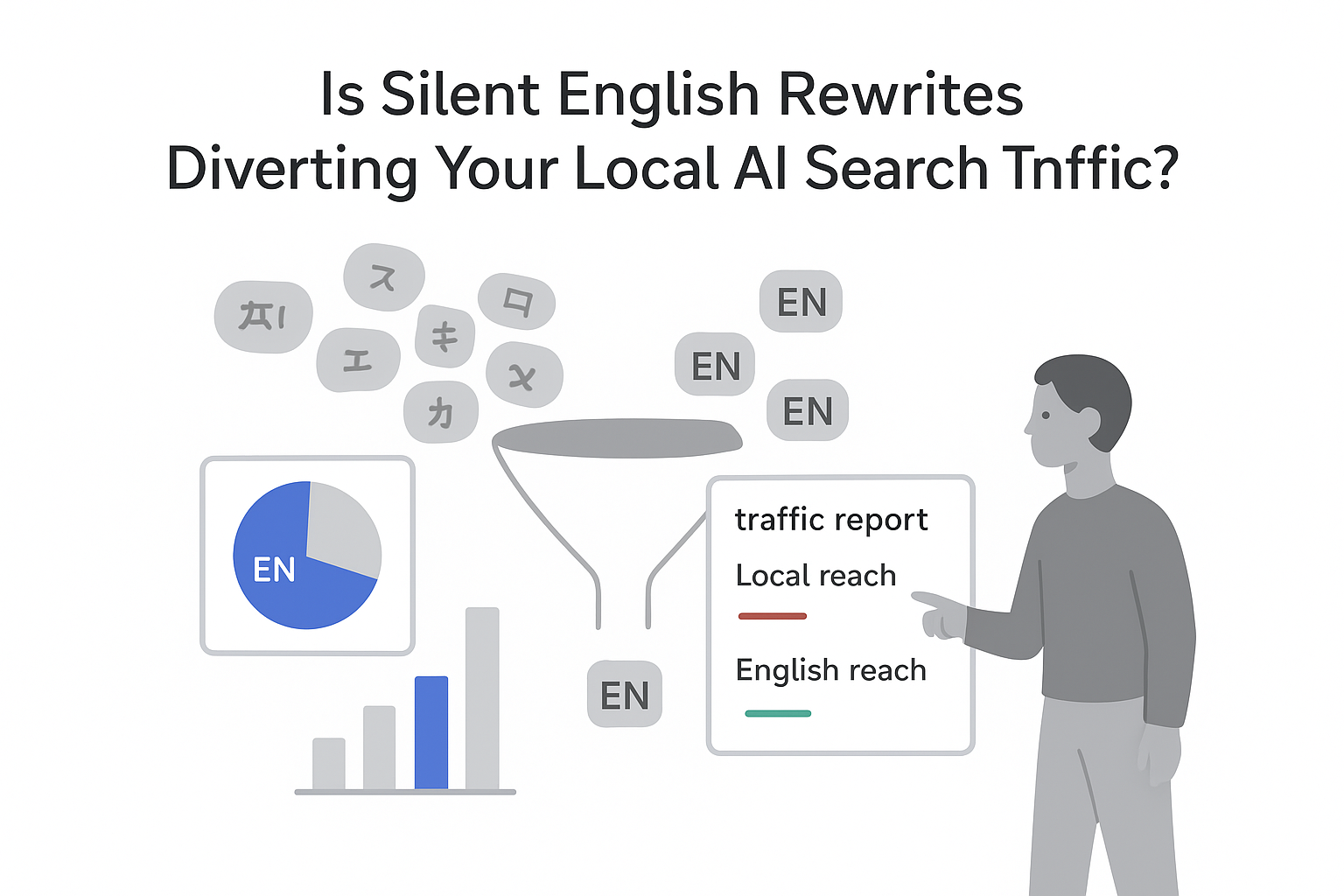
When ChatGPT Search answers user prompts, it generates background "fan-out" web queries. New data from Peec AI indicates that even for non-English prompts from non-English IPs, a large share of those background searches run in English, with measurable consequences for which sources and brands are likely to surface.
Executive Snapshot - ChatGPT Search language behavior
This section summarizes the key quantitative findings from Peec AI's report and related studies.
- Peec AI analyzed over 10 million ChatGPT prompts and around 20 million fan-out queries generated through its analytics platform, which uses browser automation to access ChatGPT's web interface. [S1][S5]
- Across all non-English prompts in the filtered dataset (where IP location matched prompt language), 43% of ChatGPT's fan-out steps ran in English. [S1]
- 78% of non-English prompt runs contained at least one English-language fan-out query. No non-English language in the dataset had less than 60% of runs with at least one English fan-out. [S1]
- Turkish-language prompts were most affected, with 94% including at least one English fan-out. Spanish-language prompts were lowest at 66%. [S1]
- Separate work by Columbia Journalism School's Tow Center found a 76.5% error rate in ChatGPT Search's source attribution, indicating that source selection and citation quality issues are already significant. [S4]
Implication for marketers: Non-English brands and publishers should expect ChatGPT Search to consult English sources heavily, which may tilt visibility toward global, English-centric competitors even for local-language queries.
Method and source notes for ChatGPT Search language analysis
Peec AI is an AI search analytics vendor that runs large volumes of scripted prompts against AI search systems via browser automation. Its documentation states that it uses headless browsers to execute customer-defined prompts daily on platforms like ChatGPT, interacting with public web interfaces rather than APIs. [S5]
Key measurement details from the report include:
- Scope: More than 10 million ChatGPT prompts and approximately 20 million associated fan-out queries. [S1]
- Data source: Prompts executed through Peec AI's own platform, not organic consumer or enterprise usage logs from OpenAI. [S1][S5]
- Filtering: The analysis of non-English behavior included only cases where IP geolocation matched the prompt language (for example, Polish prompt from Polish IP, German from German IP). Mixed cases such as German-language prompts from UK IPs were excluded. [S1]
- Metric: The language of individual fan-out queries generated while ChatGPT Search built an answer. [S1]
- Comparison framework: Peec AI used OpenAI's own description of query rewriting and follow-up queries ("fan-out" behavior) as the conceptual basis. [S2]
Limitations and caveats:
- The prompt mix, industries, and intent types in the 10 million-prompt dataset are not described, so representativeness versus typical ChatGPT usage is unknown. [S1]
- Peec AI's customers may skew toward SEO and marketing use cases, which could bias topic distribution. [S5]
- The language detection method for prompts and fan-outs is not fully detailed in the summary. [S1]
- Results reflect one point in time and one product configuration; language behavior may change as OpenAI updates ChatGPT Search. [S1][S2]
Sources referenced:
- [S1] Peec AI blog report on ChatGPT Search fan-out language behavior.
- [S2] OpenAI Help Center - ChatGPT Search documentation describing query rewriting and fan-out behavior.
- [S3] SE Ranking report on factors influencing ChatGPT Search citations.
- [S4] Tow Center for Digital Journalism study on ChatGPT Search attribution accuracy (76.5% error rate).
- [S5] Peec AI product and methodology documentation.
Findings on ChatGPT fan-out query languages and patterns
OpenAI's ChatGPT Search documentation explains that when a user submits a query, ChatGPT "rewrites your query into one or more targeted queries" and sends them to search partners, then may "send additional, more specific queries" as it refines the answer. [S2] Peec AI labels these rewritten sub-queries and follow-ups collectively as "fan-out" steps and tracks which language each uses. [S1]
Across the filtered non-English dataset, 43% of all fan-out search steps ran in English, even though the user prompts themselves were not in English and originated from IPs in matching-language countries. [S1] At the session level, 78% of non-English prompt runs included at least one English-language fan-out query. [S1] No non-English language fell below 60% of runs with at least one English fan-out, indicating that mixing the local language with English is a common pattern rather than an edge case. [S1]
The pattern was consistent but varied in intensity by language:
- Turkish prompts: 94% of runs included at least one English fan-out. [S1]
- Spanish prompts: 66% of runs included at least one English fan-out, the lowest rate in the reported dataset. [S1]
- All other non-English languages examined: at least 60% of runs included English fan-outs. [S1]
Peec AI reports that ChatGPT Search generally starts fan-out activity in the prompt's language, then adds English-language queries as it progresses. [S1] This behavior means English is often introduced as an additional retrieval layer, not as an initial replacement for the local language.
Peec AI's examples show how this can affect which brands surface: [S1]
- A Polish-language query from a Polish IP about the best auction portals produced a response that omitted or downplayed Allegro.pl, described as Poland's dominant online retail platform, in favor of eBay and other global services. [S1]
- A German-language query about German software companies reportedly produced a list with no German companies. [S1]
- A Spanish-language query from a Spanish IP about cosmetics brands produced no Spanish brands. [S1]
In the Spanish cosmetics example, Peec AI captured the underlying fan-outs: [S1]
- First fan-out: English-language query.
- Second fan-out: Spanish-language query that added the term "globales" (global), a qualifier not present in the user's original prompt. [S1]
Peec AI interprets this as ChatGPT treating a local-language query from a local IP as a request for global brands once English fan-outs enter the mix. [S1] The examples are limited but illustrate how English-layered fan-outs can shift focus from local to international results early in the retrieval process.
SEO and content implications for non-English markets
This section interprets the findings from a marketing and SEO perspective, connecting them to prior work on ChatGPT Search citations and attribution.
Interpretation - likely:
If English fan-out queries are used heavily even for non-English prompts, ChatGPT Search is repeatedly pulling from the English web corpus as a candidate pool, then deciding which sources to cite. Given that English content volume and link graphs are larger in many industries, this raises the odds that global, English-heavy domains will appear in the candidate set for answers to local-language questions. [S1][S2]
Earlier research from SE Ranking on ChatGPT Search citation factors suggests that traditional SEO signals still matter for which sources get cited, including authority-like signals and relevance to the query. [S3] When combined with Peec AI's findings, strong English-language domains may gain a double advantage: [S1][S3]
- They are more likely to be fetched during English fan-out steps. [S1]
- Once in the candidate pool, their existing authority and relevance signals increase the likelihood of citation. [S3]
Interpretation - tentative:
Non-English brands that operate in markets with strong global competitors may see their visibility in ChatGPT Search shaped more by their English-language footprint than by their local-language strength. For example, a dominant national marketplace or cosmetics brand with limited English content may appear less often than global brands that publish extensively in English. [S1]
Implications for marketers and publishers (non-prescriptive):
- Maintaining at least some high-quality, factual English-language content about a brand, products, and key topics may increase the chance of being included in English-language fan-out candidate sets, even for local queries. [S1][S2]
- Local-language entities may benefit from ensuring that their brand and core offerings are clearly associated with their category terms in both the local language and English (for example, structured data, bilingual "about" pages), so that either query language can retrieve them.
- Because Tow Center found a 76.5% error rate in ChatGPT Search attribution, [S4] marketers should treat any perceived visibility advantages or losses as volatile and monitor them over time rather than assuming stability.
- SEO and content teams focused solely on traditional search may miss an emerging layer: how AI systems rewrite and re-language queries before scoring sources. The language of fan-outs now appears to be one such hidden layer. [S1][S2]
These implications remain conditional on OpenAI's current behavior. If OpenAI changes language-handling logic, the importance of English fan-outs may rise or fall.
Limitations, contradictions, and open questions on AI search language bias
Several gaps limit how far the current data can be generalized.
- Sampling limitations: Peec AI's 10 million prompts come from its own customers and scripted runs, not a random cross-section of ChatGPT's user base. Topic, commercial intent, and language distribution may differ from real-world usage. [S1][S5]
- Unknown prompt mix: The report summary does not quantify what share of prompts were informational versus transactional, nor which industries dominated (for example, travel, software, retail). Language behavior could vary by vertical, but that breakdown is not available. [S1]
- Language handling details: OpenAI's ChatGPT Search documentation describes rewriting and fan-out behavior but gives no guidance on how the system chooses languages for those rewritten queries, or how many languages it may use per session. [S2] Whether the English fan-out pattern is an explicit design choice or an emergent outcome of internal models is not stated.
- Outcome versus process: Peec AI measures fan-out languages, not final citation shares across languages. [S1] Some local brands may still be cited even when English fan-outs are present; that rate is not documented in the summary provided. [S1]
- Anecdotal examples: The Polish, German, and Spanish examples show concerning patterns but are not statistically representative on their own. [S1] They demonstrate possibility, not frequency.
Open questions for marketers and analysts include:
- To what extent does the presence of English fan-outs actually suppress local-language sources in final answers, versus simply broadening the pool?
- How quickly will OpenAI adjust language handling if systematic local-market underrepresentation is documented and publicized?
- How do other AI search providers handle language in fan-out queries, and is English over-representation a general pattern or specific to ChatGPT Search?
Answering these questions will require either direct platform telemetry or more detailed third-party experiments segmented by language, intent, and industry.
Data appendix: ChatGPT fan-out query language stats
Key quantitative points from the reported studies and documentation:
| Metric | Value | Source |
|---|---|---|
| Total prompts analyzed by Peec AI | >10,000,000 | [S1] |
| Total fan-out queries analyzed | ~20,000,000 | [S1] |
| Share of fan-out steps in English for non-English prompts | 43% | [S1] |
| Non-English prompt runs with ≥1 English fan-out | 78% | [S1] |
| Lowest share (by language) of runs with ≥1 English fan-out | 66% for Spanish-language prompts | [S1] |
| Highest share (by language) of runs with ≥1 English fan-out | 94% for Turkish-language prompts | [S1] |
| Minimum share for any non-English language | ≥60% of runs with ≥1 English fan-out | [S1] |
| ChatGPT Search attribution error rate (Tow Center study) | 76.5% | [S4] |
For business and marketing teams, these numbers suggest that English is not just a global lingua franca for users, but also a common internal language for AI search retrieval steps, even when users interact entirely in another language.







.svg)

.svg)
.svg)