
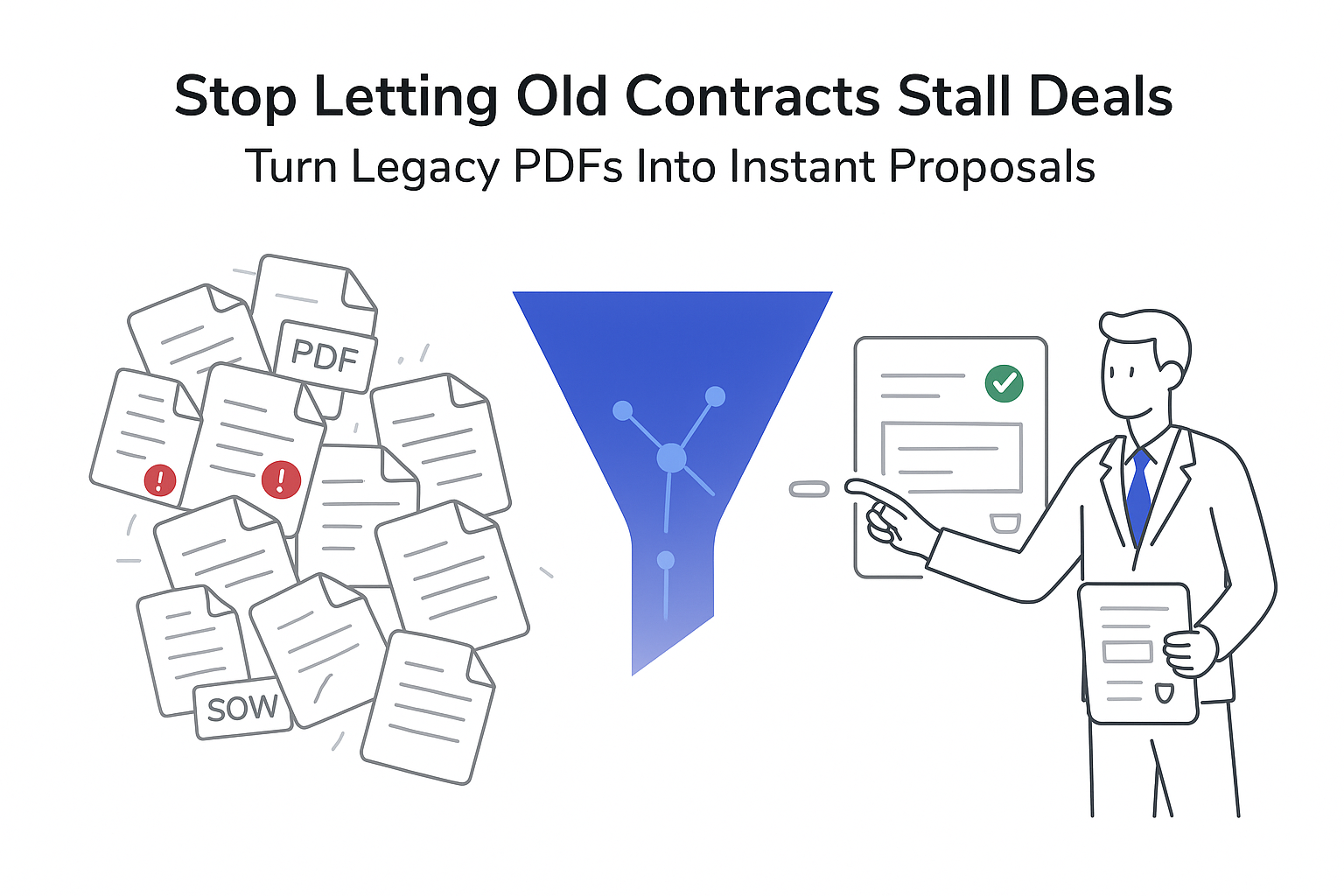
Most B2B service companies are sitting on years of contracts, SOWs, proposals, and internal reports that quietly keep the business running. The problem is simple but expensive: when someone needs an urgent client answer, a specific clause, or a strong idea from last year’s pitch, the team loses time hunting through shared drives and PDFs. Deals slow down, senior time gets consumed by document archaeology, and the organization keeps leaning on paid acquisition because it cannot reuse and productize what it already knows.
AI document intelligence for B2B service companies
AI document intelligence is the use of AI to read, organize, and explain documents at scale. Instead of relying on manual browsing or keyword search, an AI system can interpret document structure and meaning (for example, clauses, obligations, exclusions, and definitions), then return answers with context.
That meaning layer is what separates it from traditional approaches. Keyword search matches strings (every file containing “renewal”), and OCR converts scanned images into text, but neither understands what the text is saying. Document intelligence aims to answer questions like “What risks are unusual in this agreement?” or “How do payment terms differ by region?” while pointing back to the relevant passages.
In B2B services, the same high-value document categories come up again and again:
- Client contracts, SOWs, and MSAs that define scope, pricing, liabilities, and change control
- Proposals, decks, and RFP responses that show what positioning and proof points have worked before
- Research reports, compliance documentation, and internal playbooks that capture hard-won expertise
In practice, that can translate into faster proposal cycles, fewer avoidable legal escalations, and more consistent delivery promises, because people can retrieve what the firm already knows without starting from scratch. (For a related workflow, see context-aware document search for long RFP packages.)
The hidden cost of document intelligence gaps
Document chaos rarely presents as “we need document intelligence.” It shows up as slow proposals, long QA cycles, repeated legal reviews, and constant “Can someone send me the latest version?” messages. Underneath, it is a recurring tax on decision-making - and it adds up fast when knowledge workers spend large chunks of the day searching for information (often cited at IDC levels of time loss).
One common gap is that advanced search and knowledge tools tend to live with IT or data teams, not with the partners and client-facing leaders who actually need answers in the moment. When the interface is complex - or access is limited - people default to inbox archaeology and tribal knowledge. The cost is not just time; it is inconsistency. Different teams answer the same client question differently because they found different source documents (or none at all).
Another gap is the steady drain of manual review. Lawyers re-check similar clauses across similar agreements. Consultants re-read long packs before workshops. Strategy teams rebuild “new” deliverables by copying fragments from prior work. Even when each instance is only an hour or two, the aggregate effect across a quarter becomes material - especially because it is senior time. (If contracts are a major choke point, this pairs well with contract summarization for executives with risk flags by AI.)
Finally, silos across repositories create mismatched commitments. Contracts live in one system, sales collateral in another, delivery retrospectives somewhere else, and compliance in a separate knowledge base. When there is no unified view, teams unintentionally contradict each other: sales proposes a support model delivery cannot sustain, or a contract includes privacy obligations that do not match operational reality. That is how weak document intelligence turns into either revenue leakage (deals stalling) or risk exposure (unnoticed deviations) - the same kind of document-management failure mode often flagged in AIIM research and compliance postmortems.
Core AI document analysis workflows
When document intelligence works well, it does not “replace” experts. It removes low-value reading and retrieval so specialists can spend more time on judgment, negotiation, and client work.
A common starting point is natural-language Q&A over private repositories. Instead of searching folders, someone asks, “Which recent SOWs include uptime SLAs above 99.9%, and what are the penalties?” or “Summarize lessons learned from post-project reviews for financial services clients in 2023.” The value comes from (1) speed and (2) traceability - answers that link back to the exact passages used.
Single-document deep analysis is the next workflow: summarizing a long contract or RFP, extracting obligations by party, highlighting non-standard terms, and flagging areas that deserve a closer human read. This is especially useful when the document is long, repetitive, and easy to misread under time pressure.
Multi-document synthesis is where the leverage grows. Comparing clause variants across regions, aggregating change-request drivers across projects, or identifying patterns in renewal terms across a portfolio are all tasks that are possible manually, but usually too slow to do routinely. Document intelligence makes these cross-document comparisons feasible as a standard operating step, not an occasional special project.
In more mature setups, document intelligence becomes context-aware by linking documents to business metadata such as client, industry, deal size, margin band, or delivery model. That turns “text search” into something closer to decision support, because leaders can ask for patterns tied to outcomes (for example, which proposal structures tend to appear in larger enterprise wins).
Industry use cases where it tends to matter most
Document intelligence can help almost any knowledge-heavy organization, but it tends to deliver outsized impact in service verticals where value and risk are literally written into documents.
Legal and compliance-heavy work benefits from clause comparison, exception spotting, and faster first-pass review - provided that final decisions still sit with qualified professionals. Management consulting and corporate strategy benefit from faster synthesis of client materials and internal case history, which reduces reinvention and improves consistency across teams.
Finance and insurance workflows often revolve around policy language, underwriting documentation, and regulatory notices, which makes them well-suited to structured extraction and comparison, again with careful controls around what can and cannot be automated. Healthcare and clinical services can use similar approaches for protocol comparison and documentation review, but they require stronger governance because of sensitive data and higher consequence decisions.
Engineering and quality management teams typically deal with specifications, standards, QA reports, and evidence logs. Here the value often shows up in mapping requirements to proof, surfacing gaps, and accelerating audit preparation. Procurement and vendor management work benefits from benchmarking terms, monitoring SLAs, and finding early risk signals buried in correspondence or reports. Investigative and research-heavy teams use document intelligence to connect entities, timelines, and references across large corpuses, then validate the leads manually.
Across these areas, the pattern is consistent: better access to what the organization already knows reduces cycle time and improves consistency, while human experts retain responsibility for judgment.
Evaluating performance, limitations, and ROI expectations
Document intelligence should not be treated as a black box you “just trust.” It needs evaluation that matches the consequences of the workflow. The most practical method is to test the system on a realistic set of documents and questions created by domain experts, then check whether answers are correct, complete, and properly grounded in cited sources.
The types of documents matter. These systems usually perform best on digital, text-based materials like contracts, SOWs, proposals, policies, and reports. They can work with scanned files after OCR, but quality drops when scans are poor, formatting is chaotic, or handwriting is involved. In general, if a document is difficult for a human to read without effort, the AI will struggle too.
Limitations are manageable, but they need to be explicit:
- The system can produce confident-sounding answers when the needed information is not actually in the indexed content.
- Low-quality PDFs and inconsistent formatting reduce extraction accuracy and make citations less reliable.
- Niche terminology and internal abbreviations can confuse the model until it has enough in-domain examples.
- If documents are not connected, permissioned, and indexed correctly, the AI cannot use them - no matter how capable the model is.
Because of those limits, the safest posture is decision support, not decision replacement. High-stakes outputs (legal commitments, credit decisions, medical conclusions) should keep a human approver, and the system should be designed to show its sources so reviewers can verify quickly.
ROI timing depends on scope and adoption. Tightly scoped workflows - like first-pass contract review support or faster RFP triage - can show time savings early, while larger outcomes such as shorter deal cycles or higher win rates usually take longer because they depend on behavior change, process integration, and coverage of enough of the document base. The more the workflow is repeated and standardized, the faster the payoff tends to become visible. (To keep measurement consistent, you can adapt a lightweight scorecard like measuring AI content impact on sales cycle length for document workflows.)
Responsible use: privacy, security, governance, and language support
Once AI touches core business documents, privacy and governance stop being theoretical. A typical setup ingests content and metadata (title, author, dates, client identifiers) and keeps usage logs for auditing. That can be appropriate, but only if data minimization is real: sensitive personal data, detailed health data, and regulated financial identifiers should not be ingested unless the use case requires it and controls are in place.
On the security side, look for the fundamentals: encryption in transit and at rest, strong authentication, role-based access control, audit logs, and clear isolation between teams and clients. If data residency matters, it needs to be explicit rather than assumed. Also expect clarity on model behavior and change management - what model is being used, whether it is hosted externally or internally, and how updates are tested before they impact business-critical workflows. Helpful baseline guidance is available in Microsoft’s Overview of Responsible AI practices.
There are also uses that are either prohibited or high-risk without very strong governance: fully automated legal, credit, or insurance decisions; employee profiling or surveillance; and any use intended to identify or target individuals for harm. Even when something is technically feasible, it may be operationally unsafe or ethically unacceptable.
Language support is another practical governance issue. Many systems perform best in English and vary across other languages. If your organization operates across regions, define which workflows are supported in which languages, and where human expertise (or translation) is required - especially for legal and regulatory content.
If you are designing access patterns for marketing and revenue teams, it can be useful to start with secure AI sandboxes and data access patterns for marketers and then extend the same controls to legal and delivery repositories.
Getting started: scope, repositories, and success metrics
Adoption tends to work best when it is staged and measurable rather than ambitious and vague. Start by picking a small number of high-impact use cases that have three properties: frequent repetition, clear ownership, and a clear “before vs after” metric. Contract review support for one service line, proposal reuse for one segment, or compliance checks for one recurring audit are common examples.
Repository selection matters more than most people expect. Early success usually comes from connecting clean, frequently used document sources with consistent naming and access rules. If the first dataset is messy and permissions are unclear, the project will look like an AI problem when it is actually a data hygiene and governance problem.
Plan for costs the same way you would plan any operational capability: what drives consumption (users, documents, storage, query volume), what usage spikes look like during busy sales periods, and what guardrails prevent surprise overruns. The goal is not to optimize pricing on day one; it is to ensure the pilot economics stay predictable enough to judge value fairly.
To keep the pilot grounded, track a small set of operational metrics:
- Time to answer common client or internal questions (with source verification)
- Review time per contract, RFP, or proposal, especially for first-pass work
- Reuse rate of approved language and prior deliverables in new work
As reuse improves, teams often move from “search and paste” to more structured creation workflows, like auto-drafting statements of work with clause libraries and AI.
Development setup and integration
From a leadership perspective, “making it work” typically means securely connecting the system to the repositories you already use - document management, cloud storage, CRM, ticketing, and project tools - without changing how teams store files day to day. Read-only access, least-privilege permissions, and auditable access patterns are important design choices, not afterthoughts.
Implementation effort varies based on how many systems need to connect, how complex the permission model is, and whether the output needs to appear inside existing internal portals. A basic proof of value can be relatively quick if the repository is clean and the workflow is narrow; broader rollouts usually take longer because governance, training, and integration detail become the real work. This is also where skills gaps can slow down progress - a common barrier reflected in enterprise adoption research on limited AI skills and expertise.
Ownership needs to be explicit: who manages connectors, who approves access rules, who audits usage, and who is accountable when outputs are wrong or incomplete. Without that, the tool becomes “everyone’s” responsibility, which usually means “no one’s.”
How AI document intelligence changes knowledge access over time
When document intelligence is integrated into daily work, the shift is subtle but meaningful. Instead of asking, “Who remembers that client case from 2019?” people can retrieve a grounded summary of similar work, the constraints that mattered, and the language that was approved. New hires ramp faster because they can query institutional knowledge safely rather than relying entirely on the availability of senior staff.
Over time, proposals and delivery documents become more consistent because teams reuse proven sections and align on a shared source of truth. Compliance checks can move closer to real time because exceptions are easier to surface early. That does not eliminate the need for experts - it changes where their attention goes: less time finding information, more time applying judgment.
This is not a one-off productivity boost. Done well, it becomes a compounding capability: as the document base grows, indexing improves, and workflows get standardized, the organization gets faster at using what it already knows without needing to rely on memory, inboxes, or heroics.



.svg)

.svg)
.svg)