
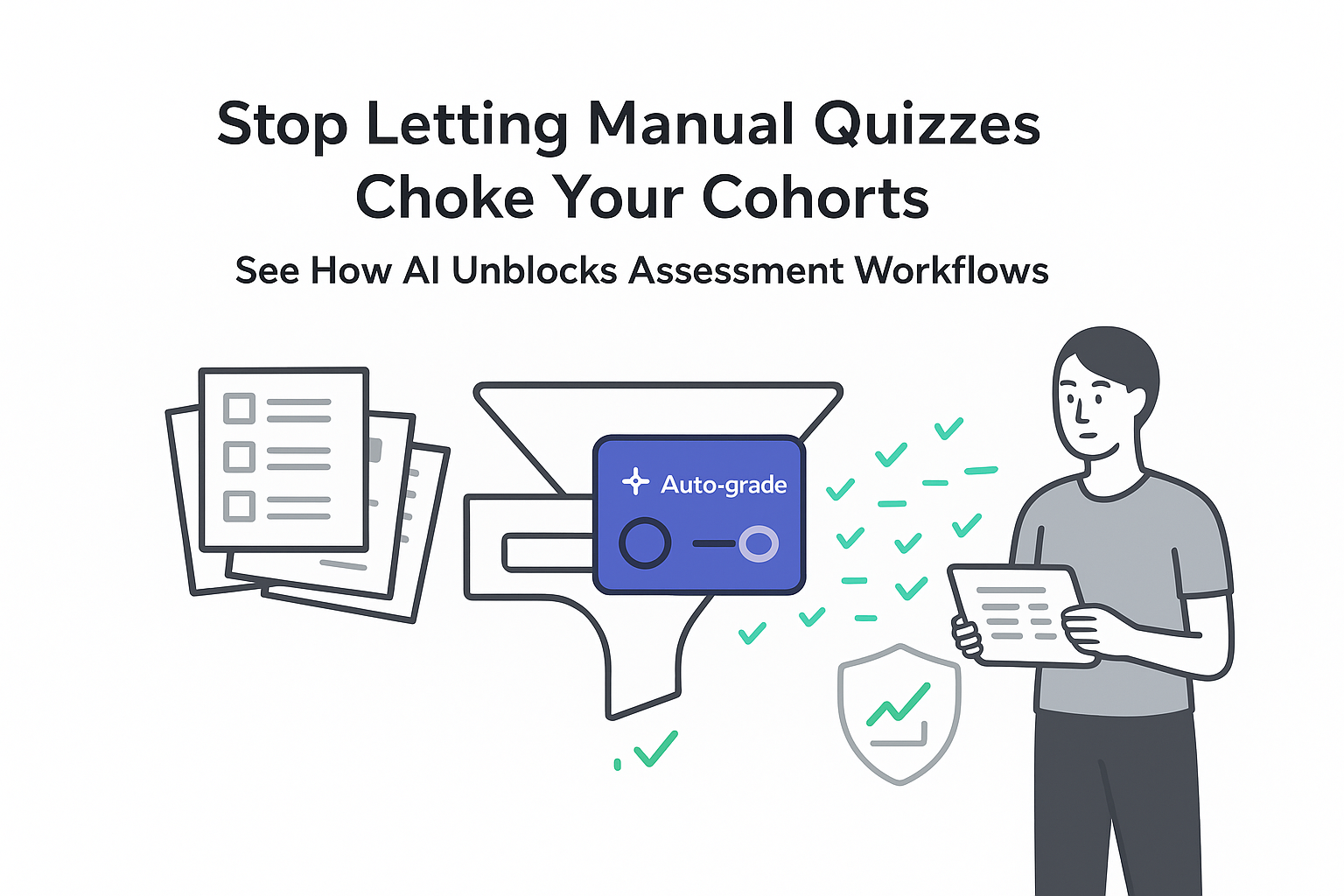
Manual quiz building feels fine when I have ten learners. It breaks the moment I’m running three cohorts at once, across two client accounts, with different versions of the same assessment. Then the grading backlog hits, instructors burn weekends, and a "premium learning experience" starts to look shaky. If my business sells training, coaching, or certification, that bottleneck is not just annoying - it caps revenue and makes margins unpredictable.
AI quiz and assessment generators solve a specific operational problem: they turn raw course content into structured questions, help score responses, and surface patterns that humans would otherwise need a spreadsheet (and a lot of time) to find. In this guide, I’ll walk through leading AI quiz and assessment generators training businesses are using heading into 2026, how they work, and how I’d pick one for a serious B2B learning operation (not just light trivia).
When manual quiz building becomes a growth bottleneck
The hidden cost of manual assessment work isn’t only the time it takes to write questions. It’s the downstream chaos: inconsistent difficulty across cohorts, version control problems when content changes, slow feedback loops for learners, and reporting that never quite answers what a client is paying for.
That’s why assessments tend to become a scaling ceiling. As soon as I increase cohort volume or start delivering the same program to multiple corporate clients, assessment creation and grading start behaving like a headcount problem. AI doesn’t remove the need for expert oversight, but it can remove the repetitive drafting and first-pass marking that usually causes the bottleneck.
Best AI quiz and assessment generators for training businesses in 2026
For founders and learning leaders, the real question isn’t “What can AI do?” It’s “Which platforms can I trust with my learners, my data, and my brand?” To keep this practical, I’m focusing on platforms that already support business training workflows today and have a reasonable chance of staying relevant through 2026.
I compare tools using five criteria: depth of AI (generation, grading, feedback), capacity to scale (cohorts, programs, clients), B2B fit (reporting and multi-program operations), data and privacy posture (exports, access control, model-training policies), and support and documentation (especially for non-technical teams).
| Tool | Best fit in a training business | AI assessment strengths | Common limitations to plan for |
|---|---|---|---|
| DISCO | Cohort programs and community-driven academies | AI-assisted quiz creation from content, engagement insights, structured learning paths | Can feel heavy if I only need quizzes; onboarding takes time |
| Kwizie | Fast testing and lightweight certification from existing materials | Rapid quiz generation from videos/docs, streamlined pass/fail flows | Less emphasis on community, complex programs, or deep assignment workflows |
| Coursebox | Writing-heavy, project-based, or rubric-driven assessment | Rubrics, AI-assisted grading, personalized feedback, multilingual support | Overkill if assessments are mostly short multiple-choice checks |
| Typeform | Diagnostics, surveys, lightweight checks, and feedback loops | AI-assisted question drafting, strong conditional logic, conversational UX | Not designed for high-stakes exams, complex grading, or rigorous proctoring |
Where each platform fits (and what I’d watch out for)
DISCO
DISCO is closer to a full learning environment than a standalone quiz tool. For cohort-based programs where discussion, projects, live sessions, and assessments all need to live together, that all-in-one design can reduce tool sprawl. On the assessment side, I can use AI to draft quiz questions from lesson content and iterate faster across repeated cohorts. The trade-off is scope: if my only need is “make quizzes and export results,” a full platform can add process and training overhead.
Kwizie
Kwizie leans into speed. If I’m turning existing assets (videos, PDFs, playbooks) into standardized checks quickly - especially in contexts like compliance, partner enablement, or recurring frontline verification - this style of tool fits well. The limitation is predictable: tools built for fast quizzes and certification-style flows typically won’t replace an LMS-like environment when I need deep cohort operations, richer assignments, or community features.
Coursebox
Coursebox stands out when grading and feedback are the real pain point. If my assessment is built around case studies, reflections, or written submissions, the work isn’t drafting questions - it’s marking fairly, consistently, and fast. Rubric-driven AI grading can reduce inconsistency across instructors and cohorts, but I still need governance: rubrics must be explicit, edge cases must be reviewed, and high-stakes decisions shouldn’t be fully automated.
Typeform
Typeform is best when the goal is learner input and segmentation rather than formal testing. I use tools like this for pre-course diagnostics, workshop comprehension checks, post-session feedback, and evaluation surveys - especially when the learner experience must be smooth on mobile. Where it weakens is exactly where it’s not trying to compete: complex marking schemes, controlled exam conditions, and assessment auditability.
How AI-driven quiz and assessment tools work
AI quiz and assessment tools typically combine three capabilities:
- Language understanding to parse slides, documents, transcripts, or lesson text and extract themes
- Generative question drafting to produce candidate items (multiple-choice, short answer, scenario questions) in varied difficulty levels
- Response analysis to summarize performance patterns across learners, cohorts, and time
Compared with traditional quiz builders, the operational difference is that I’m no longer starting from a blank page for every question bank, and I’m not relying on manual scoring for everything that can be scored consistently. The strategic difference is feedback speed: the faster learners get actionable feedback, the faster they correct misunderstandings - and the less remediation load lands on instructors.
If you’re converting recorded sessions into assessments, it helps to standardize your raw inputs first (clean transcripts, consistent naming, clear source-of-truth docs). That same “content hygiene” mindset shows up in other operational AI workflows too, like SOP generation from screen recordings via transcription + LLMs.
How AI improves quiz quality (and where it can go wrong)

AI can improve quiz quality when I use it as a structured drafting partner rather than an unsupervised author. In practice, I see quality gains in a few ways: broader variety of question types from the same source material, faster iteration when content changes, and better alignment with learning outcomes if I explicitly provide goals and constraints.
The risk is also predictable. AI can generate questions that are vague, misleading, too easy, culturally off, or simply wrong - especially when source content is thin or ambiguous. For accredited programs, compliance training, or high-stakes certification, expert review is non-negotiable. I treat AI output as draft inventory, then apply human judgment to confirm accuracy, relevance, and fairness.
Over time, item analytics help me identify questions that don’t discriminate (everyone gets them right or wrong), questions that confuse specific learner groups, and modules that consistently produce low performance. That’s where assessment quality becomes measurable rather than opinion-based - and it’s also where data quality matters. If your reporting is messy, it’s worth tightening the foundation, similar to how you’d approach data layer specification writing and validation with LLMs.
Key advantages for training businesses
When I implement AI quiz and assessment generators thoughtfully, I typically see improvements in these areas:
- Speed to launch: I can turn content into draft question banks quickly and shorten the time between curriculum updates and assessment readiness.
- Grading consistency: Objective items can be scored instantly, while rubric-based grading can reduce variation between instructors and cohorts.
- More useful feedback: Learners get targeted explanations tied to specific skills or modules, not just “right/wrong.”
- Stronger reporting for clients: Cohort-level patterns make it easier to show what learners mastered, where they struggled, and which parts of the program need refinement.
- Scalability without proportional headcount: I can increase cohort volume while keeping instructor time focused on facilitation, coaching, and edge-case review.
- Better fit for hybrid delivery: Pre-work diagnostics, in-session checks, and post-session reinforcement become easier to run without adding admin load.
On learner response: most people don’t care whether a quiz was AI-assisted. They care whether it feels fair, relevant to their role, and worth their time. If I use AI to tailor scenarios to an industry context, keep difficulty appropriate, and deliver fast, specific feedback, satisfaction usually rises - even if the underlying process is more automated.
How I choose an AI quiz platform for a B2B learning business
I start from my delivery model and risk profile, then work backward into tooling.
First, I map what “assessment” actually means in my business. If the product is a standardized knowledge check (compliance, partner enablement), I bias toward fast creation, clean reporting, and version control. If the product is capability change (leadership, coaching, sales performance), I bias toward rubrics, written feedback, and evidence of consistent marking.
Next, I pressure-test scale in two dimensions: content scale (question bank size, tagging, search, versioning, bulk exports) and learner scale (concurrency, performance during peak testing windows, permissions by client, and reliable data pipelines). Vendor promises are easy here, so I look for concrete answers: how many concurrent test takers the system supports in production, how exports work, and what happens when I need to duplicate and customize an assessment for multiple clients.
Then I validate data and governance. For B2B work, I want clear answers to questions like: who owns the assessment data; how I can export it if I switch platforms; whether my content or learner data is used to train shared AI models; what controls exist for access, retention, and audit trails; and how human review fits into the grading workflow (including the ability to override AI-generated grades before results are released). If you operate in regulated environments, it’s also worth applying the same thinking you’d use for secure AI sandboxes and data access patterns for marketers.
Finally, I check fit for hybrid programs. If part of the learning happens live, I prioritize mobile access, low-friction delivery (links/embeds), and fast visibility into results so facilitators can adjust in real time.
Rolling out AI assessments without eroding trust
Even strong AI tools disappoint when I roll them out too aggressively. A staged approach protects learner trust, instructor confidence, and client relationships.
- Pick one pilot program that has enough learners to show impact but isn’t my highest-stakes certification.
- Audit current assessments so I know where time and inconsistency actually show up (drafting, versioning, marking, reporting).
- Generate drafts, then review with experts to confirm accuracy, tone, and alignment to outcomes - especially for regulated topics.
- Calibrate grading by running historical submissions through the system and comparing results to human scores; then adjust rubrics and thresholds.
- Communicate clearly what’s automated, what’s reviewed by humans, and how data is stored and used.
- Monitor and iterate using completion rates, item performance, learner feedback, and instructor time spent per cohort.
- Scale only after the pilot is stable, with documented ownership for question quality, review cadence, and version control.
Governance is the part I don’t skip. Without clear ownership and scheduled review cycles, AI can quietly reintroduce inconsistency - even while it saves hours. If you’re rolling this out across a team (multiple instructors, client-facing ops, sales enablement), borrowing a lightweight change playbook helps: change management for rolling out AI across marketing teams.
Beyond quizzes: AI grading, adaptive paths, and analytics
Quizzes are only one slice of AI-assisted assessment. As my programs mature, I usually see the biggest gains when assessment connects to grading and learning decisions.
In practice, that means combining (1) AI-assisted scenario and assignment drafting, (2) rubric design that makes expectations explicit, (3) grading support that produces consistent scores and usable feedback, and (4) analytics that tie assessment performance to program changes. Once I have enough data, adaptive paths can also make sense - directing learners to reinforcement modules based on what they missed rather than pushing everyone through the same review content.
I don’t need every capability on day one. A sustainable sequence is to start with quiz generation to reduce build time, add grading and feedback where manual marking is a cost center, then layer in recommendations and analytics once the underlying assessment design is stable. That’s when AI stops feeling like a novelty and becomes infrastructure for consistent, scalable learning delivery. If you want to quantify whether the investment is actually paying off, apply an ROI lens similar to measuring AI content impact on sales cycle length - but focused on instructor hours saved, turnaround time, and client reporting quality.



.svg)

.svg)
.svg)