
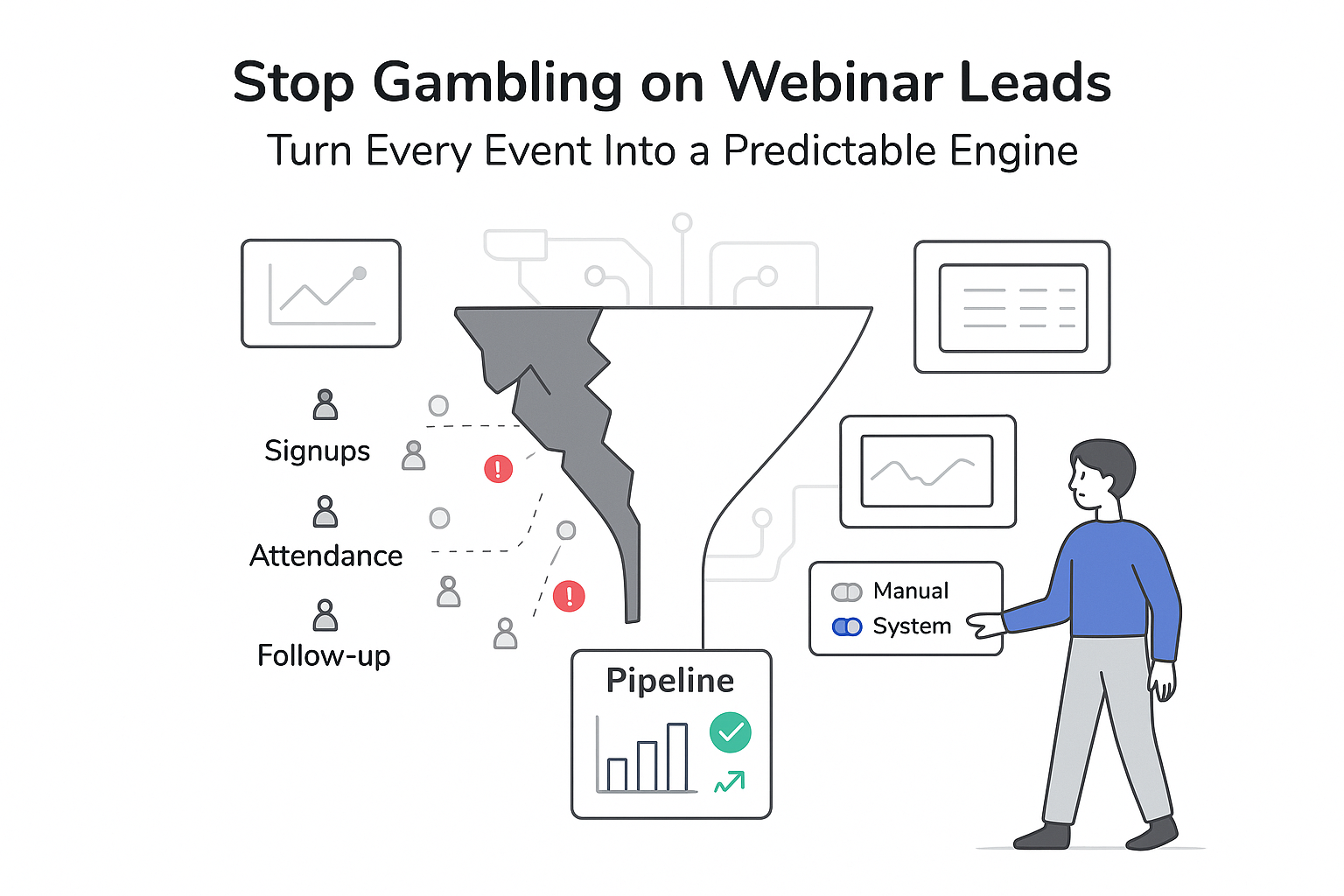
I hear the same frustration from B2B service leaders over and over: webinars can create pipeline, but they are hard to make predictable. One quarter they produce a few strong opportunities; the next quarter attendance drops, follow-up gets sloppy, and the whole thing feels like a fragile campaign instead of a repeatable system. At that point, I am usually not looking for “more clicks” or “more spend” - I am looking for consistency: stable show-up rates, clear handoffs to sales, and attribution I can defend.
That is where AI-driven webinar systems start to make sense, especially for B2B services where a webinar is essentially a leveraged sales conversation.
AI webinar marketing for B2B services
AI webinar marketing is the use of artificial intelligence to plan, promote, run, and follow up on webinars so they behave more like an operational process than a one-off event. The point is not to “automate everything.” The point is to reduce guesswork and manual effort at the exact moments where webinar programs typically break down.
In a fully manual approach, I usually see teams spend disproportionate time on repetitive work like:
- Guessing at topics and angles
- Rewriting landing page and invite copy from scratch
- Sending the same reminders to everyone regardless of behavior
- Exporting lists after the event and building segments by hand
- Deciding who is “hot” based on gut feel instead of signals
AI flips the default. Instead of treating every webinar like a fresh campaign, it can use patterns from past performance and existing customer data to improve targeting, messaging, timing, and prioritization. If you want a quick reality check on ranges, this webinar statistics roundup is a useful reference point for common benchmarks and what tends to move them.
Benchmarks vary by industry and audience, but many reports place registration-to-attendance averages in the rough 35-45% range. When teams improve segmentation and reminder logic, attendance can rise meaningfully (sometimes by double-digit percentages) because the people most likely to show up get more relevant nudges and fewer irrelevant ones. Research firms like McKinsey have also reported performance lifts from personalization programs; I treat that as supportive context for why AI-assisted segmentation and messaging can change webinar outcomes, not as a guarantee.
Conceptually, I think about the webinar as a chain of conversions: Traffic → Registration → Attendance → Engagement → Follow-up → Revenue. AI can improve each handoff - especially the weak ones between attendance and follow-up, and between engagement and revenue attribution.
Webinar marketing problems AI can reduce
Before I touch anything “AI,” I like to name the failure modes clearly. Most webinar programs do not fail because the presenter is not smart - they fail because the process is inconsistent.
High sign-ups, thin live attendance. It is common to see strong initial interest and then a steep drop at show time. A major reason is generic reminders that do not match how different contacts behave. AI can help by predicting optimal send windows and adapting subject lines and reminders based on prior interaction patterns, time zones, and role.
The wrong-fit audience ends up in the room. If the webinar draws companies that cannot buy (wrong size, wrong vertical, wrong use case), the session still “looks successful” on the surface but produces weak pipeline. AI can help prioritize invite lists using firmographic and behavioral signals so the audience matches the buying profile you actually want.
Show-up rates swing and nobody knows why. When performance varies wildly from one event to the next, it is usually because multiple variables shifted at once - topic, time, channel mix, presenter, and list quality. AI can help detect patterns across events (not just within a single campaign) so changes are made based on evidence, not post-event storytelling.
Senior experts get pulled into low-intent Q&A. Webinars often create a “Q&A tax,” where high-cost experts spend time answering edge-case questions from people who will never buy. AI can help cluster questions, surface themes, and flag intent-heavy questions so the session stays focused on problems that map to real purchase decisions.
Post-event segmentation is slow and lossy. When someone exports a list and hand-builds segments, nuance disappears: who asked what, who stayed to the end, who clicked key links, who showed repeated interest. AI can preserve and interpret these behaviors as structured signals, so segmentation is not just “attended vs. did not attend.”
Attribution back to revenue is weak. Without consistent tracking, webinars become “a thing that helps” but not a source you can quantify. AI-assisted attribution can help connect engagement signals to pipeline influence - especially when multiple touches happen over weeks or months. (If you are tightening this end of the funnel, AI for B2B customer journey mapping is a helpful companion framework.)
Across agencies, consultancies, IT services, and SaaS, the common thread is the same: AI does not “make webinars work.” It removes friction so the webinars you already run behave more like a system.
Using AI to choose stronger webinar topics
Most teams I work with do not struggle because they lack ideas - they struggle because they choose topics based on internal opinion rather than buyer reality. AI helps most at this stage when I feed it real customer language and real commercial context.
The highest-signal inputs usually come from existing internal sources: sales call notes or transcripts, support conversations, CRM notes, lost-deal reasons, on-site searches, and search query themes. When AI summarizes recurring pain points, objections, and trigger events, it becomes easier to write webinar titles that match what buyers already care about. (Related: turn call recordings into marketing insights to consistently extract themes without living in spreadsheets.)
Here is the kind of brief I find useful (anonymized, with sensitive details removed):
You are a B2B marketing strategist.

Analyze these anonymized sales conversations and deal notes.

1) Summarize recurring pains using the customer’s language.
2) List the top objections that stall deals.
3) Propose 5 webinar topics for VP/C-level buyers at mid-market companies.
4) For each topic, suggest what proof (data, example, benchmark) would make it credible.
What I am looking for in the output is not “clever titles.” I want a tight mapping between (a) pains and objections that show up in revenue conversations and (b) a webinar promise that addresses those pains with a credible mechanism and proof.
If you want examples to sanity-check AI-generated topics, Read More (Webinar Content Ideas for Coaches & Consultants) can help teams pressure-test positioning before they commit to a calendar.
Using AI to outline webinar content without going generic
Once the topic is right, AI can accelerate outlining - especially if you treat it as a drafting engine, not a source of truth. The practical value is speed: you can move from a topic to a coherent structure quickly, then let subject-matter experts sharpen the details and validate claims.
The structure I see work well for B2B services is straightforward: define the problem precisely, quantify the cost of inaction, introduce a framework, show proof, and close with clear next steps (not hype). AI can propose slide titles, transitions, and supporting visuals, but humans still need to do three things AI cannot do reliably: validate numbers, ensure the framework matches reality, and cut fluff.
When the AI output feels generic, I tighten the prompt. I ask it to write for time-poor executives, use fewer buzzwords, and explicitly call out where data is required so the team does not accidentally present assumptions as facts.
AI automation across the webinar funnel (what I actually try to improve)
AI delivers the most value when it connects the whole funnel instead of optimizing one isolated piece. In practice, I focus on five places where small improvements compound:
- Targeting and invite prioritization: Use prior customer data and engagement patterns to focus attention on the accounts most likely to buy.
- Message matching: Tailor angles by role and industry so the invite feels relevant instead of broad.
- Reminder optimization: Adjust timing and content based on behavior, not a fixed calendar schedule.
- Engagement capture: Turn live behavior (watch time, interactions, questions) into structured signals.
- Routing and follow-through: Turn those signals into consistent handoffs so sales knows who to prioritize and why.
I also draw a hard line between simple automation and AI-driven optimization. Rules keep operations clean (everyone gets a confirmation message, everyone gets a replay). AI-driven decisions help the system learn over time (who should get which reminder, which segment is most likely to convert, which topics attract higher-fit accounts).
AI during the live session: engagement, Q&A, and intent signals
During the webinar itself, I care less about “cool features” and more about whether I am capturing buying intent without distracting the presenter.
The most useful live signals tend to be: how long people stayed, what sections triggered questions, whether they interacted with key moments, and what their questions reveal about urgency and authority. AI can help by clustering similar questions, highlighting questions that indicate near-term intent (implementation timing, risk, procurement constraints), and summarizing themes for a moderator. If your team needs tactics beyond the tech, Read More (Webinar Engagement Strategies) pairs well with AI scoring by improving what you can actually measure.
I am careful here for two reasons. First, it is easy to over-score “activity” and mistake curiosity for intent. Second, regulated industries introduce real constraints: consent, data retention, and what can be processed externally. When privacy requirements are strict, I anonymize sensitive fields and keep the minimum viable dataset for scoring and routing. (For a deeper look at practical guardrails, see secure AI sandboxes and data access patterns for marketers.)
Post-webinar follow-up, lead scoring, and attribution
Most webinar ROI is decided after the event, not during it. This is where AI can turn a messy list into actions that happen quickly and consistently.
Post-event, I typically combine a small set of signals - attendance status, watch time, poll responses (if used), questions asked, and key link interactions - to create segments that reflect both fit and intent. The goal is not “three buckets for every webinar.” The goal is a segmentation model that sales and marketing actually trust and reuse.
Follow-up performs best when it reflects what the attendee actually engaged with. If someone stayed for the whole framework section and asked an implementation question, the follow-up should reference that theme directly. If someone left early, the follow-up should summarize the most valuable piece they likely missed rather than dumping a full replay and hoping they self-educate.
On attribution, I try to keep expectations realistic. Webinars rarely “cause” a deal on their own; they influence deals as part of a sequence of touches. AI can help connect engagement to later pipeline activity, but only if lifecycle definitions are consistent and the underlying CRM data is maintained. Otherwise, the model produces confident answers to messy questions. (If you are tightening measurement, measuring AI content impact on sales cycle length offers a practical way to separate activity from outcomes.)
How I evaluate AI webinar tooling choices and avoid common mistakes
I am intentionally tool-agnostic when I think about implementation. What matters is whether the system can (1) capture the right signals, (2) segment consistently, (3) route leads with context, and (4) tie influence back to pipeline. Whether that happens in one platform or across multiple connected systems is a tradeoff between speed and flexibility.
The mistakes I see most often are predictable:
- Expecting a hands-off machine. AI reduces labor; it does not replace strategy, proof, or judgment.
- Building on dirty data. If consent status, role, and company data are unreliable, AI will scale the mess. (This is where detecting feature drift in knowledge bases with AI freshness checks can prevent slow degradation.)
- Letting AI “invent” credibility. Any claim, benchmark, or case result needs validation before it hits slides.
- Optimizing for vanity metrics. Attendance matters, but pipeline quality and sales follow-through matter more.
- Not aligning with sales. If sales does not trust scoring and context, the handoff fails regardless of how “smart” the system is.
When I treat webinars as a leveraged sales motion - and treat AI as the layer that standardizes and improves each handoff - the program stops feeling fragile. It becomes measurable, repeatable, and easier to run without turning webinar day into a fire drill.
If you are evaluating platforms, start by mapping your must-have signals and integrations, then choose tooling that can operationalize them. For teams that want an AI-powered webinar workflow in one place, AEvent is one option to explore. And if qualified acquisition is the bottleneck, Read More (Webinar Facebook Ads Strategy) covers promotion levers that work best when your targeting and follow-up are already disciplined.



.svg)

.svg)
.svg)