
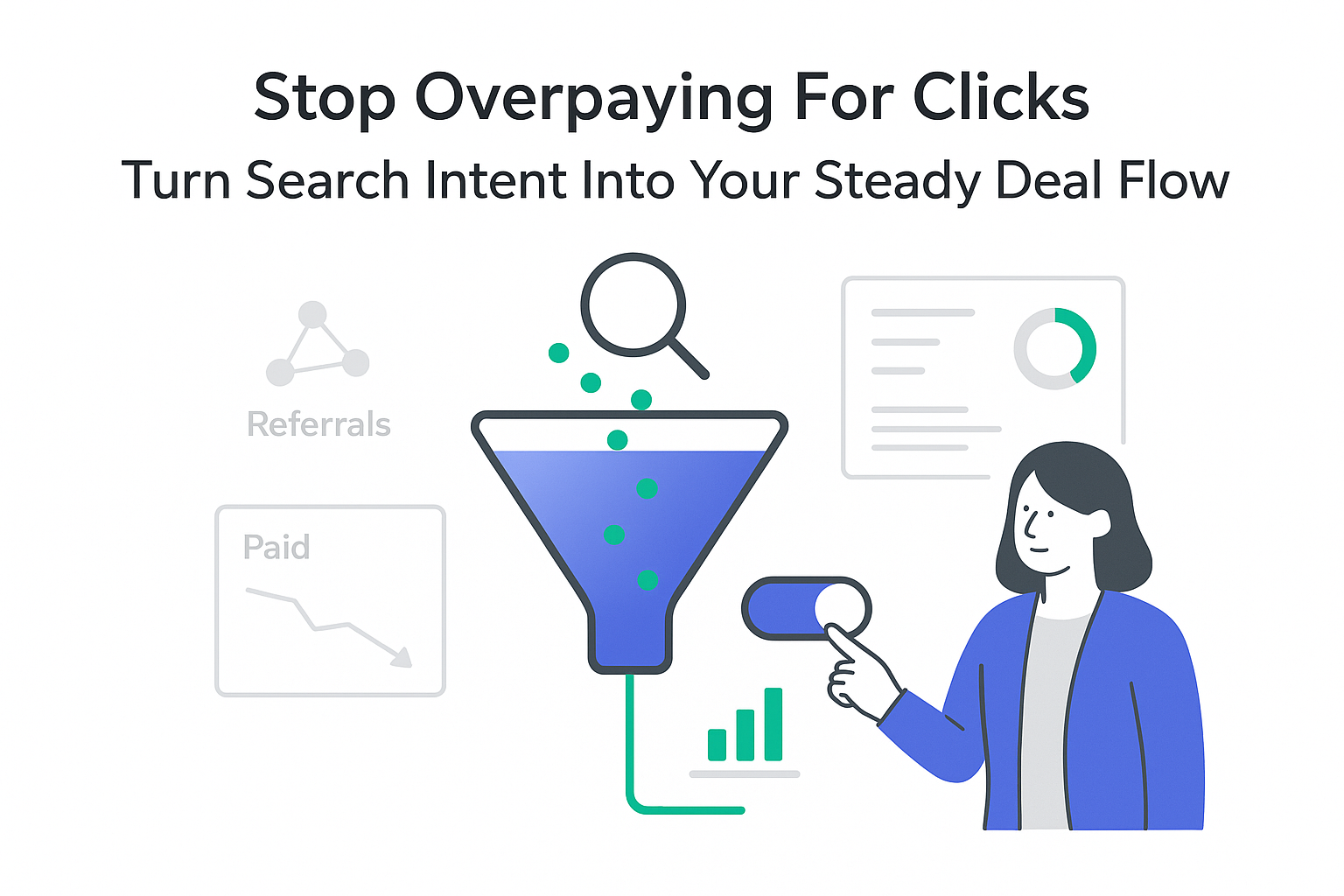
Most B2B service CEOs I talk to hit a point where referrals, outbound, and paid channels start to feel like constant maintenance. The business is solid, revenue is decent, but the pipeline still is not as steady as it needs to be. That is usually the moment when SEO shifts from “nice to have” into a real growth lever, especially when deal sizes are large, sales cycles are long, and every bad-fit lead wastes senior time.
SEO for B2B service companies (what it is and what it is not)
SEO for B2B service companies is the work of getting the right buyers to find you through search across their decision process, then guiding them toward a high-value conversation. I do not look at it as chasing vanity traffic. I look at it as showing up when a buying committee is actively shortlisting vendors for a high-stakes engagement.
Compared to paid and outbound, SEO tends to compound. Paid is linear: when spend pauses, lead flow usually drops. Outbound can work, but it often slows as lists get saturated and response rates fall. A strong page that ranks for a high-intent query (for example, “B2B supply chain consulting firm” or “IT security assessment services for healthcare”) can keep generating qualified demand without an ongoing media budget, though it still requires upkeep as competitors publish and search results change.
In B2B services, SEO also has to reflect a few realities:
- Long sales cycles with multiple stakeholders involved in the decision
- Higher ACV, complex scopes, and heavier scrutiny around risk
- Buyers who expect proof, credibility, and clear differentiation, not just marketing claims
In the rest of this article, I break a practical B2B SEO strategy into four parts: aligning keywords to your ideal buyers, upgrading service pages to convert, building authority with content and links, and measuring SEO ROI in pipeline terms (not just traffic).
Why SEO matters for scaling a B2B service business
If your B2B service company is sitting somewhere around $50k-$150k per month, you have already solved hard problems: you have market fit, you can close deals, and you have at least one repeatable way to win. The challenge is that growth often slows once referrals plateau and paid acquisition gets more expensive. (If this feels familiar, see Real-time AI coaching for discovery and demo calls for a related view on what changes when growth stalls.)
At the same time, buyers increasingly do private research before they ever fill out a form. The practical takeaway is simple: if you are invisible during early “research mode,” you are forcing sales to fight uphill later. If you sell into committees, it is worth understanding how search behavior fragments across roles and touchpoints - b2b search ads for buying committees expands on that dynamic.
That visibility shows up in very specific searches, queries that reveal both industry context and urgency. Think “managed IT support for law firms,” “B2B sales training firm for industrial companies,” or “IT security assessment services for healthcare.” The company that ranks, and backs it up with credible proof, often enters the conversation as a frontrunner rather than an option of last resort.
SEO also changes the economics of growth. While you invest upfront to earn rankings, the marginal cost of an additional qualified organic visit tends to fall over time compared to paid channels. That gap can improve margins and reduce reliance on any single acquisition source.
SEO ROI in B2B services (what to expect and how to sanity-check it)
When I evaluate SEO ROI for B2B services, I focus less on “rankings went up” and more on whether SEO is creating qualified opportunities at an acceptable payback period. If you want a deeper measurement framework, measuring pipeline impact of seo is a useful companion.
In most B2B services, results come in stages:
Months 1-3: I expect foundational work - technical fixes, improved site structure, and the first round of priority pages created or rewritten. Early leading indicators often include better impressions for niche terms, improved click-through rates on core pages, and the first lift in organic inquiries (even if closes lag because the sales cycle is long).
Months 4-6: This is typically when priority pages start landing in strong positions for high-intent queries, and organic inquiries become more noticeable. Sales feedback matters here: are organic leads better informed, clearer on scope, and closer to buying?
Months 7-12+: If execution is consistent, multiple service pages and supporting topics can rank, and organic becomes a material contributor to qualified pipeline. This is also when “cost-effective SEO” becomes visible in blended CAC - assuming lead quality stays high.
Here is a simple way to pressure-test the math. Imagine a B2B consulting firm with a $40k average deal size, a 25% close rate from opportunity, a 3% visit-to-lead conversion rate on strong pages, and a 40% lead-to-opportunity rate. If SEO adds 2,000 targeted organic visits per month across priority pages, the implied output is roughly 60 leads, 24 opportunities, and 6 new clients - about $240k in new revenue, before expansion.
That example is intentionally clean; real performance depends on niche competitiveness, current authority, conversion rates, sales execution, and how well content matches the actual buyer journey. This is why fixed promises like “3x revenue in six months” are usually guesswork. The more reliable point is that high-ticket B2B services do not need massive traffic volume - modest increases in highly targeted demand can move the pipeline dramatically.
Step 1: Align keywords with your ideal B2B buyers (not just search volume)
Good SEO starts the same place good sales starts: clarity on who you want as a client. I begin with an ICP definition (industries, company size, and the roles involved - VP Operations, CIO, CFO, Head of Sales, Founder), then map what those people search at different stages. One practical method is to mine language directly from calls - b2b saas trial intent keywords breaks down how to translate sales conversations into keyword strategy.
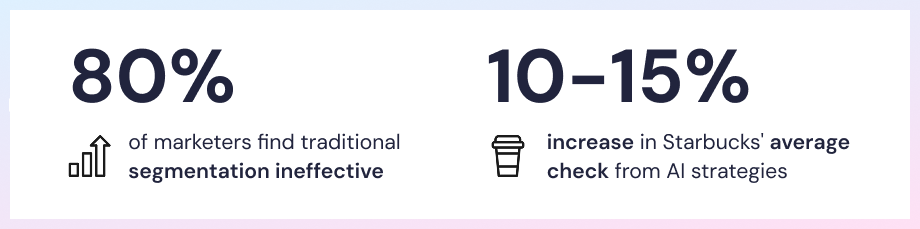
Instead of building one giant keyword list, I prefer grouping by intent:
- Early-stage problem framing (the “why is this happening?” searches)
- Category and solution searches (the “what should we hire?” searches)
- Vendor comparison searches (the “shortlist and validate” searches)
- High-intent service searches (the “who can do this in my context?” searches)
To validate topics, I combine quantitative signals (what already shows up in Google Search Console, plus third-party keyword data) with qualitative inputs (sales call notes, CRM patterns like “reason lost,” and quick customer interviews about what they searched before contacting you). This is where a lot of B2B SEO strategy gets sharper: the best terms are often not the biggest terms - they are the terms your best-fit buyers actually use.
If you want to speed up the first pass on ICP documentation, tools like M1-Project and its Ideal Customer Profile (ICP) Generator can help you structure inputs faster. The key is still the same: keep the output grounded in real deal data and real buying contexts.
For example, a managed IT provider focused on law firms might map content from broad risk education (“law firm cybersecurity risks”) to service evaluation (“IT security assessment services for law firms”) to bottom-funnel local intent (“[city] managed IT support for law firms”). The goal is tight topical ownership, not scattered traffic.
Step 2: Turn service pages into high-intent entry points that convert
Once keywords are aligned to your buyers, the fastest way to impact B2B lead generation is usually the service pages, because they target bottom-funnel intent.
Most B2B service websites undersell on these pages. I often see a generic headline, a short paragraph, and a single “Contact” button. That kind of page struggles to rank, and even when it ranks, it does not answer the questions a risk-aware buyer is using to validate a vendor.
A strong service page typically does four jobs at once. It clarifies positioning (who it is for and what outcome it drives), it answers real buying questions (process, timelines, what a typical engagement looks like), it proves credibility (case studies with metrics, testimonials with outcomes, relevant expertise), and it reduces perceived risk (clear expectations, budget guidance when possible, and straightforward next steps).
On-page SEO then amplifies the business content: a focused title tag that reflects the primary keyword, a clean header structure that mirrors how buyers scan, and internal links from supporting articles and case studies back into the service page.
If I compare “before vs after,” the difference is specificity. “Sales consulting” is vague. “B2B sales consulting for industrial companies” plus concrete outcomes, process detail, and relevant proof is both more rankable and more persuasive.
Step 3: Build authority with content and links (so you can increase organic traffic in the right areas)
Service pages help you capture high-intent searches. To consistently increase organic traffic and authority, I treat content as support infrastructure around those services.
The most effective B2B service content usually fits a few patterns: problem explainers that articulate root causes, industry deep dives that show domain fluency, comparison pieces that help buyers choose an approach, and case stories that demonstrate measurable outcomes. The key is that content should feed the service pages (and the pipeline), not exist as a publishing habit.
I also find topic clustering works well for B2B services: one central page aligned to a core service, surrounded by supporting articles that answer adjacent questions and link back. That structure helps both users and search engines understand what you are a credible option for.
Links from other sites still matter, but I am cautious about how they are earned. The most durable links in B2B tend to come from real visibility: industry publications, partner collaborations, podcasts/webinars with episode pages, association listings, and thought leadership that gets cited naturally. Tactics that feel like “manufactured authority” (bulk link buying or irrelevant guest posts) can create volatility and risk. If you want a systems view, b2b saas internal linking for product pages outlines how links tie back to pipeline outcomes.
A related point: surface-level content - whether written by humans or generated quickly with AI - rarely stands out in competitive B2B spaces. What tends to perform is content that reflects lived experience: actual frameworks you use, examples of tradeoffs, anonymized patterns from engagements, and clear points of view backed by evidence.
When you are ready to turn those insights into campaign plans and publishing momentum, tools like a Marketing Strategy Builder and a Social Media Content Generator can help operationalize the workflow without drifting away from buyer intent.
Step 4: Measure what matters (SEO results tied to pipeline, not screenshots)
This is where many SEO programs lose credibility: they report rankings and traffic, but they cannot clearly show pipeline impact. For SEO ROI to be meaningful in B2B services, measurement has to connect marketing activity to commercial outcomes.
I use a simple four-layer model:
- Activity: what was shipped (page improvements, new pages, technical fixes, earned links)
- Visibility: what changed in search demand capture (impressions, clicks, ranking movement on high-intent terms)
- Engagement: what users did (organic sessions on priority pages, behavioral signals like scroll depth as directional context)
- Pipeline and revenue: what sales can measure (qualified inquiries from organic, opportunities influenced/created, pipeline value, closed revenue)
In practice, the tooling is usually already available: analytics for traffic and events, Search Console for queries and clicks, and a CRM for opportunity and revenue attribution. The hard part is operational discipline - making sure organic conversions are tracked correctly, source data is preserved through forms and scheduling flows, and sales has a shared definition of what qualifies as a sales-worthy inquiry.
For CEO-level review, I focus on monthly trendlines like organic-sourced consultations, opportunity value where first touch was organic search, win rate and cycle length by source, and blended CAC comparisons versus paid and outbound.
Choosing a B2B SEO agency (or any external SEO help) without getting burned
Even a strong strategy can stall with weak execution. If I am evaluating a B2B SEO agency (or consultant), I look for evidence they understand how B2B services actually sell - long cycles, multiple stakeholders, and a real need to qualify demand rather than maximize volume.
I also watch for a clear connection between SEO work and pipeline outcomes. Case stories that only celebrate “traffic up” do not tell me enough; I want to see how traffic translated into qualified conversations, opportunities, and closed revenue.
When I assess fit, I look for signals like B2B service experience in similar buying dynamics, a strategy anchored to ICP and intent (not generic keyword volume), transparent reporting on what was done and why, and a willingness to connect SEO performance to CRM outcomes. On the flip side, I treat guaranteed #1 rankings, opaque link-building explanations, and an obsession with impressions over lead quality as serious red flags.
A practical way to test depth is to ask how they diagnose slow results, how they decide what to change first, and how they attribute SEO to revenue in a way sales leadership will accept.
Bringing it together: a cost-effective SEO channel built for real B2B buying
SEO for B2B service companies works when it mirrors how buyers research, compare, and commit. That means choosing keywords based on real intent and ICP fit, building service pages that answer buying questions and prove credibility, publishing content that strengthens authority around your core services, and measuring success in pipeline and revenue terms.
When I apply that standard, SEO stops being a “marketing project” and becomes a cost-effective SEO channel that supports predictable growth, without depending on a single ad platform, a single outbound motion, or a single rainmaker rep.
If you want to extend this into a more technical, system-level approach, Graph + embeddings for account mapping and influence paths is a useful next read.



.svg)

.svg)
.svg)