
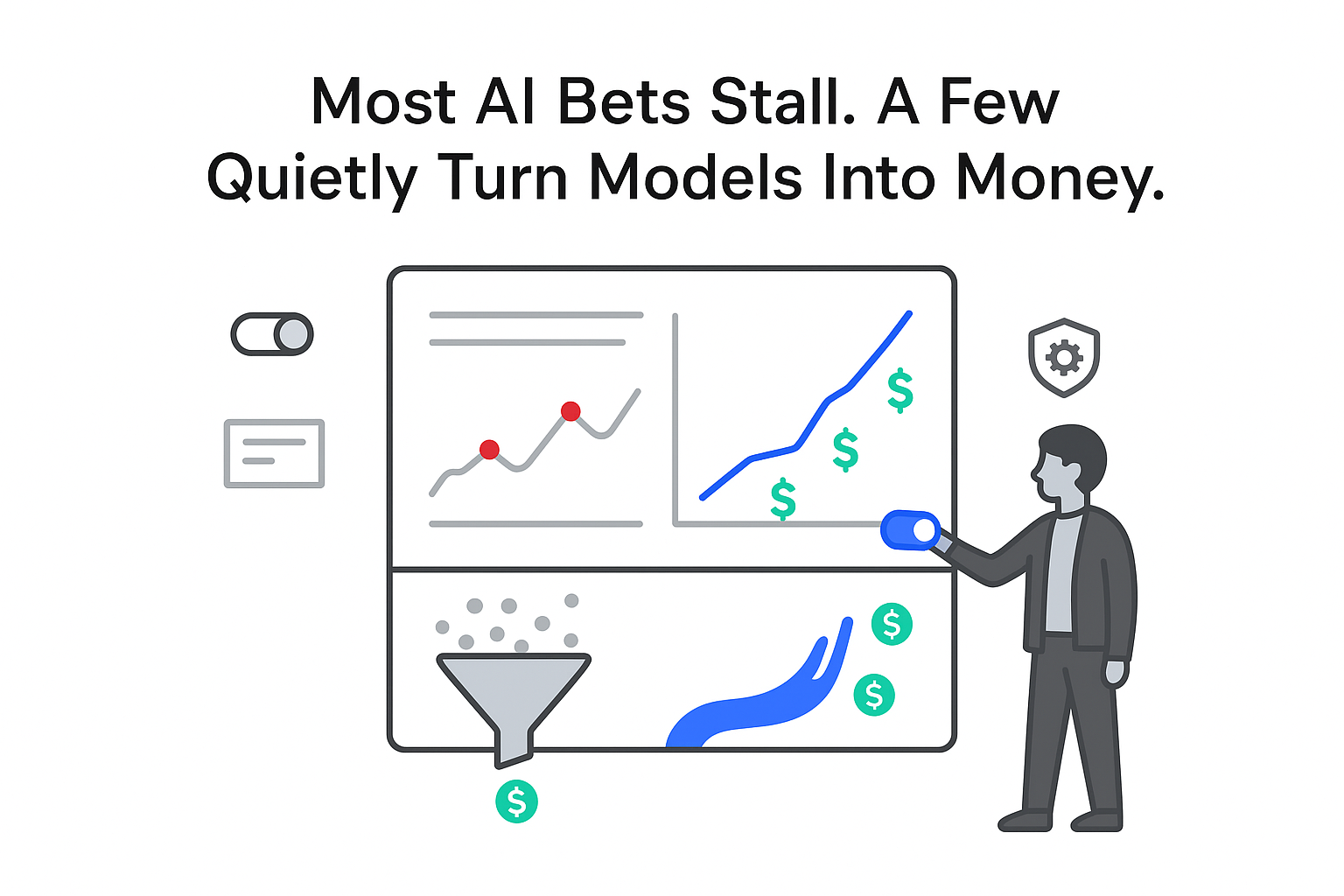
Recent data from PwC’s 29th Global CEO Survey, as summarised by Search Engine Journal, indicates that most large-company CEOs have not yet seen measurable revenue or cost benefits from AI, and that AI use in demand generation remains limited. [S1] This report condenses the findings and highlights what they imply for marketing and growth leaders assessing AI investments.
Executive snapshot
- 56% of 4,454 CEOs across 95 countries report neither higher revenue nor lower costs from AI over the past 12 months (defined as a change of at least ±2%). [S1]
- 30% report revenue gains from AI; 26% report cost reductions; 22% report cost increases. [S1]
- Only 12% achieved both revenue gains and cost reductions from AI, a segment PwC labels the “vanguard”. [S1]
- 22% say their organisations use AI for demand generation to a large or very large extent; 19% say the same for products, services, and experiences. [S1]
- CEO confidence in revenue growth is falling: 30% are very or extremely confident about next-12-month growth, down from 38% the prior year and 56% in 2022. [S1]
- Complementary surveys show strain on marketing teams: 72% of B2B marketers feel overwhelmed by AI’s pace of change (LinkedIn), and while 73% of marketing teams use AI, 87% of CMOs report campaign performance problems (Gartner), both as cited in the same article. [S1]
Implication for marketers: AI is widely in play but still rarely tied to clear, measurable financial outcomes, especially without company-wide foundations and integration. [S1]
Method and source notes
The primary data comes from PwC’s 29th Global CEO Survey, summarised by Search Engine Journal. [S1] The survey covers:
- Population: 4,454 chief executives from 95 countries. [S1]
- Period: CEOs were asked about the previous 12 months; field dates are not specified in the article. [S1]
-
Measures of AI impact:
- Revenue impact from AI, with “increase” or “decrease” defined as a change of at least 2%. [S1]
- Cost impact from AI under the same 2% threshold. [S1]
- Self-reported extent of AI use in specific business areas, including demand generation and customer-facing products, services, and experiences. [S1]
- Outcome combinations: PwC highlights a group of firms with both revenue gains and cost reductions from AI (“vanguard”). [S1]
Additional context comes from a LinkedIn report on B2B marketers and a Gartner survey of CMOs on generative AI adoption and campaign performance, both referenced within the same Search Engine Journal coverage without full methodological detail or sample sizes. [S1]
Key caveats include:
- Data is self-reported by CEOs, not derived from audited financials or system-level instrumentation.
- The summary does not show breakdowns by company size, industry, or geography, nor the exact survey questions.
- LinkedIn and Gartner figures are secondary citations via Search Engine Journal; underlying reports are not quoted directly. [S1]
AI revenue gains in the PwC Global CEO Survey - findings

PwC’s CEO data suggests that, at this stage, AI has not yet translated into broad financial upside for most organisations. Among 4,454 CEOs, 56% report that AI has delivered neither revenue growth nor cost reductions of at least 2% over the last 12 months. [S1] For more than half of respondents, AI activity has therefore not produced an effect large enough to register at profit-and-loss level under PwC’s threshold.
On the revenue side, 30% of CEOs say AI increased company revenue by at least 2% during the year. [S1] On the cost side, 26% report cost reductions from AI of at least 2%, while 22% say costs increased. [S1] PwC’s framing suggests that both benefits and new expenses are present, with net effects varying by organisation.
PwC segments a “vanguard” of companies that saw both revenue gains and cost reductions from AI - only 12% of respondents fall into this group. [S1] From the figures provided, it is possible to infer a more detailed breakdown of outcomes:
- 12%: both revenue increase and cost decrease from AI (the “vanguard”). [S1]
- 18%: revenue increase only (30% with higher revenue minus 12% with both outcomes). [S1]
- 14%: cost decrease only (26% with lower costs minus 12% with both outcomes). [S1]
- 56%: neither revenue increase nor cost decrease. [S1]
These four groups sum to 100% and use only the reported numbers, without extra assumptions.
PwC notes that the “vanguard” firms share characteristics: defined AI roadmaps, technology environments built for AI integration, and formal responsible-AI processes. [S1] The report stresses that isolated, tactical AI projects often do not deliver measurable value, and that results tend to appear where AI is deployed at an enterprise scale consistent with company strategy. [S1] This is a qualitative observation rather than a quantified causal link.
AI adoption in demand generation and marketing performance
Within CEO responses, AI use in customer acquisition and product experiences still appears limited at high intensity levels. Only 22% of CEOs say their organisation applies AI to demand generation to a large or very large extent. [S1] For AI applied to products, services, and experiences, the figure is similar at 19%. [S1] This implies that the majority of firms either use AI in these areas to a small or medium extent or not at all.
From a marketing lens, these shares represent upper-bound estimates of heavy AI usage, since the question focuses on large-scale application rather than any experimentation. The data suggests that, while AI is a board-level topic, fully scaled usage in front-office functions such as lead generation, campaign management, and personalised experiences is still a minority position. [S1]
Search Engine Journal connects this picture with two other large studies of marketers:
- A LinkedIn report found that 72% of B2B marketers felt overwhelmed by AI’s pace of change. [S1]
- A Gartner survey reported that 73% of marketing teams were using generative AI, but 87% of CMOs had experienced campaign performance problems linked to AI use. [S1]
Taken together, these figures indicate that:
- AI experimentation and usage in marketing are already widespread (73% using AI). [S1]
- A minority of CEOs report large-scale AI deployment in demand generation (22%). [S1]
- Many marketing leaders report performance challenges and overload, even as they expand AI use. [S1]
These studies do not use identical definitions or samples, but they point in a consistent direction: AI is broadly adopted at some level, yet mature, high-scale application in core demand-driving activities remains limited and often problematic.
Interpretation and implications for AI marketing ROI
Interpretation - likely
The combination of high AI awareness, moderate adoption, and limited reported financial gains suggests that many organisations are still in an experimentation and pilot phase rather than fully embedding AI in revenue-critical workflows. The fact that 56% of CEOs see no material revenue or cost benefit from AI [S1] and only 22% report large-scale AI use in demand generation [S1] supports this interpretation.
For marketing and growth leaders, a likely takeaway is that scale and integration matter more than isolated use cases. PwC’s observation that only 12% of firms achieve both revenue gains and cost reductions - and that these firms tend to have AI roadmaps, compatible technology environments, and formal governance [S1] - indicates that scattered tools (for copy, images, or ad variants) may not move company-level metrics without deeper process and data changes.
Interpretation - tentative
The growing gap between CEO revenue-growth confidence (falling from 56% in 2022 to 30% now) [S1] and the expectations often attached to AI may make senior leaders more cautious about AI spending that lacks a clear line of sight to revenue or cost outcomes. Marketing teams may need to frame AI proposals around:
- Direct impact on acquisition costs (for example, improved media efficiency or conversion rates).
- Capacity gains (for example, content or experimentation volume) that can be tied to pipeline or sales metrics.
- Risk controls, given Gartner’s report that 87% of CMOs have experienced campaign performance problems when using AI. [S1]
Interpretation - speculative
For smaller organisations, the pattern might differ. Leaner teams and shorter decision cycles could either help AI produce measurable gains more quickly or amplify the impact of missteps. The available data is heavily weighted toward larger firms represented in PwC’s CEO sample; without specific segmentation, it is uncertain how directly these findings apply to smaller B2B or local businesses.
Across all segments, a practical implication is that measurability thresholds matter. PwC uses a 2% revenue or cost change as the bar for “increase” or “decrease”. [S1] Incremental time savings or creative support that do not cross this bar may still be useful operationally, but they will not register as success at the CEO level. Marketing leaders aiming to defend AI budgets may therefore need to:
- Define upfront which metrics must shift, and by how much, for AI projects to count as success at the executive level.
- Distinguish clearly between tactical productivity gains (for example, faster asset creation) and initiatives expected to change revenue or cost figures at scale.
Contradictions and gaps in current AI impact research
Several gaps limit how strongly these findings can be applied to specific marketing strategies.
First, measurement is perception-based, not instrumented. CEO responses reflect their view of whether AI has changed revenue or costs by at least 2%. [S1] This may differ from what detailed analytics would show, especially if AI impacts are indirect (for example, faster decision cycles or improved experimentation) rather than tied to a specific AI product line.
Second, the surveys referenced cover different populations and definitions:
- PwC surveys CEOs globally, across industries and company sizes not detailed in the summary. [S1]
- LinkedIn focuses on B2B marketers, a subset of the broader market. [S1]
- Gartner’s generative-AI figures cover marketing teams and CMOs but with no public detail in the article on sectors or company scales. [S1]
This makes it difficult to generalise a single “AI ROI pattern” across sectors such as B2B SaaS, retail, or industrial firms.
Third, the use-case mix is not fully described. PwC reports AI use at a high level (demand generation; products, services, experiences) but does not list specific tactics such as ad copy generation, predictive scoring, creative optimisation, or customer service automation. [S1] As a result:
- It is unclear which marketing use cases, if any, are more strongly associated with revenue increases or cost reductions.
- The 22% figure for large-scale demand-generation use may combine very light and very advanced deployments into a single category. [S1]
Finally, the time horizon may be too short to capture longer-term AI benefits. PwC’s question looks at the past 12 months. [S1] Many AI projects (for example, data infrastructure or automation of complex workflows) may have multi-year payback periods; early-stage investment can raise costs before benefits appear. The 22% of CEOs reporting higher costs from AI [S1] may reflect this investment phase, but the survey summary does not differentiate between upfront investment and structurally higher operating costs.
Overall, the available data shows clear patterns - limited reported financial gains, moderate adoption in demand generation, and widespread marketing challenges - but does not yet identify which specific AI approaches reliably improve campaign performance or bottom-line outcomes.
Data appendix: AI revenue and cost outcomes from the CEO survey
The table below summarises the distribution of AI financial outcomes among surveyed CEOs, using only combinations stated or directly implied by the reported numbers. [S1]
| AI outcome from AI over past 12 months (≥2% change threshold) | Share of CEOs | Notes |
|---|---|---|
| Revenue increase and cost decrease | 12% | PwC “vanguard” group with both upside outcomes. [S1] |
| Revenue increase only | 18% | 30% with revenue increase minus 12% with both outcomes. [S1] |
| Cost decrease only | 14% | 26% with cost decrease minus 12% with both outcomes. [S1] |
| Neither revenue increase nor cost decrease | 56% | Reported directly: no material revenue or cost benefit from AI. [S1] |
Separate from these combinations:
- 22% of CEOs report cost increases from AI; the overlap between this group and the categories above is not specified. [S1]
Source
[S1] Matt G. Southern, “56% Of CEOs Report No Revenue Gains From AI: PwC Survey,” Search Engine Journal, summarising PwC’s 29th Global CEO Survey and citing LinkedIn and Gartner marketing studies.





.svg)

.svg)
.svg)