
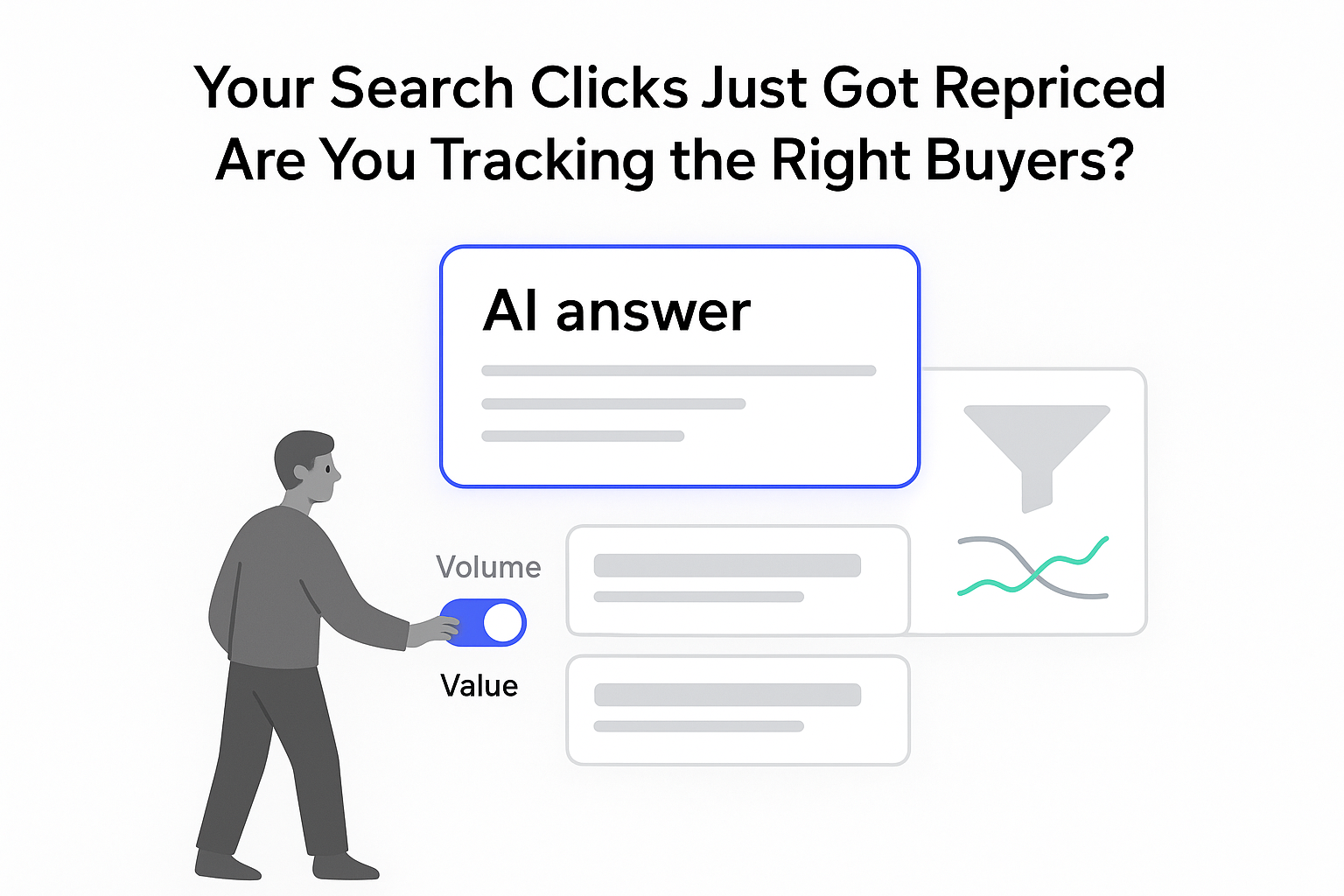
Bing's AI search update reframes where visibility and conversion actually occur: inside the AI answer layer, not on your site. The key question is whether marketers treat this as a new funnel stage with its own metrics and tactics, or cling to click-based reporting and steadily lose upper-funnel influence and demand.
AI Search Visibility: How Bing's New Signals Reprice Upper-Funnel Traffic
Bing's messaging is clear: AI search now absorbs most of the research phase, while outbound clicks shift toward later, higher-intent stages. That means impressions, citations, and placement inside AI answers start to behave like mid-funnel display or retail media views - not just "nice to have" but a separate layer of influence that your analytics currently undercount.
Key Takeaways
- Treat AI answer visibility as a distinct mid-funnel channel: citations, answer placement, and AI impressions are becoming the "viewed ad" equivalent for search, shaping preference before the click.
- Expect fewer, higher-intent organic visits from Bing AI: early research happens inside the AI experience, so top-of-funnel traffic drops while conversion rate on remaining visits rises, changing how you read SEO performance.
- Content planning must pivot from single keywords to question clusters and comparisons: the units that AI reuses are multi-sentence questions and answer patterns, not isolated phrases.
- You need instrumentation for pre-click influence: Bing Webmaster Tools and Microsoft Clarity's AI referral data give partial line of sight into how AI exposure translates into on-site behavior.
- Brands without strong review-site presence or recognizable names risk disappearing from AI answers, while publishers without a loyalty strategy face fewer pageviews per user even if they stay cited.
Situation Snapshot
Bing published a blog post, How AI Search Is Changing the Way Conversions are Measured, arguing that clicks from its AI search experiences convert better because research, comparison, and shortlisting now happen inside a single conversational environment, with outbound clicks reserved for decision-stage actions like purchase, sign-up, or demo requests [S2]. Roger Montti's Search Engine Journal article summarizes and critiques this position, while adding commentary from long-time SEO practitioner Michael Bonfils [S1], [S3].

Key points that are not in dispute:
- Bing's AI search experiences embed "high-quality content within answers, summaries, and citations," reducing the number of separate page visits during the research phase [S1], [S2].
- Bing states that people still click, but "at later stages in the journey, and with far stronger intent" [S1], [S2].
- Bing highlights three visibility signals for site owners: citations, impressions, and placement within AI answers [S1], [S2].
- Microsoft is extending Bing Webmaster Tools and Microsoft Clarity to expose AI-related referral and visibility data [S1], [S2].
- For publishers, Bing suggests success metrics like read depth, article completion, returning visitor patterns, recirculation, and email sign-ups, rather than pure pageview counts [S1].
The shared narrative: AI search is reshaping where discovery, research, and decision-making occur, and traditional click-based metrics capture a shrinking share of the buyer journey.
Breakdown & Mechanics
At a system level, Bing's model looks like this:
User query → AI aggregates multi-source content → Conversational summaries and comparisons are shown → User refines questions inside this environment → Only near-decision clicks go out to specific sites.
This differs from classic search:
User query → List of blue links → Multiple exploratory clicks to different sources → User manually compares options → Final click to transaction.
How AI repurposes and "monetizes" your content
Bing explicitly states that instead of sending users through "multiple clicks and sources," AI "embeds high-quality content within answers, summaries, and citations" [S1], [S2]. That means:
- Your content is increasingly consumed in fragments inside Bing's interface.
- The user's sense of brand familiarity is formed partly through these embedded snippets and mentions.
- Outbound clicks happen when the user already has a narrowed set of options.
From a marketing lens:
- Pre-click: your content acts like an information ad unit inside Bing's environment.
- Post-click: your site behaves more like a landing page for a pre-qualified lead than a discovery tool.
The new visibility signals: citations, impressions, placement
Bing positions three metrics as the next wave of search visibility [S1], [S2]:
- Citations - when your page is referenced as a source in an AI answer. This is akin to being quoted as an expert in a panel discussion: it signals authority and contributes to user trust.
- Impressions - how often your content, or brand, appears inside AI experiences, even without a click. This is closer to ad impressions or product shelf presence than to classic organic impressions.
- Placement in AI answers - where you appear within the AI response (primary cited source, secondary mention, supporting reference). Higher placement likely nudges click share and perceived authority.
Mechanically, these act as upstream indicators:
Visibility in AI answers → Brand familiarity and perceived authority form → User narrows options → Fewer but higher-intent clicks occur → On-site conversion rate rises.
Shift from keyword lists to question and comparison clusters
Michael Bonfils (LinkedIn profile) argues that focusing on single keywords does not match how AI search works; instead, the system builds and reuses chunks of dialogue: questions, comparisons, and structured Q&A [S1], [S3]. His framing:
- For each product or topic, the unit to target becomes a full question and its ideal answer, not just a head term.
- The FAQ set around a product category - objections, trade-offs, alternatives - feeds the AI's conversational paths.
- Optimizing means covering the question set thoroughly and consistently, so AI has little reason to source competing content for those angles.
Mechanism: rich question coverage → higher chance AI selects your content for multiple follow-up prompts → more recurring citations across a session → more brand familiarity before the user ever clicks.
Impact Assessment
Organic search and content strategy
Direction: fewer visits, higher intent; stronger rewards for expert, comparison-oriented content.
- Top-of-funnel informational clicks will decline on Bing, especially for research queries, as the AI layer answers more questions without sending traffic.
- Remaining organic sessions from Bing AI are likely to convert at higher rates, as Bing itself claims [S2], though exact uplift will vary by vertical.
- Content that covers real comparison intent ("X vs Y," "best for Z use case," trade-offs, feature differences) is more likely to be selected for AI summaries than thin, keyword-stuffed pages.
- Publishers that rely on pageview volume and ad impressions are at risk: research activity that used to yield multiple pageviews per user now collapses into a single AI session.
Needed actions:
- Map your main topics to question clusters: what people ask and compare, not just what they search. Build content that directly answers these patterns in structured ways (Q&A blocks, clear pros/cons, scenario use cases).
- Regularly check where your brand is cited inside Bing AI experiences for priority topics. If you're absent, study which domains are cited and what content format or authority they bring that you lack.
- For publishers, shift KPIs toward loyalty signals: repeat visits, email sign-ups, and depth of engagement per session, since you may get fewer sessions per user overall.
Paid search and performance marketing
Direction: more pressure on brand and shopping formats; less surface area for non-brand text ads in early research queries.
- As Bing AI answers satisfy more research queries within its environment, there is less space and attention for generic non-brand ads early in the funnel.
- Because decision-stage clicks are concentrated, brand and high-intent category terms may see stronger competition and potentially higher CPCs, as advertisers fight over a smaller set of conversion-rich queries. Actual price moves will depend on auction dynamics by vertical.
- Retail-like experiences (product cards, comparison modules) could gain relative prominence next to AI answers, acting as the transaction layer while AI handles research.
Needed actions:
- Segment Bing traffic into AI-referred vs non-AI-referred (using Clarity and referrer data where possible) to compare conversion behavior and adjust bid strategies accordingly.
- Revisit match-type and keyword strategies: over-investing in generic, research-oriented terms on Bing may return weaker value if most of that intent is now handled by AI answers.
- Coordinate messaging: ensure ad copy and landing pages align with the arguments and comparisons users just consumed in AI responses (features highlighted, key concerns, alternatives mentioned).
Analytics, measurement, and reporting
Direction: classic SEO and PPC dashboards understate your influence; pre-click AI visibility must be treated like view-through impact.
- If most research happens inside Bing AI, awareness and consideration you generate there will not appear as sessions or clicks in your analytics platform.
- Bing Webmaster Tools and Microsoft Clarity now expose some AI-related referrals and visibility metrics [S1], [S2]. These become essential for understanding your share of conversation.
- Traditional funnel views (impressions → clicks → conversions) can mislead executives into thinking search performance has deteriorated even when revenue and conversion rates are stable or improved.
Needed actions:
- Create a reporting layer that includes AI impressions, citations, and answer placement as upper-funnel indicators alongside classic impressions and clicks.
- Build simple model examples for stakeholders: for instance, "If we move from 100 visits at 2% conversion (2 sales) to 40 visits at 5% conversion (also 2 sales), traffic falls 60%, but revenue is flat while efficiency improves." Make clear that this is a model, not observed data.
- Track on-site behaviors highlighted by Bing - read depth, article completion, recirculation, repeat visits, and sign-ups - as leading indicators of long-term loyalty [S1], [S2].
Brand, reviews, and off-site presence
Direction: strong brands and review aggregators gain share; undifferentiated sites shrink.
- Bing emphasizes that AI answers combine "brand and third-party perspectives" [S2]. That favors well-known brands and review publishers with clear topical authority.
- For product and service decisions, if you are under-represented in reputable review sites or industry comparisons, AI answers will lean on others' content to describe your space.
- As a result, many smaller brands may be known only through intermediaries' descriptions inside AI answers, not through their own messaging.
Needed actions:
- Audit top review and comparison sites that Bing's AI frequently cites in your category; work on presence, data accuracy, and relationships there.
- Standardize product and service data (specs, pricing, pros/cons) so that third-party sites and AI systems both present consistent, correct information.
- For publishers, push harder on brand recognition (newsletters, communities, direct traffic) so that when AI mentions your outlet, users recognize and seek you even with fewer links.
Scenarios & Probabilities
Base scenario - AI search as a parallel mid-funnel channel (Likely)
Bing AI handles a large share of research activity for its users, reducing early-stage clicks by a noticeable but not catastrophic amount. Conversion rates on remaining visits improve. Marketers who adopt AI visibility metrics and question-driven content retain influence; others see apparent organic declines and over-react by abandoning search too early.
Upside scenario - Better conversion economics and clearer content focus (Possible)
AI search stabilizes with healthy outbound click volume to high-quality, comparison-oriented content. Bing exposes more granular AI metrics in Webmaster Tools. Marketers refine content to match real user questions and objections, gaining higher-quality leads with fewer pages. Overall customer acquisition cost falls for teams that adapt, even if raw traffic is down.
Downside scenario - Severe traffic cannibalization and consolidation (Edge)
AI search cannibalizes most informational and comparison clicks, especially on Bing-heavy demographics. Only large brands and a small group of high-authority publishers appear in AI answers. Smaller sites lose both traffic and visibility, and organic search becomes almost purely a branded and transactional play. Measurement tools remain opaque, making it hard to prove any upper-funnel value from AI exposure.
Risks, Unknowns, Limitations
- Scale of impact: Bing's market share is smaller than Google's, and adoption of AI experiences varies by region and device. The magnitude of traffic shift will differ widely across audiences.
- Opaque selection logic: we lack detailed information on how Bing's AI chooses and orders citations. That uncertainty limits any precise "AI SEO" playbook.
- Metric availability: while Bing promises AI-related metrics in Webmaster Tools and Clarity, current depth and granularity may not fully reflect your share of AI conversation.
- Cross-engine dynamics: Google's AI Overviews and other engines' approaches may follow different patterns, so strategies tuned only for Bing might not generalize.
- Model example limitations: any numeric examples in this analysis are stylized to illustrate mechanics, not real performance data; actual figures should come from your own telemetry.
Falsifiers for this analysis would include: stable or rising Bing organic traffic for research queries over time despite AI rollout; evidence that AI answer visibility does not correlate with later clicks or conversions; or major product changes where Bing reverts to more classic link-heavy SERPs.
Sources
- [S1] Roger Montti, Search Engine Journal, Dec 2025 - Article: "Pragmatic Approach To AI Search Visibility"
- [S2] Bing Webmaster Blog, Nov 2025 - Post: "How AI Search Is Changing the Way Conversions are Measured"
- [S3] Michael Bonfils (LinkedIn profile) interview, Search Engine Journal Podcast, May 2025 - Coverage in: "30-Year SEO Pro Shows How To Adapt To Google’s Zero-Click Search"
Validation: this analysis states a clear thesis, explains underlying mechanics of Bing's AI search changes, assesses channel-level impacts, outlines base, upside, and downside scenarios with likelihoods, and flags key uncertainties. Recommendations are concrete, channel-specific, and tied directly to the described product shifts and metrics.




.svg)

.svg)
.svg)