
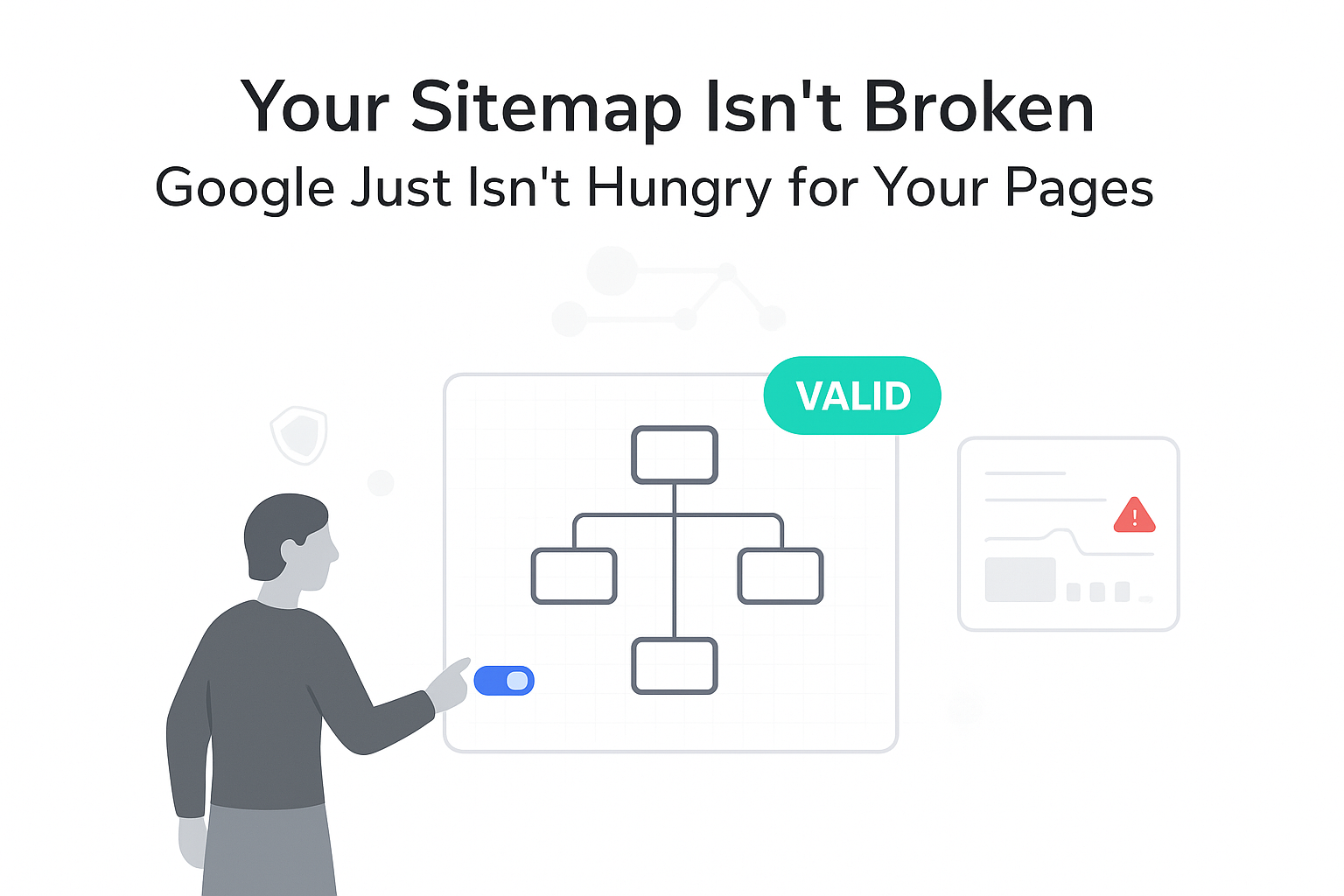
Google's response reframes many sitemap "errors" as demand and quality problems, not technical failures. If Google can ignore a perfectly valid sitemap unless it sees "new and important" content, marketers need to rethink how they interpret sitemap signals and adjust SEO strategy.

Why Google May Not Use Your Sitemap
This analysis examines John Mueller's comment that Google will only use a sitemap when it is "keen on indexing more content from the site" - and what that implies for crawl, indexation, and resource allocation for marketing teams.
Key Takeaways
- Sitemaps are conditional hints. If Google judges a site's content as low interest or rarely changing, it may ignore a technically valid sitemap. Persistent "sitemap couldn't fetch" or "sitemap could not be read" states should be treated as site-level demand signals, not just technical bugs.
- Crawl demand and perceived importance gate sitemap usefulness. Sites with thin, repetitive, or rarely updated content will see little benefit from sitemaps, even when the XML is flawless. Investment should prioritize content value, internal linking, and update cadence before micro-optimizing sitemap formats.
- Search Console messaging can mislead diagnostics. "Sitemap could not be read" can reflect Google's decision not to use a sitemap, rather than an actual fetch or parse failure. Use server logs and index coverage reports to validate Google behavior instead of relying only on Search Console labels.
- Performance marketing also depends on crawl. If product or landing pages are rarely crawled, Dynamic Search Ads, Performance Max (PMax), and organic brand coverage all suffer. Paid and organic teams should share diagnostics when new pages or categories consistently fail to gain impressions despite being listed in sitemaps.
Situation Snapshot
The trigger for this analysis is a Search Engine Journal report on a Reddit thread where a site owner saw "Couldn't fetch / Sitemap could not be read" in Google Search Console, while server logs showed Googlebot successfully retrieving the sitemap with HTTP 200 and valid XML structure [S1][S2].
Key facts:
-
The sitemap:
- Returns HTTP 200.
- Contains valid XML with
<loc>and<lastmod>tags. - Is not blocked by robots.txt or
noindex. - Shows the same near-instant "couldn't fetch" state in Google Search Console across multiple submissions over months [S1].
-
Googlebot access:
- Server logs confirm repeated, successful retrievals of the sitemap by Googlebot [S1].
-
Indexing outcome:
- A few pages submitted manually were crawled and indexed.
- Many other URLs listed in
sitemap.xmlwere not crawled or indexed [S1].
-
John Mueller's response: In the Reddit thread John Mueller explained:
One part of sitemaps is that Google has to be keen on indexing more content from the site. If Google's not convinced that there's new and important content to index, it won't use the sitemap. [S1][S2]
Taken together, this suggests the reported "fetch" problem is actually a use or trust issue: Google can fetch the sitemap but chooses not to rely on it when it perceives low value in further crawling the site.
Breakdown & Mechanics
Crawl budget and crawl demand
Crawl budget is how many URLs Googlebot is willing to fetch from a site without overloading the server. Crawl demand is how interested Google is in fetching more URLs from that site, driven by:
- Popularity signals (links, queries, user behavior).
- Content change rate and freshness expectations.
- Overall site quality and duplication levels [S3].
Mechanism: Site signals feed into a crawl-demand estimate, which shapes how much crawl budget the site receives and whether hints like sitemaps are worth acting on.
Sitemaps as hints, not commands
Google's documentation already frames sitemaps as hints for discovery and recrawl prioritization, especially for:
- Large sites.
- New URLs.
- URLs that are hard to reach via internal links [S3].
Mueller's quote adds a stricter layer: if Google is not convinced the site has "new and important" content, the sitemap hint may effectively be ignored, even when it is technically correct.
Mechanism: Sitemap is submitted, Googlebot fetches it, an internal check evaluates site-level demand and quality, and if these are low, the sitemap is de-prioritized or ignored despite being valid.
Search Console UI vs internal state
Google Search Console has to compress complex internal states into simple labels such as "Success," "Has issues," or "Couldn't fetch."
In this case, "couldn't fetch" appears to act as a proxy for "not using this sitemap," even when the HTTP fetch succeeds. That creates a diagnostic trap: site owners chase network or XML problems that do not exist instead of addressing the underlying lack of demand for more URLs from the site.
Mechanism: Internal state such as "sitemap unused due to low demand" is mapped to a generic error label, which is then misinterpreted as a technical problem.
Content "importance" filters
Mueller references "new and important content." Importance likely blends factors such as:
- Uniqueness relative to what is already indexed on the web.
- Usefulness for users compared with competing pages.
- Historical page performance and engagement.
- Site reputation and spam/quality signals (exact thresholds remain undisclosed).
Speculation (clearly labeled): It is reasonable to assume Google maintains some form of site-level quality scoring. If that score is below a threshold, the marginal value of crawling additional URLs from the sitemap is judged low, so those URLs are not scheduled for crawling.
Overall chain of behavior:
Site has mostly thin, low-uniqueness, or rarely updated content → crawl demand score remains low → Google fetches the sitemap but decides additional URLs are not a good use of resources → sitemap is not used for expanded crawling → Search Console surfaces "couldn't fetch / could not be read," even though network and XML are fine.
Impact Assessment
Organic search and technical SEO
Direction and scale
- Small and medium sites with static, generic content: Many already get full coverage through internal links. Ignored sitemaps will mainly affect new or deeper URLs. The impact is low to moderate, typically seen as slower indexation of new content that is not well linked.
- Large or fast-changing sites (news, classifieds, large catalogs): If Google stops using sitemaps on these sites due to perceived quality issues in some sections, entire clusters of URLs can remain undiscovered or stale. Impact is high in low-quality or heavily templated segments, and moderate in high-authority sections.
Winners vs losers
- Likely winners: Sites with clear, unique value per URL, strong internal linking, and regular updates, where sitemaps reinforce and accelerate existing crawl demand.
- Likely losers: Sites with thousands of boilerplate or near-duplicate pages, AI-spun content, or thin location/variant pages that depended on sitemaps to push otherwise unsupported URLs into the index.
Actions and watchpoints
- Compare sitemap URL counts with indexed URL counts in the Coverage/Pages report. Large gaps combined with "couldn't fetch" suggest a demand or quality issue, not just a technical one.
- Validate with logs: examine how often Googlebot fetches the sitemap and the listed URLs. If Google rarely touches new URLs, treat that as a content or importance signal.
- After confirming technical validity, reduce time spent on marginal sitemap tweaks (ping intervals, minor formatting changes). Focus on consolidating thin pages, improving internal linking to key URLs, and making new pages materially different from existing indexed content.
Paid search and performance media
Direction and scale
Sitemaps do not directly control Google Ads, but crawl and index patterns influence:
- Dynamic Search Ads (DSA), which rely on Google's understanding of site content.
- Performance Max (PMax) components that use landing page content to match queries and audiences.
If Google rarely crawls beyond a small subset of URLs, DSA and PMax may under-utilize deeper or niche landing pages, reducing coverage.
Who benefits or loses
- Benefit: Advertisers whose most important landing pages are high quality and well-linked. Google will keep recrawling these priority URLs regardless of sitemap state.
- Lose: Advertisers relying on thousands of thin, nearly identical landing pages fed mainly via sitemaps to gain additional coverage. If sitemaps are ignored, these pages may never meaningfully enter the ad systems' consideration set.
Actions and watchpoints
- For new landing pages, ensure discovery via internal links and feeds (product feeds, business data) as well as via sitemaps.
- Use logs to confirm whether important ad URLs are being crawled, even if they are not yet driving traffic.
- If a group of ad URLs never gains impressions despite being in sitemaps, treat this primarily as a content or quality issue. Consider consolidating into fewer, stronger pages and linking them from navigation or hub pages.
Content, product, and operations teams
Direction and scale
Mueller's framing effectively turns sitemap usage into an indirect KPI for "site worth crawling more deeply." Content teams that ship large volumes of low-differentiation pages may see whole batches effectively ignored, regardless of sitemap correctness.
Who benefits or loses
- Benefit: Teams that plan content around gaps in existing search results, focusing on unique formats, richer explanations, and clearer decision support.
- Lose: Teams that publish many slightly reworded versions of existing pages and rely on sitemaps to force them into the index.
Actions and watchpoints
- Evaluate sitemap composition by segmenting URLs by type (templates, locations, long-tail variants) and comparing crawl/index patterns by segment. Rarely crawled or indexed segments are candidates for pruning or consolidation.
- Set internal thresholds so only URLs that represent the best or canonical version of content are included in the primary sitemap.
- Place low-value or experimental sections in separate sitemaps to diagnose whether specific sections are being ignored.
Scenarios & Probabilities
These scenarios describe how this behavior may evolve and how it could affect marketers.
-
Base case - quality-gated sitemap usage becomes the norm (likely)
- Google continues to treat sitemaps as conditional hints, with site-level demand determining whether they are used.
- Search Console messaging remains coarse, and "couldn't fetch" often masks "not worth using."
- Impact: Sitemaps remain useful for high-value sites but become less effective as rescue tools for low-quality or thin content sections.
-
Upside - improved transparency and tooling (possible)
- Google refines Search Console messages to distinguish network/XML failures from "sitemap not used due to low interest."
- Google exposes clearer guidance on crawl demand signals or on how to improve sitemap usefulness.
- Impact: Technical teams waste less time on phantom errors, and content/product teams receive more actionable feedback loops.
-
Downside - harder gating and broader ignoring of sitemaps (edge case)
- Google tightens resource use further, for example if crawl infrastructure costs rise or spam volumes increase.
- More sites see entire sitemaps or large sections ignored until they build stronger authority or quality signals.
- Impact: New or small brands that depend heavily on sitemaps to get discovered face longer ramp-up times and greater pressure on link building, PR, and content differentiation.
Risks, Unknowns, Limitations
- Unknown thresholds: The exact internal scores or rules Google uses to decide that a site's content is not "new and important" enough to justify sitemap usage are not public. The weighting between content quality, authority, and change frequency is opaque.
- Single-case visibility: The primary example comes from one Reddit thread and one public comment from John Mueller [S1][S2]. While this aligns with broader messaging on crawl demand, it is still anecdotal.
- UI interpretation risk: Search Console's "couldn't fetch" label may be overloaded to cover multiple internal states (network failure, parse error, or a choice not to use the sitemap). This analysis infers from Mueller's comment that the latter sometimes applies, but the frequency is unknown.
- Temporal limits: Public Google documentation on sitemaps and crawl budget up to late 2024 already describes sitemaps as hints and emphasizes crawl demand [S3]. The 2026 reporting appears consistent with that guidance, but any undocumented changes in behavior between those dates would not be captured here.
- What could falsify this analysis: Clear confirmation from Google that "couldn't fetch" is purely a technical fetch/parse error label unrelated to content importance, or broad data showing that even low-quality or rarely updated sites consistently see full sitemap usage while still receiving that message, which would point to a pure reporting bug rather than a demand or quality gate.
Sources
- [S1] Search Engine Journal / Roger Montti, 2026 - Article: "SEO Fundamental: Google Explains Why It May Not Use A Sitemap."
- [S2] Reddit, r/SEO, 2025 - Thread: "Google Search Console sitemap couldn't be read despite successful fetch," including John Mueller's reply.
- [S3] Google Search Central documentation (pre-2024) - "Sitemaps," "Crawl budget," and related guidance describing sitemaps as hints and explaining crawl demand.







.svg)

.svg)
.svg)