
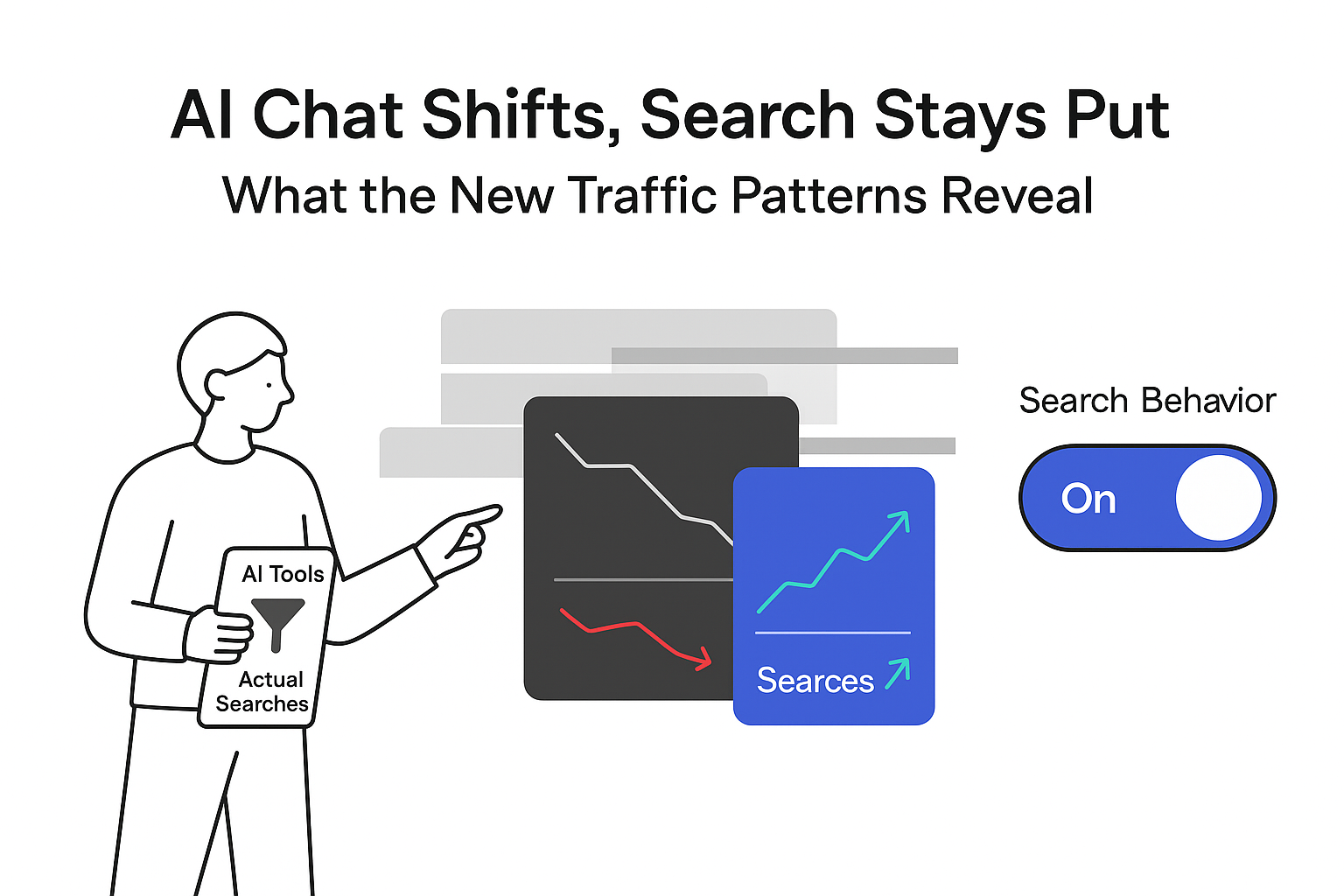
Similarweb’s January 2026 Global AI Tracker reports a measurable rebalancing in web traffic among AI chatbots and related tools: ChatGPT still dominates direct visits, but Google Gemini is gaining ground, specialized writing tools are losing traffic, and traditional search appears broadly stable year over year.
Google Gemini vs ChatGPT traffic trends in Similarweb’s AI tracker
Similarweb’s Global AI Tracker measures worldwide visits to AI-related domains, focusing on how often people go directly to these tools in a browser. In the January 2026 edition of Similarweb’s tracker, ChatGPT accounted for approximately 64-64.5% of tracked visits to generative AI chatbot sites, down from an estimated 86% a year earlier.[S1][S2] Over the same period, Google Gemini’s share rose from about 5% to 21-21.5%.[S1][S2]
In the most recent 12-week window covered, Similarweb reports that visits to Gemini’s web properties increased by 49%, while OpenAI’s ChatGPT domain traffic fell 22%.[S1] At the same time, total visits to AI tools dipped during the winter holiday period, returning to August-September levels.[S1][S2] Similarweb attributes that drop mainly to seasonality, including in commentary it wrote on X, which affects category totals but not the relative share shifts between tools.
These figures apply to browser-based, domain-level traffic and do not reflect API calls, mobile apps, or embedded assistants such as AI inside search engines, productivity suites, or operating systems.[S1][S2] As a result, they capture one important slice of AI usage - direct website visits - rather than the full landscape.
Executive snapshot and key metrics
- ChatGPT’s share of global web visits among tracked generative AI chatbot sites fell from an estimated 86% to about 64-64.5% year over year.[S1][S2]
- Gemini’s share rose from roughly 5% to 21-21.5% over the same period, with a 49% increase in visits in the most recent 12 weeks while ChatGPT traffic declined 22%.[S1]
- Other chatbots remained smaller: DeepSeek at 3.7%, Grok at 3.4%, and both Perplexity and Claude at 2.0% of tracked chatbot visits.[S1][S2]
- Writing and content-generation sites saw a 10% drop in visits over 12 weeks. Some tools posted double-digit declines (Jasper -16%, Writesonic -17%, Rytr -9%), while Originality grew 17% and Growthbarseo’s traffic fell 100%.[S1][S2]
- Developer-oriented code-completion tools showed mixed trends over 12 weeks: Bolt -39%, Cursor +8%, Replit +2%, Base44 +49%.[S1][S2]
- In disrupted sectors, traditional search traffic was roughly flat (down about 1-3% year over year), Reddit traffic increased 12%, and Quora traffic declined 53%.[S1][S2]
Implication for marketers: direct web attention around AI is concentrating in a small set of general-purpose assistants (with Gemini catching up to ChatGPT), while search queries appear relatively stable and some Q&A activity shifts toward Reddit and AI tools.
Method and source notes for the Similarweb AI dataset
The figures cited come from Similarweb’s “Global AI Tracker #6” (January 2026) and Search Engine Journal’s summary of that report by Matt G. Southern.[S1][S2]
Key measurement characteristics:[S1][S2]
- Scope - Global traffic to selected AI-related websites (chatbots, writing tools, developer tools, and “disrupted sectors” such as search and community Q&A).
- Metric - Total visits at the domain level (for example, chat.openai.com, gemini.google.com). The data shows share of visits and short-term change, not user counts or engagement time.
- Time frame - Year-over-year comparisons and a “most recent 12-week” trend window leading into January 2026.
- Channel coverage - Web browser traffic only. API usage, product integrations such as AI embedded in Android or Google Workspace, and native apps are not included.
Limitations and caveats:[S1][S2]
- The tracker does not reveal underlying visit totals, user demographics, or segment-level breakdowns such as by country or industry.
- The winter holiday period caused a category-wide dip in daily visits, which Similarweb notes brought usage back to August-September levels. That seasonality affects absolute traffic but not relative shares.
- The data is domain-based. If users migrate from web to apps or integrations for a given tool, that shift will not appear in this view.
- All percentages and growth rates here are as reported or described by Search Engine Journal from the Similarweb report. The underlying raw dataset is not publicly reproduced in full.[S1][S2]
Findings on chatbot, writing, and coding tool traffic
Gen AI chatbots - share shifts over 12 months
Similarweb estimates that, a year earlier, ChatGPT had roughly 86% of global web visits among tracked generative AI chatbot sites.[S1][S2] By January 2026, that share had fallen to around 64-64.5%.[S1][S2] In the same interval, Google Gemini’s share rose from approximately 5% to 21-21.5%.[S1][S2]
In the most recent 12 weeks covered:[S1]
- Gemini’s visits grew by 49%.
- ChatGPT’s visits declined by 22%.
Smaller but notable players included:[S1][S2]
- DeepSeek - 3.7% of tracked chatbot visits.
- Grok - 3.4%.
- Perplexity - 2.0%.
- Claude - 2.0%.
Search Engine Journal notes that Google has promoted Gemini through Android and Workspace, which could support its gains in direct web traffic if users move between those environments and the Gemini website.[S2] The tracker itself, however, only measures web visits, not in-product usage.
Writing and content-generation tools - 12-week declines
In Similarweb’s category view for writing and content-generation tools, total visits fell 10% over the most recent 12 weeks.[S1][S2] At the individual domain level:[S1][S2]
- Growthbarseo - down 100% (no visits recorded in the latest period compared with the baseline).
- Jasper - down 16%.
- Writesonic - down 17%.
- Rytr - down 9%.
- Originality - up 17%.
The dataset does not show whether this reflects users churning away from these tools, using them via integrations, or simply reducing visits during the holiday period. The only clear signal is that web traffic to specialized writing-tool domains declined during this window.
Developer and code-completion tools - mixed trends
Developer-focused tools tracked in the code-completion category moved in different directions over the same 12 weeks:[S1][S2]
- Bolt - down 39%.
- Cursor - up 8%.
- Replit - up 2%.
- Base44 - up 49%.
This suggests no single directional shift comparable to the Gemini gain versus the ChatGPT decline. Instead, individual tools show idiosyncratic patterns that may be influenced by product updates, community adoption, or migration between tools, factors not visible in the Similarweb summary.
Findings on traditional search, Reddit, and Quora traffic
Within its “disrupted sectors” view, Similarweb compares traffic to traditional search engines and community Q&A platforms year over year.[S1][S2]
For traditional search, the data shows:[S1][S2]
- Search traffic down roughly 1-3% year over year in recent periods, depending on the specific time slice.
This indicates modest softness rather than a sharp contraction in search activity in the web traffic Similarweb observes.
For key Q&A and discussion sites:[S1][S2]
- Reddit - up about 12% year over year.
- Quora - down about 53% year over year.
These movements are consistent with a pattern where some question-and-answer behavior shifts toward Reddit, AI tools, or other sources, while Quora’s domain sees a steep reduction in visits. The dataset does not attribute causes, but the magnitude of the change for Quora is notable.
Interpretation and implications for marketing strategy
This section is interpretation based on the data above, not direct reporting from Similarweb.
AI assistants and brand visibility
- Likely - ChatGPT remains the dominant web destination among AI chatbots, but Gemini is taking a material share of direct visits, rising from roughly 5% to over 21% in a year while its recent 12-week traffic grew nearly 50%.[S1][S2] For brands, that suggests user attention across AI assistants is still concentrated but no longer overwhelmingly centered on a single provider.
- Likely - Because Similarweb’s tracker excludes APIs and embedded usage, overall AI usage is almost certainly higher than the web trends indicate. The reported shares, however, still matter for where users are consciously going in a browser to ask questions or generate content.
Specialized vs. general-purpose AI tools
- Likely - The 10% decline in visits to writing-tool domains over 12 weeks, plus double-digit drops for Jasper, Writesonic, and others, suggests some user demand is consolidating into broader assistants like ChatGPT and Gemini, or into integrations in existing software.[S1][S2]
- Tentative - If this pattern holds in future tracker updates, specialized writing-only tools may face higher acquisition and retention costs relative to general-purpose chatbots that users already frequent for multiple tasks.
Developer tools
- Tentative - The mixed picture for code-completion tools (Bolt -39% versus Base44 +49%, Cursor and Replit modestly positive) points to a fragmented adoption curve rather than a clear winner.[S1][S2] For teams building around developer AI, competitive dynamics may be more tool-specific than category-wide at this stage.
Search and Q&A behavior
- Likely - A 1-3% year-over-year dip in traditional search traffic does not signal a collapse in search use within this dataset.[S1][S2] SEO and search ads remain foundational channels, while AI assistants add incremental surfaces rather than outright replacing search traffic in the near term.
- Likely - Reddit’s 12% increase alongside Quora’s 53% decline suggests that, where users shift away from traditional search listings for some queries, they may gravitate toward high-signal communities and AI outputs rather than legacy Q&A platforms.[S1][S2]
Channel mix and monitoring
- Likely - For marketing and product teams, monitoring both ChatGPT and Gemini for brand mentions, citations, and referral patterns is becoming more important as Gemini’s share grows. Even if current referral traffic from these assistants is limited, their influence on user research and perception is rising.
- Tentative - As browser-based visits move from niche tools toward a smaller group of general assistants, consolidating experimentation budgets (content formats, prompt patterns, integrations) around those high-share assistants may deliver clearer learning than spreading efforts thinly across many smaller tools.
Contradictions, gaps, and data limitations
- Web-only view - The tracker ignores API usage, mobile apps, and in-product assistants, yet much AI usage has moved into those channels. This limits conclusions about overall AI adoption. The data is best interpreted as a measure of direct website demand.[S1][S2]
- Seasonality - Similarweb notes that winter-break effects pulled daily visits for AI tools back to August-September levels.[S1][S2] That seasonal dip complicates short-term trend interpretation, especially for tools that already have smaller traffic bases.
- Lack of user and regional segmentation - The available summary does not break out results by geography, device type, or user segment. For marketers, that means any regional or vertical-specific strategy still needs to rely on first-party analytics or other localized datasets.
- Metric scope - The tracker reports percentage shares and growth rates but does not present absolute visit numbers in the public summary. Without that context, a 49% gain for one tool and a 22% decline for another cannot be translated directly into user counts or revenue impact.
- Minor internal inconsistencies - The Search Engine Journal coverage cites both 64% and 64.5% as ChatGPT’s traffic share, and 21% versus 21.5% for Gemini.[S1][S2] These are small differences that likely stem from rounding or slightly different time windows, but they illustrate the need to treat reported percentages as approximate rather than exact.
- Causal ambiguity - While Search Engine Journal notes that Google’s promotion of Gemini through Android and Workspace “may help explain” share gains,[S2] the Similarweb tracker itself does not attribute causality. Any links between product bundling and web traffic remain speculative without additional data.
Data appendix - key Similarweb AI traffic figures (as reported)
[S1][S2]
| Category / Tool | Metric / Change | Period |
|---|---|---|
| ChatGPT (OpenAI) | 86% → ~64-64.5% share of chatbot visits | Year over year |
| Gemini (Google) | 5% → ~21-21.5% share of chatbot visits | Year over year |
| Gemini | +49% visits | Most recent 12 weeks |
| ChatGPT | -22% visits | Most recent 12 weeks |
| DeepSeek | 3.7% share of chatbot visits | Latest snapshot |
| Grok | 3.4% share of chatbot visits | Latest snapshot |
| Perplexity | 2.0% share of chatbot visits | Latest snapshot |
| Claude | 2.0% share of chatbot visits | Latest snapshot |
| Writing/content tools (category total) | -10% visits | Most recent 12 weeks |
| Growthbarseo | -100% visits | Most recent 12 weeks |
| Jasper | -16% visits | Most recent 12 weeks |
| Writesonic | -17% visits | Most recent 12 weeks |
| Rytr | -9% visits | Most recent 12 weeks |
| Originality | +17% visits | Most recent 12 weeks |
| Bolt (code completion) | -39% visits | Most recent 12 weeks |
| Cursor (code completion) | +8% visits | Most recent 12 weeks |
| Replit (code completion) | +2% visits | Most recent 12 weeks |
| Base44 (code completion) | +49% visits | Most recent 12 weeks |
| Traditional search (category) | -1% to -3% visits | Year-over-year ranges |
| +12% visits | Year over year | |
| Quora | -53% visits | Year over year |
Sources:
[S1] Similarweb, “Global AI Tracker #6,” January 2026 (as summarized in public materials).
[S2] Matt G. Southern, “Google Gemini Gains Share As ChatGPT Declines In Similarweb Data,” Search Engine Journal, January 2026.






.svg)

.svg)
.svg)