
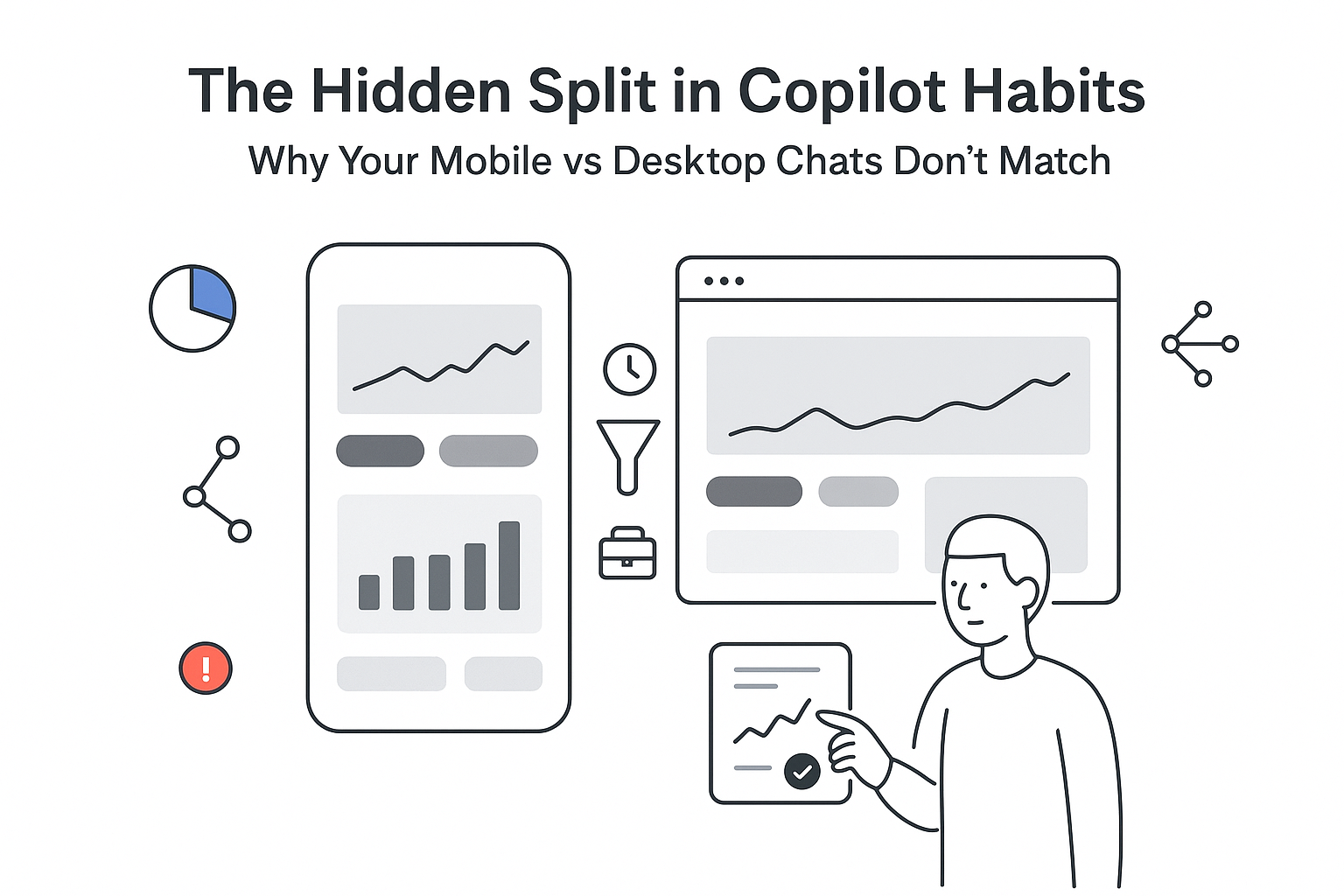
This report, "How people use Microsoft Copilot on mobile vs desktop," summarizes key usage patterns from the company’s analysis of 37.5 million consumer Copilot conversations and highlights the main implications for marketers and product leads.
How people use Copilot on mobile vs desktop: executive snapshot
- Microsoft analyzed 37.5 million consumer Copilot conversations between January and September, categorizing topics and intents with automated classifiers across devices and time of day [S1].
- On mobile, Health and Fitness is the top-ranked topic every hour of the day and every month in the dataset, with people seeking both information and advice rather than only factual answers [S1].
- On desktop, Technology is the top topic overall, but Work and Career becomes the leading topic between 8 a.m. and 5 p.m., reflecting workday-focused usage [S1].
- Education and Science topics rise on desktop during business hours, while Religion and Philosophy, relationships, and other reflective topics become relatively more common late at night and in the early morning [S1].
- Programming topics appear more during weekdays, gaming topics rise on weekends, and relationship-related queries show a sharp increase on Valentine’s Day [S1].
Implication for marketers: Copilot behavior shifts strongly by device and time, so AI-related content, campaigns, and product features benefit from being planned around specific device-time-topic combinations rather than treating "AI chatbot usage" as a single pattern [Likely].
Method and source notes on Copilot usage data
Microsoft’s analysis focuses on consumer usage of Copilot and excludes enterprise-authenticated traffic, such as Copilot inside Microsoft 365 under corporate accounts [S1]. The dataset consists of 37.5 million Copilot conversations sampled over a nine-month period from January through September (year not specified in the secondary report) [S1][S2]. Conversations are segmented by device type (mobile vs desktop) and by time of day.
To categorize conversations, the researchers used automated, machine-based classifiers for both topic (for example, Health and Fitness, Work and Career, Technology, Education, Science, Religion and Philosophy, Gaming, Relationships) and intent, and they state that no human reviewed the content of individual messages [S1]. This means all topic labels reflect model judgments about conversation content rather than direct manual coding.
The work is described as a preprint, so it has not yet completed peer review [S1]. It is also based on Microsoft Copilot specifically, using Microsoft’s internal tooling and taxonomy for classification [S1]. The Search Engine Journal article by Matt G. Southern provides a journalistic summary of the same preprint, which helps clarify scope and caveats but does not add new quantitative data [S2].
Key limitations include:
- No visibility into enterprise usage or Copilot inside Microsoft 365 under corporate licenses [S1].
- Possible classifier errors or biases and no published error rates [S1].
- Lack of demographic detail and limited regional or device-OS breakdowns [S1][S2].
- Limited transparency about sampling procedures and geographic coverage [S1][S2].
Findings on Copilot usage by device, topic, and time of day
The clearest split in the data is between mobile and desktop behavior. On mobile devices, Health and Fitness dominates as the leading topic across every hour and every month observed in the sample [S1]. The paper notes that mobile users ask about physical well-being in a way that often seeks advice, not just facts, which the authors summarize as the phone acting as a "constant confidant for physical well-being" [S1]. This suggests recurring, personal use of Copilot in a health and lifestyle context while on the phone.
On desktop, Technology is the top topic overall, but this changes once time of day is considered [S1]. During business hours (8 a.m. to 5 p.m.), Work and Career overtakes Technology as the primary topic, and Education and Science topics also increase in relative share during those hours compared with nighttime usage [S1]. This pattern matches typical office and study hours, indicating that many desktop conversations are tied to work and learning tasks.
Outside business hours, the pattern on desktop shifts toward more personal and reflective conversations. Religion and Philosophy rises in rank during late-night hours and into dawn, while other personal categories such as relationships become more prominent in relative terms [S1]. Temporal patterns also align with the calendar: programming-related conversations are more frequent on weekdays, gaming topics increase on weekends, and relationship-themed conversations spike on Valentine’s Day [S1]. Together, these observations led the authors to describe three modes of interaction: workday use, constant personal companion (especially on mobile), and introspective night use [S1].
Interpretation and implications for marketers and product leads
Device- and context-specific behavior [Likely]
The data supports the view that Copilot behavior is strongly shaped by device context and time of day [S1]. Treating "AI assistant users" as a single, homogeneous group is likely to mislead planning. For marketing and product decisions, it is reasonable to treat at least three segments as distinct:
- Mobile health and wellness seekers (health questions, exercise, diet, lifestyle support)
- Desktop work and learning users during business hours (productivity, research, professional development)
- Nighttime and weekend users seeking reflection or entertainment (philosophy, religion, relationships, gaming)
Health and wellness: mobile-first, advisory content [Likely]
For health, fitness, and wellness brands, the findings point to a mobile-first AI experience strategy, emphasizing conversational guidance, routines, and coaching-style answers rather than only static facts [S1]. AI content surfaced on mobile may benefit from clear, actionable next steps, checklists, or plan formats that align with advisory queries [Likely]. Compliance and safety guardrails remain critical, as users appear willing to ask sensitive, personal health questions in this channel [Likely].
B2B, education, and productivity: desktop and workday emphasis [Likely]
For B2B, HR, career services, and education providers, the workday desktop window (8 a.m. - 5 p.m.) appears to be the prime context for Copilot-related engagement around Work and Career and Education/Science topics [S1]. Content and campaigns aimed at skills, certifications, tools, and workplace issues are more likely to intersect with Copilot use when designed around desktop usage patterns and business hours [Likely]. This includes knowledge base content, help documentation, and structured answers that Copilot can draw from for work-related queries.
Brand and content planning around personal and seasonal topics [Tentative]
The rise of Religion and Philosophy and relationships at night, plus programming vs gaming weekday-weekend splits and Valentine’s Day spikes, indicates that Copilot mirrors everyday rhythms similar to search behavior [S1]. Entertainment, gaming, and relationship-focused products can consider scheduling content releases, social promotions, or AI-driven experiences that align with evenings, weekends, and specific cultural dates [Tentative]. Since the study does not quantify conversion or engagement outcomes, these should be treated as planning signals rather than direct performance guarantees.
Channel and UX design for AI assistants [Tentative]
The description of phones as "constant confidants" suggests that conversational flows, privacy messaging, and continuity of context may matter more on mobile, especially around health [S1]. On desktop, integrations with documents, browsers, and productivity tools likely matter more, given the focus on Work, Technology, and Education [Tentative]. For companies building on Copilot or similar assistants, this supports different UX priorities for mobile vs desktop experiences.
Contradictions, gaps, and open questions in Copilot usage research
Several important gaps limit how far these findings can be generalized. The analysis covers only consumer Copilot traffic and specifically excludes enterprise-authenticated use, so it does not represent how Copilot is used inside Microsoft 365 under corporate licenses [S1]. This means the most work-heavy use cases for knowledge workers might be underrepresented.
Topic classification relies entirely on automated models, and the report does not provide detailed error rates or inter-model agreement statistics [S1]. Misclassification could blur distinctions between, for example, Technology vs Work and Career or Health and Fitness vs general Lifestyle. Without independent validation, the exact topic shares should be treated as approximate [Tentative].
The preprint format means method choices and results have not passed independent peer review, and the public summary does not include detailed demographic, regional, or device-OS breakdowns [S1][S2]. There is no direct link to downstream outcomes such as purchases, signups, or task completion, so the study stops at behavior description rather than tying usage patterns to business performance.
The findings are specific to Microsoft Copilot during a defined nine-month period and may not generalize to other assistants, later product versions, or different interface designs [S1]. Follow-up studies that include enterprise usage, more transparency on geography and demographics, and validation against other platforms would help clarify how stable and universal these patterns are.
Data appendix: Copilot usage snapshot
Table 1 - High-level Copilot topic patterns by device and time
| Dimension | Mobile (consumer) | Desktop (consumer) |
|---|---|---|
| Top topic overall | Health and Fitness - top every observed hour/month [S1] | Technology - top overall across the dataset [S1] |
| Business hours (8 a.m. - 5 p.m.) | Health and Fitness remains dominant [S1] | Work and Career overtakes Technology; Education and Science increase [S1] |
| Evenings / late night | Health focus continues [S1] | More Religion and Philosophy and other reflective topics [S1] |
| Weekdays vs weekends | Not specified in detail [S1] | Weekdays - more programming; Weekends - more gaming [S1] |
| Key event spikes | Not specified in detail [S1] | Relationships topic spikes on Valentine’s Day [S1] |
Sources
- [S1] Microsoft, "What people do with Copilot" (preprint, Microsoft AI; analysis of 37.5M consumer Copilot conversations, January-September, year not specified in secondary report).
- [S2] Matt G. Southern, "How People Use Copilot Depends On Device, Microsoft Says," Search Engine Journal, reporting on the same Microsoft preprint.





.svg)

.svg)
.svg)