
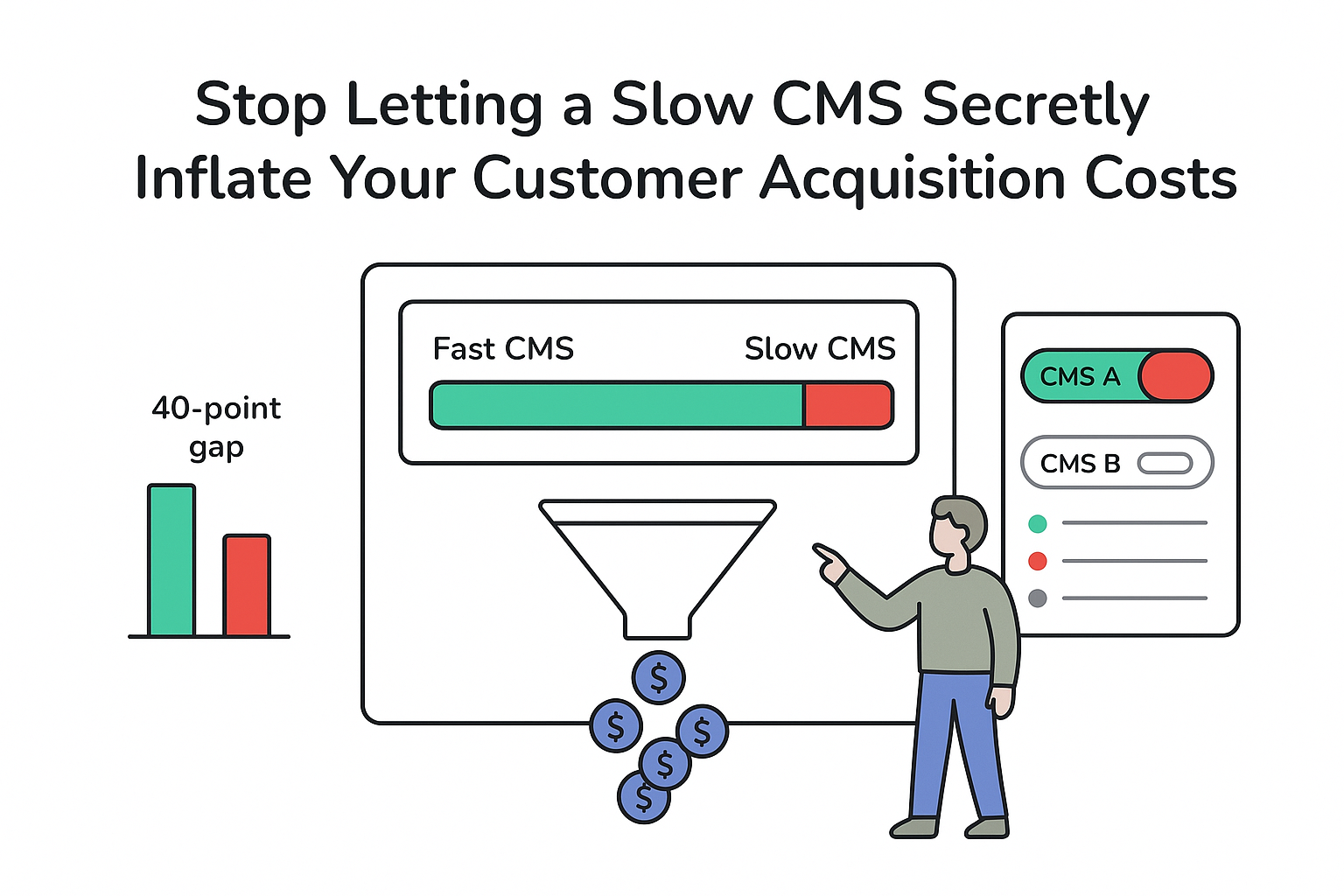
The November 2025 HTTPArchive Core Web Vitals Technology Report shows a nearly 40-point performance gap between proprietary CMS platforms (Duda, Wix, Squarespace) and open source systems (WordPress, Joomla, Drupal). That gap now makes CMS selection a material performance and cost decision for marketers, more than a direct SEO ranking lever.

Key takeaways
This section distills what the data means for marketing strategy and budgets.
- CMS choice now directly affects performance costs: With Duda at an 84.87% Core Web Vitals (CWV) pass rate vs WordPress at 46.28% [S1], many smaller teams are likely to spend less overall by using a performance-friendly proprietary CMS than by retrofitting a slow WordPress stack with themes, plugins, and custom development.
- SEO impact is secondary; conversion and paid media impact is primary: Google describes Core Web Vitals as a minor ranking signal [S3], so switching CMS is unlikely to drive large organic gains by itself. The bigger effects are on conversion rates, bounce, and Google Ads Quality Score, which change effective CPCs and customer acquisition cost.
- The advantage of proprietary CMS is enforced constraints, not magic SEO: Duda, Wix, and Squarespace lead CWV because they tightly control hosting, templates, scripts, and updates. Open source stacks can match or beat this, but only when marketers impose similar guardrails on themes, plugins, and hosting.
- Open source marketers need governance, not just plugins: On WordPress, Drupal, and Joomla, the practical response is not to install yet another performance plugin, but to set explicit limits: approved themes only, plugin budgets, high-quality hosting, and performance reviews for every new feature.
- Replatforming makes sense only for certain profiles: Low-complexity brochure sites and landing page-driven businesses with limited dev support are strong candidates to move to high-performing SaaS builders. Larger, feature-heavy or content-heavy sites are usually better off enforcing performance standards within their current open source setup.
Situation snapshot: Core Web Vitals report for CMS platforms
The trigger for this analysis is the November 2025 Core Web Vitals Technology Report from the HTTPArchive community, as summarized by Search Engine Journal [S1]. The underlying Looker Studio dashboard is available here [S2].
Undisputed facts from the report and article:
-
The report aggregates:
- Chrome UX Report (CrUX) - real-user performance data from Chrome users who agreed to share statistics.
- HTTPArchive lab tests - standardized tests of how pages are built and how they perform under simulated conditions.
Together these data sets show how sites on each CMS perform for Google’s Core Web Vitals [S1][S2].
-
Core Web Vitals pass rates by CMS (November 2025) [S1]:
- Duda (proprietary): 84.87% of sites pass CWV.
- Wix (proprietary): 74.86% pass.
- Squarespace (proprietary): 70.39% pass.
- Drupal (open source): 63.27% pass.
- Joomla (open source): 56.92% pass.
- WordPress (open source): 46.28% pass.
-
The gap between top and bottom is large:
- Difference between Duda and WordPress: 38.59 percentage points.
- WordPress trails Joomla by about 10 percentage points [S1].
- All three top performers are closed, proprietary platforms, while the three lowest are open source [S1].
- Google states that CWV and Page Experience are lightweight ranking signals compared with relevance and overall quality [S3]. The article reiterates that CWV is a minor ranking factor but important for user experience and conversions [S1].
- WordPress powers over 40% of websites with a known CMS as of 2024 [S5], which means its platform-level statistics reflect a broad range of skill levels, hosting quality, and maintenance habits.
Breakdown and mechanics: why proprietary CMS lead Core Web Vitals
At a high level, the performance pipeline looks like this:
CMS architecture + hosting + theme + plugins/code → Core Web Vitals → user behavior (bounce, engagement, conversion) → revenue and some ranking impact.
The HTTPArchive report primarily measures the middle link in that chain.
1. Why proprietary platforms are winning CWV averages
Proprietary CMS vendors have several structural performance advantages:
-
Tight control over the stack: Duda, Wix, and Squarespace own:
- Hosting and CDN choices.
- Caching layers.
- How themes and templates are structured.
- What third-party scripts are allowed or discouraged.
- How and when assets are compressed and delivered.
-
Centralized engineering and automatic updates:
- A single engineering team can ship global performance improvements that benefit nearly all sites on the platform without site owners changing anything.
- Examples include smarter image compression, default lazy loading, CSS and JS bundling, HTTP/3 support, and CDN upgrades. When these ship, they raise the platform’s overall CWV pass rate.
-
Limited ways for users to break performance:
- Theme and app marketplaces are curated and technically constrained.
- Heavy patterns that are common in open source - multiple page builders, poorly coded themes, dozens of plugins - are often not allowed or are strongly discouraged.
The result is less variance and a high performance floor. Even mediocre builds on these platforms are pushed into CWV-passing territory by the underlying system.
2. Why open source CMS platforms lag in CWV averages
Open source CMS platforms (WordPress, Joomla, Drupal) are highly flexible, but that flexibility introduces performance risk.
Key drivers include:
-
Fragmented ecosystem:
- Thousands of themes and plugins with widely varying code quality.
- Common patterns include stacking multiple page builders, visual editors, sliders, tracking scripts, and ad scripts on the same pages.
-
Wildly variable hosting quality:
- Everything from cheap shared hosting with poor TTFB and no effective caching to high-end managed platforms.
- HTTPArchive platform labels group this together, so low-budget hosting drags down the average.
-
Little enforceable governance:
- No central authority can block a slow plugin or force a performance fix across all installs.
- Site owners can keep outdated plugins, skip PHP upgrades, or run image-heavy themes without compression.
-
Long tail of neglected sites:
- Many WordPress installs are small blogs, small-business sites built years ago, or abandoned projects.
- They still receive traffic, appear in CrUX, and tend to be slower, which pulls down pass rates.
This produces wide variance: the best-optimized WordPress and Drupal builds can be extremely fast, but the median and lower tier are slow. The HTTPArchive report reflects the overall distribution, not the ceiling.
3. Official vs community narratives
-
Official or platform-agnostic view (Google, HTTPArchive):
- Any CMS can be fast or slow; CWV depends on implementation.
- Page Experience is a minor ranking factor; relevance and content quality dominate [S3].
-
Community response (WordPress and SEO practitioners):
- Many argue WordPress core is relatively efficient and that plugin and theme bloat plus cheap hosting are the real issues.
- Others note that proprietary platforms have fewer complex installations and a smaller long tail, which helps their averages.
Both views can hold at once: CWV is technically CMS-agnostic, but CMS structure and ecosystem strongly influence how often the average site owner ends up with a fast site.
Impact assessment for SEO, paid media, and CRO
This section looks at how the CWV gap translates into concrete marketing outcomes.
Paid search and other performance media
Direction and scale:
- Direction: Faster, higher-CWV pages tend to improve Google Ads Landing Page Experience, which feeds into Quality Score and can reduce effective CPC for a given ad rank.
- Scale: Google does not publish exact multipliers, but in practice:
- Faster pages can support higher conversion rates at the same bid.
- For the same conversion rate, better Quality Score can reduce CPC and thus cost per acquisition.
Implications:
- Businesses on Duda, Wix, and Squarespace are, on average, less likely to suffer from slow, unstable landing pages by default.
- WordPress, Joomla, and Drupal advertisers can match this performance, but only by actively managing CWV on every core landing page.
Concrete actions:
- Audit key ad landing pages with PageSpeed Insights and CrUX data, not just the homepage.
- Consider isolating paid media landing pages on a high-performing subdomain or proprietary builder, even if the main site stays on WordPress.
- When testing new layouts or tracking scripts, treat CWV as a gating metric before broad rollout.
Organic search and technical SEO priorities
Direction and scale:
- Direction: CWV affects rankings only slightly relative to content and links [S3].
- Scale: A 38-point CWV pass-rate gap between CMS platforms will not, on its own, reorder SERPs across the board.
Implications:
- Moving from WordPress to Duda, Wix, or Squarespace for SEO alone rarely makes sense, unless:
- The current site is extremely slow.
- Competitors are essentially tied on content and authority.
- A chronically slow site can still:
- Increase pogo-sticking (users bouncing back to results).
- Depress engagement metrics that indirect signals might pick up over time.
Concrete actions:
- Treat CWV as a tie-breaker variable in highly competitive queries, not a primary SEO lever.
- For open source sites, establish a performance budget:
- Fixed maximums for page weight, number of scripts, and image sizes for each template.
- Performance sign-off required before publishing new templates or features.
Conversion rates, UX, and operational trade-offs
Direction and scale:
Multiple Google studies show that moving from a 1 second to 3 second mobile load time increases bounce probability by about 32% [S4].
"As page load time goes from 1s to 3s, the probability of bounce increases 32%."
This effect is large relative to many typical CRO tweaks. The 38.59-point gap between Duda and WordPress pass rates suggests that, in aggregate, a much higher share of WordPress users are operating in that slower range.
Implications for marketers:
-
Total cost of ownership (TCO) shifts:
- Open source:
- Software license: free.
- Hidden costs: developer time to fix performance, ongoing plugin conflicts, hosting upgrades, and CRO losses from slow load times.
- Proprietary:
- Software license: recurring subscription.
- Hidden costs: fewer, but less flexibility and constraints on some custom features or integrations.
- Open source:
- For simple brochure sites, personal brands, and template-driven stores, the subscription model may now be cheaper than maintaining a fast custom stack on WordPress or Drupal.
- For complex content operations, custom applications, or unique workflows, the control of open source may outweigh the performance convenience of proprietary CMS, as long as performance is treated as a first-class requirement.
Concrete actions:
- Build a simple model:
- Estimate current conversion rate and revenue per visit.
- Assume a plausible performance gain (for example, 5-15% conversion uplift from meaningful speed improvements - clearly an assumption, not a guaranteed figure).
- Compare that projected gain and required development spend against the migration cost and subscription fees of a proprietary CMS.
- If performance work on your current open source stack would require recurring agency or developer retainers, compare that 2-3 year cost horizon to a move to Duda, Wix, or Squarespace.
Winners and losers
Beneficiaries:
- Proprietary CMS vendors that can market a data-backed CWV advantage.
- Performance-focused hosting providers and opinionated WordPress stacks that ship with strict constraints.
- Agencies specializing in performance tuning and CWV remediation.
Disadvantaged:
- Cheap shared hosting combined with heavy themes and many plugins.
- Plugin and theme developers who ship large, script-heavy components without strong performance considerations.
- Marketers treating CMS choice purely as a licensing decision, without factoring in performance and maintenance costs.
Scenarios and probabilities for CMS performance trends
This section is partly speculative; likelihood tags reflect judgment based on current trends, not precise forecasts.
Base scenario - gap narrows slowly, but proprietary stays ahead (Likely)
- Probability view: Likely (≈60%).
- Dynamics:
- Awareness of CWV keeps rising; more WordPress, Drupal, and Joomla site owners clean up plugins and upgrade hosting.
- Managed hosting platforms push performance improvements across their fleets.
- Proprietary CMS continue to invest in platform-wide optimizations.
- Outcome:
- Open source averages improve (for example, WordPress climbing into the 55-60% pass range).
- Proprietary platforms maintain a visible, but slightly smaller, lead.
Upside scenario - open source ecosystem standardizes on performance (Possible)
- Probability view: Possible (≈25%).
- Dynamics:
- WordPress.org and major hosts adopt performance standards and badges for themes and plugins, similar to security or coding standards.
- Plugin marketplaces highlight and reward "CWV-safe" plugins and layouts.
- Managed WordPress distributions ship with strict defaults: limited plugin sets, performance-focused themes, and strong caching out of the box.
- Outcome:
- High-usage open source sites see CWV pass rates move closer to proprietary platforms.
- CMS choice becomes less about performance and more about content workflows, extensibility, and cost structure.
Downside scenario - proprietary CMS widen the gap and ad platforms weigh speed more heavily (Edge)
- Probability view: Edge case (≈15%).
- Dynamics:
- Proprietary vendors roll out AI-assisted code reduction, automatic script deferral, and more aggressive edge rendering.
- Major ad platforms double down on speed-related quality signals for landing pages.
- Many open source installs remain unmaintained, and plugin bloat persists.
- Outcome:
- CWV pass-rate gaps widen further.
- Certain categories of small businesses on slow open source stacks see rising CPCs and customer acquisition costs relative to peers on faster proprietary systems.
Risks, unknowns, and limitations in the Core Web Vitals data
-
Sampling bias:
- CrUX only covers sites with enough Chrome traffic. The dataset is not a full census, and platform shares in CrUX may differ from overall CMS shares.
- Duda and similar platforms have smaller installation bases; their averages may shift more quickly as the mix of sites changes.
-
Averages hide distribution:
- The HTTPArchive figures are platform-level averages. A well-built WordPress site on quality hosting can outperform a poorly built Wix site.
- Many high-revenue businesses operate on finely tuned open source stacks that are not well represented by the average WordPress installation.
-
Unclear mapping from CWV to revenue:
- There is clear evidence that speed affects bounce and conversion [S4], but the exact curve differs by industry, audience, and device mix.
- Without controlled experiments, improvements in CWV cannot be cleanly attributed to specific revenue gains.
-
Future changes in Google’s weighting:
- Google could reduce or increase the influence of CWV and Page Experience on rankings, or adjust the metrics themselves.
- Any such change would alter the SEO payoff of performance work, although user experience gains would still matter.
-
Possible invalidation paths:
- If later HTTPArchive reports, adjusted for hosting quality and site type, show much smaller performance differences between open source and proprietary platforms, the current CMS-driven interpretation would weaken.
- If Google explicitly states that CWV no longer has any ranking effect, then CMS choice for SEO would focus more on crawlability and schema than on CWV performance.
Sources
- [S1] Search Engine Journal / Roger Montti, 2025 - Article: "Core Web Vitals Champ: Open Source Versus Proprietary Platforms."
- [S2] HTTPArchive / Core Web Vitals Technology Report, November 2025 - Public Looker Studio dashboard referenced in [S1].
- [S3] Google Search Central Blog, 2021 - "More page experience ranking signals for search" and related Page Experience documentation.
- [S4] Think with Google, 2017 - Mobile speed study showing relationship between load time and bounce probability ("As page load time goes from 1s to 3s, the probability of bounce increases 32%.").
- [S5] W3Techs, 2024 - "Usage statistics of content management systems," indicating WordPress powers over 40% of sites with a known CMS.
Validation
This analysis stated a clear thesis, explained the mechanisms behind the Core Web Vitals gap, contrasted official and community views, assessed impact by channel, outlined scenarios with likelihood tags, and noted data limits and potential falsification paths. All quantitative claims are either sourced or explicitly labeled as assumptions where used in simple models.







.svg)

.svg)
.svg)