
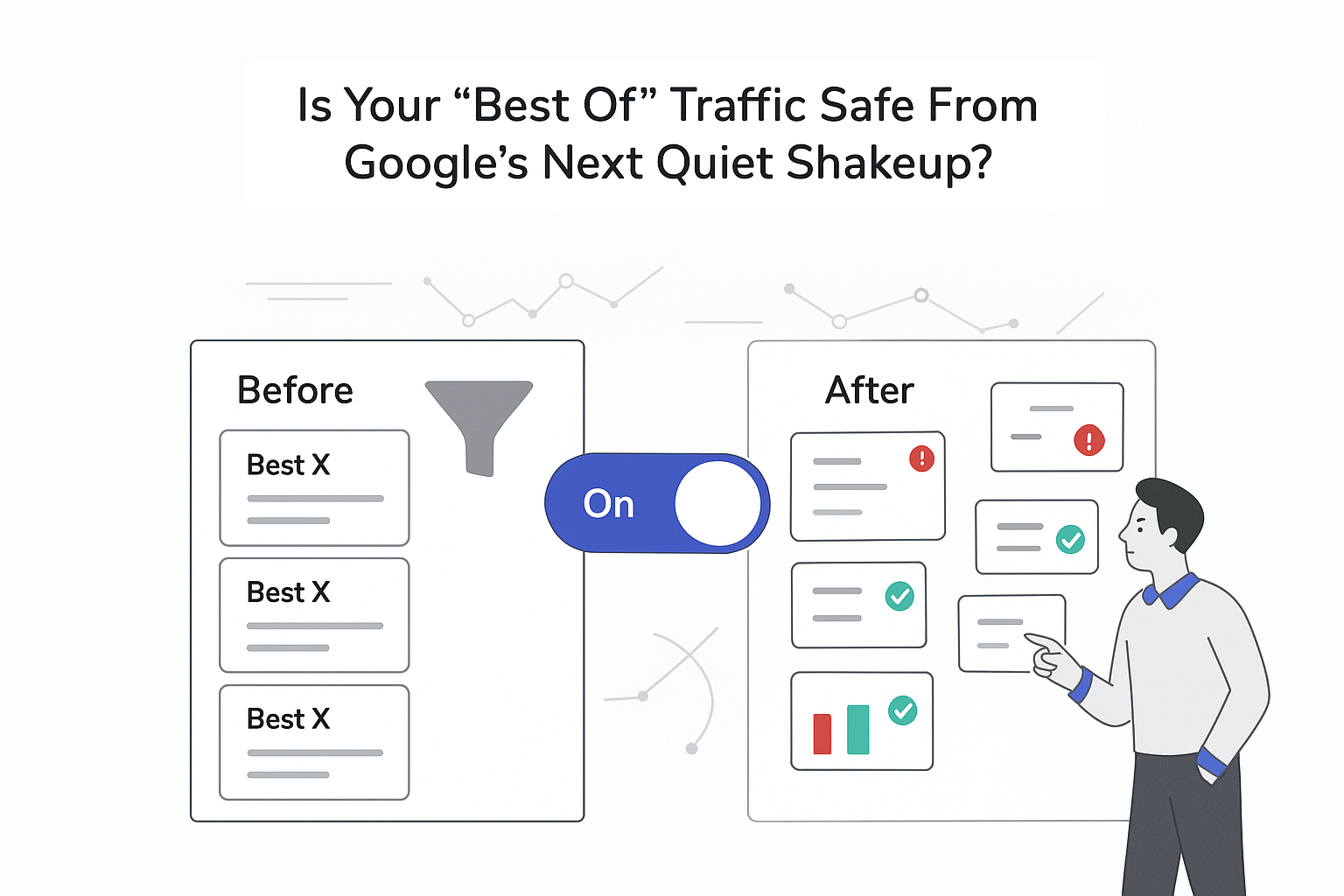
Google’s December 2025 core update appears to extend a long-running shift: commercial and mid-funnel queries that once favored generalist publishers, aggregators, and large retailers are being reassigned to brands and narrow specialists. The key question is whether this is a short-term spike or a durable reordering of who can win "best of" and category queries - and how marketers should respond in SEO, content, and paid media planning.
Key takeaways from the Google December core update
- Google is treating many "best of" and mid-funnel product queries as more commercial, which pushes brand and specialist category pages above publisher guides. Marketers should expect fewer easy SEO wins from generic listicles.
- Narrow, category-focused brands and software providers gained visibility at the expense of broad retailers, SaaS platforms, and generalist news sites. Budgets should shift toward deep category hubs, not broad horizontal coverage.
- For news and media, heavier reliance on Google Discover means volatility during core updates now has outsized traffic and revenue impact. Executives should treat Discover exposure as a high-risk channel, not a guaranteed baseline.
- Paid search and Shopping performance on mid-funnel terms will be reshaped by organic changes: brands that now win more unpaid visibility can rebalance spend, while losing retailers and publishers may push bids up on critical category terms.
- Over the next 12-24 months, the safest position is clear topical specialization plus strong product or subject authority. Generic "best X" coverage without clear expertise is likely to keep eroding.
Situation snapshot for brands, retailers, SaaS, and publishers
The December 2025 core update ran from December 11 to December 29, 2025. Google described it as a routine core quality update without calling out specific verticals or ranking factors, consistent with Google’s guidance on core updates [S7].
Independent analysis from Aleyda Solís, who published an analysis on LinkedIn, highlights a consistent pattern across multiple sectors [S2]:
- Publications and guides: Generalist publishers lost "best of" and broad comparison queries (for example, "best Steam Deck games," "best coop games," "upcoming video games") to brand or platform catalogs such as Nintendo and Epic Games [S1][S2].
- Online retail: Large multi-category stores such as Macy’s lost positions for mid-funnel queries like "winter boots women," "winter coats," and "men’s cologne," while specialist brands and category-focused retailers (Columbia, The North Face, Fragrance Market) gained [S1][S2].
- SaaS and software: Non-specialist SaaS platforms and business publications (Zapier, Adobe, CNBC) declined for terms like "accounting software for small business" and "sole trader accounting software." Specialist accounting tools with focused landing pages (FreshBooks, Xero) rose [S1][S2].
News publishers showed heavy volatility across multiple Google surfaces. Will Flannigan shared SISTRIX data showing major India-based outlets (Hindustan Times, India Times, Indian Express) losing visibility in U.S. search results [S1][S3]. Glenn Gabe, as Gabe wrote on LinkedIn, reported sizable swings for publishers on Google Search, Google News, and Google Discover, including steep Discover traffic drops for some outlets [S1][S4].
NewzDash data shared by John Shehata suggests the mix of traffic that news publishers receive from Google has shifted: Google Web Search’s share of traffic from Google surfaces to news sites fell from roughly 51% to 27% over two years, while Discover’s share rose [S1][S5]. This does not prove causation for the December update, but it shows why Discover volatility has become more painful.
Google’s Topic Authority system for news, launched in 2023, is explicitly designed to surface expert sources for "newsy" topics by favoring specialized outlets over generalists [S6]. The December patterns align with that direction of travel.
Breakdown and mechanics of Google’s December core update
At a high level, the update appears to change how Google matches three things: query intent, site-level topical depth, and commercial vs. informational content types. The likely mechanics:
1. Query intent reclassification for "best of" and mid-funnel terms
Many "best X" queries were historically treated as informational research. Evidence from Aleyda Solís’s examples indicates more of these are now evaluated as mixed or primarily commercial. That leads to a different ranking pattern:
- Old model: "best winter boots women" → seen mostly as research → publisher roundups and generalist guides rank.
- New model: same query → seen as shopping or comparison with buying intent → brand and specialist category pages rank, with product grids and filters.
Illustrative cause-effect chain:
User query "best X" → intent model predicts high probability of near-term purchase or download → systems favor pages with product inventory, structured data, reviews, and clear commercial relevance → brands and specialists outrank generalist guides that lack direct product control.
2. Stronger weighting for narrow topical authority
In online retail and SaaS, brands and category specialists already send strong, consistent signals around a specific product line or business function. The update appears to give more weight to:
- Concentrated coverage of a category (for example, outdoor gear only, accounting software only).
- Entity associations that link a brand tightly to that category (via links, mentions, structured data).
- Historic performance for related head and long-tail terms.
Generalist retailers, broad SaaS suites, and horizontal publications spread authority across many topics. Under a model that rewards concentrated expertise, they lose some share on category terms even if their overall domain authority is high.
3. Interaction with news Topic Authority and surface-specific systems
For news, Google runs separate but related systems for Web Search, Top Stories, Google News, and Discover. Topic Authority explicitly prioritizes outlets with depth in a subject area (for example, local government, health, finance) [S6].
The December update seems to have rebalanced:
- Which outlets are considered "go-to" sources by topic and region.
- How often those outlets appear across multiple surfaces at once.
Illustrative cause-effect example:
Publisher with broad, general coverage and limited depth in any single beat → Topic Authority scores weaker in discrete areas → less presence in Top Stories or Discover for those beats → combined with core quality updates, net visibility and traffic can swing sharply.
All of this happens without Google explicitly coding "brands now win." It emerges from changes to intent models and authority weighting that favor properties with direct product control and topic depth.
Impact assessment across organic search, paid media, and news
This section focuses on practical channel-level effects and likely response moves for marketers.
Organic search and content strategies after the December update
For brands and specialist retailers or SaaS vendors, the update opens more mid-funnel search real estate:
- Category and solution pages that clearly map to common "best X" and "[category] for [use case]" queries have more upside.
- Product-driven content (feature comparisons, buyer guides hosted on brand domains) now competes more directly with third-party review sites.
For publishers, affiliates, and review sites, the economics of "best X" content shift:
- If a "best X" page drops from position 2 to 7, its click-through rate might fall from roughly 15-20% to 3-5%, based on common industry CTR curves. This is a modeled assumption, not site-specific data. That can translate into a 60-80% traffic loss for that URL.
- Sites heavily reliant on generic "best" roundups across many categories face compounded risk, as multiple pages see this pattern at once.
- Surviving strategies likely include deeper vertical focus (for example, only gaming, only enterprise software), proprietary testing or scoring frameworks, and content that adds value beyond what a vendor page can reasonably publish (for example, cross-brand comparisons, negative findings, total-cost-of-ownership analysis).
For horizontal SaaS platforms and business media, broad "software for small business" queries now favor category specialists. That pushes horizontal players toward:
- Owning brand-modified queries (for example, "[platform] accounting features") and cross-workflow stories.
- Building sub-brand or microsite experiences with real depth in high-value functions (for example, finance, HR, CRM) if they want to compete on unbranded category terms.
Paid search, Shopping ads, and mid-funnel keyword costs
Changes in organic rankings typically influence auction dynamics in paid channels:
- Brands and specialists that now rank higher organically for mid-funnel queries (for example, "winter boots women," "accounting software small business") may see improved blended CPA. Many will be able to reallocate part of their paid budget from defensive bidding on those terms to either higher-intent queries or upper-funnel discovery campaigns.
- Generalist retailers and publishers that lost organic share have an incentive to compensate through paid search and Shopping. That added competition can raise CPCs on key category and comparison terms.
Speculation:
If a mid-funnel keyword previously averaged a $1.80 CPC with three serious bidders and now attracts two more aggressive competitors that lost organic coverage, a 20-30% CPC uplift (for example, to $2.20-$2.35) is plausible. Actual numbers will vary by vertical and auction.
For affiliate and review publishers, losing organic "best X" placements reduces their ability to monetize via affiliate links. Some may increase paid activity to remain in contention, but for many the unit economics of buying mid-funnel traffic and monetizing through affiliate commissions are weak. Expect a shake-out where only the most efficient operators can justify paid amplification.
News SEO, Google Discover, and Topic Authority signals
News and media businesses are exposed on two fronts:
- Traffic mix shift: With Google Web Search’s share of Google-driven traffic dropping from roughly 51% to 27% and Discover’s share rising [S5], any algorithmic shock to Discover now has enterprise-level implications.
- Specialization bias: Topic Authority and related systems reward depth in specific topics. Generalist outlets without clear beats, or with thin coverage in high-value areas, risk losing out to focused competitors.
Illustrative impact model:
- A publisher receives 10 million monthly pageviews from Google: 7 million via Discover, 3 million via Web Search.
- A Discover visibility drop of 40% during an update reduces Discover traffic to 4.2 million.
- Total Google-sourced traffic falls from 10 million to 7.2 million - a 28% decline - before considering any changes on Web Search or Google News.
Operationally, this pushes newsrooms toward:
- Clear topic prioritization (beats where they can genuinely be seen as "expert"), supported by consistent, high-quality coverage.
- Reducing dependency on Google traffic in financial plans, with more emphasis on direct, newsletters, apps, and alternative platforms.
Scenarios and probabilities for future Google core updates
Base case - specialization trend continues (likely, roughly 60-70%)
- More "best X," "[category] ideas," and "[category] for [use case]" queries are treated as commercial or mixed intent.
- Brand and specialist category pages hold or grow share on these terms.
- Generalist publishers and retailers face a long-term decline in generic product recommendation visibility unless they narrow focus or create standout, in-depth resources.
Upside case - partial rebalancing toward information quality (possible, roughly 20-30%)
- Google refines intent classification where user behavior signals show information needs outweigh commercial ones (for example, "best open source X," "best productivity methods").
- High-quality, investigative, or methodology-rich guides from publishers regain some "best X" visibility where vendor pages underperform on user satisfaction metrics (engagement, long clicks, minimal pogo-sticking).
- Brands still dominate clear shopping queries, but publishers stabilize or recover in more research-heavy segments.
Downside case - further compression for third-party commercial content (edge, roughly 10-15%)
- Future core updates and AI-generated answer boxes take more screen real estate above the fold on commercial queries.
- SERPs display more direct brand cards, comparison modules, and AI overviews, pushing independent review content below the fold or to page two.
- Affiliate and comparison publishers lose a large share of commercial-intent organic inventory, accelerating consolidation or business model pivots.
All probabilities are judgment calls based on current signals and may shift as more data emerges.
Risks, unknowns, and limitations in this analysis
- Sample bias: Early observations come from a limited set of verticals and sites highlighted by Aleyda Solís, Will Flannigan, Glenn Gabe, and NewzDash [S2-S5]. Large-scale data across thousands of sites could reveal counter-examples.
- Attribution complexity: It is difficult to fully separate the December core update from other recent Google updates (helpful content, spam, and others) without detailed site-level data and longer time series. Some observed changes may be cumulative effects.
- Intent modeling opacity: The argument that queries were reclassified as more commercial is inferred from ranking outcomes, not confirmed by Google. Alternative explanations (for example, new link or content quality thresholds) could also contribute.
- Paid search impact estimates: CPC and CPA examples are illustrative only. Real auction dynamics depend on Quality Scores, budgets, ad formats, and vertical competition.
- News volatility drivers: While Topic Authority and specialization are plausible drivers for news volatility, other factors (for example, spam controls, regional policy, personalization changes) could be involved.
This analysis would be materially weakened or disproven if:
- Large, independent datasets showed generalist publishers and broad retailers gaining, or at least maintaining, share on "best X" and mid-funnel queries post-December.
- News publishers with clear topical focus and strong Topic Authority scores also experienced sharp, lasting declines that cannot be explained by other signals.
Sources
- [S1] Search Engine Journal / Matt G. Southern, Jan 2026, News article - "December Core Update: More Brands Win ‘Best Of’ Queries."
- [S2] Aleyda Solís, Dec 2025, LinkedIn post - early analysis of December core update impact across publications, retail, and SaaS.
- [S3] Will Flannigan, Dec 2025, LinkedIn post - SISTRIX visibility data showing India-based news publishers losing U.S. search visibility.
- [S4] Glenn Gabe, Dec 2025, LinkedIn posts - observations on December broad core update volatility across news, Google News, and Google Discover.
- [S5] NewzDash / John Shehata, 2024, LinkedIn post - shifts in traffic share to news publishers from Google Web Search vs. Discover over two years.
- [S6] Google Search Central Blog, May 2023, product explainer - "Understanding news topic authority."
- [S7] Google Search Central, ongoing documentation - "What site owners should know about Google’s core updates."





.svg)

.svg)
.svg)