
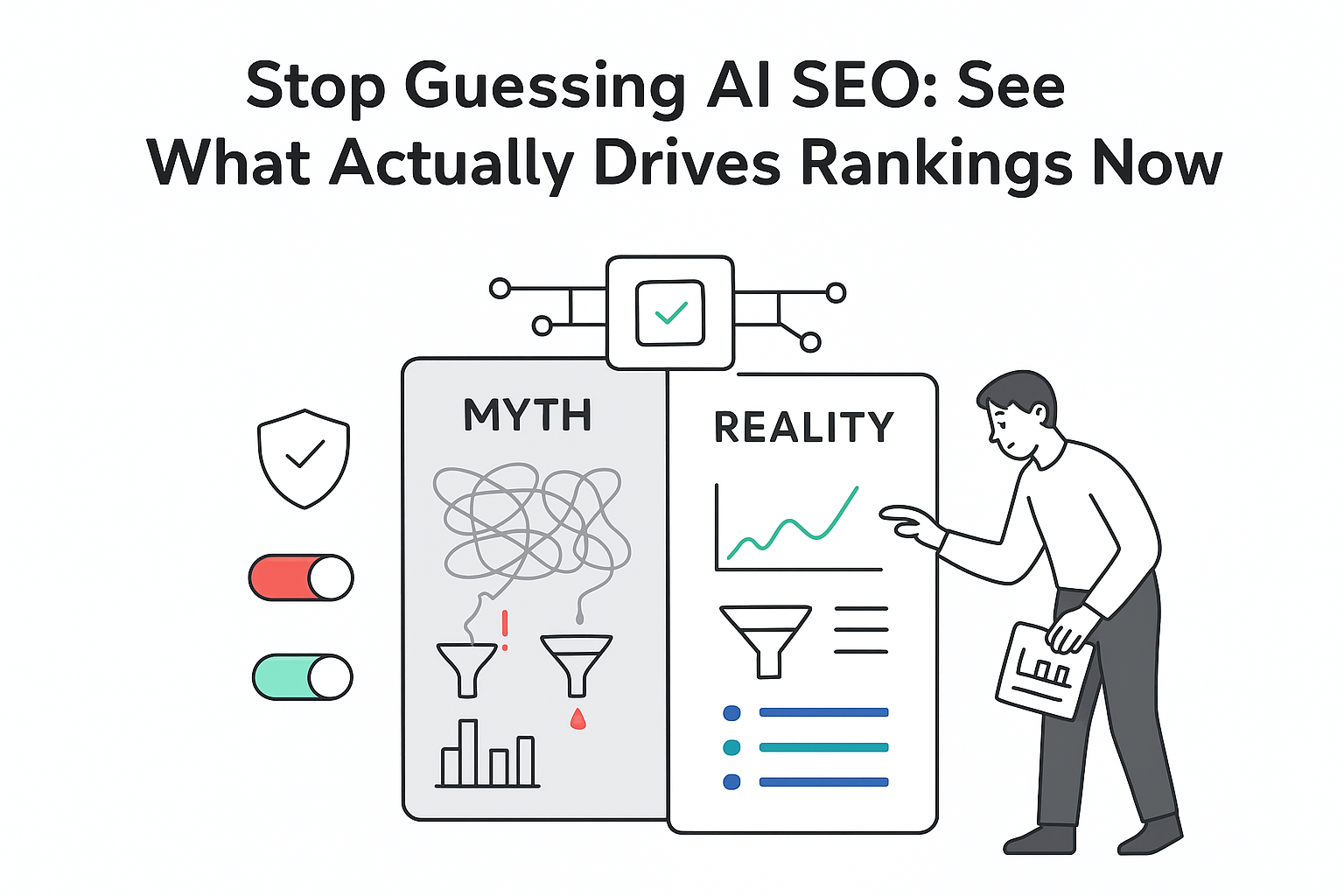
Between late 2025 and January 2026, search professionals and major platforms publicly clarified their positions on SEO, generative engine optimization (GEO), and answer engine optimization (AEO). Representatives from Microsoft, Google, and independent experts outlined how AI search systems select and rank content. Their statements show where long-standing SEO techniques overlap with newer AEO and GEO concepts.
SEO, GEO, and AEO: Key Details
Discussions about GEO and AEO often question whether they differ meaningfully from traditional SEO work. Harpreet Singh Chatha of Harps Digital used X to list GEO and AEO "myths" for marketers to drop in 2025, shared on his X profile. His examples included concepts such as "LLMs.txt," paid "chunk optimization," and declaring that SEO is dead.
SEO practitioner Greg Boser (LinkedIn profile) argued on X that the field should keep the SEO label while redefining its meaning. He tweeted this perspective, suggesting that the "E" in SEO should stand for "Experience" and that new acronyms for GEO or AEO are unnecessary. His comments frame AI era work as a continuation of existing SEO principles.
In October 2025, Microsoft Advertising published a blog post on optimizing content for inclusion in AI search answers. The company advised that successful content should remain fresh, authoritative, well-structured, and semantically clear. Microsoft also restated the importance of crawlability, metadata, internal links, and backlinks as fundamentals for AI visibility.
Microsoft's post stated that AI search continues to rank content but focuses on specific pieces of information instead of entire pages. This aligns with comments from Perplexity AI's Jesse Dwyer, who described "sub-document processing" for granular snippet indexing. Both descriptions contrast with older approaches that indexed and ranked whole documents.
In January 2026, Microsoft released a separate AEO and GEO explainer focused heavily on shopping use cases: From discovery to influence: A guide to AEO and GEO. The guide outlined how AI driven experiences surface products, influence discovery, and connect to performance advertising formats. Search Engine Journal coverage noted rising expectations that commercial publishers may benefit most from AI answer environments.
Background Context on SEO, GEO, and AEO Claims
Critics of GEO and AEO argue that many promoted tactics mirror established SEO methods, such as answer style content. They point to structured content, short paragraphs, and schema markup as existing SEO practices, not separate GEO activity.
Some experienced practitioners report frustration with agencies marketing GEO services while showing limited prior SEO experience. They say many GEO case studies simply repackage typical on-page improvements.
Googlers including Danny Sullivan and John Mueller have repeatedly said that standard SEO remains valid for AI Overviews. They describe AI generated answers as relying on existing ranking systems and search results, rather than on separate GEO requirements.
Separate analysis from Search Engine Journal has argued that agentic AI will treat many informational sites primarily as data sources. According to that coverage, such systems could weaken publisher branding inside aggregated AI answers.
Source Citations and Official Materials
The current discussion draws on several public statements from platforms and search professionals. Key official sources include the following items.
- Microsoft Advertising blog "Optimizing your content for inclusion in AI search answers" - October 2025.
- Microsoft Advertising guide "From discovery to influence: A guide to AEO and GEO" - January 2026.
- Harpreet Singh Chatha's X profile, where he listed AEO and GEO myths for 2025.
- Greg Boser's X post proposing "Search Experience Optimization" as an updated reading of SEO.






.svg)

.svg)
.svg)