
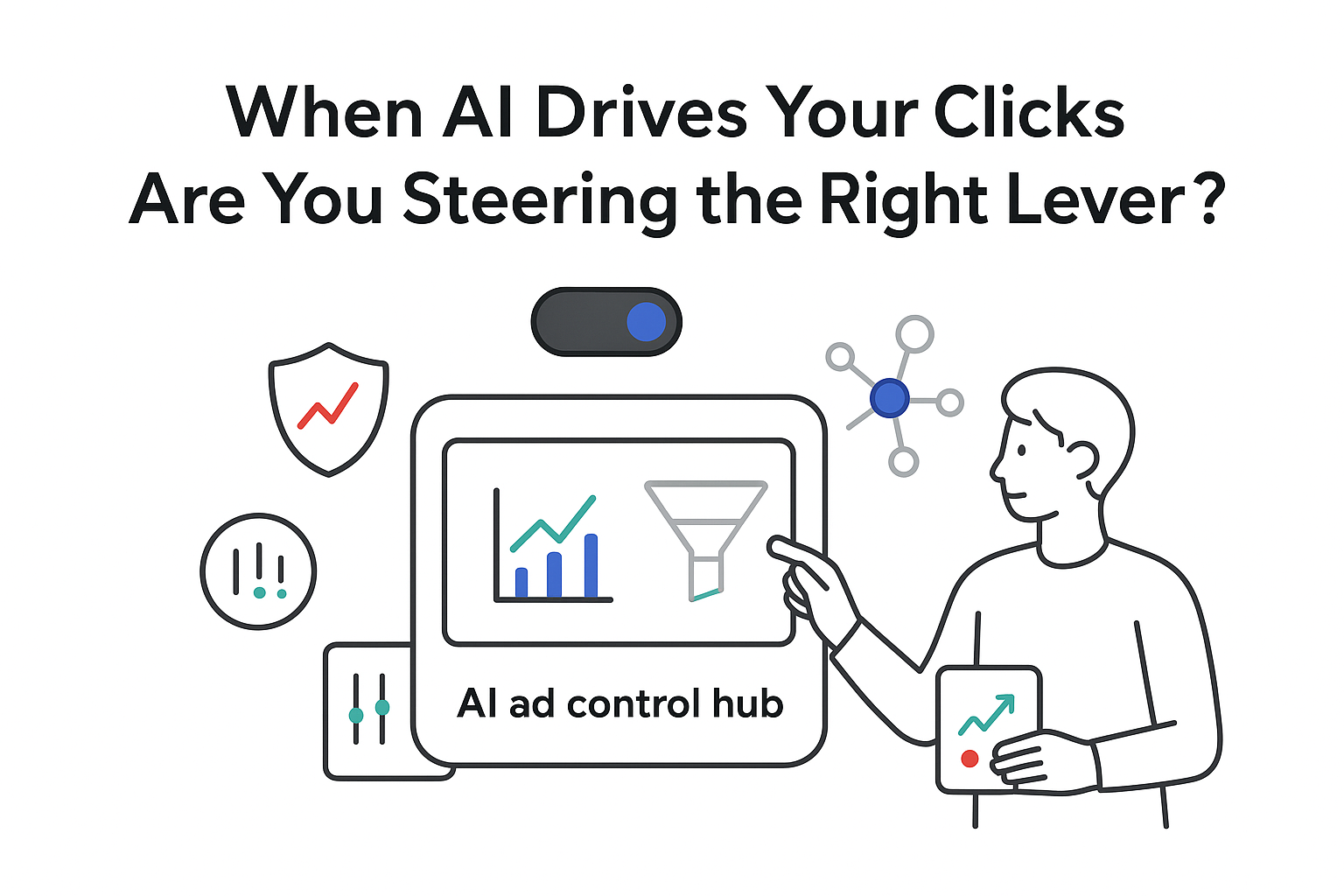
Google’s 2025 Year in Review, which details the year's major updates, points to a clear thesis: Google is turning PPC into an AI-directed system where human value shifts from manual controls to data quality, creative strategy, and smart constraint-setting. The question for 2026 is not "should I use automation?" but "how do I guide it better than my competitors?"
Google 2025 Year in Review PPC: Key Takeaways
Google’s 2025 recap and related releases show a coordinated move toward AI-led planning, bidding, and creative, with more guardrails for advertisers than in previous years [S1][S2].
-
Search is being rebuilt around AI surfaces, not just blue links
Ads in AI Overviews, AI Mode, and AI Max signal that Google is shifting revenue toward conversational and summary-style experiences [S1][S2]. For marketers, mid-funnel search and "research mode" queries become more addressable, which likely changes keyword portfolios, messaging, and how you budget between generic vs brand terms.
-
Automation now expects human constraints, not blind trust
Smart Bidding Exploration, PMax channel controls, full Search terms, and expanded negatives move Google away from "just feed the machine" toward "set smart boundaries and let AI operate inside them" [S2]. Teams that define clear targets and exclusions will usually see lower waste than those who simply switch everything to AI Max/PMax and wait.
-
Creative volume and variation become performance levers, not nice-to-haves
With Asset Studio and Nano Banana Pro, Google is structurally reducing the cost of image and video production [S2]. The accounts that win will be those that treat creative testing as a core budgeting line, not leftover capacity.
-
YouTube, Demand Gen, and App campaigns are positioned as growth engines
Shoppable CTV, Demand Gen with product feeds, and improved iOS Web-to-App measurement all push spend into upper and mid-funnel Google inventory [S1][S2]. Expect relative CPC/CPM efficiency here in 2026 while classic keyword search becomes more competitive.
-
Measurement is being re-centralized inside Google’s stack
Meridian MMM, Data Manager, and Web-to-App tracking encourage advertisers to use Google’s view of incrementality and data consolidation [S1][S2]. This can improve decision speed but risks over-indexing on one platform’s accounting of value.
Situation Snapshot: Google Ads 2025 AI-driven changes
This analysis is based on Google’s 2025 Year in Review for ads and performance, summarized in detail by Brooke Osmundson on Search Engine Journal [S1][S2].
Undisputed from those materials:
- Google shipped AI-centered changes across Search (AI Overviews, AI Mode, AI Max), YouTube (Shoppable CTV, Cultural Moments, sports lineups), Demand Gen, Performance Max, App campaigns, and Merchant Center [S1][S2].
- Automation and reporting updates: Smart Bidding Exploration with flexible ROAS targets, PMax channel-level reporting and full Search terms, negative keyword lists, device targeting, and more granular audience controls [S2].
- Creative and workflow: Asset Studio and Nano Banana Pro for image/video generation, improved ad previews, Ads Advisor, and Analytics Advisor for guided campaign setup and analysis [S2].
- Measurement and data: expanded iOS Web-to-App acquisition measurement, Meridian MMM, Data Manager, and Google tag gateway for data quality and consolidation [S1][S2].
- Google reports performance lifts tied to specific features, such as:
- Smart Bidding Exploration delivering an average 18% increase in unique converting query categories and a 19% conversion lift when flexible ROAS targets are used [S2].
- Demand Gen seeing a 26% increase in conversions per dollar after more than 60 AI-powered updates [S2].
These points establish that 2025 was less about single features and more about a coordinated shift: AI is now embedded in targeting, bidding, creative, and measurement across the Google Ads stack.
Breakdown & Mechanics: how Google’s 2025 PPC updates shift incentives
-
Search monetization is moving into AI interfaces
Mechanic: AI Overviews + AI Mode + AI Max → More inventory in summary/conversational layers → Ads injected into those experiences → Higher share of search revenue from non-traditional SERP layouts [S1][S2].
Effect:
- Advertisers can now reach users during longer, research-heavy query chains that previously had little or no paid inventory.
- Traditional keyword matching weakens; Google’s systems infer intent from broader context and query clusters.
-
Automation is being paired with "guardrail controls"
PMax and Smart Bidding:
- Channel reports, Search terms, asset-level insights, device targeting, and negatives mean performance can be steered rather than only observed after the fact [S2].
- Smart Bidding Exploration’s flexible ROAS targets allow controlled expansion: set a core ROAS, plus a range within which the system can seek new converting query categories [S2].
Mechanic: More structured constraints → Models explore within defined corridors → More predictable spend distribution and fewer "mystery" placements.
-
Creative is now an input, not just a wrapper
Asset Studio and Nano Banana Pro shift creative from an external bottleneck to an in-platform variable [S2].
Mechanic: Cheaper creative iteration → More assets per ad group/campaign → More combinations for Google’s systems to test → Higher odds of finding winning formats and angles, especially in PMax, Demand Gen, and YouTube.
This also pushes advertisers toward visual storytelling even in traditionally text-heavy categories.
-
Measurement upgrades aim to recover signal loss from privacy changes
Expanded iOS Web-to-App tracking closes a long-standing gap where web campaigns drove app installs and in-app actions but did not receive credit, especially post-ATT [S2].
Meridian’s open-sourced MMM template plus Data Manager encourage more model-based attribution anchored in Google’s own signals [S1][S2].
Mechanic: Better modeled linking of touchpoints → Smart Bidding and automated campaigns see more conversions → AI optimizers can justify higher bids where value was previously invisible.
-
Official narrative vs practitioner experience
Official Google line: AI + automation = easier, more efficient, more creative advertising; reported double-digit conversion gains support this [S1][S2].
Community summary (per Osmundson and shared practitioner feedback):
- Appreciation for new controls (PMax transparency, better negatives, channel reports).
- Frustration with unpredictable AI Overviews appearances and sometimes inconsistent creative outputs from Asset Studio [S2].
- Ongoing skepticism about relying entirely on Google’s measurement (Meridian vs independent MMM).
The mechanics point toward the same conclusion: Google is balancing revenue growth from AI surfaces with just enough advertiser control to keep sophisticated teams engaged.
Impact Assessment for paid search, YouTube, app growth, and creative
Paid Search & Shopping / PMax
Direction: Higher automation, more mid-funnel coverage, better controls.
-
Effect size:
If Smart Bidding Exploration’s reported 19% conversion lift holds in practice, a campaign spending $5,000 per month at a $50 CPA (100 conversions) could move to about 119 conversions at the same spend, pulling CPA down to roughly $42 (around 16% lower) [S2].
Google’s 18% increase in unique converting query categories suggests broader reach with controlled ROAS tolerance [S2].
-
Winners:
- Advertisers with strong first-party data and clear ROAS bands that can be widened slightly to find growth.
- Brands comfortable blending Search, Shopping, and PMax under a single performance framework.
-
Those disadvantaged:
- Teams reliant on tight exact-match keyword control; their influence shifts from query-level to target- and constraint-level.
- Highly regulated categories where AI-written or AI-mutated creative is risky; they must spend more time on approvals.
-
Actions / watchpoints:
- Use Smart Bidding Exploration first on non-brand search where there is headroom, keeping a conservative ROAS floor while expanding the upper bound.
- Segment PMax into at least "Prospecting" vs "Existing customers" so new channel and Search term reports can inform budget shifts instead of blended results.
- Monitor AI Overviews and AI Mode entry points for your core categories via structured query logging; treat these as distinct mid-funnel placements in planning, not as ordinary search impressions.
YouTube, Demand Gen, and upper-funnel reach
Direction: More shoppable, more event-based, more performance-oriented.
-
Effect size:
Google reports a 26% increase in conversions per dollar for Demand Gen after more than 60 AI updates [S2]. At a constant $10,000 monthly spend, that equates to moving from 1,000 to 1,260 conversions and lowering CPA by around 21%.
-
Winners:
- Brands with clear product feeds and creative suited to short-form video and image layouts.
- Advertisers willing to treat YouTube and Demand Gen as performance channels, not only for awareness.
-
Those disadvantaged:
- Marketers stuck on last-click reporting; much of the incremental value appears in upper-funnel touches and modeled conversions.
-
Actions / watchpoints:
- Use Demand Gen experiments to run A/B tests against existing remarketing or Discovery-style setups, using the same budgets and audiences for clean comparisons.
- For Shoppable CTV, pilot with limited geos or high-value launches where you can justify higher CPMs and then track assisted conversions through Analytics Advisor.
App campaigns and iOS measurement
Direction: Better visibility from web to app, more confidence in bidding for value events.
-
Effect size:
Hard numbers are not shared beyond the qualitative claim, but the impact is structurally large for app-first businesses that previously saw missing iOS conversions [S2].
-
Winners:
- App marketers who rely on web search and PMax to feed their install funnel and then monetize in app.
- Finance and BI teams that need clean LTV and cohort forecasting by source.
-
Those disadvantaged:
- Web-only advertisers see little direct gain here and may face more competition from app advertisers who can now justify higher bids.
-
Actions / watchpoints:
- Implement the new Web-to-App measurement as early as possible, then shift bid strategies from install volume to value-based in-app actions where sample sizes allow.
- Rebuild channel ROAS models for iOS traffic after a few months of data, since historical under-attribution will make older numbers look artificially weak.
Creative, workflow, and organizational design
Direction: Creative is industrialized; the bottleneck shifts from production capacity to strategic direction.
-
Effect size:
While there is no single percentage, the main gain is lower time and cost per creative variant, especially for small teams [S2].
-
Winners:
- Lean teams that can quickly brief Asset Studio, then filter and refine outputs against brand standards.
- Organizations that integrate media and creative planning, since ad preview tools now make joint review easier.
-
Those disadvantaged:
- Brands with very strict visual rules or luxury positioning; AI outputs may be inconsistent or off-brand, forcing manual correction [S2].
-
Actions / watchpoints:
- Define internal rules: which campaigns can use AI-generated visuals, which require studio-grade assets, and what approval steps apply.
- Use Nano Banana Pro for volume testing (thumbnails, variants), but keep cornerstone brand moments on human-designed creative, at least until AI quality stabilizes for your category.
Measurement, MMM, and analytics operations
Direction: Google wants to become the main source of truth for incrementality and data consolidation.
-
Winners:
- Teams currently lacking any MMM or consistent data warehouse; Meridian and Data Manager give them a starting framework [S1][S2].
-
Those disadvantaged:
- Advanced advertisers already running independent MMM across Google, Meta, Amazon, etc., who now must reconcile different modeling outputs.
-
Actions / watchpoints:
- Use Meridian as one input, not the only referee; compare its recommendations against external models or controlled tests where possible.
- Standardize naming and conversion schemas across Google Ads, GA4, and other channels before relying heavily on Data Manager outputs.
Scenarios & probabilities for Google Ads strategy in 2026
Base case - AI-guided, constraint-driven PPC (Likely)
- AI Max and PMax continue to gain share of search and shopping budgets.
- Ads in AI Overviews and AI Mode remain secondary but steadily grow as mid-funnel placements.
- More advertisers adopt flexible ROAS ranges, leading to moderate CPA improvements where data quality is good.
- YouTube and Demand Gen hold their position as the main incremental growth channels within Google’s ecosystem.
Upside case - Performance lift outpaces cost inflation (Possible)
- Reported conversion lifts from Smart Bidding Exploration and Demand Gen generalize, so many advertisers see low double-digit improvements in conversions per dollar.
- Creative tools mature, reducing off-brand output issues; adoption accelerates among larger, brand-sensitive advertisers.
- iOS Web-to-App measurement restores enough signal that app advertisers significantly increase Google Search and PMax budgets.
Downside case - AI surfaces cannibalize profitable search and add noise (Edge)
- AI Overviews and AI Mode absorb a large share of informational queries but fail to convert at expected rates.
- Advertisers chase these surfaces because they are new, pushing CPCs up without equivalent revenue gains.
- Meridian and similar tools over-credit Google touchpoints; marketers over-allocate spend and later face board-level scrutiny when independent checks disagree.
Speculation: The base case is the most plausible path, but in categories where user journeys are very research-heavy (finance, B2B SaaS, complex healthcare), the downside scenario for AI surfaces has a higher probability because intent is harder for models to interpret cleanly.
Risks, unknowns, and limitations in this 2025 PPC analysis
- AI Overviews and AI Mode triggers remain opaque - There is limited public data on exactly which queries surface AI Overviews, the share of traffic they represent, and how ad inventory is prioritized within those modules [S2]. Better third-party tracking could either validate or challenge the importance of these placements.
- Self-reported lifts from Google - The 18–19% Smart Bidding and 26% Demand Gen performance figures come from Google’s own reporting, likely based on selected test groups [S2]. Independent audits or broad-based case studies could confirm or reduce these figures.
- Creative quality variance by category - Asset Studio performance may differ sharply between, for example, fashion and industrial B2B; current commentary is mainly anecdotal [S2]. Systematic testing across sectors is lacking.
- MMM and attribution comparisons - Meridian’s recommendations have not yet been widely compared against long-running independent MMM for the same brands. Conflicting findings could materially change how much weight advertisers give to Google’s models.
- Limitations of this analysis - This assessment relies primarily on Google’s Year in Review summary and Osmundson’s article [S1][S2]. It does not incorporate proprietary account-level performance data, and any projections for 2026 are conditional on macro factors (overall ad demand, regulation, competitive moves by Meta/TikTok/Amazon) that could shift.
Evidence that would challenge this analysis includes: large-scale studies showing no net performance gain from these AI features, stable or declining Google ad revenue from Search while AI surfaces grow, or advertiser surveys showing reduced rather than increased satisfaction with control and transparency.
Sources
- [S1] Google, 2025, Blog - "Year in Search / Year in Review 2025" (ads and AI product recap, as referenced).
- [S2] Brooke Osmundson, Search Engine Journal, 2025, Article - "What Google’s 2025 Year in Review Tells Us About the Future of PPC."
- [S3] Search Engine Journal, 2025, Article - "Google AI Overviews Appear on 21% of Searches: New Data" (usage context for AI Overviews, as cited in [S2]).
- [S4] Search Engine Journal, 2025, Article - "It’s Official: Google Launches AI Max for Search Campaigns" (feature description, as cited in [S2]).
- [S5] Search Engine Journal, 2025, Article - "Google Demand Gen Campaigns Just Got a Major Update" (Demand Gen enhancements, as cited in [S2]).
- [S6] Search Engine Journal, 2025, Article - "PPC Pulse: Nano Banana Pro Image Animation & the Top PPC Influencers" (Nano Banana Pro capabilities, as cited in [S2]).
- [S7] Search Engine Journal, 2025, Article - "Google Expands iOS App Marketing Capabilities" (iOS Web-to-App measurement improvements, as cited in [S2]).
Validation: This analysis states a clear thesis, explains mechanisms behind Google’s 2025 changes, assesses impacts by channel, outlines scenarios with likelihoods, and flags key risks and data gaps, all grounded in cited sources and quantified examples where possible.





.svg)

.svg)
.svg)