
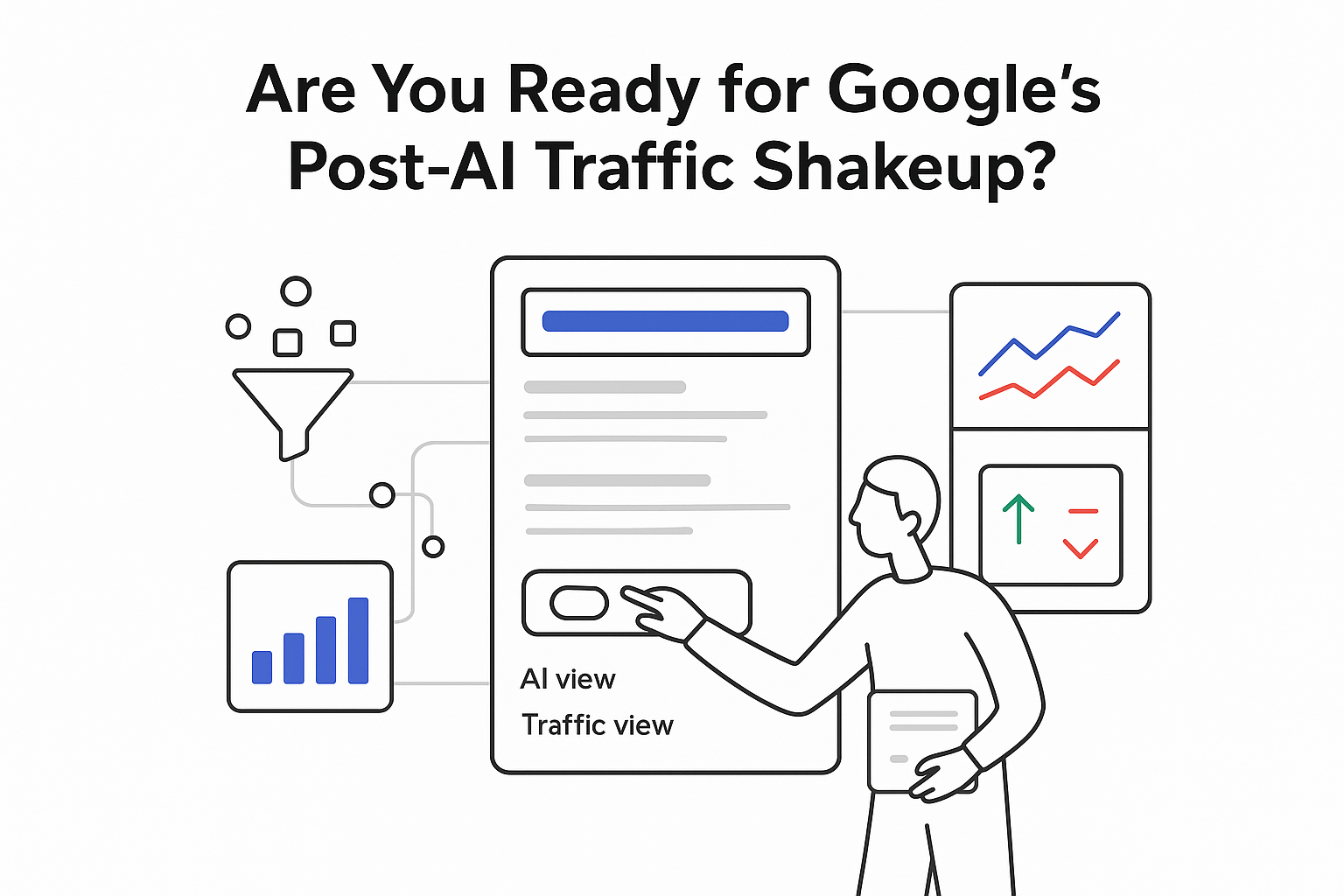
How "information ecosystem is richer than AI" shapes Google's search and AI roadmap
Google's CEO is publicly repositioning AI as one tool inside a broader "information ecosystem," not as a complete replacement for search or human experts. For marketers, the question is what this signals about how Google will treat search, AI answers, and reliability - and how SEO, PPC, and content strategy should adjust.
Sundar Pichai's repeated claim that "the information ecosystem has to be much richer than just having AI technology" [S1] is more than media spin. It reflects Google's need to maintain three things at once: user trust, ad revenue, and a healthy supply of web content that its models can draw from. For marketers, that points to a hybrid future: AI-generated summaries layered on top of search, grounded in external sources such as your site, with human experts still needed to anchor trust-sensitive topics.
Key takeaways
- Expect a hybrid search experience, not a full shift to AI chat: Google will keep classic search central and use AI as a summarized layer, so SEO and PPC remain core but will compete with AI modules for attention.
- Reliability and "grounded" answers raise the bar for authority: content from identifiable experts, with clear sourcing and up-to-date facts, is more likely to be used as grounding for Gemini and similar features.
- Informational organic traffic is the main pressure point: AI summaries will absorb part of early-stage research traffic, so brands should prioritize high-value queries and design content that still earns clicks beyond the answer box.
- Paid search will follow users into AI experiences: expect new ad formats in conversational and AI-assisted search; brands that adapt creative and measurement for those flows will capture share while CPC markets reprice.
- Marketers should treat AI outputs as a volatile layer: build owned authority (brand, experts, first-party data) knowing that Google is distancing itself from guarantees about AI truthfulness.
Situation snapshot
The trigger for this analysis is a BBC interview where Sundar Pichai responds to questions about AI reliability and Google's responsibility for transformer models. A BBC News social post on November 18, 2025 summarized his stance as "Don't blindly trust what AI tells you," a framing several outlets echoed [S1][S2]. Pichai, however, emphasized a broader view:
- Generative AI models predict likely next tokens; they are not direct sources of truth.
- Google is "working hard" to ground Gemini answers in real-world information using Google Search as a tool [S1].
- Current AI systems are "prone to some errors," so people should "use these tools for what they're good at and not blindly trust everything they say" [S1].
- He stresses that "truth matters" and that journalism, teachers, doctors, and other experts remain vital parts of the information ecosystem [S1].
These remarks align with Google's public positioning of AI Overviews and Gemini as assistive layers on top of Search, not full replacements [S3].
Breakdown and mechanics - how Google blends AI with the wider information ecosystem
The mechanics Pichai describes can be summarized as:
- User submits a query.
- Gemini or another LLM receives the query.
- The model uses Google Search as a tool to fetch current, high-quality pages.
- Retrieved documents are used to ground the model's answer.
- AI generates a synthesized response, often with citations or links.
This architecture serves several incentives at once:
- User trust: By tying AI outputs to current search index data and premium sources, Google can reduce some hallucinations and show evidence, which is critical for health, finance, and civic topics.
- Business model: Search remains the "spine" that supports ads, shopping units, and downstream clicks. If AI fully replaced search clicks, Google's primary revenue engine would be at risk.
- Content supply: Models depend on a steady flow of public web content. If AI cannibalized traffic so aggressively that publishers lost business models, the quality of training and grounding material would erode over time.
Pichai resists attempts to isolate AI from this context, repeatedly returning to "the information ecosystem" [S1]. For marketers, that means Google sees AI not as a separate product that lives instead of search but as a layer that depends on, and reshapes, existing search behavior.
From a marketer's point of view, the cause-and-effect chain looks like:
- Google manages risk and incentives.
- AI is tightly coupled with Search and external sources.
- AI experiences answer more questions directly while still citing sites.
- Click patterns and value per visit shift for both organic and paid traffic.
Impact assessment - marketing consequences of Google's information ecosystem framing
Pichai's comments point to directional changes rather than a hard break. Below, impacts are organized by channel.
Paid search and performance media
Pichai's focus on AI as an assistive layer suggests that commercial intent will still be captured through query-driven experiences, but more of those journeys will be conversational or task-based. Users may ask multi-step questions ("compare," "outline," "plan") where AI orchestrates information and then proposes actions.
Near-term likely effects:
- Impression and click shifts: Some generic and exploratory queries that currently trigger standard text ads may move into AI-style interfaces. Ads will appear as sponsored suggestions or product cards within those flows, potentially with fewer but more contextually relevant placements.
- Pricing changes: If AI-driven sessions concentrate high-intent users and filter out lower-value clicks, average CPCs on remaining inventory could rise, while conversion rates might improve. For planning purposes, a plausible modeling assumption is a 10-20% decline in low-intent impressions paired with a 5-10% lift in conversion rate on AI-augmented surfaces for commercial queries.
- Measurement strain: Pathways will look less like linear "query - ad click - session." Instead, users may interact with several AI answers before clicking. Attribution models that rely on last non-direct click will distort the real contribution of early AI-assisted touchpoints.
In the short term, larger advertisers with experimentation budgets will benefit. Smaller accounts that do not monitor query-level shifts or new formats may see gradual performance changes without clear explanation.
Organic search and content strategy
The strongest direct signal for SEO is Pichai's insistence on grounding and on the continuing importance of experts. That points to three themes:
- Authority and sourcing: Pages with clear authorship, credentials, and primary data are more attractive as grounding material than generic, rephrased summaries. This is consistent with earlier E-E-A-T guidance but gains weight when AI is searching for "safe" evidence to quote.
- Traffic mix pressure: AI summaries will likely answer basic informational questions on-page, especially "what is" and quick fact queries. If 30-40% of a site's organic traffic currently comes from such queries, and AI reduces clickthrough on those by, say, 25-35%, total organic sessions could fall by roughly 8-14%. Revenue impact may be smaller if those visits have low transaction rates.
- Depth and differentiation: Since AI can already synthesize surface-level information, content that only rephrases known facts will generate little incremental value. Detailed comparisons, proprietary research, and opinionated frameworks from named experts will be harder for models to replace and more likely to attract users who click beyond the AI box.
Likely winners: brands with strong expertise signals and original material. Likely losers: thin affiliates, anonymous content farms, and sites whose value proposition is basic aggregation.
Brand, PR, and subject-matter authority
Pichai's repeated mention of teachers, doctors, and journalists positions human experts as the reference point for truth-sensitive information, not AI models [S1]. For marketers this implies:
- Visibility beyond clicks: Being cited or paraphrased in AI answers may influence perception even when users do not click. While systematic tracking of such mentions is limited today, high-authority brands and experts are more likely to be used as examples or sources.
- Reputation risk management: Since Pichai stresses that AI can be wrong, regulators and the public are being primed to see AI outputs as probabilistic, not guaranteed. Brands in regulated sectors should assume that some fraction of users will still attribute AI misinformation to the underlying company mentioned or to Google. Monitoring for harmful or inaccurate AI mentions becomes a brand safety task.
- Owned channels as anchor: As platform answers get more synthesized, brands need clear, trustworthy hubs (reference pages, FAQs, expert explainers) that act as the "single source of truth" for their category claims. These hubs support both human users and the grounding systems Pichai describes.
Scenarios and probabilities - how this might evolve
Base case - Hybrid search with gradual AI share growth (Likely)
Probability: ~60%. AI Overviews and Gemini-style answers expand across more markets and query types, but classic SERP layouts remain common. Informational clickthrough declines modestly; commercial search and ad revenue remain strong enough that Google does not rush a complete redesign. SEO becomes more focused on authority content and high-value queries; PPC adapts to new formats but keeps similar budgets.
Upside for marketers - Slower AI rollout, stronger click preservation (Possible)
Probability: ~25%. Quality issues, political pressure, or legal risk push Google to limit AI on sensitive or ambiguous queries. AI answers carry clearer source links and encourage deeper reading. In this case, well-optimized informational content still receives significant traffic, and brands that already invested in E-E-A-T style signals gain.
Downside - Aggressive AI default with sharp organic loss (Edge)
Probability: ~15%. Google makes AI responses the primary interface for most queries, with full-page conversational views and limited organic visibility. Clicks concentrate on a small set of "read more" links and sponsored content. Organic traffic for many sites falls sharply, while paid units move inside AI flows. Brands with flexible budgets and strong creative testing adjust; others see rising acquisition costs.
(These probabilities are judgment-based speculation, not measured forecasts.)
Risks, unknowns, limitations
- Lack of public metrics: Google has not published comprehensive data on how AI Overviews or Gemini-style grounding change CTR, dwell time, or ad interaction by query type. Any traffic impact figures above are model-based assumptions, not direct measurements.
- UI and policy volatility: Small interface changes (placement of links, size of AI box, disclosure text) can shift behavior significantly. Google is still iterating on these, especially across regions and categories.
- Source selection criteria: While E-E-A-T and quality rater guidelines give clues, the exact rules for which pages are used as grounding sources are not fully disclosed. That limits the ability to design content precisely for AI inclusion.
- Regulatory and legal shocks: Court cases or new rules around AI liability, copyright, or competition could force Google to slow or even roll back features Pichai describes.
- Time lag in data: This analysis uses public statements and patterns visible up to late 2024. The BBC interview adds direction but not hard numbers; actual 2025 performance data may alter these conclusions.
Evidence that would challenge this analysis includes clear data showing AI experiences significantly boosting, rather than suppressing, organic clicks on informational queries, or Google formally committing to strict, verified accuracy standards for AI outputs, which would change its risk calculus.
Sources
- [S1] Roger Montti / Search Engine Journal, 2025, article - "Google CEO Sundar Pichai Says Information Ecosystem Is Richer Than AI."
- [S2] BBC News, 2025, interview - Sundar Pichai on AI, Gemini, and reliability (referenced and summarized in a BBC social post).
- [S3] Google, 2023, blog post - "A new way to search with generative AI" (overview of early Search Generative Experience and AI Overviews design and objectives).




.svg)

.svg)
.svg)