
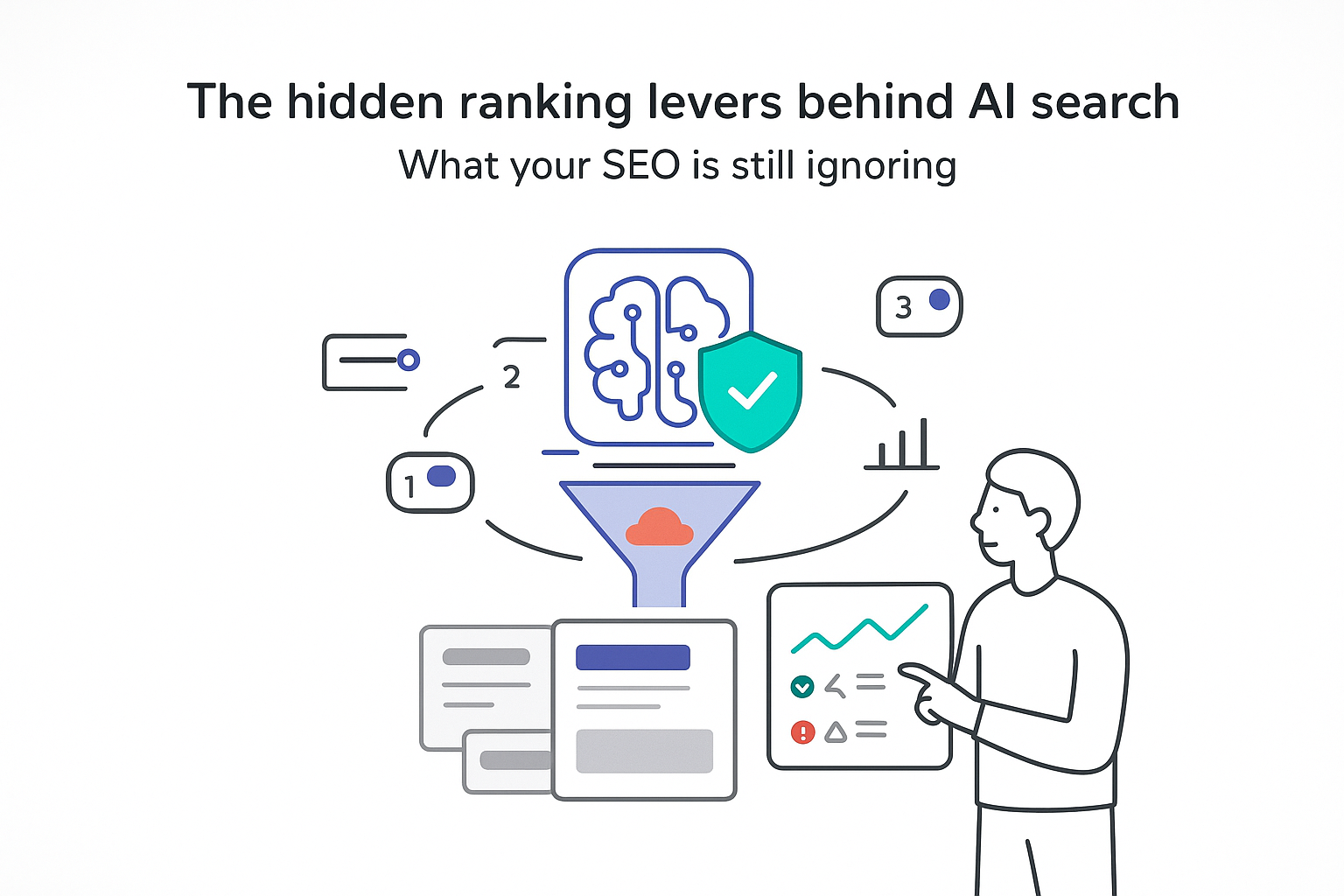
Robby Stein, vice president of product for Google Search, recently detailed how Google's AI Mode evaluates and ranks content, including how it controls hallucinations, measures helpfulness, and uses five SEO-related factors when generating answers.

Key details: Google AI Mode SEO factors and signals
Stein said AI Mode first interprets the user's question and intent. It then triggers many related Google searches in the background to approximate information people have previously found helpful. According to Stein, this fan-out can surface a broader range of sources than a single traditional results page.
This query fan-out means AI Mode effectively performs research across many pages at once on the user's behalf, then synthesizes what it finds. Stein noted that this can expose users to a wider variety of content than a standard set of search results, describing the process as AI Mode "doing the research for the user" behind the scenes.
Stein listed five factors that he said apply to ranking in both classic Search and AI Mode:
- Content that directly answers the user's question
- High quality information
- Fast loading pages
- Original material
- Use of sources and citations
He added that if people click through to content, find it valuable, and return to it, that behavior can help the content rank for a given question in both environments.
Stein said Google uses both offline and online methods to evaluate whether AI responses are helpful. Offline, human evaluators review the quality of information. Online, users can submit thumbs-up or thumbs-down feedback on answers. Google also looks at whether people continue using AI Mode and Search because they see value in the results.
According to Stein, Google triangulates across these metrics because any single signal can be misleading. Heavy usage of a product, for example, might reflect confusion rather than satisfaction. He said Google tracks repeated queries on the same topic and treats that pattern as a negative sign that users may not be getting what they need.
Background context: AI Mode and Google Search quality systems
Addressing hallucinations, Stein said AI Mode builds on search quality systems developed over the past 20 to 25 years. The mechanisms that decide which links to show and how to judge content quality are encoded within the AI model itself. According to Stein, the model uses these quality signals while also calling on Google Search as a tool to retrieve information.
Stein said ongoing model improvements, including better instruction following, reduce the chances of hallucinated responses. He noted that designers can specify guidelines inside AI Mode, such as what to avoid and what to include. This lets teams define basic building blocks (primitives) and layout constraints for how AI answers should look and behave.
In the interview, Stein stressed that AI Mode is not starting from scratch but instead builds directly on Google's long history in Search. He characterized the experience as an extension of Google's established understanding of reliable information sources and search quality.
Source citations
Stein's comments are drawn from a public interview about Google Search and AI Mode reported by Search Engine Journal. Google documents its search quality and helpful content principles in its official Search Central resources at developers.google.com/search. Those resources include guidance for site owners on creating content that aligns with Google's publicly stated quality expectations.








.svg)

.svg)
.svg)