
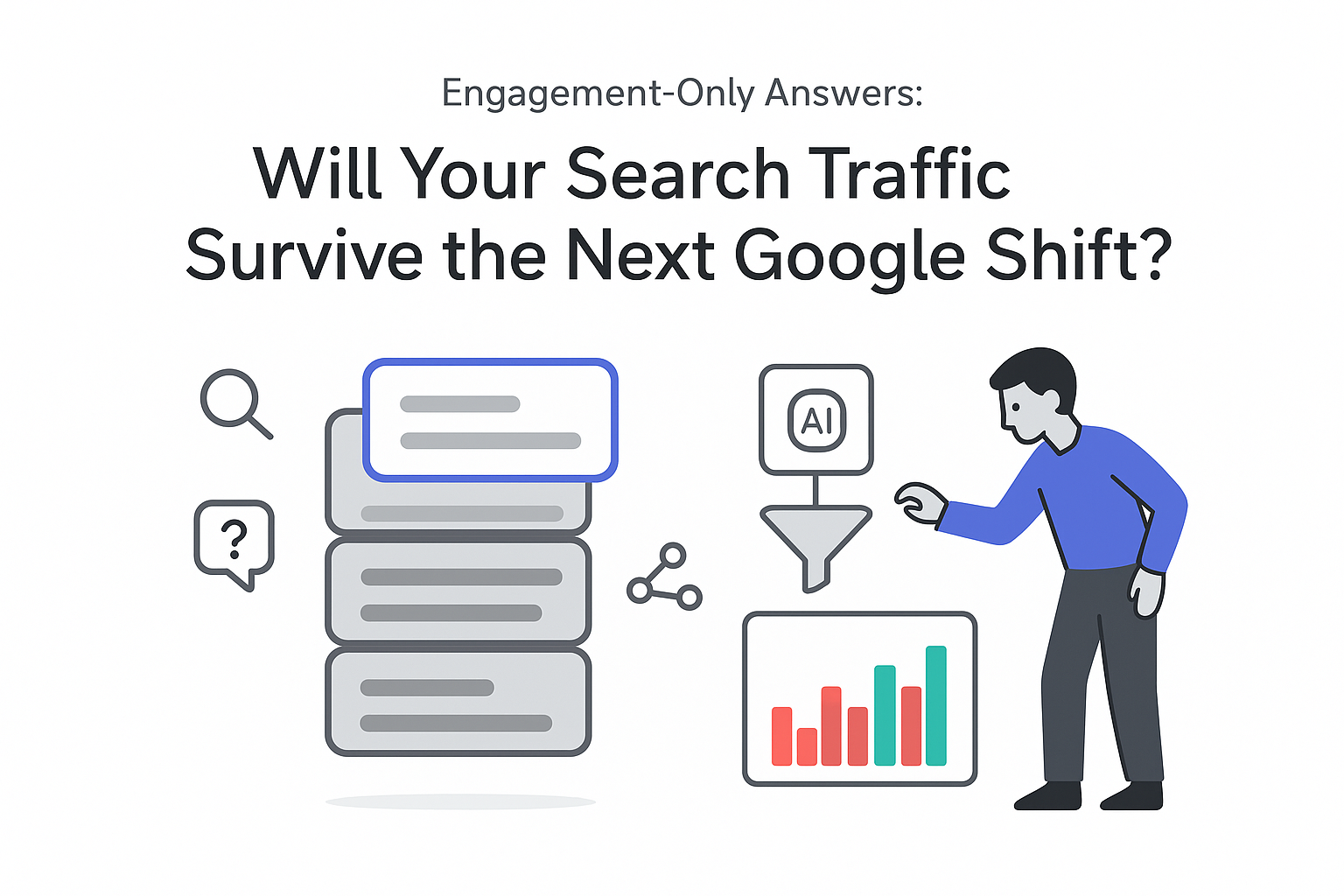
Google's explanation of AI Overviews (AIO) confirms a shift toward engagement-gated visibility at the query-type level. That raises a core question for marketers: how will an AI layer that appears only where users interact with it redistribute traffic, clicks, and ad value across different kinds of searches?

Google AI Overviews: engagement-driven visibility and marketing impact
Google's Robby Stein says AI Overviews only continue to appear where users interact with them and "find them useful" and are pulled back where they are ignored or not valued [S1]. Combined with independent research showing AIO exposure falling to roughly 8% of queries by July 2024 [S2], this points to an adaptive system that tests AIO on query classes, measures engagement, and then scales usage up or down by pattern rather than for each individual query.
This has direct implications for where organic traffic is most at risk - complex, research-heavy queries - versus where traditional SERPs will likely remain dominant, such as branded, navigational, and some highly transactional searches.
Key takeaways for marketers on AI-driven search results
-
AI Overviews will concentrate around complex, multi-step questions.
For simple or navigational queries such as athlete names or brand terms, Google reports that users often ignore AIO, so the feature is removed for those query types [S1]. Expect the heaviest impact on research, comparison, and "how to plan/do X" queries where users actually interact with summaries. -
Fluctuations in AIO presence are more about user behavior than constant algorithm rewrites.
Once you group keywords by intent, week-to-week AIO changes likely reflect Google's engagement tests per query type rather than a volatile ranking shake-up. Reporting should segment by query intent, not just by keyword. -
"Under the hood" query expansion favors content that answers related sub-questions.
Because AIO issues extra internal queries to answer related angles of a question [S1], pages that cover clusters of related questions and context are more likely to be cited, even if they do not match the user's exact wording. -
AI Mode shifts some high-value research into longer, more specific sessions.
Google reports 2-3x longer queries in AI Mode with many follow-ups [S1]. That suggests some high-intent research journeys will move into a conversational flow, changing how and where users see ads and organic links. -
Personalization is currently modest but directionally important.
Today, AIO and AI Mode are mainly driven by query type and global metrics, with only small personal adjustments such as surfacing more video if you click videos [S1]. Over time, if Google increases personalization, the same query could generate different layouts and click paths for different users.
Situation snapshot and current AI Overview behavior
Event trigger:
Robby Stein, VP of Product at Google Search, explained how AI Overviews decide when to appear, how "under the hood" queries work, and the current personalization approach in a CNN interview, later summarized by Search Engine Journal [S1].
Key facts (non-speculative):
- AIO is not a default layer: the system "learns where they are helpful" and "will only show them if users have engaged" [S1].
- For certain query types, such as person or athlete name searches, AIO was tested and later removed due to low engagement [S1].
- Google tracks "lots of metrics" on AIO interaction and withdraws the feature where users "didn't engage with it or value it" [S1].
- Google sometimes issues additional internal queries beyond the user's typed query to surface relevant information and citations [S1].
- AI Mode is designed for more complicated questions and shows 2-3x longer average queries than classic Search, with more follow-up questions [S1].
- Personalization exists but is described as a "smaller adjustment" so that results remain broadly consistent across users [S1].
- Independent July 2024 research found AI Overview coverage fell by 52%, down to around 8% of analyzed queries [S2].
These points are consistent with Google's broader public framing of AI Overviews as a "help where useful, not everywhere" layer [S3].
Breakdown and mechanics: how engagement-based AI Overviews work
At a high level, the logic appears to work like this:
- Query class is identified, such as navigational brand, person lookup, or multi-step research.
- AIO is tested on that class for some share of traffic.
- User interaction is measured, including scroll, clicks within AIO, follow-up questions, and pogo-sticking back to results.
- If interaction is strong -> AIO continues or expands for that class. If interaction is weak -> AIO is reduced or removed for that class.
So the flow is: query pattern -> AIO trial -> engagement metrics -> AIO expansion or rollback.
This helps explain why AIO can vanish from large swaths of apparently similar queries: the decision is made at a class or pattern level, not per keyword.
"Under the hood" query expansion
Google internally issues extra queries to better cover the user's task [S1]. Mechanically:
User query ("restaurants to go to in Nashville if one friend has an allergy and we have dogs and we want to sit outside") ->
Internal sub-queries such as "[outdoor dog friendly restaurants Nashville]" and "[restaurants Nashville peanut allergy policies]" ->
Model composes an answer and cites pages from those internal result sets.
Result: your page can appear as a citation even if it is optimized for a sub-topic such as "dog-friendly outdoor dining in Nashville" and never mentions allergies, as long as it contributes relevant context for the composed answer.
AI Mode as an extended session layer
Google's intended flow is:
Classic Search -> AIO snapshot where helpful -> AI Mode for deeper, multi-step planning [S1].
Observed differences:
- AI Mode queries are 2-3x longer on average [S1].
- Users add multiple follow-up questions as a conversational chain rather than issuing isolated queries.
From a system design perspective, AI Mode collects far richer intent signals per session: detailed constraints, preferences, and clarifications. That creates strong incentives for Google to keep high-value research in that environment, where it can observe more of the decision process.
Personalization: small today, expandable later
Current state:
- Some re-ranking based on past behavior, such as favoring videos for video-preferring users [S1].
- AIO presence itself is predominantly governed by overall usefulness, not individual history.
This means:
- Whether AIO shows at all is mostly a function of aggregate engagement for that query class.
- What is shown inside AIO and in surrounding results can vary slightly by user, but not radically, at least for now.
Speculation: Over time, Google has room to increase personalization within AI Mode, such as preferred content types, brand affinities, and historical conversions. That could yield different exposure for the same query across audience segments.
Impact assessment on paid search, organic traffic, and content
Paid search (Google Ads)
Direction
- Short term (12-18 months): For high-intent commercial queries where users typically click ads or a single site quickly, AIO likely appears less because engagement is low. Ad impression and click volumes on these terms may stay relatively steady. For upper-funnel research queries, especially in shopping-heavy categories, AIO plus integrated product data could intercept some early clicks.
Magnitude (assumption-based model)
Suppose 20% of your non-brand search volume is research-oriented and AIO remains visible on half of those queries. If AIO reduces ad CTR on that subset by 10-20% in relative terms, for example 5% CTR dropping to 4-4.5%, the blended account-level CTR impact is roughly 1-2% relative, but concentrated in research campaigns.
Winners and losers
- Performance-driven advertisers on high-intent keywords: slightly insulated, and possibly benefiting if competitors are distracted by AIO-related noise.
- Brands relying heavily on broad, exploratory keywords: more exposure to impressions with weaker CTR and a harder time attributing upper-funnel value as journeys stretch into AI Mode.
Actions and watchpoints
- Track CTR and conversion rate by intent cluster (brand, exact commercial, broad research) around queries where you can manually confirm AIO presence.
- Monitor impression share and conversions from broad, DSA, and PMax campaigns tied to informational queries, and adjust bids and budgets if they show rising impressions but softening CTR.
Organic search and SEO
Direction
- AIO will most consistently appear on complex informational queries, where many content marketers focus. That raises risk of zero- or low-click searches in exactly those areas.
- Because AIO uses expanded sub-queries, pages that cover related subtopics thoroughly are more likely to appear in citations, even if they are not optimized for the exact phrasing of the top-level query.
Quantitative framing (hypothetical example)
Assume 30% of your organic traffic comes from informational queries. If AIO is present on one-third of those and reduces click-through from 40% to 30% for those results, a relative 25% drop, your total organic traffic could decline by about 8-10%, concentrated in informational content.
Winners and losers
- Sites with comprehensive, high-quality content on complex topics: more likely to be cited and still attract clicks from users who want to go deeper than the AIO summary.
- Thin, single-question pages or weak listicles: more likely to have their value aggregated into AIO with fewer direct clicks.
Actions and watchpoints
- Map your keyword set by intent and complexity, and estimate which groups are most exposed to AIO.
- Focus key resources on topics where users are likely to need depth beyond a summary and where your brand can be the "next click" after the AIO, not just a footnote.
Content and user experience
Direction
- The "under the hood" strategy rewards content that addresses a full task or journey rather than one isolated query.
- Google's examples show many users still click through from AIO to supporting sources when they want detail, diverse opinions, or local nuance.
Actions
- Structure long-form resources with clear sections targeting sub-questions a model might decompose, such as who, what, when, how, comparisons, pros and cons, and step sequences, using descriptive headings and concise answers.
- Build internal linking that mirrors the likely set of sub-queries users and models might ask, helping Google surface and navigate related pages.
Analytics and reporting
Direction
- AIO presence will vary by query type and over time as Google runs engagement tests. Raw position and CTR metrics will look noisier, especially for informational clusters.
Actions
- Segment organic and paid performance reports by query intent and by AIO-prone versus AIO-rare categories. Use manual sampling or third-party tools to maintain a catalog of example queries with and without AIO.
- When explaining CTR drops internally, distinguish among ranking demotion, SERP layout changes such as a new AIO block, and shifts of queries into AI Mode, which are harder to track but can be inferred from branded search and direct traffic behavior.
Future scenarios for AI Overviews and search monetization
(Base, upside, and downside scenarios below are speculative; probabilities are approximate.)
Base scenario - engagement-gated AIO stabilizes (likely, ~60%)
- AIO coverage holds in the single-digit to low-teens percentage of queries, focused on complex informational and planning tasks.
- AI Mode adoption grows, but most commercial intent continues in classic SERPs where ads are well optimized.
- Impact: sustained pressure on informational organic traffic; paid search mostly stable, with some shifts in upper-funnel behavior.
Upside scenario for marketers - AIO recedes on commercial queries (possible, ~25%)
- Google sees stronger engagement and revenue from traditional ads on commercial queries than from AIO, so it gradually limits AIO to clearly informational patterns.
- New ad formats may appear near AI Mode, but traditional SERPs remain the primary revenue engine.
- Impact: organic and paid performance for bottom-of-funnel terms remains strong; experimentation focuses on using AIO primarily as discovery and research support.
Downside scenario - improved AI boosts AIO engagement and coverage (edge case, ~15%)
- Answer quality improves enough that users rely heavily on AIO, including for some product comparisons and early purchase research.
- Engagement metrics justify expanding AIO exposure beyond 8-10% of queries, and Google introduces more ad inventory inside or adjacent to AIO.
- Impact: broader organic CTR compression, especially for content-heavy sites; paid search must navigate new AI-native formats with uncertain early ROI.
Risks, unknowns, and limits of this analysis
- Opaque metrics: Google has not disclosed which specific engagement signals drive AIO rollbacks, such as scroll depth versus click patterns versus satisfaction proxies. If later disclosures show a different primary driver, such as manual quality review or revenue trade-offs, parts of this reasoning would need revision.
- Measurement blind spots: Most marketers cannot directly track when AIO appears for every query at scale, so impact estimates must rely on sampled SERPs and third-party tools, which may lag actual changes.
- Evolving product design: AI Mode and AIO layouts in late 2024 are still changing. New surfaces such as AI-generated product carousels or inline comparisons could reshape engagement independent of the current engagement gate.
- Personalization growth: If Google meaningfully increases personalization, AIO exposure and layouts may vary more by user segment. That would weaken any model that assumes a uniform SERP for all users sharing a query.
- External shocks: Regulatory or antitrust pressures could push Google to adjust how much AI content appears above organic results, or how clearly it distinguishes AI-generated versus classic results.
Evidence that might falsify key parts of this analysis:
- Reliable third-party data showing AIO coverage expanding heavily into low-engagement query classes such as branded navigational terms.
- Public technical documentation or empirical studies demonstrating that engagement signals have minimal influence on AIO presence.
- Clear monetization shifts, such as widespread ads embedded inside AIO, that change the economic logic for Google's rollout.
Sources
- [S1]: Matt G. Southern / Search Engine Journal, 2026, news coverage - "Google: AI Overviews Show Less When Users Don't Engage" (summary of CNN interview with Robby Stein).
- [S2]: Search Engine Journal, July 2024, analysis - "Google Dials Back AI Overviews in Search Results, Study Finds" (reports 52% reduction in AIO presence to ~8% of queries).
- [S3]: Google Search Central and The Keyword, 2024, product posts - official announcements and explainers on AI Overviews and AI Mode (general framing of AIO as a helpful, not default, layer).
Validation: This analysis states a clear thesis, explains mechanics and cause-effect, contrasts Google's framing with observed patterns, quantifies impact through explicit assumptions, and covers impacts, scenarios, and risks in separate sections. Speculative elements are labeled, and recommendations focus on concrete monitoring and planning rather than generic advice.





.svg)

.svg)
.svg)