
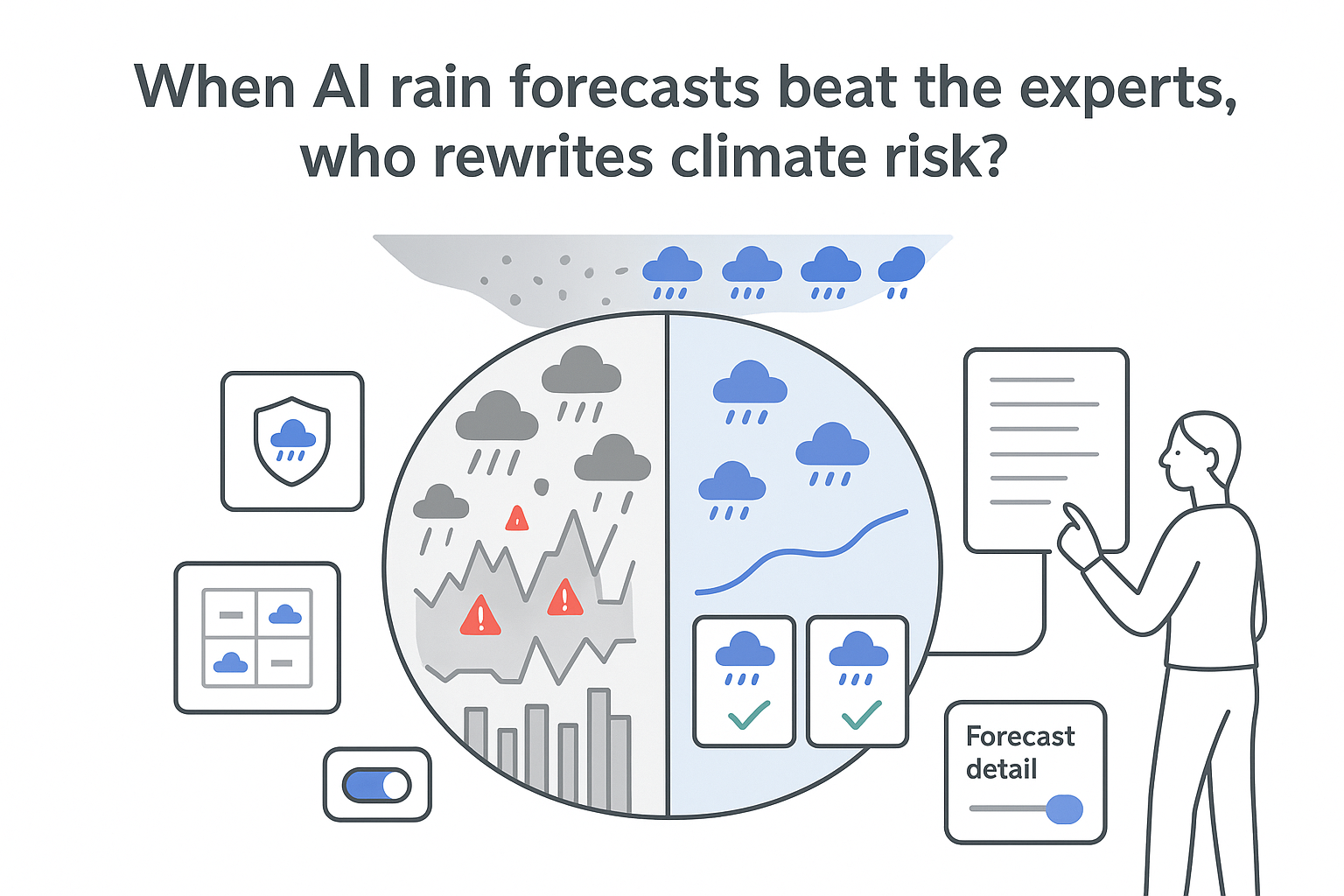
On January 12, 2026, Google Research detailed new precipitation modeling capabilities for its NeuralGCM atmospheric model in the journal Science Advances and in a Google Research blog post titled "NeuralGCM harnesses AI to better simulate long-range global precipitation" by research scientist Janni Yuval. The peer-reviewed article, "Neural general circulation models for modeling precipitation", describes work carried out on global scales at 280 kilometers resolution using AI trained on NASA satellite-based IMERG precipitation observations to simulate rainfall. The results cover both 2 to 15 day forecasts and multi-year climate simulations evaluated against independent datasets.
Key Details on NeuralGCM Precipitation Results
NeuralGCM is a hybrid atmospheric general circulation model that couples a traditional fluid dynamics solver with neural networks. The neural components represent small scale processes such as clouds, radiation, and precipitation that are not resolved by the coarse grid.
For the new study, the team trained NeuralGCM's precipitation component on NASA GPM IMERG satellite precipitation data from 2001 to 2018. The differential dynamical core infrastructure behind NeuralGCM enabled direct training on observed precipitation rather than traditional reanalyses.
Using the WeatherBench 2 evaluation framework, the authors compared NeuralGCM with a leading medium range forecast model from the European Centre for Medium-range Weather Forecasts. They tested forecasts initialized at noon and midnight for every day of 2020, data that was not used during training. NeuralGCM achieved lower continuous ranked probability score values for 24-hour and 6-hour accumulated precipitation across all 15 forecast days, including over land.
For climate timescales, the team ran multi-year simulations and compared them with atmospheric models used in the latest Intergovernmental Panel on Climate Change report. NeuralGCM's mean absolute precipitation error was less than 0.5 millimeters per day globally and 0.3 millimeters per day over land, an average error reduction of about 40% compared with leading participating models.
The study also examined extreme rainfall, defined as the top 0.1% of events at each location between 2002 and 2014. NeuralGCM's simulated frequency distribution matched IMERG observations more closely than the ERA5 reanalysis and the IPSL climate model, including for events above 160 millimeters per day. The model reduced the common drizzle problem, where light rain is overestimated and heavy rain underestimated.
For the daily precipitation cycle, part of the atmosphere's daily weather cycle, NeuralGCM reproduced the time of day of peak rainfall more accurately than the ERA5 reanalysis and NOAA's Geophysical Fluid Dynamics Laboratory (GFDL) SHiELD model. In regions such as the Amazon, NeuralGCM's simulated afternoon peak aligned more closely with IMERG satellite observations. The comparison focused on precipitation over land in summer, when the diurnal cycle is strongest.
Background Context on NeuralGCM and AI Weather Modeling
Google Research first introduced NeuralGCM publicly in 2023 in a blog post on fast, accurate climate modeling with NeuralGCM, with detailed results published in a 2024 Nature paper. That work showed improved 2 to 15 day weather forecasts and accurate reproduction of historical temperatures over four decades compared with traditional models.
Conventional global weather and climate models operate on grid boxes spanning tens of kilometers. Cloud processes important for precipitation often occur at scales smaller than 100 meters, so these models rely on parameterizations that approximate the net effects of unresolved physics. NeuralGCM instead trains neural networks to learn those effects directly from data.
NeuralGCM sits within a broader set of AI-based weather tools developed at Google, including the AI-only WeatherNext 2 forecasting system. According to the latest blog, NeuralGCM's hybrid design targets longer-range climate and weather questions while complementing such pure AI models. Google has released the NeuralGCM library along with the open-source code and the associated precipitation checkpoints as an openly available precipitation model.
The blog also notes early field use through a partnership between the University of Chicago and the Indian Ministry of Agriculture and Farmers’ Welfare. After testing multiple systems, the team selected NeuralGCM and one other model to build an AI-based monsoon onset forecasting tool. This pilot program using AI-based forecasts to predict the onset of the monsoon season was deployed for the first time during the most recent monsoon season, providing guidance to farmers.
Source Citations
- Google Research blog announcement: NeuralGCM harnesses AI to better simulate long-range global precipitation.
- Science Advances paper: Neural general circulation models for modeling precipitation.
- Journal overview: Science Advances.
- Original NeuralGCM blog: Fast, accurate climate modeling with NeuralGCM.
- 2024 Nature study on NeuralGCM: paper.
- Model implementation: NeuralGCM library and open-source code.
- Released checkpoints: precipitation model.
- Training and evaluation data: NASA GPM IMERG precipitation data.
- Benchmarking framework: WeatherBench 2.
- Forecast skill metric: continuous ranked probability score.
- Operational baseline model: European Centre for Medium-range Weather Forecasts medium range forecast documentation.
- Climate assessment context: Intergovernmental Panel on Climate Change.
- Reanalysis comparison dataset: ERA5.
- Climate model baseline: IPSL climate modeling center.
- NOAA comparison model: Geophysical Fluid Dynamics Laboratory SHiELD model.
- Related AI forecasting system: WeatherNext 2.
- Model training infrastructure: differential dynamical core.
- Background on reanalysis products: reanalyses.
- Overview of atmospheric parameterizations: parameterizations.
- Discussion of light-rain bias: drizzle problem.
- Explanation of the diurnal cycle: daily weather cycle.
- Climate model grid spacing: climate model resolution.
- Higher-resolution global modeling: kilometer-scale ECMWF models.
- Standard climate model ensembles: Atmospheric Model Intercomparison Project.
- Widely used climate model description: Community Earth System Model 2.
- Background on longer climate simulations: multi-decadal climate changes from NOAA GFDL.
- Academic deployment partner: University of Chicago.
- Government deployment partner: Indian Ministry of Agriculture and Farmers’ Welfare.
- Project overview: pilot program using AI-based forecasts to predict the onset of the monsoon season.
- Academic case study: selected NeuralGCM and one other model.
- External news coverage: deployed for the first time.








.svg)

.svg)
.svg)