
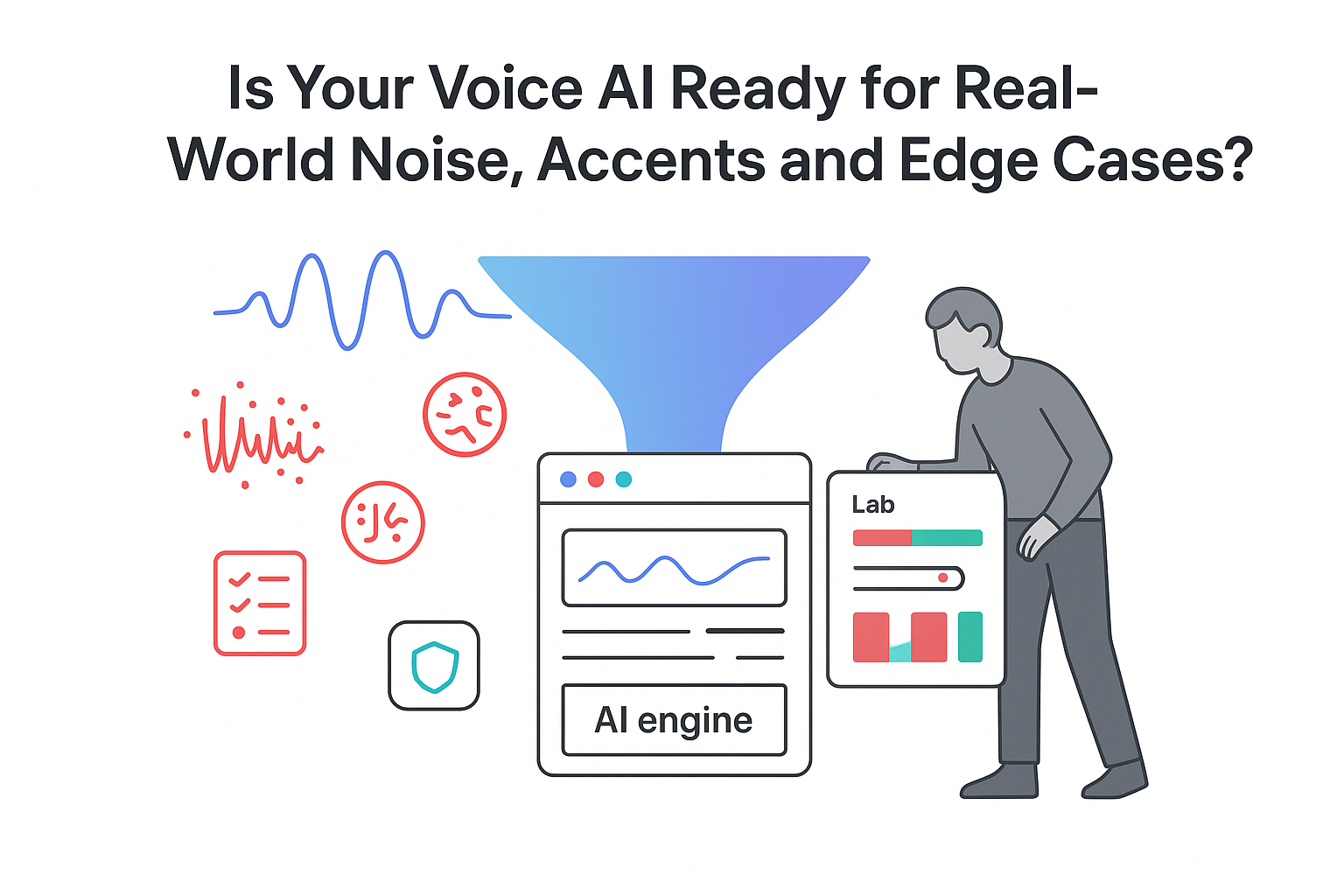
Google's Massive Sound Embedding Benchmark (MSEB) is an open evaluation suite from Google Research that measures how well AI models understand sound across eight real-world capabilities and highlights sizable performance gaps in current voice and audio systems. [S1]
Massive Sound Embedding Benchmark for audio AI: marketing-focused overview
This report summarizes what Google's Massive Sound Embedding Benchmark (MSEB) and its Simple Voice Questions (SVQ) dataset reveal about current machine sound understanding and what that means for voice search, call insights, and audio-driven products. [S1]
Executive Snapshot: audio AI performance signals that matter
- MSEB evaluates eight capabilities - retrieval, reasoning, classification, transcription, segmentation, clustering, reranking, and reconstruction - using standardized tasks that all start from sound, often combined with text or knowledge base context. [S1]
- The Simple Voice Questions Dataset contains 177,352 short spoken queries across 26 locales and 17 languages, recorded in four acoustic conditions (clean, background speech, traffic noise, media noise), with speaker metadata and term-level timing. [S1]
- Across all eight capabilities, current models leave "substantial performance headroom", indicating that today's sound embeddings are not yet general purpose across languages, noise conditions, and task types. [S1]
- For semantic tasks (voice search, spoken QA, reranking), the automatic speech recognition (ASR) step consistently bottlenecks performance, especially in low-resource languages and noisy conditions. [S1]
- For simpler acoustic tasks (for example, identifying who is speaking), complex pre-trained audio models often perform no better than basic waveform features, implying potential overspend on heavyweight models for some use cases. [S1]
Implication for marketers: treat current voice and audio AI as powerful but uneven - particularly fragile in noisy, multilingual, and long-tail scenarios, and sometimes over-engineered for simple classification work.
Method & source notes for Google's sound embedding work
What was measured
- Google Research created the MSEB Benchmark as an open evaluation suite for "machine sound intelligence", focusing on eight core capabilities: retrieval, reasoning, classification, transcription, segmentation, clustering, reranking, and reconstruction. [S1]
- Tasks are split into:
- Semantic tasks (voice search, question answering, reranking) that judge whether the model correctly captures meaning and intent. [S1]
- Acoustic tasks (classification, clustering, segmentation, reconstruction) that focus on who/what/where in the sound, regardless of linguistic meaning. [S1]
Key datasets and scope
- Simple Voice Questions (SVQ): 177,352 short spoken queries, 26 locales, 17 languages, four noise conditions, and rich speaker and term-level metadata. The dataset is available for interactive exploration on Hugging Face. [S1]
- Additional public datasets integrated into MSEB:
- Speech-MASSIVE for multilingual spoken language understanding and intent classification. [S1]
- FSD50K for environmental sound events covering 200 AudioSet classes. [S1]
- BirdSet as a large-scale bird bioacoustics suite with complex soundscapes. [S1]
- Tasks and datasets are packaged in the benchmark's GitHub repo, reflecting MSEB's role as an extensible open evaluation suite. [S1]
Evaluation approach
- For semantic tasks, MSEB compares performance when models consume the original audio against a text-only upper bound based on ground-truth transcripts. [S1]
- For non-semantic tasks, MSEB compares general-purpose sound embeddings to the strongest available task-specific systems to define realistic ceilings. [S1]
- Metrics include Mean Reciprocal Rank (MRR), F1, mean Average Precision (mAP), accuracy (ACC), Word Error Rate (WER), Normalized Discounted Cumulative Gain (NDCG), V-Measure, and Fréchet Audio Distance (FAD). [S1]
Limitations
- The blog source summarizes results but does not publish full numeric scores or per-language breakdowns; these likely reside in the underlying MSEB Paper presented at NeurIPS 2025, which is referenced but not summarized in detail here. [S1]
- Performance examples are described at a high level (for example, "substantial headroom", "sharp degradation under noise") without precise percentages, limiting quantitative comparison for commercial planning. [S1]
Sources used
- [S1] Google Research Blog - "From Waveforms to Wisdom: The New Benchmark for Auditory Intelligence," Dec 3, 2025.
Findings on current machine sound understanding capabilities
MSEB is positioned as a unifying test suite for sound embeddings across speech, environmental audio, and bioacoustics, designed to expose where current models fall short in realistic multimodal scenarios, a core challenge in multimodal perception. [S1]
Dataset coverage and Simple Voice Questions (SVQ)
- SVQ is the central speech dataset within MSEB, created and open-sourced by Google. It contains:
- 177,352 short, spoken queries.
- Coverage of 26 locales and 17 languages, including multiple accents and dialects.
- Recordings in four environments: clean, background speech, traffic noise, and media noise.
- Metadata on speaker attributes and time-aligned "salient terms" within each query. [S1]
- MSEB also integrates domain-specific datasets to test non-conversational sound understanding:
- Speech-MASSIVE for multilingual spoken language understanding and intent classification. [S1]
- FSD50K for multi-label environmental sound event recognition covering 200 AudioSet ontology classes. [S1]
- BirdSet as a large-scale bird sound evaluation suite with complex soundscapes. [S1]
- These datasets collectively span:
- Human speech in many languages and acoustic conditions.
- Everyday environmental sounds (vehicles, alarms, human activities).
- Bioacoustic signals (bird calls and soundscapes). [S1]
Taken together, this structure allows MSEB to test whether one sound embedding family can support both human-centric and non-human audio use cases under realistic noise and context variation. [S1]
Eight sound capabilities evaluated by MSEB
MSEB's "super-tasks" are framed as abilities any intelligent system should have when interacting through sound. Every task uses audio as the primary input and may combine it with text or knowledge-base information to reflect real user scenarios. [S1]
- Retrieval (voice search) - Given a spoken query, find relevant documents or passages in a knowledge base, mirroring voice search or spoken site search. [S1]
- Reasoning (intelligent assistants) - Given a spoken question and a context document, locate a precise answer span, simulating question answering from audio queries. [S1]
- Classification (monitoring/security) - Categorize sounds by speaker attributes, user intent, acoustic environment, or specific events. [S1]
- Transcription - Produce verbatim text from spoken language, measured using Word Error Rate as the main metric. [S1]
- Segmentation (indexing) - Identify key terms within a clip and localize them in time for indexing and navigation. [S1]
- Clustering (organization) - Group sound samples by shared attributes (such as speaker identity or environment) without labels, reflecting tasks like unsupervised speaker clustering. [S1]
- Reranking (hypothesis refinement) - Reorder text hypotheses (for example, candidate ASR outputs) so that the top choice best matches the spoken input. [S1]
- Reconstruction (generative audio) - Recreate the original waveform from its embedding and rate quality via metrics such as Fréchet Audio Distance. [S1]
These tasks extend from basic perception (transcription, classification) to higher-level organization and generation (clustering, reconstruction), providing a broad view of model behavior under various objectives. [S1]
Performance ceilings and five structural failure modes
MSEB's main message is that current "universal" sound embeddings fall well short of their potential across all eight capabilities, even when evaluated against realistic, task-specific ceilings. [S1]
Key comparative setup
- For semantic tasks, performance from audio-based models is compared to a text-only "ideal" using human transcripts, which acts as a ceiling on what good audio understanding could achieve. [S1]
- For acoustic and generative tasks, MSEB compares general-purpose embeddings to the strongest task-specific systems, marking the level that a single, shared embedding would need to match. [S1]
From this evaluation, Google reports five main issues: [S1]
- Semantic bottlenecks from ASR
- For retrieval, reasoning, and reranking, the standard pipeline (audio → ASR → text-based retrieval/QA) loses meaning due to transcription errors. [S1]
- Even when overall WER looks reasonable, semantic fidelity - preserving the user's actual intent and crucial terms - is degraded, capping downstream performance far below the text-only ceiling. [S1]
- Misaligned objectives in speech pipelines
- ASR models are trained to minimize WER, but many real tasks care more about relevance, decision quality, or reasoning accuracy than about perfect verbatim transcripts. [S1]
- Optimizing only for WER can harm performance on retrieval and QA if low-impact words are fixed while high-impact entities remain wrong. [S1]
- Non-universality across languages
- Performance is described as "severely" uneven across languages. Systems work well for major, well-resourced languages but deteriorate sharply for less common languages. [S1]
- This decline in transcription quality propagates to failures in search, ranking, and segmentation for those languages. [S1]
- Poor robustness to noise and complex soundscapes
- Reconstruction quality and environmental understanding collapse when realistic background noise is added, such as overlapping speech, traffic, or media. [S1]
- This is noted as especially challenging for general environmental sounds in settings like busy offices or streets. [S1]
- Over-complexity for simple acoustic tasks
- For tasks that do not require language understanding - for example, identifying who is speaking - complex pre-trained audio models often perform no better than representations derived directly from the waveform. [S1]
- This suggests that, for some problems, model complexity and pre-training may not translate into measurable gains. [S1]
Google characterizes the gap between current audio-based performance and these ceilings as "substantial" across all eight super-tasks, reinforcing that no existing sound representation behaves as a truly universal backbone. [S1]
Interpretation & implications for marketers and product leads
(This section is interpretation based on the evidence above; labels indicate confidence.)
Likely: Voice search and spoken QA remain fragile in noise and long-tail languages
- Because semantic tasks are bottlenecked by ASR errors and semantic drift, any product relying on "audio → text → search/QA" will show uneven performance, particularly in noisy conditions and for less-resourced languages. [S1]
- For marketing teams investing in voice search, IVR automation, or spoken FAQ bots, this suggests that performance dashboards should track language, environment, and device segments separately, not just overall accuracy.
Likely: Overspending on heavy audio models for simple tasks is a real risk
- The finding that complex models sometimes match raw waveform features for simple acoustic discrimination indicates that some call routing, speaker recognition, or environment tagging use cases may not benefit substantially from large, general-purpose audio encoders. [S1]
- Product and analytics teams can challenge vendor claims by asking whether simpler feature-based baselines were tested and how much incremental gain the larger model delivered.
Likely: Multilingual and "real-world" audio coverage is still limited
- MSEB's emphasis on non-major languages, varied locales, and real-world noise highlights current systems' drop-offs in these conditions. [S1]
- Marketers working across markets should expect lower reliability in languages outside the top few supported languages and should budget for manual review or human-in-the-loop workflows where accuracy matters (for example, compliance monitoring or sentiment analysis on calls).
Tentative: Unified audio embeddings may eventually cut integration and data costs
- MSEB's design - eight capabilities over shared datasets - targets a future where one audio representation can serve transcription, retrieval, classification, and generation. [S1]
- If such representations mature, enterprises could reduce the number of separate audio models they maintain and reuse the same representation across analytics, personalization, and QA systems. This remains aspirational but is directionally important for long-term architecture planning.
Tentative: Evaluation standards for audio AI will influence vendor comparisons
- An open test suite with clearly defined ceilings and datasets creates a reference point similar to what ImageNet did for vision. [S1]
- Over time, buyers may ask vendors how their audio models perform on Massive Sound Embedding Benchmark or similar public tests, rather than relying solely on proprietary case studies.
Speculative: Regulatory and fairness scrutiny may extend to audio and accents
- The reported "severe" performance variance across languages suggests likely disparities along accent, dialect, and socio-linguistic lines as well. [S1]
- As regulators and large platforms increase focus on fairness in AI, audio systems that work only for certain accents or languages may face pressure, affecting localization and compliance strategies.
Contradictions & gaps in the current evidence
- Lack of detailed numeric results in the public summary - The blog describes gaps as "substantial" and "sharp degradation" under noise but does not provide exact numbers, confidence intervals, or per-task deltas vs ceilings. [S1] This limits quantitative ROI estimation for business deployment.
- Limited visibility into model types compared - While the text mentions cascade systems and "novel" audio encoders, it does not list specific architectures, parameter counts, or training data volumes, making it hard to generalize findings to any named commercial model. [S1]
- No direct mapping to business KPIs - MSEB focuses on technical metrics (MRR, WER, FAD, etc.). [S1] There is no data on how changes on these metrics translate into conversion rate, CSAT, NPS, or call-handle time, which are critical for marketing and CX decisions.
- Fairness and bias analysis not detailed - The summary notes severe performance variance across languages but does not quantify gaps by language family, accent, gender, or age, nor propose fairness metrics for audio AI. [S1]
- Limited coverage of music and other audio verticals - Future development is said to target music and combinations with images. [S1] Current results may not reflect performance in domains such as advertising audio, podcasts, or branded sonic assets.
These gaps mean that while directionally clear, MSEB's public description should be treated as an early technical signal, not yet a full decision guide for specific vendor or architecture choices.
Data appendix: key MSEB and SVQ figures
Core datasets in MSEB [S1]
- Simple Voice Questions (SVQ)
- 177,352 short spoken queries.
- 26 locales, 17 languages.
- Four acoustic setups: clean, background speech, traffic, media noise.
- Metadata: speaker attributes, time-aligned salient terms.
- Speech-MASSIVE
- Multilingual dataset for spoken language understanding and intent classification.
- FSD50K
- Environmental sound dataset with 200 sound event classes drawn from the AudioSet ontology.
- BirdSet
- Large-scale avian bioacoustics suite including complex, real-world soundscapes.
Eight capabilities evaluated [S1]
- Retrieval - voice search against text corpora or knowledge bases.
- Reasoning - answer extraction from documents given spoken questions.
- Classification - speaker, intent, environment, and sound event labels.
- Transcription - verbatim speech-to-text.
- Segmentation - key term detection and time localization.
- Clustering - unsupervised grouping by shared audio traits.
- Reranking - ordering text hypotheses to match spoken input.
- Reconstruction - waveform regeneration and quality assessment.
Main failure modes summarized [S1]
- ASR-induced semantic bottlenecks in retrieval, QA, and reranking.
- Objective mismatch between WER-focused training and real application needs.
- Large quality gaps between major and less-common languages.
- Strong sensitivity to background noise and complex environments.
- Limited added value from complex models on simple acoustic discrimination tasks.






.svg)

.svg)
.svg)