
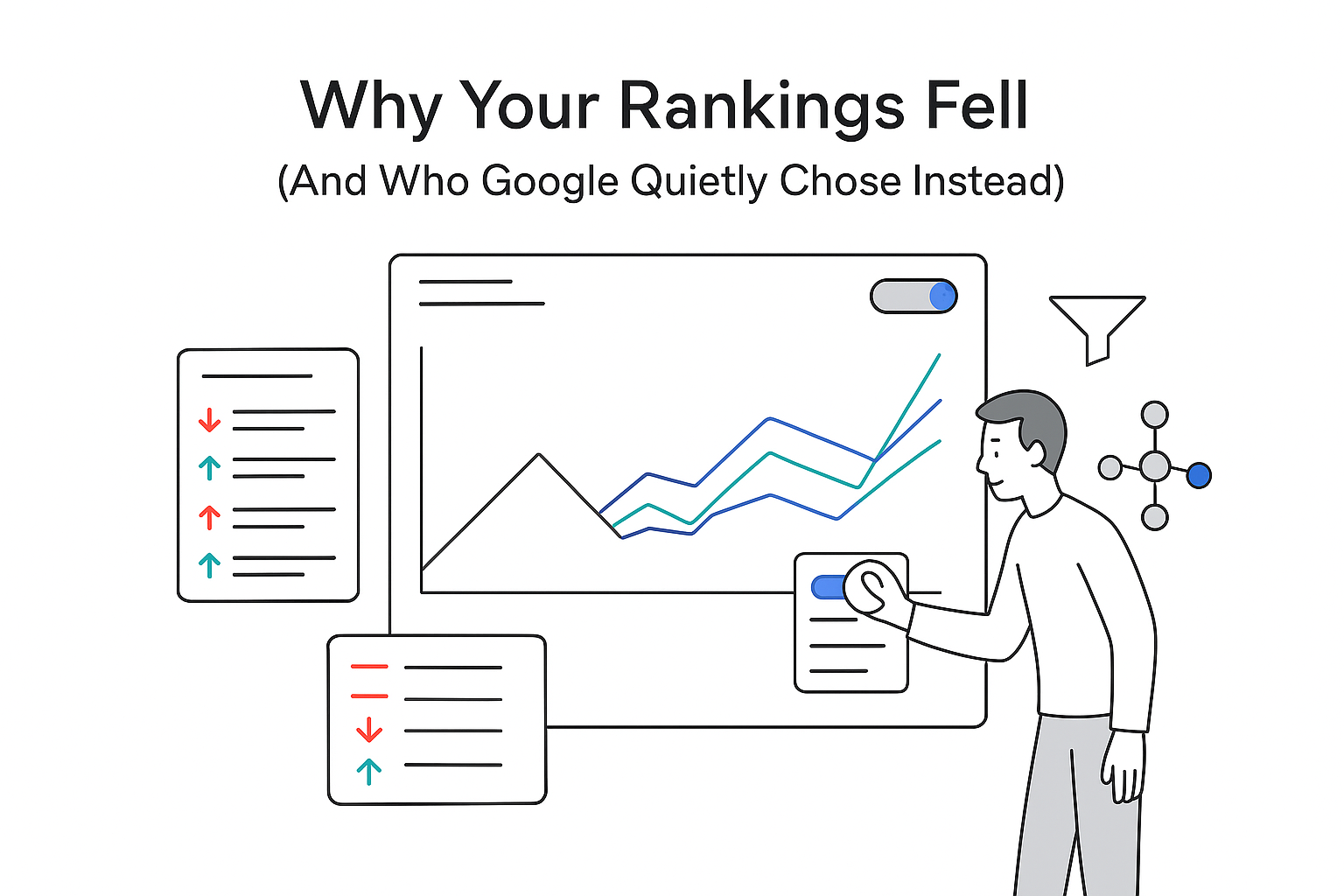
Most coverage of Google core updates treats ranking drops as something to "fix" on the page. The SEJ piece this analysis is based on argues that many losses actually reflect Google getting better at matching topics, intent, and authority, not handing out new penalties. The core question for marketers: how should diagnosis and strategy change when a core update hits, given eight under-discussed causes of ranking change?
Google core update ranking drops: what they really signal for marketers
For marketers, the key shift is moving from a "what is broken on my site?" mindset to "how has Google reclassified my queries, topics, and competitors?" Google states that core updates are broad changes that reassess content against largely the same signals as before, rather than introducing manual penalties or whitelists [S2][S6].
The SEJ article aligns with that view: ranking declines often trace back to refined topical systems, better query interpretation, and stronger external validation of authority, not sudden technical faults [S1]. The right response is therefore less about emergency disavows or mass content pruning, and more about understanding the new SERP landscape, where you sit in Google's topic and authority maps, and how your broader marketing footprint feeds those signals.
Key takeaways
- Treat core update losses as re-scoring events, not punishments. Many drops mean Google has closed a loophole or sharpened topic boundaries. First step: compare your pages with current top results to see whether you were over-rewarded before or have been moved into a different intent cluster.
- Topic systems and intent filters matter more than marginal on-page tweaks. Core topicality systems and site-level "knowledge domain" models can remove you from entire query classes, especially in medical and other "your money or your life" areas [S1][S3]. Chasing these terms without the right topic and expertise profile is usually wasted effort.
- Authority is earned off-page; E-E-A-T is a lens, not a checklist. Google uses E-E-A-T to decide which relevant pages are "most helpful" [S2][S7]. You cannot fix an E-E-A-T issue by editing a template. The lever is wider recognition: links, citations, reviews, PR, partnerships, and branded search demand.
- Temporary boosts and competitor gains often drive volatility. New pages and sites often get a short-term test, then settle back [S1]. Many post-update drops reflect competitors improving user experience, content formats, and brand reach while you stayed flat.
- People-first experience is now a ranking input via indirect signals. Pages that reduce friction, answer real objections, and visually reflect their audience tend to earn more links, mentions, and repeat visits. Over time those signals feed the authority and "helpfulness" systems that core updates reassess.
Situation snapshot
This analysis is based on Roger Montti's Search Engine Journal article, "Eight Overlooked Reasons Why Sites Lose Rankings In Core Updates," which synthesizes Google public statements, a Google patent on website representation vectors, and field observations of SERP behavior across past core updates (notably "Medic" in 2018) [S1][S3].
Key factual points:
- Google runs broad core updates several times per year that "assess content overall" rather than targeting specific sites or issues [S2][S6].
- Google acknowledges having "core topicality systems" that help it understand what content is about and how it matches queries [S1][S2].
- A Google patent on "website representation vectors" describes classifying websites by knowledge domain and expertise level, then selecting results only from certain classes for some queries (for example, medical conditions) [S3]. Bill Slawski wrote an in-depth analysis of this patent, titled Website representation vector, which explores how such classifications may influence ranking.
- Google states that, once relevance is established, systems use signals related to experience, expertise, authoritativeness, and trustworthiness (E-E-A-T) to prioritize content [S2][S7]. Google's own documentation explains how E-E-A-T fits into its ranking systems.
- John Mueller has clarified that E-E-A-T is not something you "add" to a page; it is a quality inferred from content and external signals, not a direct on-page feature [S4].
These positions are consistent with Google's public guidance from 2018 onward: core updates tighten relevance and quality judgments instead of operating as manual penalties.
Breakdown and mechanics
The SEJ article's eight reasons can be grouped into four main mechanisms that affect ranking after a core update.
1. Over-ranking correction vs. new penalty
Mechanic: legacy scoring quirks plus incomplete topic or authority signals allow some pages to rank higher than they should. A core update refines the scoring, and those pages move down to a more accurate position [S1][S2].
For marketers, that means:
- A sudden loss may simply be a return to your true competitive level once Google closes a loophole (for example, over-weighted anchor text, vague topical models, or thin authority signals).
- If your content, UX, and authority are mid-pack, a core update that rewards stronger competitors will expose that gap, even if nothing "broke" on your site.
2. Topic theming, domain classification, and personalization
Mechanic (simplified): query intent is inferred and mapped to a topic cluster, then matched to site or domain "topic vectors" and expertise classes. Results are adjusted for user context (history, location, device, time), and pages from sites that best match the topic and intent profile are ranked [S1][S3].
Key parts:
- Topic theming and domain vectors. The patent Montti cites describes representing websites as vectors in knowledge domains (for example, medical expert, lifestyle advice, commercial product) and selecting only certain classes for a given query [S3]. After the Medic update, many folk remedy sites lost visibility for clinical medical queries because the system favored domains classified as medical experts [S1].
- Query intent refinement. Core updates often sharpen what Google considers the primary intent behind queries like "bomber jacket" (commercial, fashion-oriented, military heritage, or informational history) [S1]. Sites whose overall topic signals (product range, brand story, link context) match the winning interpretation gain; others fall.
- Personalization layer. For some queries, Google can shift dominant intent based on user context: past searches, geography, device type, or time of day [S1]. The same page can rank well for some users and not appear at all for others.
Traffic consequence:
- A move from position 2 to 8 on a key query can cut click-through rate from roughly 15–17% to about 2–3%, based on industry CTR curves [S5].
- If that query drives 10,000 impressions per month, clicks could fall from around 1,600 to about 250, a loss of roughly 1,300 visits, without any technical change on your side. The driver is topic and intent reclassification.
3. Authority and E-E-A-T as filters on top of relevance
Mechanic: after indexing and initial relevance matching, E-E-A-T-related signals (citations, links, brand mentions, reviews, offline prominence) help systems prioritize which relevant pages seem most helpful [S2][S7].
Important distinctions:
- Expertise vs. authoritativeness. Expertise starts on-site (depth, accuracy, demonstrated experience). Authoritativeness is off-site recognition of that expertise (citations, mentions, press, referrals, professional affiliations) [S1][S2].
- E-E-A-T is a judgment, not a tag. Mueller's comment that you "cannot sprinkle some experiences on your web pages" means there is no direct on-page switch [S4]. Rich author bios and schema can help clarity, but the heavy lifting comes from how people and other sites respond to your content over time.
- Practical effect. Among a pool of equally relevant pages, those backed by stronger authority signals (links from experts, consistent brand searches, high-quality reviews) are more likely to move up post-update, while weaker brands slide.
4. Temporary tests, competitor progress, and people-first optimization
Mechanic: new URLs or sites are often given early test visibility to gather behavioral and linking data, leading to short-term spikes, then normalization as long-term relevance and authority patterns settle [S1]. In parallel, competitors may be:
- Publishing more focused and comprehensive content on the same topics.
- Improving UX and conversion flows, increasing engagement and word-of-mouth.
- Investing in PR, community, offline, and paid channels that build brand strength.
Montti notes that when one commercial site ranks among mainly government or .edu results, it often has superior "people-optimized" content and outreach [S1]. That typically includes:
- Visuals that reflect the actual audience.
- Clear social proof and trust signals.
- Multimodal content (video, tools, guides, offline events) that earns discussion and links.
These factors are not direct ranking switches, but they raise the probability of acquiring the third-party signals Google relies on.
Impact assessment
Organic search and SEO strategy
Topic focus and query selection. Sites that chase high-volume topics outside their credible domain (for example, general lifestyle blogs targeting clinical medical terms) face structural limits. A core update can wipe out those positions permanently if Google reclassifies the topic as expert-only. For affected properties, that can mean double-digit organic traffic loss to those sections with no realistic path back.
Action: map your key queries against your true topical strength. Where you are an obvious expert-class domain, deepen coverage. Where you are adjacent or hobby-level, pivot toward informational, comparison, or community angles instead of direct expert advice.
SERP-first diagnostics after updates. Instead of searching for "penalties" or launching mass disavow projects, the first diagnostic should be a SERP review:
- What types of sites now dominate (publishers vs. brands vs. institutions)?
- Has intent shifted toward informational vs. transactional?
- Are new content formats (guides, tools, videos) appearing high in results?
This lens often explains ranking losses more cleanly than immediate technical audits.
E-E-A-T as roadmap, not checklist. Use E-E-A-T guidelines to identify missing proof points: independent citations, strong reviews, author credentials, safety or quality certifications, and real-world case studies. Adjust content and outreach plans to generate, then surface, those assets.
Content, brand, and creative
People-first UX as an indirect ranking driver. Sites that reassure visitors with credible badges, clear contact options, transparent pricing, and audience-reflective imagery tend to convert better and attract more advocacy and links. Over a 6–18 month horizon, those external signals help cushion you against future core updates.
Multimodal and off-site presence. Brands that communicate through video, social, podcasts, events, and PR create more touchpoints where they can earn mentions and links. That feeds the authority layer Google applies after relevance. The impact can be large in competitive verticals where link growth has slowed for text-only publishers.
Intent-specific content splitting. When personalization and topic shifts push an existing page out of certain SERP variants, building additional, clearly targeted assets (for example, a pure informational explainer alongside a commercial page) can help recapture visibility across intent segments.
Paid media and performance marketing
Paid search as buffer and insight engine. Sudden organic losses on core commercial queries can be partly offset with paid search and shopping ads. More strategically, ad copy and landing page tests can reveal which angles (benefits, objections, imagery) align with the pages currently winning in organic, guiding your next content iteration.
Brand campaigns to support authority. Display, video, and social campaigns that increase branded search volume and direct traffic can indirectly support perceived authority and trust. While Google does not state that branded search is a ranking factor, strong brands appear more resilient in core updates across many case studies [speculation based on industry observation].
Analytics and operations
New post-update playbooks. Teams should have a documented workflow that starts with:
- Query and SERP mapping for the biggest losers.
- Topic and intent classification changes.
- Competitive gap analysis (content depth, UX, authority signals).
Technical audits and link checks should follow this analysis, not precede it.
Expectation management for new projects. Stakeholders need to understand the "honeymoon then settle" pattern for new sites and major sections. Forecasts should treat early spikes as tests, not baselines, to avoid over-staffing or over-committing based on temporary peaks.
Scenarios and probabilities
(Judgment calls based on current evidence; these may change as Google updates its systems.)
- Base case - topic and authority tightening continues (likely). Google continues refining core topicality and E-E-A-T-related systems. Vertical-level volatility remains high, particularly in health, finance, reviews, and product search. Brands with clear topical focus, credible authority signals, and strong user-centric UX see relative stability.
Implication: prioritize clear topical positioning and real-world authority gains over marginal technical experiments. - Upside case - strong brands gain share from weaker generalists (possible). As site-level domain vectors and authority signals gain weight, generalist sites and thin affiliates lose ground to well-defined experts and recognizable brands. Marketers who invest in depth, brand presence, and multichannel promotion see rising visibility after each core update.
Implication: coordinated SEO, PR, content, and offline activity becomes a competitive advantage and makes rankings more defensible. - Downside case - more aggressive query filtering and AI Overviews (edge). Google may expand AI Overviews and expert-only filters on sensitive or high-stakes queries. Smaller or mid-tier commercial sites could lose direct blue-link exposure even where they are relevant, as more clicks go to AI answers or institutional sources.
Implication: reliance on a small set of generic head terms becomes fragile; growth must come from diversified keywords, channels, and direct audience relationships.
Risks, unknowns, limitations
- Opaque implementation. The website representation vector patent and "core topicality systems" are partial windows into how Google might operate, not guaranteed full descriptions of live systems [S1][S3]. Google can deploy or retire such methods without notice.
- Signal weighting uncertainty. The exact weighting of links, engagement proxies, branded search, or offline prominence in authority calculations is not known. Correlations from case studies can mislead if confounded by brand size or marketing spend.
- Vertical variation. Local, news, B2B SaaS, and online retail may experience different mixes of topic, authority, and user-behavior signals. The patterns described here are clearest in health, finance, product reviews, and information-heavy verticals.
- Potential falsifiers. This analysis would be weakened if:
- Google explicitly stated that site-level topic or domain classification is not used for ranking, even for sensitive queries.
- Strong, recognized brands consistently lost ground to anonymous but technically polished sites in future core updates across many verticals.
- Reliable leaks or research showed that E-E-A-T is applied in a fundamentally different way than currently documented.
Sources
- [S1] Montti, R., 2025, Search Engine Journal - "Eight Overlooked Reasons Why Sites Lose Rankings In Core Updates."
- [S2] Google Search Central, updated 2022–2024, Help Center - "What site owners should know about Google's core updates."
- [S3] Google, 2020, Patent - "Website representation vectors" (US20200050707A1).
- [S4] Search Engine Journal, 2025 - "Google Confirms You Cannot Add E-E-A-T To Your Web Pages," reporting on John Mueller at Search Central Live NYC.
- [S5] Sistrix, 2020, Study - "Google Click-Through Rate by Ranking Position in the SERPs."
- [S6] Google Search Central Blog, 2019 - "Core updates & what you should know."
- [S7] Google Search Central, ongoing - "Creating helpful, reliable, people-first content" (E-E-A-T and helpful content guidance).




.svg)

.svg)
.svg)