
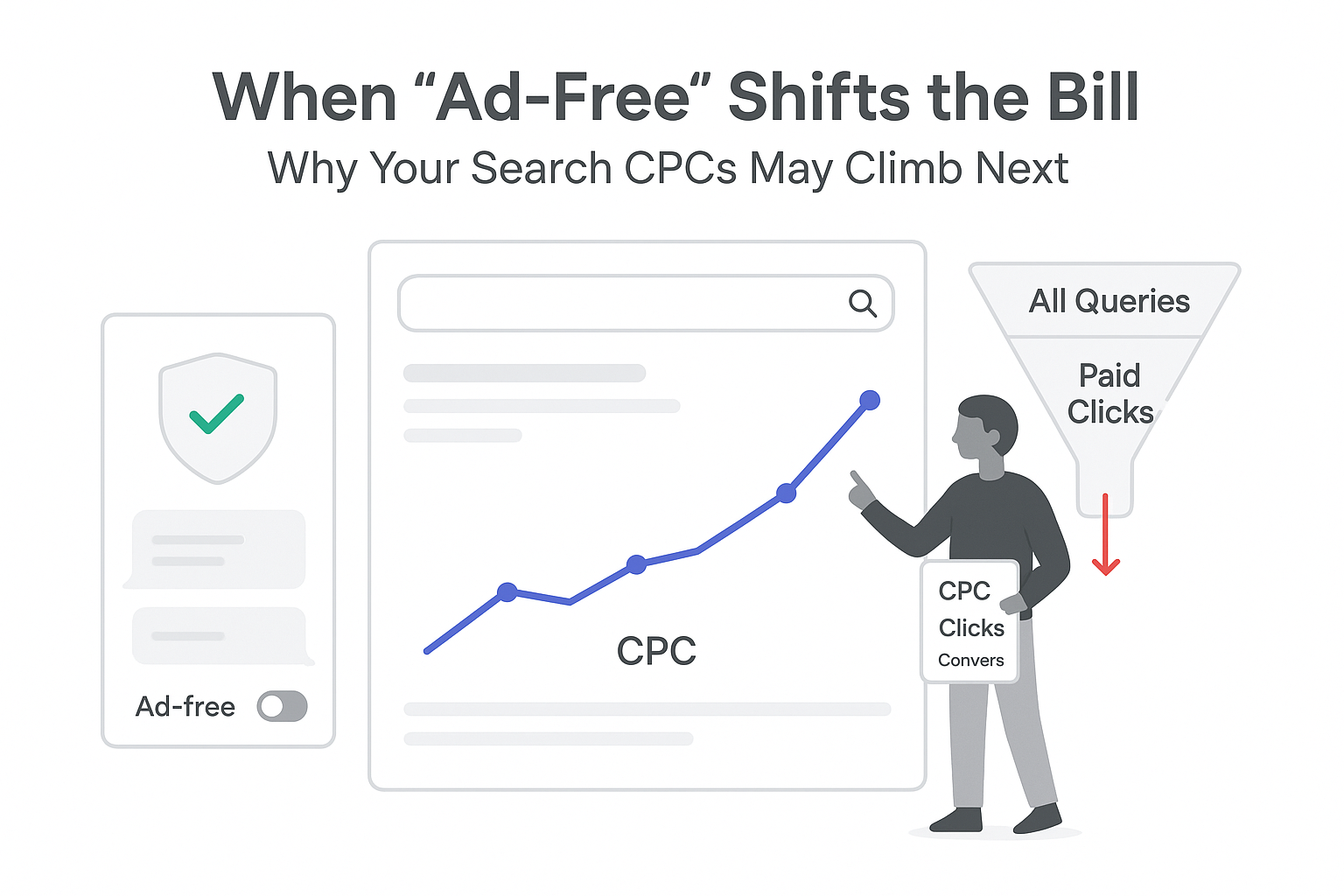
Google's public stance is that Gemini will not run ads for now, even as Google expands ads inside AI Overviews in Search. For marketers, the key question is whether "no ads in Gemini" is a durable line or a temporary phase while Google routes monetizable intent back to classic search inventory.
Key Takeaways: Google Gemini ads and assistant monetization
- Google is ring-fencing trust in Gemini while monetizing AI Overviews in Search. That suggests commercial assistant queries are likely to be pushed into search-like experiences where ads already run. Marketers should expect more traffic reshuffling than net-new inventory in the short term.
- By moving slower than OpenAI on assistant ads, Google is trading near-term ad experiments for a credibility story ("assistant works for you"). This may delay new formats but helps protect user adoption and, by extension, long-run ad reach.
- If even 5–10% of commercial-intent queries migrate from standard SERPs to assistants over the next 1–2 years (assumption), and Gemini stays ad-free, competition and CPCs in remaining search placements may rise as brands crowd fewer clear ad slots.
- For organic and brand marketers, influence over Gemini is likely to flow mainly through existing signals - authority, structured data, and presence in sources Gemini trusts - rather than any near-term "assistant SEO" product.
- OpenAI's early ChatGPT ad tests will likely become the primary assistant-native ad lab. Performance marketers should expect Google to watch those results and then ship more conservative, disclosure-heavy formats once user tolerance is clearer.
Situation Snapshot
Demis Hassabis, CEO of Google DeepMind, said at the World Economic Forum, in an interview with Axios, that Google has "no current plans" to introduce advertising into its Gemini AI assistant and framed assistants as technology that "works for you as the individual," raising concerns about how ads would affect trust in that relationship [S1][S5]. He noted that "no one's really got a full answer" for how advertising fits that model yet [S1][S5].
Hassabis explicitly separated Gemini from Google Search, where ads already appear inside AI Overviews. He described search as a "completely different use case," where user intent is clear from the query and ads can be aligned with that intent [S1]. Google began rolling out ads in AI Overviews in late 2024 and claims those surfaces monetize at roughly the same rate as traditional search results [S3].
This is the second recent statement from Google leadership that there are no current plans to monetize the Gemini app. In December, Google Ads VP Dan Taylor rejected a report that Gemini ads were planned for 2026, calling it "inaccurate" and saying Google had "no current plans" to monetize the Gemini app [S4]. Hassabis's comments echo that position and add the trust framing.
Meanwhile, OpenAI has announced that it will begin testing ads in ChatGPT for logged-in adults in the U.S. on free and Go tiers [S2]. Hassabis said he was "a little bit surprised" they moved this early into ads but acknowledged that advertising funds much of the consumer internet and can be "done right" or "not good" in assistants [S1].
Breakdown & Mechanics
Under the hood, this is about how Google segments intent and risk:
User query → Product context → Intent clarity → Monetization method.
- Search: Query typed into a search box → high intent clarity (for example, "best running shoes size 11") → ads served in auction, with clear labels and multiple options.
- Gemini assistant: Conversational context, mixed tasks ("help plan my week," "what should I buy for...") → softer intent, more personal relationship → higher sensitivity to perceived bias.
Hassabis's "technology that works for you" framing positions Gemini closer to a personal adviser than a results page [S1]. In a results page, users expect a mix of organic and sponsored listings, scannable at a glance. In a single conversational answer, a sponsored suggestion can feel more like a hidden recommendation than a transparent ad.
That creates a harder design problem: a single stream of advice must either (a) clearly flag sponsored content and risk breaking immersion or (b) integrate ads seamlessly but risk user backlash if people feel manipulated. Hassabis is essentially saying the industry has not solved this yet [S1].
On the business side, Google's incentives are clear:
- Search ads still fund the company.
- AI Overviews are being tuned so they do not cannibalize revenue; Google claims revenue per search is similar when AI Overviews show [S3].
- A standalone, ad-free Gemini could, if it captured lots of commercial queries, erode that revenue - unless Gemini routes commercial flows back into Search surfaces that already carry ads.
A plausible internal routing model is:
Assistant conversation → detect commercial intent → hand off to Search or Shopping result with AI Overview and ads → user clicks ad or organic result → revenue captured in existing systems.
That would let Google keep Gemini "ad-free" while protecting the search ad business and maintaining the trust narrative.
By contrast, OpenAI has no legacy search business, so it can embed ads directly into ChatGPT and treat the assistant as the primary canvas for monetization [S2]. That creates two different experiments: Google is testing "assistant as gateway to ad-funded search," while OpenAI is testing "assistant as ad surface."
Impact Assessment
Paid search / PPC
Over the next 12–24 months, the main effect for paid advertisers is likely displacement rather than net-new inventory. As more queries trigger AI Overviews, and as assistants hand off commercial questions to search-like views, impressions will keep concentrating in high-intent, auction-driven slots. Google's claim that AI Overviews monetize at similar rates to traditional search suggests that, so far, revenue per query is stable [S3].
If assistant usage grows but Gemini itself stays ad-free, competition may intensify for the commercial queries that still surface in SERPs, pushing CPCs up, especially in categories where users quickly accept a single answer and skip scrolling. Brands that rely heavily on non-branded search may feel this pressure first.
Marketers can treat Gemini as an upstream influence channel that changes how and when people decide to search, not as a reachable ad placement yet. Budget planning should still focus on Search, Shopping, YouTube, and Performance Max, with a watchlist for any future "assistant recommendations" products.
Organic search and content
Gemini's outputs draw on web content, knowledge graphs, and other signals, but there is no dedicated "Gemini ranking console" today. Influence over Gemini will largely come from the same levers that influence AI Overviews: strong topical authority, accurate structured data, and consistent brand presence across trusted sources.
As assistants answer more informational and planning queries inside chat, some organic traffic may shift away from site clicks to summarized answers. That trend started with AI Overviews and featured snippets; assistants extend it. The absence of ads inside Gemini does not change that traffic risk, but it does mean you are not competing with paid placements inside the assistant itself yet.
Brand, creative, and trust positioning
Hassabis is framing trust as the core product promise for assistants [S1]. That has indirect brand implications. If users see Gemini as "on my side," then any future sponsored placements inside assistants will need strong disclosure and alignment with user goals. That could favor brands that already provide credible, helpful information and have positive reviews, since assistants will be wary of recommending low-trust options.
OpenAI's move to run ads inside ChatGPT [S2] may, over time, shape user expectations of assistant sponsorship. If users tolerate that well, it will lower the perceived risk for Google to follow. If users push back, Google's slower, search-centric approach may look wise and reinforce Gemini as the "less pushy" assistant, which can influence brand campaigns that depend on perceived objectivity.
Operations and measurement
In analytics, "assistant-influenced" journeys will be harder to see. When Gemini routes a user into a search result or a site, it may still appear as "google / organic" or "google / cpc" with little context on the assistant step. That makes it harder to attribute incremental impact from being favored by Gemini.
Teams should expect more traffic that originates in the Google app or Gemini interface and lands on the site through standard search or browser flows. Over time, any referral parameters or specific "from assistant" tags from Google would materially improve attribution; none are publicly standard today.
Scenarios & Probabilities
Base case - Gemini remains ad-free but drives more traffic to ad-funded search (Likely, ~60%)
- Timeframe: 12–24 months.
- Gemini stays ad-free as a standalone assistant, with commercial-intent queries routed into Search, Shopping, or Maps surfaces that show ads.
- AI Overviews expand across query classes, keeping revenue per query close to current search levels [S3].
- Practical impact: budgets remain centered on existing Google Ads products, but impression share and CPCs slowly shift as query mix changes. Assistant presence matters mainly through its effect on which queries reach search and with what intent.
Upside case for advertisers - carefully labeled assistant recommendations become a new performance channel (Possible, ~30%)
- Google introduces formats where Gemini says something like "Here are sponsored providers that match your request," with clear labels and opt-out controls, testing low-risk verticals first (for example, travel or local services).
- Ads are context-aware but limited in volume; pricing initially sits below mature search CPCs while Google calibrates performance and user sentiment.
- Practical impact: early adopters get a new high-intent channel with short supply. This would resemble the early days of Shopping or local ads, with learning advantages for early testers.
Downside case - assistant usage jumps, but monetization lags (Edge, ~10%)
- Gemini and ChatGPT rapidly shift user behavior from search results to assistants for a wide range of commercial decisions.
- Users resist assistant-embedded ads, or regulators push strict constraints, slowing monetization.
- Practical impact: measurable ad impressions fall faster than revenue can be replaced. Competition for remaining classic SERP and Shopping inventory intensifies, driving up CPCs, especially for performance-heavy advertisers with few upper-funnel channels.
All probabilities above are subjective, based on public statements and historical patterns from previous Google product launches.
Risks, Unknowns, Limitations
- User behavior data: There is limited independent data on how often users currently use Gemini or ChatGPT for commercial decisions versus pure information, which affects how serious the "hidden funnel" risk is.
- Design of ChatGPT ads: OpenAI has not yet fully disclosed how its ChatGPT ads will look and behave [S2]. If those formats perform well and users accept them, Google's risk tolerance around Gemini ads could change quickly.
- Internal routing rules: How and when Gemini decides to hand off a query to Search or Shopping is not fully documented. Changes to that routing could alter how much commercial intent remains within ad-free chat versus ad-funded surfaces.
- Regulatory pressure: Future guidance around transparency, dark patterns, and AI recommendations could restrict how ads appear in assistants. Strong rules either way (very strict or very permissive) would affect the balance between trust and monetization.
- Falsifiers for this analysis: A clear Google roadmap announcing Gemini-specific ad formats, or hard usage data showing assistants remain mostly informational with limited commercial use, would each weaken parts of the scenarios above.
Sources
- [S1]: Matt G. Southern / Search Engine Journal, Jan 2026, news article - "Why Google Gemini Has No Ads Yet: 'Trust In Your Assistant'."
- [S2]: Search Engine Journal, Jan 2026, news article - "ChatGPT To Begin Testing Ads In The United States."
- [S3]: Search Engine Journal, 2024, news article - "Google Claims AI Overviews Monetize At Same Rate As Traditional Search."
- [S4]: Search Engine Journal, Dec 2025, news article - "Google Disputes Report Claiming Ads Are Coming To Gemini In 2026."
- [S5]: Axios / World Economic Forum, Jan 2026, video interview with Axios - Demis Hassabis interview on AI assistants and advertising.





.svg)

.svg)
.svg)