
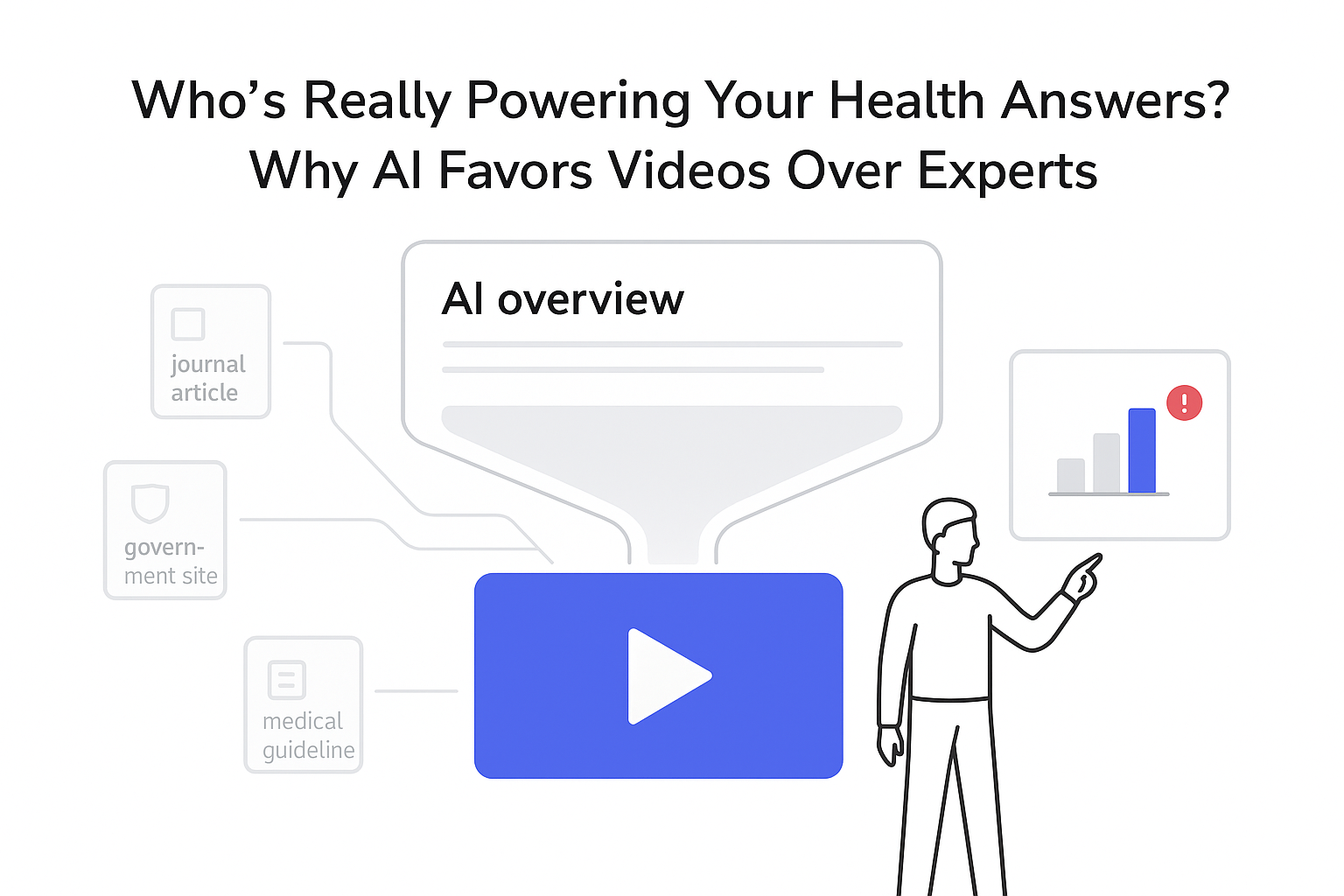
New data on Google’s AI Overviews for health, according to new research, shows a heavy reliance on YouTube and comparatively limited use of government and academic sources, based on a large German query dataset and recent investigative reporting.
Google Health AI Overviews citation patterns in German search
SEO platform SE Ranking analyzed 50,807 German-language health-related queries run from Berlin in December and found that Google’s AI Overviews appeared on more than 82% of those searches. That makes health one of the categories where users are very likely to see AI-generated summaries rather than a traditional list of links at the top of the page.
Across this dataset, AI Overviews included 465,823 total source citations. YouTube was the single most-cited domain, with 20,621 citations, or 4.43% of all references. The next most-cited domains were ndr.de (a German public broadcaster, 14,158 citations, 3.04%) and MSD Manuals (9,711 citations, 2.08%). In practice, that means the most frequently surfaced source is a general video platform with a mixture of medical institutions, individual clinicians, and non-expert creators, rather than a hospital, government health portal, or medical journal.
SE Ranking grouped sources into “more reliable” vs. “less reliable” based on organization type. Government, academic, and recognized medical institutions were treated as more reliable, while general media, forums, and broad platforms were treated as less reliable. Within this framework, 34.45% of citations came from the more reliable group, while 65.55% came from sites “not designed to ensure medical accuracy or evidence-based standards.” Academic research and medical journals accounted for just 0.48% of citations, German government health institutions 0.39%, and international government health institutions 0.35%.
To understand what users might see most often from YouTube, SE Ranking manually reviewed the 25 most-cited YouTube videos in the dataset. Twenty-four of 25 were from medically oriented channels, and 21 explicitly stated that the content was produced by a licensed or trusted source. The authors stressed that these 25 videos represent less than 1% of all YouTube links cited, so they do not characterize the long tail of content the system may reference.
Executive snapshot
- AI Overviews appeared on more than 82% of health-related Google searches in a 50,807-query German dataset.
- YouTube supplied 4.43% of all AI Overview citations (20,621 of 465,823), the highest share of any single domain.
- Only 34.45% of citations came from a “more reliable” group (government, academic, and medical organizations); 65.55% came from other types of sites.
- Academic journals, German government health institutions, and international health agencies together accounted for roughly 1.2% of all citations.
- Only 36% of AI-cited URLs ranked in the top 10 organic results for the same queries, and 74% appeared somewhere in the top 100.
One-line implication for marketers: Health visibility in Google now depends heavily on whether AI Overviews cite your content - including YouTube assets - not just on where you rank organically.
Method and source notes for the SE Ranking health AI Overview study
The primary quantitative data comes from SE Ranking, which ran a large-scale snapshot study of Google’s health-related AI Overviews in Germany. The company executed 50,807 German-language health prompts and keywords from Berlin in December, capturing:
- Whether an AI Overview was shown
- Which URLs and domains were cited within each AI Overview
- How those citations compared with the organic search results for the same queries
SE Ranking reports 465,823 total citations across all AI Overviews in the dataset, which were then classified by domain and organization type. The study also compared domain-level overlap between AI Overview citations and frequently appearing organic domains, as well as URL-level overlap and ranking positions.
In addition, the SE Ranking report incorporated separate consumer survey data about attitudes toward AI health information. It highlights that 55% of chatbot users said they trust AI for health advice, and 16% said they had ignored a doctor’s advice because an AI system recommended something different. However, the survey methodology details (sample size, recruitment, and demographics) are not specified in the summary text, which limits how far those figures can be generalized.
The Guardian published an investigation that identified specific, misleading, or unsafe AI Overview responses for health-related queries in Google Search. After publication, the outlet reported that Google removed AI Overviews for certain medical queries and issued a statement emphasizing ongoing quality work while disputing some of the investigation’s conclusions. This reporting is case-based rather than a comprehensive measurement study.
Key limitations:
- Single country (Germany) and language (German)
- One-time snapshot from December, with no trend data across months or regions
- Health query set defined by SE Ranking, not necessarily representative of all real-world health searching
- Source reliability is categorized by site type, not by page-level evidence grading
- YouTube quality assessment covers only the 25 most-cited videos, under 1% of all YouTube links cited
Findings on YouTube, government, and academic sources in Google AI Overviews
SE Ranking found that AI Overview citations only partially mirror organic rankings for health queries. At the domain level, 9 of the 10 most frequently cited domains also appeared frequently in organic results, but YouTube was a major outlier: it ranked first among AI Overview citations and only 11th in organic search. In raw counts, YouTube URLs appeared 20,621 times as AI citations versus 5,464 times as organic results. This indicates that Google’s AI module pulls YouTube content into summaries far more often than YouTube appears as a standard blue-link result for similar queries.
At the URL level, overlap was limited. Only 36% of AI-cited URLs ranked in the top 10 organic results for the same keyword, 54% appeared in the top 20, and 74% were present somewhere in the top 100 organic results. That pattern implies that AI Overviews are often assembled from URLs that are not the most prominent organic answers, even when they come from familiar domains.
SE Ranking’s reliability classification shows that two-thirds of citations originate from organizations that do not have an explicit mandate to uphold medical accuracy or evidence-based standards. Within the “more reliable” grouping, the study notes that academic research and medical journals make up 0.48% of all citations, German government health institutions 0.39%, and international government bodies 0.35%. Even assigning these organizations to the highest-trust category, they account for only a small fraction of the material that AI Overviews surface in response to health questions.
The Guardian’s reporting adds an example-driven layer to these structural findings. It documented instances in which AI Overviews presented misleading or potentially harmful medical advice, then tracked Google’s subsequent move to remove AI Overviews for certain sensitive queries. SE Ranking’s authors position their study as showing a broader pattern behind such incidents: a source mix that leans heavily on general platforms like YouTube and a wide variety of non-official sites, while giving relatively little weight to government and academic health resources at scale.
Interpretation and implications for health and search strategies
Interpretation (analyst view) - this section provides reasoned conclusions for marketers and business leaders based on the data above. These are not direct findings of the cited studies.
[Likely] AI Overviews are now a primary interface for health search in Germany
- With AI Overviews present on more than 82% of health queries in the dataset, many users will consume AI summaries before - or instead of - clicking through to traditional organic results.
- For health publishers, clinics, and insurers, visibility in AI Overviews is now a separate channel from classic SEO, and performance reporting that tracks only organic rankings may understate changes in real exposure.
[Likely] YouTube has structural visibility advantages within AI Overviews
- YouTube’s top position among AI Overview sources, combined with its more modest presence in organic rankings, suggests that Google’s AI systems treat video content - and potentially platform-level signals from YouTube - as disproportionately useful for health summarization.
- Health organizations that publish credible video content are more likely to appear in cited YouTube results than peers who focus only on text pages, which can shift competitive dynamics between hospitals, patient communities, and individual creators.
[Likely] Official and academic health information is underrepresented in AI citations
- Academic journals and government health institutions together account for roughly 1.2% of citations, despite being primary sources for evidence-based guidance.
- The reliance on general media and commercial sites for two-thirds of citations may increase legal and reputational risk for platforms and publishers when incorrect summaries appear, especially in regulated categories such as prescription drugs or high-risk interventions.
[Tentative] Traditional SEO signals are necessary but not sufficient for AI Overview inclusion
- The fact that 64% of AI-cited URLs do not rank in the top 10 organic results suggests that AI selection criteria differ meaningfully from the ranking factors governing normal blue links.
- Google may be weighting attributes such as content format (video vs. text), topical breadth, perceived author expertise, or engagement patterns on the page more heavily when assembling AI Overviews, although the study does not identify specific factors.
[Tentative] Brand risk extends beyond owned sites into third-party platforms
- Since AI Overviews frequently quote YouTube, patients may encounter health information from independent creators immediately alongside - or ahead of - hospitals and health authorities.
- For large health brands and insurers, this creates a monitoring challenge: inaccurate or misleading third-party content hosted on a platform like YouTube can be surfaced via AI Overviews in ways that impact brand perception even if the organization’s own content is accurate.
[Speculative] Regulatory and public scrutiny may push Google toward more official sources
- The Guardian’s reporting and Google’s decision to suppress some health-related AI Overviews show that external scrutiny can lead to quick changes in product behavior for sensitive topics.
- Over time, sustained pressure from regulators, professional medical bodies, and the press may drive Google to increase the share of government and academic sources in health AI Overviews. That would benefit organizations that already publish high-quality, standards-compliant content and have strong technical foundations, although there is no published roadmap from Google on future weighting.
Contradictions and gaps in the current evidence
There are several unresolved tensions in the data. SE Ranking’s analysis suggests that the majority of AI Overview citations come from sites without explicit evidence-based mandates, yet its spot check of the 25 most-cited YouTube videos showed that almost all were produced by medical channels and most clearly indicated licensed or trusted authorship. That implies that the very top tier of YouTube content surfaced by AI Overviews may be relatively well curated, while the broader long tail of YouTube citations - which constitutes more than 99% of YouTube links in the dataset - remains largely unexamined.
The German-only, one-month snapshot leaves open regional and temporal questions. Health search behavior, publisher landscapes, and regulatory expectations differ substantially across markets, and Google may adjust AI Overview behavior country by country. The study also does not measure user interaction: citation frequency does not necessarily translate to click-through, nor does it quantify how many users accept AI answers without further verification.
Finally, the consumer survey figures on trust in AI health advice (55% trusting, 16% having ignored a doctor) lack disclosed sampling details, so they should be treated as indicative signals rather than definitive measures of population behavior. Together, these gaps suggest that additional, independent audits - ideally with multi-country data and direct user behavior metrics - are needed before drawing firm global conclusions about health AI Overviews.





.svg)

.svg)
.svg)