
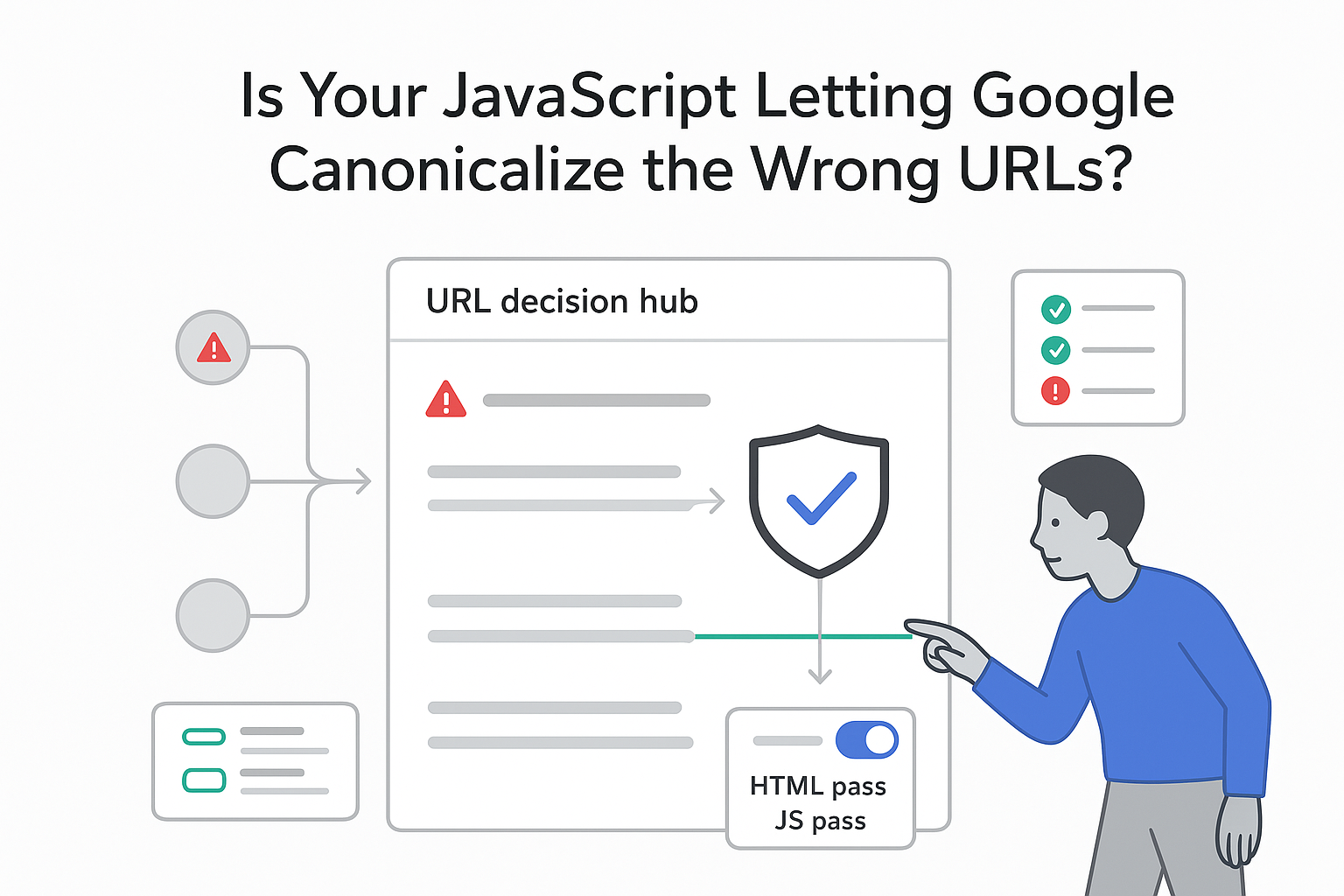
Google has updated its JavaScript SEO documentation on the Search Central site with new guidance on canonical URLs. The update clarifies how Google Search handles canonicalization for JavaScript-rendered pages during crawling and rendering, especially when sites add or modify canonical tags with client-side JavaScript.

Key details on Google's JavaScript canonical guidance
The updated JavaScript SEO basics page explains that canonicalization can occur twice during Google Search processing. First, Google evaluates canonical signals in the raw HTML response when it initially crawls a URL. It then reevaluates those signals after executing JavaScript and processing the rendered version of the page.
- Google recommends keeping the canonical URL consistent between the initial HTML and the JavaScript-rendered page.
- Conflicting canonical tags between HTML and rendered content can lead to unexpected indexing outcomes.
- Injecting or changing canonical tags with JavaScript is supported but described as not recommended.
- Multiple canonical tags on a single page can send mixed signals and cause unexpected indexing behavior.
- Google advises ensuring that only one canonical tag remains in the final rendered HTML.
The documentation outlines two main implementation patterns for JavaScript-heavy sites:
- Set the canonical tag in the server response and keep that value unchanged during rendering.
- If JavaScript must specify a different canonical URL, omit the canonical tag from the initial HTML entirely and let JavaScript add it once.
Google notes that these approaches help avoid conflicting signals between the crawl and render stages. This guidance aligns with its broader best practices for consolidating duplicate URLs.
Background on canonical URLs and JavaScript in Google Search
Google uses a two-step approach for processing many JavaScript-powered pages. In the first step, Googlebot crawls and may index the initial HTML response from the server. In the second step, Google's rendering system executes JavaScript and generates a rendered HTML snapshot.
During both steps, Google evaluates multiple signals to identify a page's preferred URL, including rel=canonical tags, internal links, sitemaps, and redirects. When these signals conflict, Google's systems may select a canonical URL that differs from the one declared on the page.
Search Central documentation has long advised placing critical metadata directly in server-rendered HTML so key signals, such as rel=canonical, are available during the initial crawl. The latest JavaScript guidance reiterates this recommendation while clarifying how supported JavaScript-based implementations should be structured to avoid inconsistent canonical signals.
Source citations
The canonical URL guidance described here is based on updates to Google's publicly available documentation and help resources, which outline how Google Search handles JavaScript rendering, canonicalization, and duplicate URLs.
- Google Search Central: JavaScript SEO basics - canonicalization section in the JavaScript SEO guide.
- Google Search Central: best practices for consolidating duplicate URLs.
- Google Search Console Help: guidance on using the URL Inspection tool to compare raw and rendered HTML views.







.svg)

.svg)
.svg)