
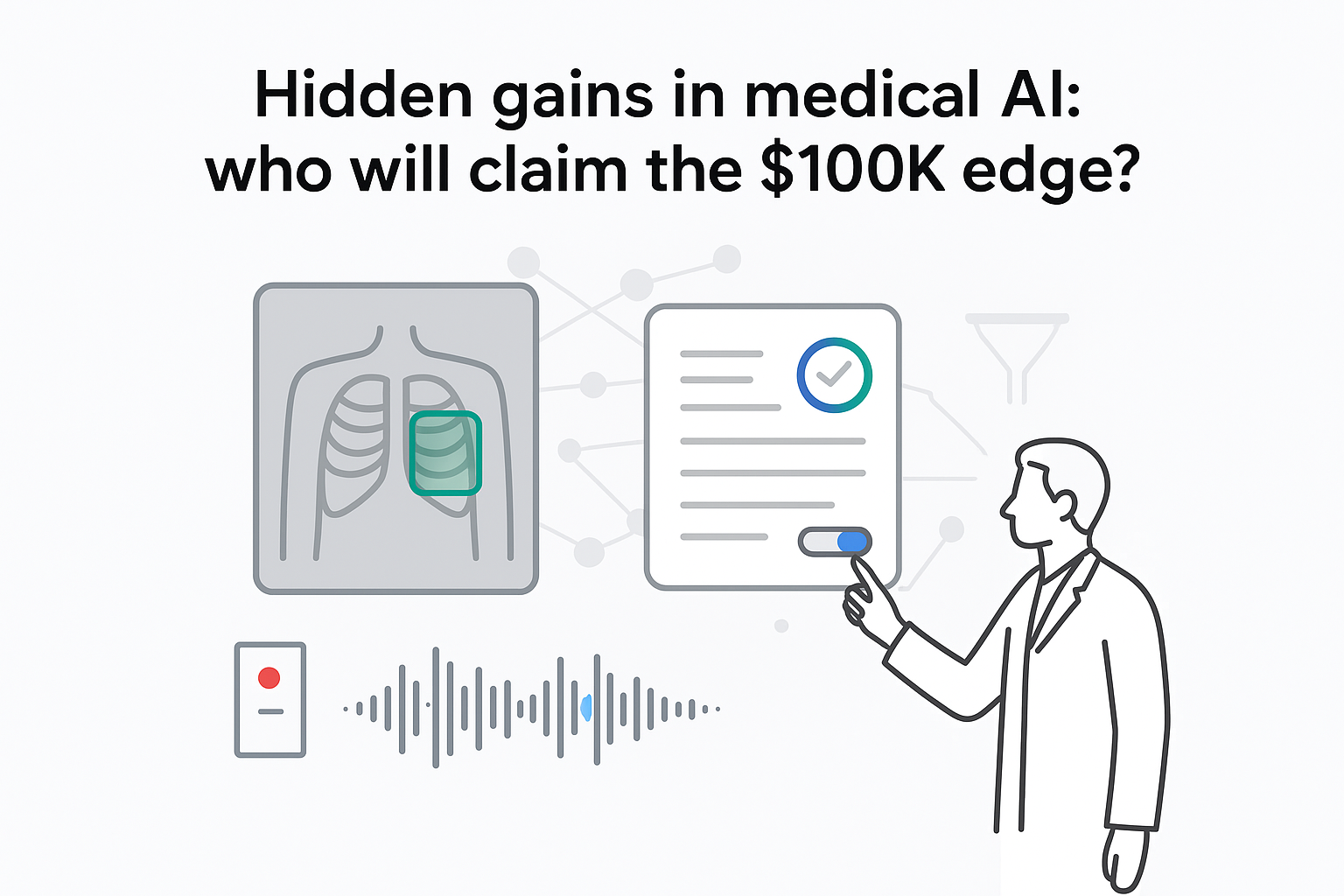
Google Research announced MedGemma 1.5 4B and the MedASR speech model on January 13, 2026. The update adds new capabilities for medical imaging, text and speech workflows and launches a MedGemma Impact Challenge on Kaggle for developers building with the MedGemma family. The release comes as healthcare organizations accelerate AI adoption, with some estimates suggesting uptake at roughly twice the rate of the broader economy.
Key Details
MedGemma 1.5 4B is an open multimodal model for medical text and images released under Google's Health AI Developer Foundations program. The 4 billion parameter model is optimized for lower compute environments, including some offline use cases. The earlier MedGemma 1 27B parameter model remains available for text-heavy workloads that benefit from a larger parameter count.
- On internal CT imaging disease classification tasks, MedGemma 1.5 reached 61 percent accuracy, compared with 58 percent for MedGemma 1.
- On internal MRI disease finding tasks, MedGemma 1.5 reached 65 percent accuracy, versus 51 percent for MedGemma 1.
- For chest X-ray anatomy localization on the Chest ImaGenome dataset, intersection over union increased from 3 percent to 38 percent. On the MS-CXR-T chest X-ray time-series dataset, macro accuracy improved from 61 percent to 66 percent.
- Across internal image tests for chest X-ray, dermatology, histopathology imaging and ophthalmology, accuracy increased from 59 percent to 62 percent. Lab report data extraction macro F1 on an internal test set rose from 60 percent to 78 percent.
- On the MedQA medical exam dataset, MedGemma 1.5 4B reached 69 percent accuracy. On the EHRQA electronic health record question answering dataset, accuracy increased from 68 percent to 90 percent.
- MedASR is an automated speech recognition model fine tuned for medical dictation and spoken prompts to MedGemma. On chest X-ray dictations from the EGD-CXR corpus, Whisper large-v3 reached a 12.5 percent WER, while MedASR reached 5.2 percent on the same dataset.
- On an internal multi-specialty medical dictation test set, Whisper large-v3 recorded a 28.2 percent word error rate, compared with 5.2 percent for MedASR.
- Google states that MedGemma 1.5, MedASR and other Health AI Developer Foundations models are free for research and commercial use, subject to the program's terms of use and prohibited use policy.
The models are distributed through Hugging Face, Google Cloud's Vertex AI Model Garden entries for MedGemma and MedASR, and the Health AI Developer Foundations site. MedGemma on Google Cloud now includes full DICOM support for medical imaging workflows.
The MedGemma Impact Challenge on Kaggle offers 100,000 dollars in prizes for projects built with the MedGemma model family.
Background Context
Google introduced the MedGemma collection in 2025 within its Health AI Developer Foundations program. These open models support medical imaging and text tasks and are hosted on the Hugging Face collection and Google Cloud through Vertex AI. Related models in the ecosystem include MedASR and the MedSigLIP image encoder.
Google reports strong community interest, including millions of downloads and hundreds of model variants published on Hugging Face. Many community-built variants of MedGemma are already available, alongside the official MedGemma 1.5 model card and other documentation.
Google positions these Health AI Developer Foundations models as starting points for research and development. Outputs require validation, adaptation and independent verification, and the models are not cleared to directly guide diagnosis, patient management, treatment recommendations or other clinical decisions. According to Google, training and evaluation use a mix of public and private de-identified datasets, and use is governed by the program's terms of use and prohibited use policy.
Source Citations
- Google Research blog announcement on MedGemma 1.5 and MedASR
- MedGemma 1.5 4B model card (Google Developers)
- MedASR model card (Google Developers)
- MedGemma 1.5 4B repository (Hugging Face)
- MedASR repository (Hugging Face)
- MedGemma Impact Challenge overview (Kaggle)
- Health AI Developer Foundations site (Google)
- Health AI Developer Foundations terms of use and prohibited use policy





.svg)

.svg)
.svg)