
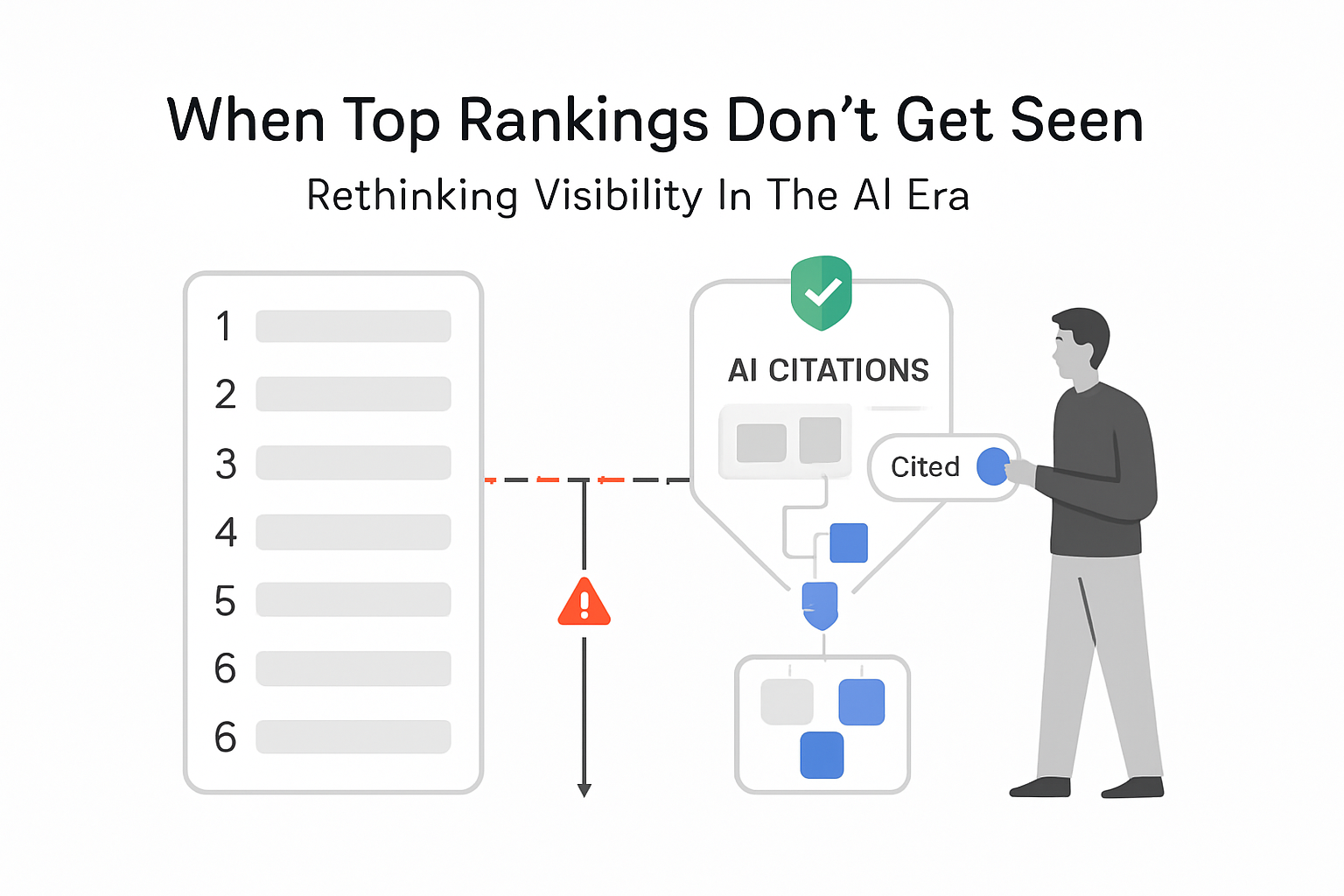
Business visibility inside AI assistants depends not only on Google rankings but also on how large language models (LLMs) select and cite sources. New research from Search Atlas, summarized by Search Engine Journal, quantifies how often sites that rank in Google also appear as citations in ChatGPT, Gemini, and Perplexity. The data shows that overlap is modest and highly uneven across models, which affects how SEO work translates into AI-driven exposure.
Google rankings and LLM citations
Gap between Google rankings and LLM citations in ChatGPT, Gemini, and Perplexity
Executive snapshot of AI search visibility vs Google rankings
- The study matched 18,377 queries between Google and LLM outputs to compare which domains and URLs appeared in each. [S1][S2]
- Perplexity showed a median domain overlap of roughly 25-30% with Google and a median URL overlap near 20%. Overall, 43% of Perplexity domains cited in answers also appeared in Google results. [S1][S2]
- ChatGPT’s median domain overlap with Google was around 10-15%, with URL overlap usually below 10%. Only about 21% of its cited domains also ranked in Google for matched queries. [S1][S2]
- Gemini was the least aligned with Google. It shared just 160 domains with Google, around 4% of domains appearing in Google’s results, although those domains accounted for 28% of Gemini’s citations. [S1][S2]
- The dataset was heavily skewed toward Perplexity queries (89% of matched queries), with OpenAI at 8% and Gemini at 3%. [S1][S2]
Implication for marketers: SEO that improves Google rankings tends to track more closely with Perplexity visibility than with ChatGPT or Gemini, but rankings alone do not secure LLM citations.
Study methods and data sources for AI search citations
Search Atlas, an SEO software company, compared how often domains and URLs from Google search results appeared as citations in responses from three AI systems: OpenAI’s GPT-based interface (ChatGPT), Google Gemini, and Perplexity. [S1][S2] The company collected queries to each AI system and to Google, then used semantic similarity scoring with OpenAI’s embedding model to match pairs of queries that expressed similar information needs. Matches were accepted at or above an 82% similarity threshold, resulting in 18,377 matched query pairs. [S1][S2]
For each pair, the study compared:
- Domain-level overlap - whether the same domains appeared in Google results and in the LLM’s cited sources
- URL-level overlap - whether the exact same URLs appeared in both lists
The analysis covered a two-month window in 2025 (dates not specified in the summary) and focused on a recent snapshot rather than long-term trends. [S1] Perplexity accounted for 89% of the matched queries, OpenAI for 8%, and Gemini for 3%, which gives the Perplexity results much more statistical weight than the others. [S1][S2]
Key limitations include: lack of detail on query topics, user geography, and the exact depth of Google results used for comparison; reliance on semantic matching rather than identical queries; and the heavy skew toward Perplexity queries, which reduces comparability across platforms. [S1]
Sources:
- [S1] Matt G. Southern, “New Data Finds Gap Between Google Rankings And LLM Citations,” Search Engine Journal, 2025.
- [S2] Search Atlas, “How GPT Results Differ From Search Engine Results,” company research report, 2025 (as cited in [S1]).
Key findings on LLM citation patterns vs Google search results
Search Atlas reports that Perplexity, ChatGPT, and Gemini each align with Google at different levels and in different ways. [S1][S2]
Perplexity - closest to traditional search
Perplexity performs live web retrieval, and its citation behavior reflects that. Across 18,377 matched queries, Perplexity showed:
- Median domain overlap with Google of around 25-30%
- Median URL overlap close to 20%
- 18,549 domains shared with Google, representing about 43% of all domains Perplexity cited in answers [S1][S2]
This suggests that almost half of the domains Perplexity cites are also present in Google’s results for similar queries, though still a minority of its total citations for any given query.
ChatGPT - lower overlap and more selective sourcing
ChatGPT’s overlap with Google was considerably lower:
- Median domain overlap generally around 10-15%
- URL-level matches usually below 10%
- 1,503 domains shared with Google, representing about 21% of the domains ChatGPT cited [S1][S2]
This indicates that only about one-fifth of ChatGPT’s cited domains for these queries were domains that also appeared in Google’s results, and exact URL matches were rarer. The model appears to draw on a narrower set of sources compared with Perplexity and less directly from current search rankings. [S1]
Gemini - inconsistent overlap with search
Gemini showed the least consistent relationship with Google rankings:
- Some Gemini responses had almost no overlap with Google results
- Others were more aligned, but overall overlap remained low
- Across the dataset, Gemini shared 160 domains with Google, about 4% of all domains appearing in Google’s results, yet those 160 domains made up 28% of Gemini’s citations [S1][S2]
This pattern implies Gemini often reuses a relatively small core of domains that also appear in Google, while many domains that rank in Google do not receive citations from Gemini at all in the tested queries.
General visibility takeaway
Across all models, the study concludes that ranking in Google does not guarantee being cited in LLM outputs. Perplexity’s citations track search visibility more closely than the others, likely due to its retrieval-centric design. ChatGPT and Gemini rely more heavily on pre-trained knowledge and selective retrieval, with relatively low URL-level overlap against Google even when domain overlap exists. [S1]
Marketing implications of divergent Google and LLM visibility
Likely: SEO for Google translates best to Perplexity, but only partially
Because Perplexity shows 25-30% median domain overlap and 20% URL overlap with Google, and 43% of its cited domains also appear in Google’s results, investments that raise Google rankings are relatively more likely to improve visibility inside Perplexity answers. [S1][S2] However, the majority of Perplexity citations still do not match Google results for a given query, so ranking alone is not a complete proxy for AI exposure.
Likely: ChatGPT and Gemini use narrower, more curated source sets
With only 21% of ChatGPT’s cited domains and 28% of Gemini’s cited domains overlapping with Google-ranking domains in the sample, these systems appear to favor a smaller group of sources. [S1][S2] For businesses, this suggests that domain authority, topical depth, and possibly historical prominence may matter at least as much as current position on a search results page.
Tentative: LLM citation strategies need to be model-specific
Given the gap between Perplexity’s relatively search-like behavior and the more selective patterns of ChatGPT and Gemini, approaches that target “AI visibility” as a single goal may miss important differences. For example, content that aims to be crawled and retrieved in real time may align better with Perplexity, while content designed to be highly authoritative, structured, and widely referenced across the web may be more relevant for model training and selective retrieval in ChatGPT and Gemini. This interpretation is tentative because the study does not measure underlying ranking or citation algorithms directly. [S1][S2]
Tentative: Google rankings remain necessary but not sufficient
The data indicates that Google-ranking domains are regularly used as sources by all three models, but with low to moderate overlap rates and strong variation by platform. [S1] A reasonable reading is that search visibility still supports LLM visibility but does not secure it, especially for ChatGPT and Gemini. Additional factors such as clarity of page structure, machine-readable metadata, and reputation signals across the wider web may be influencing which sources the models favor.
Speculative: Brand and domain trust signals may have outsized impact in LLMs
Gemini’s pattern - only 4% of Google-ranking domains but 28% of its citations - suggests that once a domain is selected as “trusted,” it may be reused frequently. [S1] This could give large publishers or long-established brands an advantage inside some AI assistants that exceeds their raw share of Google rankings. This is speculative, since the study does not break results down by brand type or authority metrics.
Data gaps and uncertainties in current LLM citation research
Several constraints limit how far these findings can be generalized:
- Query mix and intent are not disclosed. The study does not break out commercial, informational, local, or transactional intents, so overlap rates may differ by category in ways the summary does not show. [S1]
- Google comparison depth is unclear. The number of Google results used to measure domain and URL overlap is not specified. Overlap figures might change if only the top 3, top 10, or a deeper set of URLs were considered. [S1]
- Dataset is heavily skewed to Perplexity. With 89% of matched queries coming from Perplexity, its overlap metrics are much more stable than those for ChatGPT and Gemini, which are based on smaller samples (8% and 3%). [S1] That makes cross-platform comparisons less precise.
- Only a short time window is covered. The two-month sampling period gives a snapshot of behavior but does not reveal whether overlap patterns are stable over time or sensitive to model updates and index refreshes. [S1]
- No direct quality or outcome metrics. The research does not evaluate whether higher overlap with Google correlates with better answer quality, user satisfaction, or downstream business results.
For marketers and business leads, these gaps mean the numbers should be treated as directional evidence about how LLMs relate to search, rather than as fixed rules. Additional, transparent datasets - especially with clearer breakdowns by industry, intent, and geography - would help refine strategy.
Data appendix: summary of AI search overlap metrics
| Model | Share of matched queries in dataset | Median domain overlap with Google | Median URL overlap with Google | Shared domains with Google | Shared domains as % of model’s cited domains | Shared domains as % of domains in Google results* | Notes |
|---|---|---|---|---|---|---|---|
| Perplexity | 89% | ~25-30% | ~20% | 18,549 | ~43% | Not specified | Live web retrieval, closest to search patterns [S1][S2] |
| ChatGPT | 8% | ~10-15% | <10% | 1,503 | ~21% | Not specified | More selective sourcing, lower overlap [S1][S2] |
| Gemini | 3% | Highly variable, often low | Not specified | 160 | 28% | ~4% | Reuses a small subset of Google-ranking domains [S1][S2] |
*Percentage of all domains that appeared in Google’s results for the matched queries, as reported in the summary for Gemini (4%). Equivalent figures for Perplexity and ChatGPT were not provided. [S1]





.svg)

.svg)
.svg)