
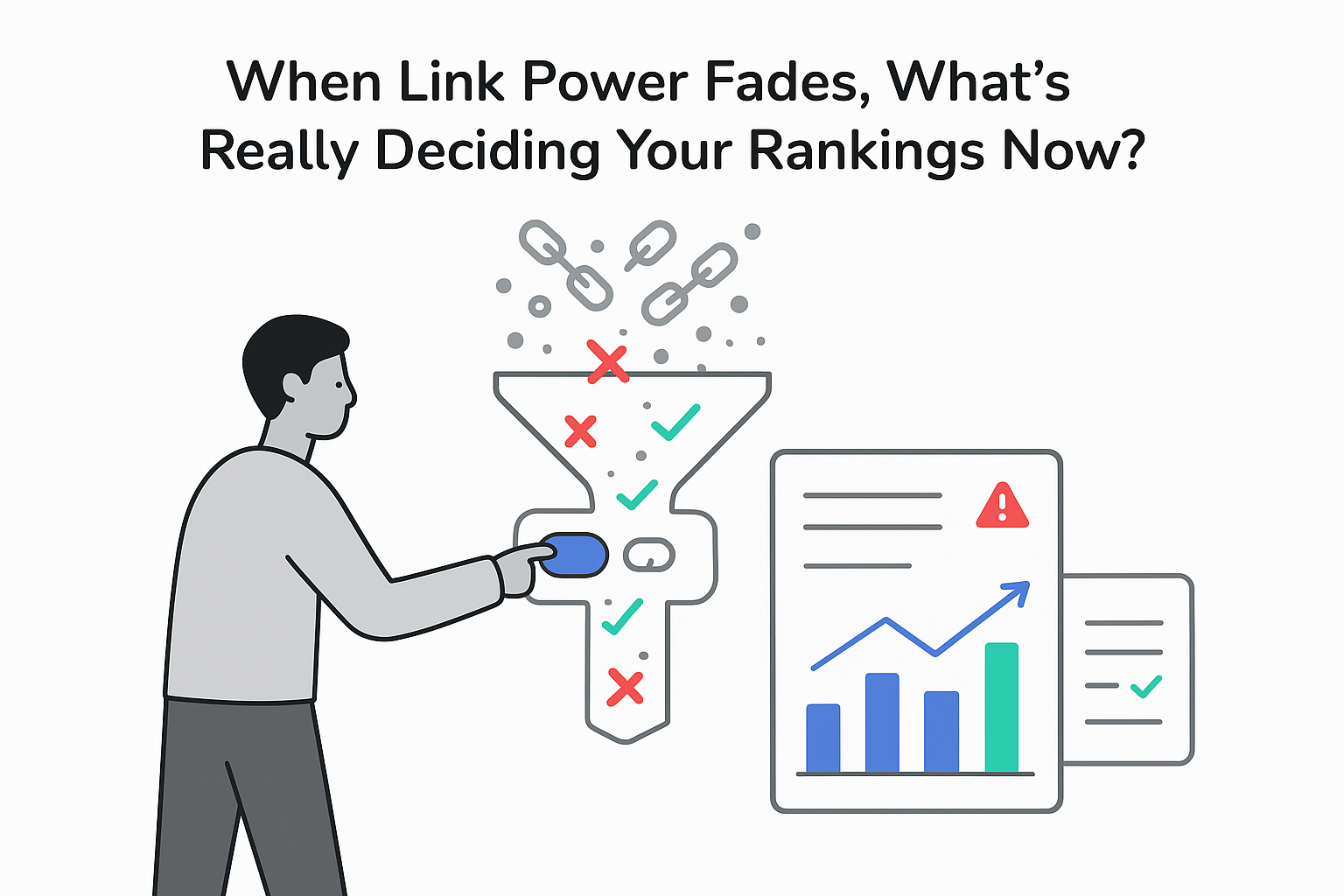
Links are no longer the blunt ranking lever they were in early Google. As content understanding, spam detection, and AI-based search mature, the role of links is being repriced. Using Roger Montti's recent work as a starting point, this analysis examines how links now function more as trust and topical signals than as raw ranking fuel, and what that shift means for SEO, AI search visibility, and marketing planning.
How the ranking power of links is shifting in SEO and AI search
Thesis: links increasingly act as filters for trust and topical fit within a "reduced link graph", while high-quality content and on-page signals do most of the ranking work. The main question: should marketers still invest heavily in link building, and if so, with what objective?
Montti argues that:
- Search engines can rank many pages based on content alone; links help confirm legitimacy and relevance rather than act as standalone drivers of results.
- Search systems maintain a reduced link graph that excludes spammy or low-quality sites from passing value.
- Outbound links can "poison" a site's standing and cause it to lose the ability to transmit PageRank-like signals.
- Citations and mentions (including from sponsored, nofollowed content) are increasingly influential in AI-powered surfaces like Google's AI Overviews. [S1]
This aligns with Google's statements that links are "just one of many signals" and no longer a top-three factor. [S2][S4] The practical change is that link building's primary job is shifting from pushing positions to keeping your domain inside a trusted network where strong content can compete.
Key takeaways for SEO and link building
-
Treat links as eligibility and trust, not a ranking shortcut
Prioritize links that signal your site is real, safe, and clearly about its topic. Expect modest direct ranking movement compared with a decade ago, especially for mid-tail queries.
-
Audit outbound links as aggressively as inbound
Any connection to spammy, hacked, or "casino/crypto/loan" type neighborhoods can harm perceived trust and potentially exclude your site from the trusted link graph, reducing the value of both your links and links to you.
-
Shrink your link-building target list and raise the bar
With fewer active, editorially strong sites, scaled outreach is low yield. Focus resources on a smaller set of domains with clean link profiles, real audiences, and topical relevance.
-
Use sponsored and PR content for AI citations, not PageRank
Clearly labeled, nofollowed sponsored articles can still be cited in AI Overviews and AI modes, giving visibility and brand mentions without link risk. Measure them like PR or advertising, not as link equity.
-
Integrate link strategy with brand and content strategy
Plan links to support clear topical clusters and brand authority. Ask: "Does this placement help machines and humans see us as the right answer for this topic?" rather than "How many links can we collect this month?"
Situation snapshot: links, rankings, and AI Overviews
This analysis was triggered by Roger Montti's Search Engine Journal article "Let’s Be Honest About The Ranking Power Of Links", which argues that:
- Search engines now have enough content and semantic understanding to rank many queries without relying heavily on links.
- Links are still important, but mainly to: (a) confirm that a site is legitimate and high quality, and (b) clarify which topic a page belongs to. [S1]
- The "reduced link graph" model means spammy sites are excluded from the graph used for ranking and link propagation, isolating them in their own spam clusters. [S1]
Undisputed facts from public sources and history:
- Google's documentation describes links as a ranking signal, but emphasizes relevance and natural acquisition, and warns against link schemes. [S2][S3]
- Google has multiple link spam systems designed to neutralize unnatural links and, in some cases, prevent sites from passing any link value. [S3]
- In 2023, Gary Illyes from Google stated that links are "not in the top 3" ranking signals anymore, implying a relative decline in their weight versus other signals such as content quality and user satisfaction. [S4]
- Google's AI Overviews and other AI surfaces cite web content, including news, blogs, and some sponsored or partner content, as sources for their generated answers. [S1]
Within this context, Montti's core framing - that links are shifting from "power lever" to "eligibility and trust gate" - is consistent with both Google's public stance and observed practice, though the exact weights remain opaque.
Breakdown and mechanics: link signals, reduced link graph, and trust
1. Reduced link graph and link distance
Search engines conceptually maintain:
- Full web link graph: all pages and links they crawl.
- Reduced link graph: a filtered subset where spammy, hacked, or policy-violating sites are removed or heavily discounted. [S1][S3]
Simplified flow: spammy domains detected - removed or heavily dampened from the graph - they stop passing meaningful value - sites that mainly receive links from these domains lose effective link equity.
Distance-based ideas (in research like TrustRank) suggest that being "closer" to trusted seed sites in the link graph increases perceived reliability, while being connected primarily to low-trust clusters reduces it. Montti's "poisoned site" framing for domains with bad outbound links is consistent with this model. [S1]
2. Outbound links as negative quality signals
Outbound links are data points about what you endorse. Patterns that tend to trigger spam systems include:
- Sitewide or repeated links to casinos, adult, payday loans, hacked sites, or obvious link farms.
- Pages selling "guest posts" or "sponsored links" without proper labeling or nofollow/rel attributes.
- Sudden bursts of outbound links to unrelated, commercial targets.
Mechanically: low-quality outbound links - domain flagged as risky or part of spam clusters - domain's ability to pass value reduced or removed - any incoming links you have from strong sites help you less than they could have.
3. Content-first ranking with link-based gating
Modern ranking systems use large-scale machine learning and language models to:
- Assess topical relevance and coverage.
- Estimate content quality, expertise, and helpfulness.
- Model likely user satisfaction from behavioral data such as clicks, dwell time, and returns to the results page.
Links now plug into this system more as:
- Trust and inclusion signals: "Is this a legitimate site that belongs in the main index for this topic?"
- Topic classification aids: "Given who links to this and where it links out, what vertical and intent cluster does it fit into?"
Evidence includes:
- Google's repeated stance that high-quality content, not link count, is the primary lever. [S2]
- Reduced correlation over time between raw link metrics and rankings, especially outside high-competition queries, based on multiple industry studies (directionally, not as a fixed percentage).
4. Citations and mentions in AI search
AI Overviews and similar systems typically:
- Retrieve documents relevant to a query.
- Generate a summary using an LLM-style model.
- Attach citations to show sources.
Montti observes that sponsored articles with nofollowed links can still be selected as citations. [S1] For search ranking, the nofollow attribute tells Google not to treat those links as a signal. For AI systems, the text and brand mention still contribute to:
- Content mentions - association between brand and topic in training and retrieval systems.
- Higher chance of being cited or recognized as a relevant entity in AI outputs.
So even when link equity is neutralized, mentions still have value in AI discovery.
Impact assessment for organic SEO, AI search, and paid media
Organic SEO: site owners and content marketers
Direction: links still matter, but as a trust and context layer, not a direct throttle on rankings.
Winners:
- Sites with strong, useful content that naturally earns links and mentions from clean, relevant domains.
- Brands with coherent topical focus, where new content clearly fits into existing authority clusters.
Losers:
- Sites relying on paid guest posts, manipulative anchor text, or high-volume outreach on thin content.
- Domains selling or trading outbound links, which risk being quietly excluded from the reduced link graph.
Actions and watchpoints:
- Run periodic outbound link audits; remove or nofollow anything that looks transactional, irrelevant, or low trust.
- When doing outreach, screen prospects for spammy outbound patterns such as casino, adult, and obvious link schemes. Avoid those domains regardless of their metrics.
- Expect diminishing returns from campaigns that produce large volumes of medium-quality links; aim for fewer, stronger, contextually perfect placements.
- Track ranking movements alongside link acquisition. If new links consistently fail to influence performance, assume that domain cluster has little to no passing power.
AI search and AI Overviews
Direction: citations and entity recognition matter more than raw link equity.
Winners:
- Brands mentioned in authoritative content that AI systems consider safe and informative.
- Sites that publish substantial, topic-focused resources likely to be retrieved as inputs for AI answers.
Losers:
- Sites that only participate via paid links in low-quality guest networks, which are less likely to be surfaced or trusted by AI modules.
Actions and watchpoints:
- Evaluate PR, sponsored content, and thought-leadership placements for their likelihood to be cited (clear topic fit, strong domain, editorial quality), not just referral traffic.
- Ensure sponsored content uses proper disclosure and nofollow or rel attributes, so it cannot trigger link spam issues while still contributing mentions.
- Monitor where your brand appears in AI Overviews (manually or via tools) and map those citations back to source pages to see which channels or partnerships tend to feed AI.
Paid media and broader marketing operations
Direction: budgets that were historically aimed at "SEO-only link building" may perform better when reclassified as PR or brand spend and measured accordingly.
Winners:
- Teams that integrate SEO, PR, and paid content promotion under a single planning framework, prioritizing placements that work for brand, referral traffic, and search or AI signals.
Losers:
- Siloed SEO teams judged solely on link count or DA/DR metrics, without regard to actual organic performance or AI visibility.
Actions and watchpoints:
- Move away from KPIs such as "links per month" to blended metrics: share of links from clean, topical domains; growth in non-branded visibility; AI citation frequency.
- When buying sponsored content, budget and brief it as a brand or PR play first. Treat any SEO or AI impact as upside, not the primary justification.
Scenarios and probabilities for future link-based ranking power
Base case - links decline slowly but stay as trust and inclusion filters (Likely)
- Probability: Likely (about 60%).
- Description: Google continues to improve content and user-satisfaction modeling, while keeping links as a supporting signal to decide which sites are safe and credible for each topic. Link spam systems stay active, and the reduced link graph concept remains core.
- Implications: keep investing in selective link acquisition and outbound-link hygiene, but allocate more effort to content depth, UX, and brand building.
Upside for high-quality brands - citations gain more weight in AI and search (Possible)
- Probability: Possible (about 25%).
- Description: As AI Overviews mature, Google leans more on entity-level trust, source reliability, and citation patterns. Mentions in trusted sources (editorial and clearly disclosed sponsored) strengthen brand-level authority signals more than classic anchor-text links.
- Implications: increase focus on digital PR, expert commentary, and high-quality sponsored thought pieces. SEO teams work closely with communications to seed brand mentions in the right contexts.
Downside - aggressive spam pruning shrinks the usable link graph (Edge)
- Probability: Edge case (about 15%).
- Description: Under pressure to reduce spam and misinformation, Google tightens thresholds so that more domains lose the ability to pass value. Some legitimate smaller sites with messy historic link neighborhoods get caught in the blast radius.
- Implications: sites with any history of link selling, paid guest posting, or dubious outbound linking must clean up aggressively. Smaller publishers should avoid monetization models that sell outbound links, or risk being sidelined from the graph that matters.
Risks, unknowns, and limitations of this link-focused analysis
- Opaque algorithms: Google does not disclose exact weights for links versus other signals. Statements about "not top 3" are directional, not precise. [S4] The interpretation that links mostly act as trust or inclusion filters is logically consistent but not confirmed in detail.
- Vertical variation: some sectors (medical, finance, legal, product reviews) may rely more on authority and trust signals, where links and citations carry higher relative weight than in low-stakes informational queries. This analysis treats the web broadly; your sector may deviate.
- Measurement noise: isolating the impact of links from content changes, technical fixes, and SERP layout differences is difficult. Individual case studies often conflict because of confounding variables.
- AI search in flux: Google's AI Overviews and AI modes are still evolving; citation behavior, traffic impact, and inclusion criteria may change quickly. Conclusions about future value of citations are partly speculative.
- Potential falsifiers: if controlled tests repeatedly show that adding modest numbers of high-quality links reliably moves pages from page two to top positions, even with no content or UX change, that would argue for a stronger direct ranking role than presented here. Likewise, if outbound-link patterns prove to have little correlation with ranking or visibility, the "poisoned site" concern would be overstated.
Sources
- [S1]: Roger Montti, 2025, Search Engine Journal article - "Let’s Be Honest About The Ranking Power Of Links."
- [S2]: Google Search Central, 2023, documentation - "Search Essentials (formerly Webmaster Guidelines)."
- [S3]: Google Search Central, 2023, documentation - "Spam policies for Google web search" (sections on link spam and unnatural links).
- [S4]: Search Engine Journal, 2023, news coverage - "Google: Links Are Not a Top 3 Ranking Signal" (reporting remarks by Gary Illyes at a conference).
Validation: this analysis states a clear thesis, explains the mechanics of link signals and reduced link graphs, contrasts official and practitioner views, and lays out channel-specific impacts, scenarios with probabilities, and limitations. Recommendations are framed in terms of concrete strategic shifts around link quality, outbound-link hygiene, and AI citation planning.





.svg)

.svg)
.svg)