
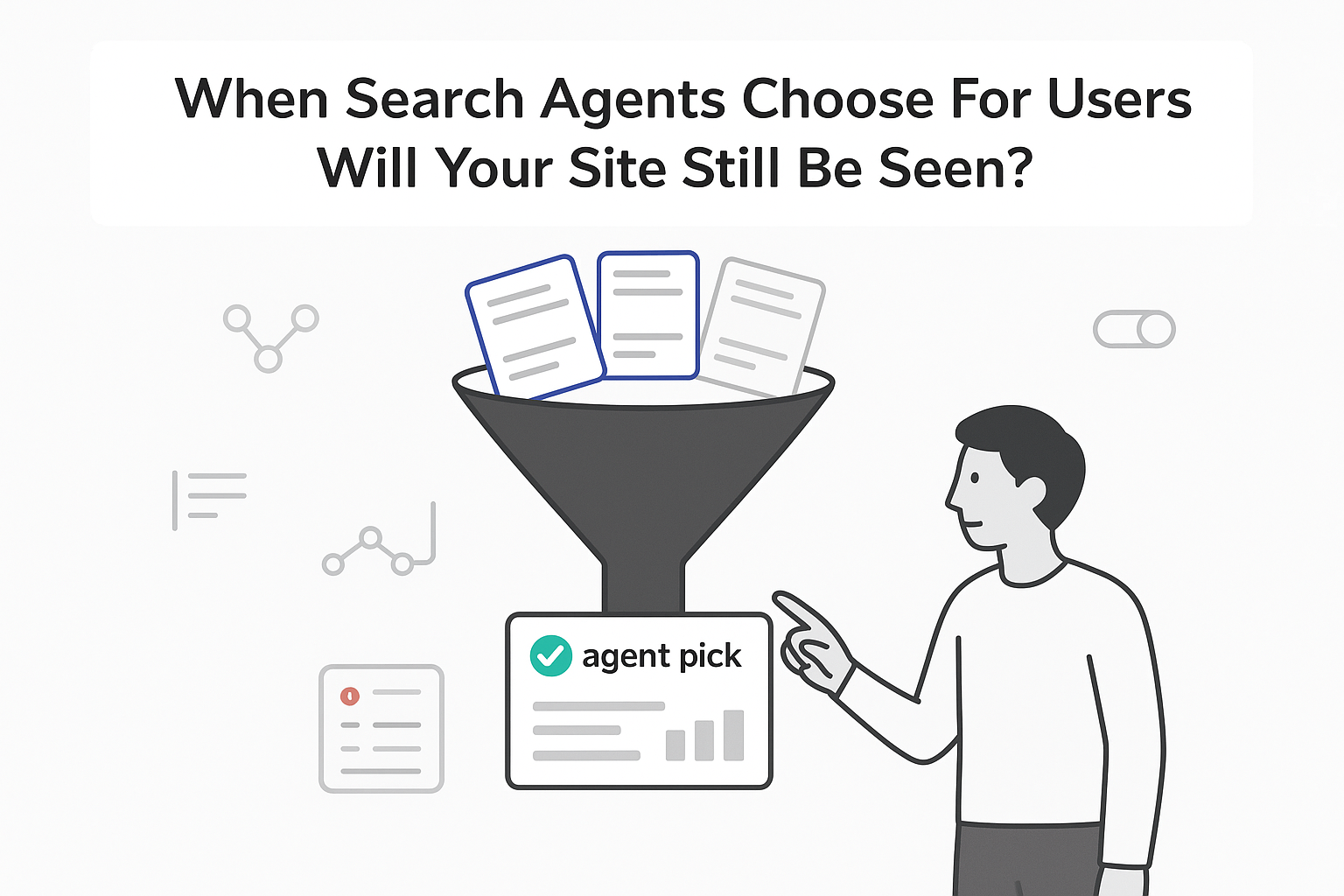
Google's new SAGE research is not a product launch, but it does show how Google is thinking about "deep research" agents: they sit on top of classic search rankings and reward pages that let an agent short-circuit multi-step tasks. The key question is how this will reshape which content wins visibility as agentic search rolls out.
Key Takeaways from Google SAGE agentic AI for SEO
SAGE (Steerable Agentic Data Generation for Deep Search with Execution Feedback) is a system Google uses to create hard, multi-step search questions for training AI agents [S1].
- Deep research agents still start from classic search. The SAGE agent solves tasks mostly using the top 3 Google results for each sub-query, so ranking in the top 3 for decomposed sub-questions becomes the main lever for being visible to agents [S1][S2].
- Comprehensive but tightly on-topic pages gain value. About 35% of "failed" deep questions were solved via information co-location on a single page, which is a failure for training but a win state for a live agent and the site that hosts that page [S1][S2].
- Topic clusters that answer several sub-questions per page align better with agent behavior than thin one-keyword pages; they increase the odds that a single query retrieves enough information to end the agent's search.
- Risk profile shifts toward more zero-click answers for complex queries and a higher chance that a small set of authorities dominate agent-generated responses.
- Practically, marketers should tighten a "top 3 or irrelevant" mindset for priority keywords and design content with deliberate co-location of key facts, while still keeping UX and topical focus intact.
Situation Snapshot: Google SAGE agentic AI research and SEO context
Google published the research paper SAGE: Steerable Agentic Data Generation for Deep Search with Execution Feedback on January 26, 2026 as an academic-style description of a dataset generator for training "deep search" agents [S1]. It does not announce a public product, but it uses live Google search results (via the Serper API) and is clearly aligned with Google's ongoing AI Overviews and agentic research.
Key factual points from the paper and Roger Montti's write-up on Search Engine Journal (he also publishes at Martinibuster.com) [S2]:
- Existing QA datasets such as Musique and HotpotQA needed on average 2.7 and 2.1 searches per question, while Natural Questions (NQ) needed about 1.3 searches [S1][S2]. These were too shallow to train deep research agents.
- SAGE uses two agents: one generates challenging questions, the other attempts to solve them by issuing multiple search queries and visiting results, mostly from the top 3 Google listings per query [S1].
- If the solver agent answers too easily or incorrectly, its search trajectory (queries, clicked URLs, steps) is fed back, and the question is revised so that shortcuts are removed [S1].
- Four shortcut types explain why many questions did not need deep research: information co-location (35%), multi-query collapse (21%), superficial complexity (13%), and overly specific questions (31%) [S1][S2].
- Montti notes that while these are "failures" for dataset construction, they describe exactly how a live agent would try to solve problems efficiently, giving SEO-relevant signals [S2].
Officially, Google frames SAGE as methodology research. The SEO community is reading it as a window into how any future deep research or agentic search feature will source and sequence web content.
Breakdown & Mechanics of SAGE deep search agents
At a high level, SAGE can be thought of as:
Question generator → Solver agent using Google search → Execution trace feedback → Revised question set.
Mechanics:
- A generator model creates a complex question designed to require multiple reasoning steps and multiple web searches.
- A separate search agent receives the question and is allowed to issue a series of queries to a Google-like API (Serper), seeing mainly the top 3 results per query and reading those pages [S1].
- The agent either answers correctly (with some minimal search depth) or fails. Its execution trace - which queries it used, what pages it opened, and how many steps were involved - is logged.
- If the agent solved the task using too few searches or via an obvious pattern, the generator model is informed of the specific shortcut, and the question is rewritten to avoid that shortcut.
The four shortcut types are central:
- Information co-location (35%): multiple required facts happen to sit on one page.
- Multi-query collapse (21%): one clever query retrieves pages that cover several sub-questions at once.
- Superficial complexity (13%): questions that look hard to humans but are trivial for a search engine to answer directly.
- Overly specific questions (31%): queries that already contain so many constraints that the first search almost always finds the answer.
SAGE's goal is to remove these shortcuts for training. In production, however, a well-designed agent will seek exactly these shortcuts to cut cost and latency, which is where the SEO angle starts.
Impact Assessment for organic search, content, paid, and operations
Organic SEO and content architecture
Direction and scale:
- Direction: tilt toward pages that can answer multiple related sub-questions within a topic, while still matching specific intents.
- Scale: high impact for competitive informational queries likely to trigger deep research agents; moderate for simple transactional terms.
Who benefits:
- Sites already ranking in the top 3 for core informational queries.
- Brands with in-depth, topic-focused content hubs where supporting data (definitions, dates, formulas, examples) lives close to primary explanations.
Who loses:
- Thin pages that only answer one fragment of a broader question.
- Sites relying on "one keyword, one micro-page" architectures where crucial facts are scattered across many URLs.
Mechanically, agents decompose a user's broad question into several atomic queries. If each query pulls the top 3 Google results, and an average deep task needs 4-6 hops (assumption based on "more than 4" being their training gap [S1]), the agent might consult roughly 12-18 slots. If a single page appears for multiple sub-queries due to information co-location, it can occupy several of those slots and dominate the agent's evidence set.
Practical content shifts:
- Where it is natural, consolidate scattered FAQ-style facts and supporting tables into the main evergreen guide instead of separate thin pages.
- Structure longform content so that each major sub-question (the kinds of things a human might ask as follow-ups) has a clearly labeled section that an agent can target with a query.
- Maintain topical focus; SAGE's failures with superficial complexity imply that agents and search can ignore filler and jump straight to the factual snippet that matches the sub-query.
Paid search and commercial outcomes
SAGE itself does not mention ads, but the mechanics provide directional clues.
Near-term impact (speculative):
- If deep research agents are rolled into AI Overviews and similar features, more high-depth informational tasks may be answered on the results page, pushing some top-funnel research traffic away from clicks. That is negative for both organic and generic non-brand paid campaigns.
- For advertisers, branded and high-intent queries where the agent's job is primarily navigational should be less affected. Paid search may retain stronger value in those zones.
Medium-term patterns to watch (speculative):
- Ad placements might appear inside or adjacent to agent responses, re-pricing some informational inventory away from standard text ads.
- If complex journeys shrink from many shallow queries to fewer in-depth conversations, impression counts for broad informational keywords could drop, but remaining queries may be closer to decision points, raising average value per impression.
Given the uncertainty, marketers should treat SAGE as an early justification to segment paid search measurement more sharply: separate deep research journeys (many queries per conversion) from shallow, direct journeys, and watch how those profiles trend as AI features expand.
Analytics, operations, and measurement
Operational consequences:
- Top-3 focus: SAGE's reliance on top 3 results for each hop implies a steeper drop-off in value beyond position 3 for queries likely to be decomposed by agents. For these, the usual "top 10" ambition is probably not enough.
- Query decomposition: what the user types ("How do I do X with Y constraint?") is not what the agent searches. It may rewrite into multiple fact-seeking queries. Keyword research and content planning need to consider those implicit sub-questions, not only the initial user phrasing.
Measurement actions:
- In Search Console, track impressions and click-through rate specifically for rankings 1-3 vs 4-10 on core informational terms. Model organic value curves under a "top 3 or barely used" assumption.
- Log and cluster the actual questions users ask in on-site search, chatbots, and support tickets. These often mirror the sub-questions an agent would generate and point to missing co-located content on your pages.
Scenarios & Probabilities for agentic AI search
These scenarios are extrapolations from SAGE mechanics and current public products; they are speculative and tagged with rough likelihoods.
Base case - Agentic layering on top of classic search (Likely, ~60%)
- Google continues to treat classic web ranking as the primary retrieval layer for agents, much as SAGE does, sampling top-N results for each generated sub-query.
- AI Overviews and future deep research panels expand, but they mostly source from a small set of high-authority, top-ranked pages.
- Impact: stronger returns to authority and top-3 rankings; mid-tier results lose share. Zero-click behavior rises for complex research questions, but exposure for top sources increases within AI summaries.
Upside case - Broader evidence set and richer source diversity (Possible, ~25%)
- To counter concentration risk, Google tunes agents to sample beyond the top 3 results and blend in more diverse or fresh pages.
- Vector-based retrieval and vertical sources (forums, videos, PDFs) feed the agent more, so highly specialized content outside the classic top 3 still finds a role.
- Impact: more room for niche players and new entrants; content depth and uniqueness matter even if a domain is not a traditional SERP winner.
Downside case - Heavy zero-click and winner-takes-most sourcing (Edge, ~15%)
- Deep research agents become the default interface for many informational sessions, with users rarely clicking through.
- Sourcing concentrates on a small whitelist of highly trusted sites for each category, learned during training on datasets like the one SAGE generates.
- Impact: organic traffic from research queries collapses for most sites; even many top-3 rankings produce exposure but few clicks, concentrating informational visibility and brand lift in a handful of publishers.
Risks, Unknowns, and Limitations of this analysis
Key uncertainties:
- Research vs production gap: SAGE is a dataset generator in a controlled environment [S1]. Production agents may use different k-values (number of results per query), different ranking signals, and additional retrieval methods. Any direct mapping from "top 3 in SAGE" to "top 3 in live Google" is an assumption.
- Query complexity distribution: the paper highlights gaps for questions needing more than four search steps [S1]. The share of real-world queries that fall into this bucket is not specified. If deep research tasks remain a minority of traffic, impact is limited.
- Commercial integration: SAGE does not address ads or monetization. Any claims about paid search impacts are speculative and depend on product choices Google has not announced.
- Content sampling details: we know SAGE mainly uses top 3 results and that shortcut categories exist, but we do not know how often live agents will choose to stop early (for example, after the first satisfactory page) vs keep exploring.
What could falsify or change this outlook:
- Evidence that production agents systematically bypass classic ranking (for example, relying mainly on first-party or closed-corpus data).
- A shift where Google publicly states agents sample dozens of results per sub-query regardless of rank, reducing the top-3 advantage.
- Clear data showing that AI Overviews and future deep research features send more clicks to a broader set of results rather than concentrating on a few.
Given those unknowns, the analysis above is best seen as directionally informative for content and ranking strategy, not as a precise forecast of traffic volumes.
Sources
- [S1] Google / Arxiv, Jan 26 2026, research paper - "SAGE: Steerable Agentic Data Generation for Deep Search with Execution Feedback" (PDF).
- [S2] Roger Montti, Search Engine Journal, 2026, article - "Google's SAGE Agentic AI Research: What It Means For SEO."
Validation: This analysis states a clear thesis, explains SAGE mechanics and shortcut types, assesses channel impacts with explicit assumptions, outlines three future scenarios with likelihood tags, and flags key uncertainties tied to what the sources do and do not confirm.




.svg)

.svg)
.svg)