
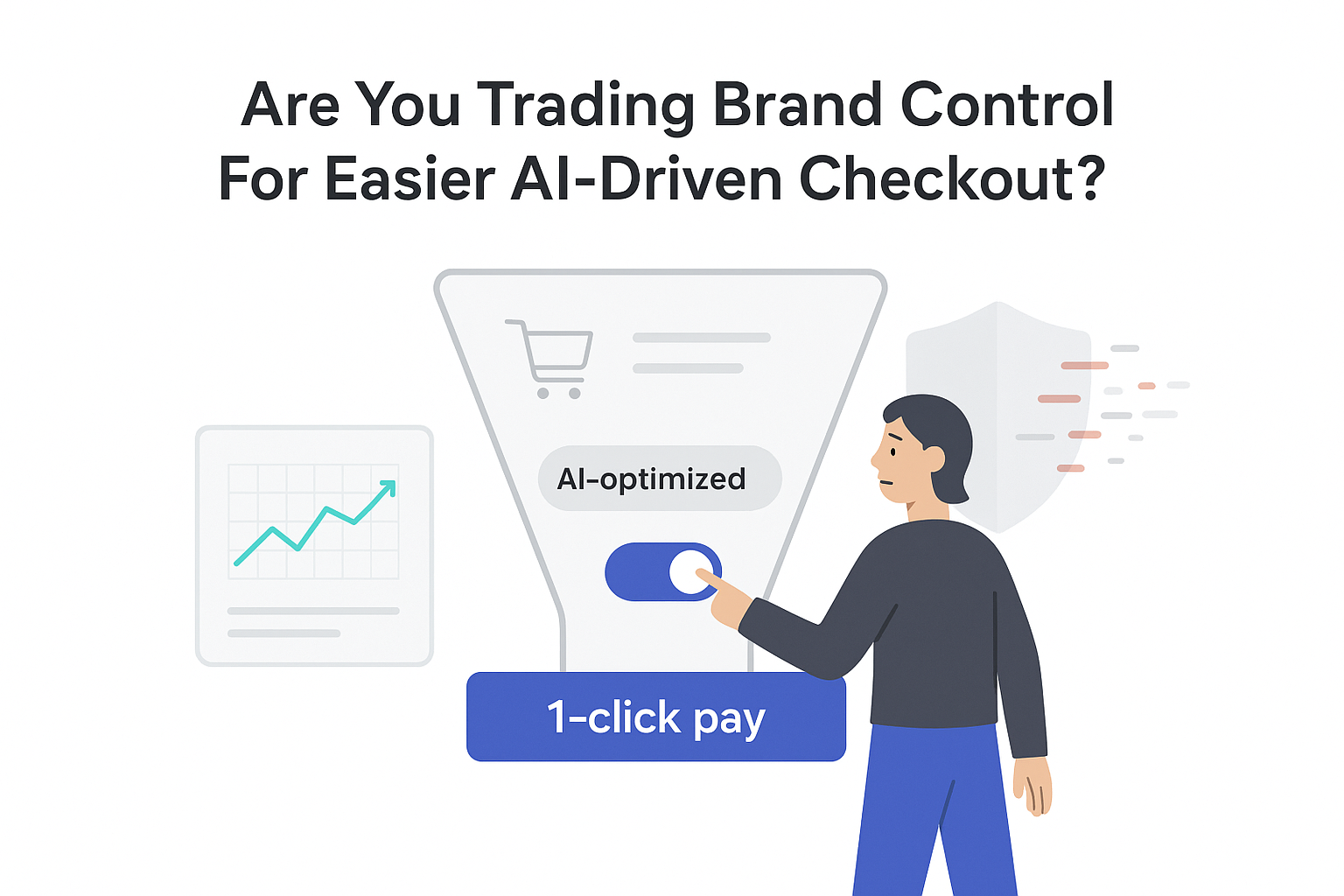
Google’s UCP checkout in AI Mode is essentially a new auction for retail attention. It trades lower friction and potentially higher conversion for weaker brand presence and thinner data. The core question is whether the incremental orders justify ceding part of the customer journey to Google, especially for brands that rely on cross-sells and long-term relationship value.
Key Takeaways for Google UCP Checkout
- UCP checkout will likely increase conversion on Google surfaces but reduce site visits - good for price- and convenience-led retailers, risky for brands that rely on onsite discovery, cross-sells, and storytelling.
- Unless Google shares rich journey and customer data, UCP-driven sales will weaken first-party data assets, which can raise future acquisition costs and limit remarketing scale.
- For paid media, any uplift in conversion from AI Mode checkout may push Smart Bidding to value these placements higher, indirectly affecting CPCs and budget allocation even for brands hesitating to join.
- The model mirrors Amazon marketplace tradeoffs - traffic and convenience in exchange for control and data - but spreads them across the open web, which could deepen dependence on Google as a transaction layer.
- Early tactical stance for most retailers: test UCP in narrow product ranges with clear unit economics (CAC, AOV, margin, expected repeat rate), while holding out on high-LTV categories until data-sharing and controls are clearer.
Situation Snapshot
Google announced in a recent Google Developers blog post that its Universal Commerce Protocol (UCP) will allow shoppers to complete purchases directly inside AI Mode in Search and the Gemini app, with eligible U.S. retailers able to participate “soon.” Retailers remain the merchant (seller) of record and can customize the integration to some extent, including an embedded checkout experience on Google surfaces.[S1][S2]
In parallel, Google launched “Business Agent,” which surfaces branded AI chat for participating retailers directly in Search results. Interactions still occur on Google’s platform, not on the retailer’s site.[S1]
The Search Engine Journal report highlights retailer concerns: reduced site visits; fewer touches with onsite merchandising and cross-sells; and compressed brand storytelling inside a standardized AI Mode interface.[S1] Google has not yet specified:
- Fee structure for UCP checkout.
- Exact reporting and funnel visibility for AI Mode transactions.
- How much customer and journey data flows back to merchants.
Industry context: prior attempts at on-platform checkout (for example, Google’s “Buy on Google,” various social network shops) show that reduced friction can help conversion but often at the cost of control and data for merchants.[S3]
Breakdown & Mechanics of UCP Checkout and AI Mode
At a system level, UCP changes where and how the transaction finishes.
Traditional Google flow:
Search/Shopping ad click → Retailer site (PLP/PDP) → Cart → Checkout → Order confirmation.
UCP + AI Mode flow (simplified):
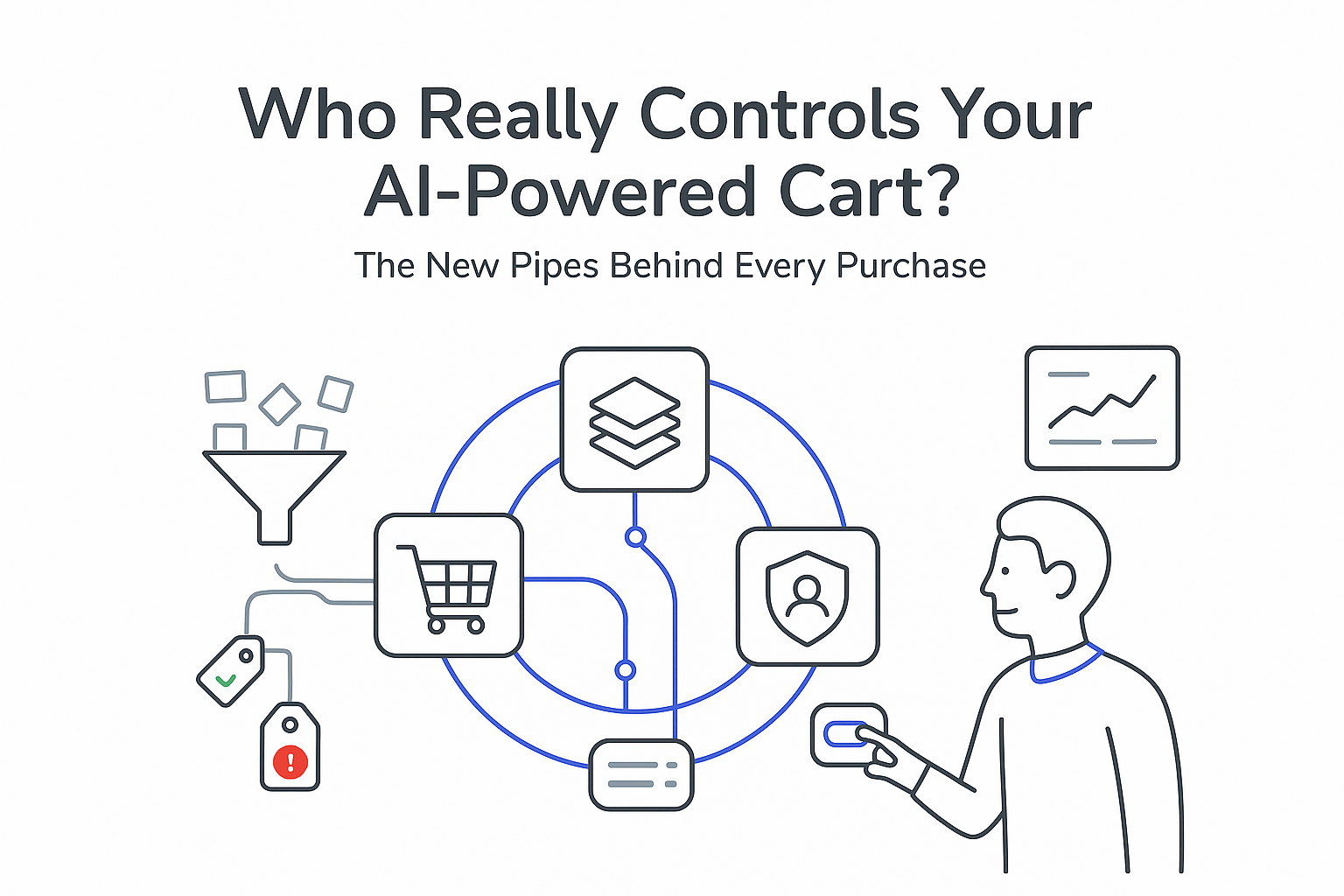
Search/AI query → AI Mode recommendation → UCP checkout on Google surface → Order routed to retailer’s system as merchant of record.
Key mechanical shifts
-
Control of the last mile
- Before UCP, the retailer owned the cart and checkout UX, plus immediate pre- and post-purchase prompts (upsells, warranty offers, email capture, loyalty signups).
- With UCP, Google controls much of that interface. The retailer supplies structured product, inventory, and pricing data, but Google’s AI experience shapes what the user sees and in what sequence.[S1][S2]
-
Cross-sell logic and merchandising
- Onsite, retailers design cross-sell rules based on margin, inventory, and brand strategy (for example, high-margin accessories prioritized).
- In UCP, Google has signaled plans for “discovering related products” and applying loyalty rewards directly on its surfaces but has not clarified:
- Whether cross-sells will favor the same retailer or show items from other merchants.
- Whether merchants can configure or suppress certain add-ons.[S1][S2]
-
Data and attribution pathways
- Onsite sessions typically feed analytics tools, CDPs, and ad platforms through tags and server-side tracking.
- UCP introduces a partial black box unless Google exposes:
- View-through and click-level paths within AI Mode.
- Event-level data that can map into merchants’ CRM and attribution models.
- Without that, many orders become aggregated events in Merchant Center or Ads, limiting segmentation and lookback analysis.
-
Platform incentives
- Google’s business incentive is clear: make searches more “shoppable” and retain users on its surfaces, boosting ad value and user reliance on AI Mode.
- Retailers’ incentive is conditional: accept some loss of control if conversion and lifetime economics improve enough to offset that loss.
Mechanically, the net effect is:
- Reduced friction at query level → higher probability of immediate purchase on Google.
- Fewer deep visits to the retailer site.
- Lower exposure to onsite merchandising and weaker first-party data collection.
Impact Assessment
Paid Search & Shopping Ads
Direction of impact: Mixed; depends on integration details and bidding logic.
- Conversion dynamics: If UCP reduces checkout friction, then for AI Mode surfaces we should expect a relative lift in conversion rate versus a send-to-site flow. Industry data suggests average online cart abandonment near 70%.[S3] A smoother on-Google flow, especially for logged-in users with stored payment details, could cut that by several percentage points.
- Bidding behavior: Smart Bidding systems optimize toward cost-per-conversion or ROAS. If Google attributes UCP conversions cleanly into Ads, campaigns feeding AI Mode could show stronger performance and attract more budget automatically, regardless of whether the brand is comfortable with reduced data.
- Likely winners:
- Retailers competing heavily on price and convenience, where unit margin is thin and brand storytelling is secondary.
- Brands with strong operational capacity (inventory accuracy, fulfillment) that can feed clean data into Google’s systems.
- Likely losers:
- High-touch brands using Google primarily as a discovery channel before richer site experiences.
- Advertisers relying on checkout add-ons and onsite email capture to make paid traffic profitable.
Watchpoints:
- Whether Google exposes separate conversion types for “AI Mode / UCP checkout” versus “site-based conversions.”
- Any shift in Google Ads recommendations nudging adoption of UCP as a performance “upgrade.”
Organic Search, AI Overviews, and Brand Equity
Direction of impact: Brand presence risks rise if AI Mode becomes a significant share of shopping queries.
- AI Mode already compresses multiple organic results into an answer-style interface. Adding checkout pulls even more of the action into Google’s frame.
- Organic listings, buying guides, and brand content may still influence AI outputs, but users who purchase inside AI Mode bypass the full site, reducing exposure to:
- Category storytelling.
- Educational content that positions the brand as expert.
- Onsite content that supports higher-priced, higher-margin choices.
For content-led brands, this may weaken differentiation and push price and convenience as default decision drivers.
Watchpoints:
- How often AI Mode shows a “buy here” flow versus traditional organic and Shopping results.
- Whether AI Mode shopping outputs skew toward merchants participating in UCP, introducing another ranking dimension beyond relevance and price.
CRM, Lifecycle Marketing, and First-Party Data
Direction of impact: Potentially negative unless Google returns granular customer data.
- Today, an onsite checkout can include newsletter opt-ins, loyalty enrollment, consented tracking, and rich behavioral data (pages viewed, cart additions, time on site).
- With UCP on Google surfaces, most of that exposure compresses into a standardized UI. Unless Google supports retailer-owned signups and passes identity back, merchants may see:
- Fewer new emails or loyalty IDs tied to first purchases.
- Smaller retargeting and lookalike audiences in Google and other ad platforms.
- Weaker signals for churn prediction and LTV modeling.
Unit economics risk (hypothetical example):
- CAC via Google Ads: $30.
- Onsite AOV: $50; 30% gross margin → $15 gross profit on the first order.
- Onsite cross-sell adds $10 AOV (accessories), raising gross profit to $18.
- Email and loyalty retention add 1.5 repeat orders on average, pushing LTV high enough that the $30 CAC is acceptable.
If UCP checkout removes or reduces cross-sell and retention opportunities, the same $30 CAC might no longer clear your target LTV:CAC ratio.
Watchpoints:
- Whether UCP events can create or match customer profiles in your CRM/CDP.
- Ability to run lifecycle campaigns specifically targeted at UCP-acquired customers.
Merchandising, Cross-Selling, and AOV
Direction of impact: Pressure on average order value and attach rates.
- Onsite merchandising gives retailers substantial control over add-ons: what is promoted, where, and at what price threshold.
- In UCP, Google’s AI may suggest “related items,” but the economic logic might prioritize user satisfaction and price competitiveness, not necessarily the merchant’s margin mix. It may even surface competitor accessories if the protocol and experience allow multi-merchant carts (unclear today, speculative).
- Categories dependent on bundles (for example, cameras plus lenses and cases; printers plus ink) are most exposed.
Practical implication:
Assume your current attach rate on a core product is 25% (one accessory for every four units sold), with an average accessory margin significantly higher than the core item. If UCP-driven orders cut that attach rate even slightly, the profit gap can be material, especially on paid traffic.
Watchpoints:
- Google’s eventual documentation on how related products are chosen and whether merchants can restrict cross-sells to their own catalog.
Operations, Analytics, and Channel Strategy
Direction of impact: Added complexity, with risk of channel fragmentation.
- Teams may need to plan for multiple checkout flows: onsite, marketplace (Amazon and others), and now UCP. Each has different data structures, refund flows, and performance metrics.
- Attribution models must decide where to credit AI Mode orders: search, paid shopping, brand marketing, or a new channel bucket.
- Merchants might selectively enroll products:
- Commodity SKUs where price and speed dominate.
- Excluding high-service categories that depend on guidance and education.
Watchpoints:
- Merchant Center and Gemini/AI Mode configuration options for product-level or category-level participation.
- Integration costs for mapping UCP orders into your OMS/ERP and reporting stack.
Scenarios & Probabilities
(All quantitative expectations below are speculative and based on patterns from prior platform-controlled checkout models.)
Base scenario - Gradual adoption, partial data sharing (Likely)
- Adoption: Medium; many major retailers test UCP, but primarily for lower-complexity products.
- Data: Google exposes aggregate reporting (conversions, revenue, some device/geo breakdown) and basic event tagging in Ads, but limited user-level data.
- Impact:
- 5–20% of Google-originating retail orders for participating merchants flow through UCP within 2–3 years.
- Some improvement in top-of-funnel conversion, but reduced cross-sell and weaker CRM capture compress long-term profit for higher-touch categories.
- Marketers maintain hybrid strategies: protect hero categories onsite, feed commoditized SKUs into UCP.
Upside scenario - Strong data access, high user acceptance (Possible)
- Adoption: High; clear reporting APIs and transparent policies lead many retailers to roll out UCP broadly.
- Data: Merchants receive detailed conversion events and some level of consented identity (for example, hashed email, loyalty IDs when applicable).
- Impact:
- UCP becomes a major transaction layer for Google-originating retail traffic.
- Brands use UCP as an “express lane” while still nurturing customers via post-purchase communication fed by Google data feeds.
- Overall ROAS improves or holds steady; cross-sell gaps are offset by volume and retention programs.
Downside scenario - Limited data, soft enforcement through ranking (Edge but material)
- Adoption: Reluctant but coerced; Google favors UCP-enrolled merchants in AI Mode results or Shopping ads (explicitly or implicitly through quality scores).
- Data: Little more than summary revenue and order counts; no practical way to backfill CRM profiles.
- Impact:
- Retailers feel compelled to participate to remain visible on high-intent queries.
- First-party data weakens over time; remarketing and LTV modeling degrade.
- High-service brands see falling profitability on Google-originating customers and shift budget toward other channels (direct, social, marketplaces).
Risks, Unknowns, Limitations
- Data-sharing specifics: The scale of impact depends heavily on what Google chooses to share: event granularity, identity resolution, audience creation rights, and latency. Current public information does not resolve this.[S1][S2]
- Fee structure and commercial terms: Any per-transaction or service fee would change the economics; so far there is no public detail. Prior history (for example, Buy on Google) shows that fee models can change materially over time.[S3]
- User adoption of AI Mode for shopping: If most users stick with traditional SERPs and Shopping tabs, UCP will remain a side-channel. If AI Mode becomes default for product searches, the impact is far larger.
- Merchant configuration controls: Open questions remain about whether retailers can:
- Limit UCP checkout to certain SKUs or price bands.
- Control whether cross-sells are intra-merchant only.
- Distinguish UCP conversions cleanly in Ads and analytics.
- Comparison to Amazon and marketplaces: While the analogy is useful, UCP is an “open” protocol by design.[S1] How open it remains in practice - and whether other AI agents use it without Google’s gatekeeping - could change competitive dynamics.
- Potential falsifiers:
- If Google publishes documentation revealing strong, privacy-safe data portability and granular controls, the pessimistic view on data loss would be weakened.
- If, after rollout, merchants report that UCP conversions are clearly incremental (rather than cannibalizing onsite orders) with healthy AOV, concerns about brand erosion would be tempered.
- Conversely, if early case studies show lower LTV or weaker brand engagement for UCP-acquired customers, more cautious strategies would be justified.
Sources
- [S1] Matt G. Southern / Search Engine Journal, 2026, news article - “Google’s UCP Checkout Brings New Tradeoffs For Retailers.”
- [S2] Google, 2026, Google Developers blog post - AI Mode checkout and Universal Commerce Protocol / agentic commerce tools.
- [S3] Baymard Institute, ongoing research - cart and checkout abandonment rates for online retail.




.svg)

.svg)
.svg)