
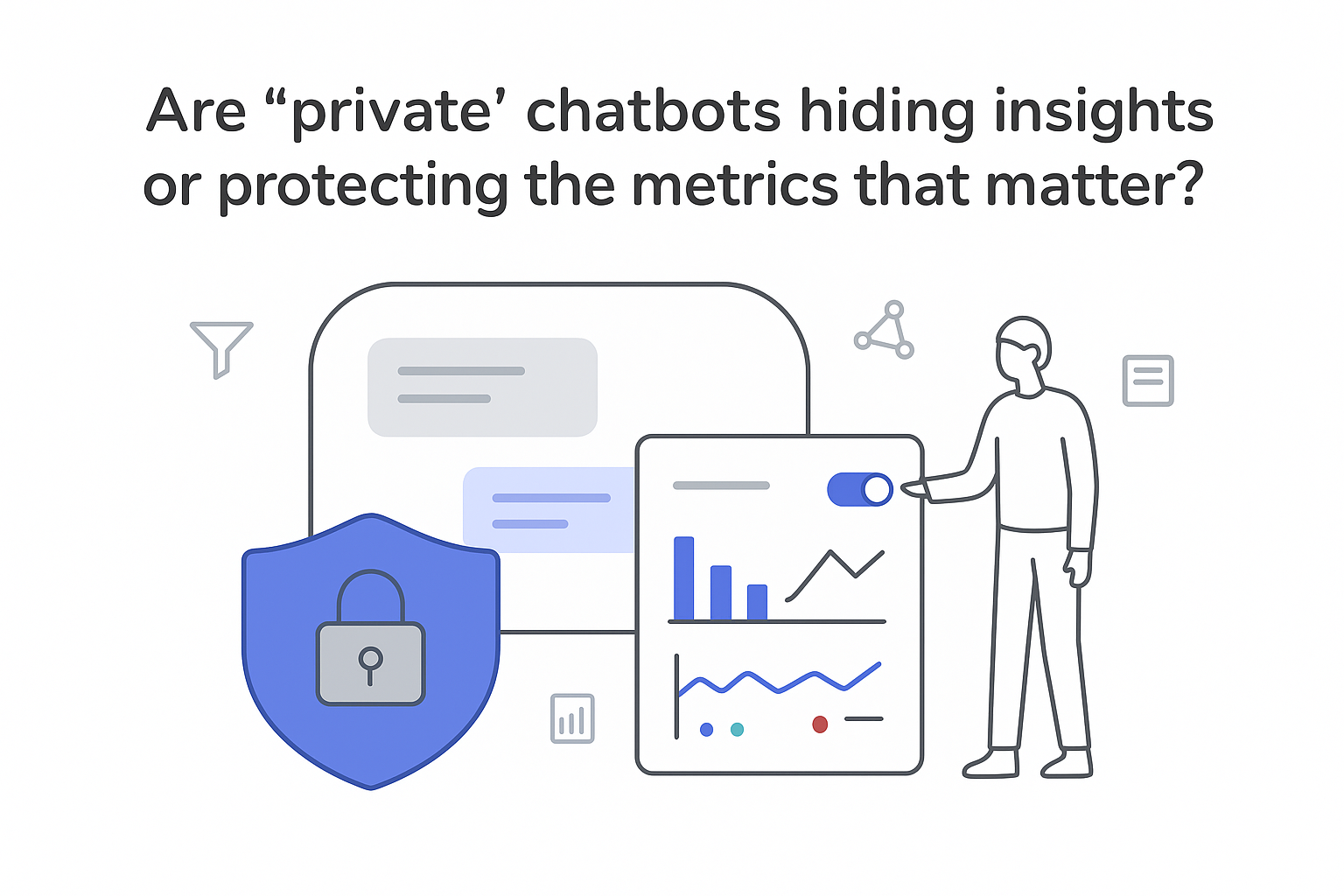
AI chatbot analytics with differential privacy: what Google’s Urania study shows
Large language model (LLM) chatbots now process hundreds of millions of conversations daily. These logs are a rich source of behavioral data, but analyzing them directly creates significant privacy risk. Google’s Urania framework proposes a pipeline based on differential privacy (DP) that extracts high-level usage themes from chatbot conversations while mathematically limiting the influence of any single user’s data, and compares it with a non-private, CLIO-style summarization baseline.[S1][S2] The results are relevant for any team running AI assistants or conversational interfaces that needs aggregate insights without exposing raw logs.
Differentially private chatbot analytics for usage insights
This section summarizes what Urania does, how it was evaluated, and why it matters for product analytics and marketing teams assessing AI usage data.
Executive snapshot of Urania study results
- Urania applies DP at two stages: clustering of conversation embeddings and keyword histogramming. It then uses an LLM to summarize clusters using only those DP-protected keywords.[S1][S2]
- In LLM-based head-to-head evaluations, summaries from the DP pipeline were preferred as high-level descriptions in up to 70% of comparisons against a non-private Simple-CLIO baseline.[S1]
- A membership inference-style attack achieved an AUC of 0.53 against the DP pipeline (near random guessing) versus 0.58 against the non-private pipeline, indicating measurably higher information leakage for the non-private approach.[S1][S4]
- As the privacy parameter ε is tightened (stronger privacy), topic coverage drops and clusters become fewer and less specific, reflecting a clear privacy-utility trade-off.[S1]
Implication for marketers: high-volume chatbot or assistant products can use DP summarization to monitor dominant use cases and themes with significantly reduced risk of exposing individual conversations, though with less ability to study small or niche segments.
Method and data sources for the Urania privacy framework
Google Research’s Urania work is presented in the paper Urania: Differentially Private Insights into AI Use and an accompanying blog summary.[S1][S2]
What was measured
- Ability of a DP pipeline to generate useful high-level summaries of chatbot use cases.
- Comparative quality of those summaries versus a non-private, CLIO-style baseline.
- Resistance of both pipelines to a membership inference-style attack.
Who, when, and where
- Authors: Alexander Knop, Daogao Liu, and colleagues at Google Research.[S1][S2]
- Paper: Urania: Differentially Private Insights into AI Use, presented at COLM 2025.[S2]
- Blog: “A differentially private framework for gaining insights into AI chatbot use,” published December 10, 2025.[S1]
Pipeline overview
- Conversations are embedded into vector representations and clustered using a DP clustering algorithm.[S1][S2]
- For each conversation, keywords are extracted via one of three methods: an LLM that proposes top-5 keywords, a DP variant of TF-IDF, or an LLM selecting from a predefined keyword list built from public data.[S1]
- Within each cluster, a DP histogram mechanism counts keyword frequencies with added noise, using standard DP histogram methods (1, 2); only high-frequency keywords survive.[S1]
- An LLM generates a textual cluster summary using only these DP-filtered keywords, never the raw conversations.[S1]
Key limitations and unknowns
- The blog does not report dataset size, languages, or domain mix; these details likely appear in the paper but are not visible in the summary.[S1][S2]
- Exact ε (epsilon) and δ (delta) values, as well as how the DP budget is split between clustering and histograms, are not provided in the blog.[S1]
- Evaluation relies heavily on LLM judges rather than human raters, which may bias quality assessments.[S1]
- The work is based on a single provider’s chatbot data; cross-platform generalization is untested.[S1][S2]
Findings on privacy guarantees and chatbot usage summarization
This section collects the main factual results on how the DP framework behaves, compared with a non-private CLIO-style baseline.
1. DP pipeline design and guarantees
- Urania relies on two standard differential privacy properties:[S1][S5]
- Post-processing: any algorithm that uses only the output of an ε-DP mechanism remains ε-DP.[S1][S5]
- Composition: running two ε-DP mechanisms on the same dataset yields combined privacy on the order of 2ε.[S1][S5]
- DP clustering on embeddings ensures that no single conversation strongly shifts a cluster center.[S1][S2]
- DP histograms over keywords in each cluster use noise so that only terms that appear frequently across multiple users are likely to be selected.[S1]
- Because the summarization LLM receives only these noised, cluster-level keywords, and never raw texts, the full pipeline maintains a formal DP bound on any individual conversation’s effect on the final summary.[S1][S2]
- The authors stress that privacy does not rely on heuristic PII stripping. Even if a keyword itself reflects sensitive content, the DP mechanism is designed so rare, user-specific terms are very unlikely to appear or to affect the final text summary.[S1]
2. Comparison to Simple-CLIO non-private baseline
- The Simple-CLIO baseline approximates Anthropic’s CLIO approach by clustering embeddings non-privately, then feeding a sample of raw conversations from each cluster to an LLM with instructions to hide personally identifiable information (PII).[S1][S3]
- This baseline depends on heuristic redaction prompts and model behavior rather than formal guarantees; an LLM failure or prompt injection could reveal sensitive data from example conversations.[S1][S3]
- Urania’s DP pipeline does not require showing any raw conversation text to the summarizing model, making it less vulnerable to such failures by design.[S1]
3. Privacy-utility trade-off
- Stronger privacy (smaller ε) increases the noise added in DP clustering and DP histograms, which leads to:
- Fewer clusters overall.
- Cluster centroids that are less precise representations of specific subtopics.
- Reduced topic coverage in the resulting summaries, especially for less frequent intents.[S1]
- Under moderate privacy settings (exact ε not given), LLM evaluators often judged Urania’s DP summaries preferable to the baseline, with DP summaries winning up to 70% of pairwise comparisons in at least one evaluation.[S1]
- The authors suggest that constraining summaries to rely on frequent, shared keywords encouraged more concise and focused descriptions of use cases than the unconstrained baseline, which sometimes fixated on idiosyncratic or overly detailed aspects of sampled conversations.[S1]
4. Membership inference-style privacy evaluation
- To approximate an adversary trying to learn whether a specific “sensitive” conversation was part of the training set, the authors use a membership inference-style attack inspired by Shokri et al.[S1][S4]
- Performance is reported using ROC area under the curve (AUC):
- DP pipeline: AUC = 0.53, close to the 0.5 value expected from random guessing.[S1]
- Non-private Simple-CLIO pipeline: AUC = 0.58, indicating that the attacker can distinguish members from non-members better than chance.[S1]
- The gap in AUC is presented as empirical evidence that Urania’s DP pipeline leaks less information about whether any specific conversation was included in the analyzed dataset.[S1]
Interpretation and implications for AI product and marketing teams
This section separates interpretation from raw findings and focuses on what is most actionable for teams running chatbots, AI assistants, or other conversational interfaces.
Likely implications
- DP summarization is practically usable for high-volume chat products. The combination of DP clustering and DP keyword aggregation still produced summaries that LLM judges often preferred to those from a non-private baseline.[S1] For teams monitoring broad patterns of chatbot use (for example, top intents, common support topics, frequent content requests), DP mechanisms appear compatible with day-to-day analytics needs.
- Granularity will be limited, especially for niche segments. The reported drop in topic coverage at stronger privacy settings reflects a structural property of DP: outlier or small-segment conversations are deliberately obscured.[S1][S5] Marketers should expect excellent visibility into frequent intents and weaker visibility into rare, long-tail use cases or very small audience cohorts.
- Formal DP protection may age better than heuristic redaction. Because Urania’s guarantees rely on DP mathematics rather than an LLM’s success at stripping PII, the privacy risk should be less sensitive to model updates, prompt changes, or new attack techniques.[S1][S5] For regulated sectors, this likely makes DP-based analytics easier to justify to legal and compliance stakeholders than pipelines that process raw conversations with ad hoc anonymization.
- Aggregate summaries can support content and messaging strategy with lower privacy risk. DP summaries still surface which tasks users most often bring to the chatbot (for instance, drafting communications, coding help, trip planning, or menu design, as mentioned in the blog).[S1] Product and marketing teams can use these themes for content planning and positioning without storing or reviewing verbatim user logs.
Tentative implications
- Noise constraints may improve focus, not only privacy. LLM evaluators preferring DP summaries up to 70% of the time suggests that restricting summaries to high-frequency, shared keywords can reduce drift into anecdotal or sensational details from a small number of conversations.[S1] This pattern hints that well-designed DP pipelines might sometimes sharpen high-level insight quality even when privacy is not the sole priority.
- Evaluation practices for analytics summaries may need updating. Urania relies on LLM judges, rather than humans, to rate summary quality.[S1] While this is now common in LLM research, it introduces uncertainty about how closely those ratings track human analyst judgments. Teams adopting similar frameworks may need targeted human evaluations for the specific dashboards or reports analysts use most.
Speculative implications
- Regulatory expectations could move toward formal privacy for log analysis. Urania shows that DP summarization is technically viable at scale.[S1][S2] Over time, regulators may distinguish between analytics pipelines with mathematically defined privacy guarantees and those relying only on heuristic anonymization, especially when analyzing sensitive text such as medical, legal, or financial conversations.
- Vendor assessment checklists may shift. Buyers of analytics or “insights from chat” tooling may begin to ask not only whether PII is redacted, but whether the system applies formal DP, which steps are DP, how ε is chosen, and whether raw logs ever reach summarization models. Urania provides a concrete reference architecture for such discussions.[S1][S2]
Contradictions, gaps, and open questions in private chatbot analytics
Several uncertainties and limitations are important before treating Urania as a complete template.
- Limited transparency about dataset and ε values. The blog omits dataset size, domain distribution, and the specific ε and δ settings used.[S1] Without these, it is difficult for practitioners to judge whether the reported privacy-utility balance would hold for smaller products, highly sensitive domains, or multilingual deployments.
- Non-private baseline still shows relatively low attack performance. The non-private pipeline’s AUC of 0.58 in the membership inference-style attack is only moderately above random guessing.[S1] That indicates measurable, but not extreme, leakage. The practical risk difference between AUC 0.53 and 0.58 in real adversarial settings remains uncertain.
- LLM-only evaluation may not match analyst needs. Quality judgments are made by LLMs rather than human analysts who would use these summaries for product decisions.[S1] LLMs might prefer stylistically concise summaries, while analysts might prefer summaries that capture edge-case behaviors, even if they are less polished.
- Impact on fairness and minority groups is unstudied in the blog. DP mechanisms tend to prioritize frequent patterns, which can mask the behavior or needs of smaller groups.[S5] The summary does not discuss whether Urania disproportionately obscures insights about minority user segments or rare but important failure cases.[S1]
- Online and streaming settings are not yet addressed. The authors note future work on adapting the framework to online settings where conversations arrive continuously.[S1] For many commercial chatbots, this streaming context is the norm, so the current results mainly apply to batch analysis of historical logs.
Data appendix for Urania differential privacy study
Key reported quantitative metrics from the Urania work, as described in the Google Research blog:[S1]
| Aspect | DP pipeline (Urania) | Non-private Simple-CLIO baseline |
|---|---|---|
| Attack ROC AUC (membership-style test) | 0.53 | 0.58 |
| LLM summary preference rate (selected evaluation) | Up to 70% | Remainder of comparisons |
| Clustering method | DP clustering | Non-DP clustering |
| Text exposure to summarization LLM | DP keywords only | Raw sampled conversations |
These figures summarize the reported trade-off: Urania materially reduces measurable information leakage and, under some settings, yields summaries that LLM evaluators judge more favorably, while sacrificing some topical granularity, especially for low-frequency use cases.[S1]





.svg)

.svg)
.svg)