
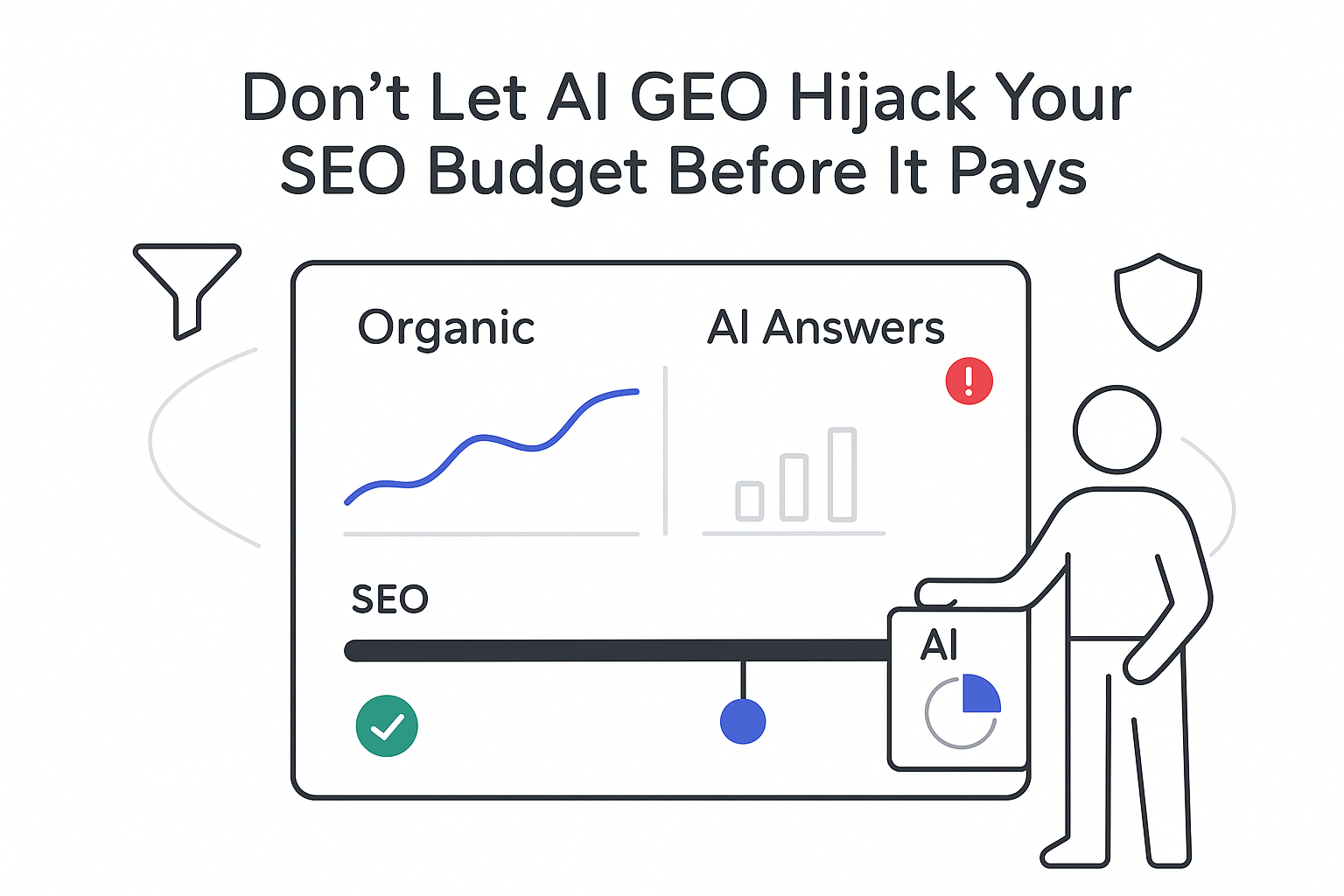
John Mueller's comments on the SEO vs GEO debate raise a practical question for marketers: based on current data, when should AI answer engine optimization (GEO) materially change how you allocate SEO and broader marketing resources?
SEO vs GEO: How AI Answer Engines Reprice Referral Value
Mueller is effectively treating GEO as a channel-mix and budgeting problem, not a new discipline with its own rules. The key issue is whether AI assistants and answer engines already represent a large enough share of discovery and referral traffic in your audience to justify shifting time, money, and attention away from existing channels.
Key Takeaways
- GEO is a resource allocation question, not a new craft for most teams: with ChatGPT sending roughly 0.19% of traffic to the average site and AI assistants combined still under 1% for most publishers, GEO rarely justifies more than experimental effort today [S1][S2][S3].
- For organic-focused businesses, AI visibility should be sized relative to other channels: if AI referrals are under 1% of traffic and organic search is 40-60%, then AI-focused work likely stays under roughly 5-10% of your SEO/organic roadmap unless growth is unusually fast.
- The same fundamentals largely power both SEO and GEO, but selection patterns differ: Google says AI features share infrastructure with Search, yet LLM citation data shows a gap between rankings and citations, which means GEO is an incremental refinement of strong SEO, not a replacement [S1][S4][S5].
- Audience behavior, not industry hype, should drive timing: Mueller's advice to check "what % is using 'AI'? what % is using Facebook?" is a simple test to decide whether AI should displace work on search, social, or other channels in your plan [S1].
- Early GEO efforts should focus on measurement and a small number of high-intent topics: identifying where AI assistants already cite or summarize your space lets you test GEO with limited effort while you wait for the traffic share to justify bigger changes.
Situation Snapshot
The trigger for this analysis is a Search Engine Journal article covering Google Search Advocate John Mueller's comment, where he responded to a Reddit thread asking whether SEO is still enough or if marketers now need GEO - "Generative Engine Optimization" for AI answer engines such as ChatGPT, Gemini, and Perplexity [S1].

Key facts from the article and linked coverage:
- Mueller's framing:
- Businesses that make money from referred traffic should "consider the full picture" and prioritize based on how all channels contribute [S1].
- He downplayed terminology: "What you call it doesn't matter... thinking about how your site's value works in a world where 'AI' is available is worth the time" [S1].
- He urged marketers to check usage metrics: what percentage of their audience uses AI, Facebook, and other channels, and allocate effort accordingly [S1].
- Google's official stance:
- At Search Central Live, Gary Illyes said AI features in Search reuse much of the same infrastructure as traditional results, implying no separate framework is required for GEO/AEO [S5].
- Traffic data referenced in the SEJ piece:
- Ahrefs' tracker suggests ChatGPT currently sends about 0.19% of traffic for the average site [S2].
- Combined AI assistants still account for under 1% of traffic for most publishers [S3].
- SEJ coverage of LLM citation studies shows a measurable gap between Google rankings and which sites large language models actually cite [S4].
These points are broadly undisputed within the article set, though the implications for strategy are contested in the wider SEO community.
Breakdown & Mechanics
How SEO and GEO are structurally related
Mueller and Illyes are both signaling that GEO is not built on a wholly new technical stack; AI features "share infrastructure with traditional Search" [S5]. Conceptually:
- Classic SEO: Crawlability + indexation + relevance + authority → ranking in Search results → clickthroughs.
- GEO (for AI answer engines): Content availability + clarity + authority + compatibility with AI tools → presence in model training or live retrieval → inclusion as a cited or influential source → potential referral traffic.
That relationship can be sketched as: good SEO fundamentals → more likely to be visible and comprehensible to AI systems → higher chance of being referenced or cited → some portion of users click through.
Most of the investment in technical quality, information architecture, and trustworthy content therefore supports both SEO and GEO, which aligns with Google's position that you do not need a separate framework today.
Where GEO diverges from classic SEO
Despite shared infrastructure, SEJ's coverage of LLM citation data shows that high Google rankings do not guarantee citations in AI answers [S4]. The selection process typically looks like:
User query → LLM retrieves or consults sources → model synthesizes an answer → optionally surfaces citations.
Key differences compared with traditional SERPs:
- Fewer clickable slots:
- A search results page may show 10 blue links and various modules.
- An AI answer often surfaces only a handful of citations, sometimes none.
- Different selection signals:
- Evidence suggests that topical authority, clear explanations, and information density may matter more for citations than micro-ranking differences among the top 10 Google results [S4].
- Higher "zero-click" risk:
- Many user questions are fully answered within the AI output, reducing downstream clicks even when you are cited.
GEO is therefore less about moving from position 5 to position 3, and more about being one of the few sources the model trusts, understands, and chooses to show.
Incentives: Google, AI vendors, and site owners
The different incentives help explain why Google downplays GEO as a separate discipline:
- Google:
- Wants to reassure site owners that investments in quality content and technical health are still rewarded, regardless of whether users see classic results or AI-based answers.
- Benefits from consolidating guidance; separate "GEO rules" would increase confusion and scrutiny.
- AI vendors (OpenAI, Perplexity, etc.):
- Aim to maximize direct question answering and user retention inside their interfaces.
- Use citations and links as a partial answer to publisher concerns and as a way to improve answer quality.
- Site owners:
- Want predictable referral traffic and clear levers they can pull to increase it.
- Face a coordination problem: GEO effort may pay off only if enough of their audience actively uses those AI tools.
Mueller's answer reframes this conflict into a portfolio decision: each business should invest in GEO only to the extent that AI usage and referrals are meaningful for its users and revenue.
Impact Assessment
Impact on organic search and owned channels
Direction: Incremental changes now, potentially larger over a multi-year window.
Who benefits now:
- Sites already strong in SEO: High-quality, well-structured content is more likely to be included in both Google's AI features and external answer engines because it is already widely visible and machine-readable.
- Brands with distinct, authoritative perspectives or proprietary data: These assets are harder to replace and more likely to be cited when models seek authoritative information.
Likely effects and actions:
- Short term (0-12 months):
- For most sites, AI referrals under 1% suggest GEO should be handled as experiments within the SEO/content roadmap rather than as a separate track [S2][S3].
- Practical action: pick 5-20 high-value topics, check where AI tools already show content in your niche, and adjust those pages to answer questions clearly, with concise fact statements that can be quoted.
- Medium term (12-36 months):
- If AI referrals for your site rise into the low single digits (1-5%), it starts to justify a stable share of organic resources - for example, 10-20% of SEO/content planning focused on AI-specific layouts, FAQs, and structured answers. This split is a model, not a hard rule, and should follow your own analytics.
- Expect more overlap between content that performs in search results and content that is selected for AI answers, though not a 1:1 mapping [S4][S5].
Likely losers:
- Sites dependent on thin comparison content or easily summarized answers: AI systems are more likely to answer these queries directly with minimal need to send clicks, shrinking the value of mid-tier rankings.
Impact on paid search and partner channels
Direction: Minimal direct impact now; potential structural shift later.
Current situation:
- Paid search on Google: Mueller's comments focus on referral traffic, not ad inventory. For now, ad auctions run separately from AI assistants.
- External AI assistants: There is limited or no mainstream paid placement in products like ChatGPT's general interface as described in the referenced SEJ coverage; most traffic is organic or from citations [S2][S3].
Implications for marketers:
- Paid search budget: There is no immediate reason, based on Mueller's comments or current data, to reallocate PPC spend specifically toward GEO. Any changes should follow measurable shifts in query volume or conversion rates caused by AI features.
- Affiliate and partner channels: If your model depends on being listed as one of many options (travel, software lists, affiliate-heavy categories), AI engines that collapse those lists into a small number of recommendations can compress partner-driven volume. Monitoring referral sources from AI-branded domains becomes important here.
Speculation: If AI assistants add sponsored answers at scale, GEO may blend with a new paid channel. In that case, early brand visibility in organic AI answers could function similarly to "quality signals" that influence ad units. There is no concrete evidence of this yet in the cited material.
Scenarios & Probabilities
These scenarios model how GEO could matter over the next 2-3 years. Percentages are rough probability tags, not precise forecasts.
Base case - GEO as an extension of SEO (Likely)
Assumptions:
- AI assistants' share of total traffic for a typical site grows from under 1% to a modest low-single-digit share (for example, 2-5%) [S2][S3].
- Google continues to use overlapping infrastructure for Search and AI features, and guidance remains unified [S1][S5].
Implications:
- GEO matures as a specialization within SEO/content teams: formats and answer styles adapt, but core technical and editorial priorities stay the same.
- Most businesses cap AI-focused work at a minority share of organic resources, making decisions based on their own numbers rather than industry hype.
Upside case - GEO as a differentiated growth lever (Possible)
Assumptions:
- AI answer engines see rapid adoption in specific verticals (developer tools, health, complex B2B research, and similar), pushing AI referrals to mid-single or even low-double digits for those segments.
- Vendors improve and highlight outbound links and source browsing inside AI interfaces.
Implications:
- First movers that structure content and brand presence for AI answers could win share disproportionate to their search rankings.
- Agencies and in-house teams may formalize GEO roles, reporting into SEO but with distinct KPIs around AI citations, assistant mentions, and AI-originated conversions.
Downside case - AI reduces overall referral volume (Edge)
Assumptions:
- AI interfaces answer a rising share of questions without offering clear, clickable citations, or users rarely click through.
- Regulatory or publisher backlash does not materially change these products in the short term.
Implications:
- Traffic from informational queries falls across the board, particularly for publishers and comparison sites.
- GEO becomes less about click-based referrals and more about brand presence within answers (for example, your name and products mentioned even if clicks are low), pushing it closer to upper-funnel branding than direct response.
Risks, Unknowns, Limitations
- Measurement uncertainty: Tracking AI referrals is still inconsistent. Some AI tools send clear referrer data (for example, domain-specific referrals); others may appear as direct traffic. The SEJ-cited 0.19% average from ChatGPT is based on Ahrefs' panel and may not represent all sites [S2].
- Vertical variation: The under-1% AI share figure is "for most publishers" [S3]. Niche communities or technical audiences could adopt AI assistants faster, making GEO more important there than the averages suggest.
- Model and product changes: AI vendors frequently update how they choose and display citations. A change in UI could significantly alter click behavior without any algorithmic change in which sources are referenced.
- Data gaps: The referenced LLM citation studies show a gap between Google rankings and AI citations [S4], but they do not fully explain which signals drive those citations. That limits how precisely GEO tactics can be prescribed today.
- Dependence on Google's statements: Google's claim that AI features share infrastructure with Search [S5] is informative but not a guarantee that ranking and visibility factors will remain closely aligned over time.
- Source limitations: This analysis relies on SEJ's reporting of third-party data and Google statements. Independent replication of the exact figures (0.19% and under 1%) would strengthen confidence in the quantitative framing.
Sources
- [S1]: Search Engine Journal / Matt G. Southern, 2026-01 (news article) - "Google's Mueller Weighs In On SEO vs GEO Debate."
- [S2]: Search Engine Journal, n.d. (news article) - "Ahrefs Launches Tracker Comparing ChatGPT & Google Referral Traffic."
- [S3]: Search Engine Journal, n.d. (analysis) - "Is AI Search SEO Leaving Bigger Opportunities Behind?"
- [S4]: Search Engine Journal, n.d. (analysis) - "New Data Finds Gap Between Google Rankings And LLM Citations."
- [S5]: Search Engine Journal, n.d. (event coverage) - "Do We Need Separate Framework For GEO/AEO? Google Says Not - Search Central Live."






.svg)

.svg)
.svg)