
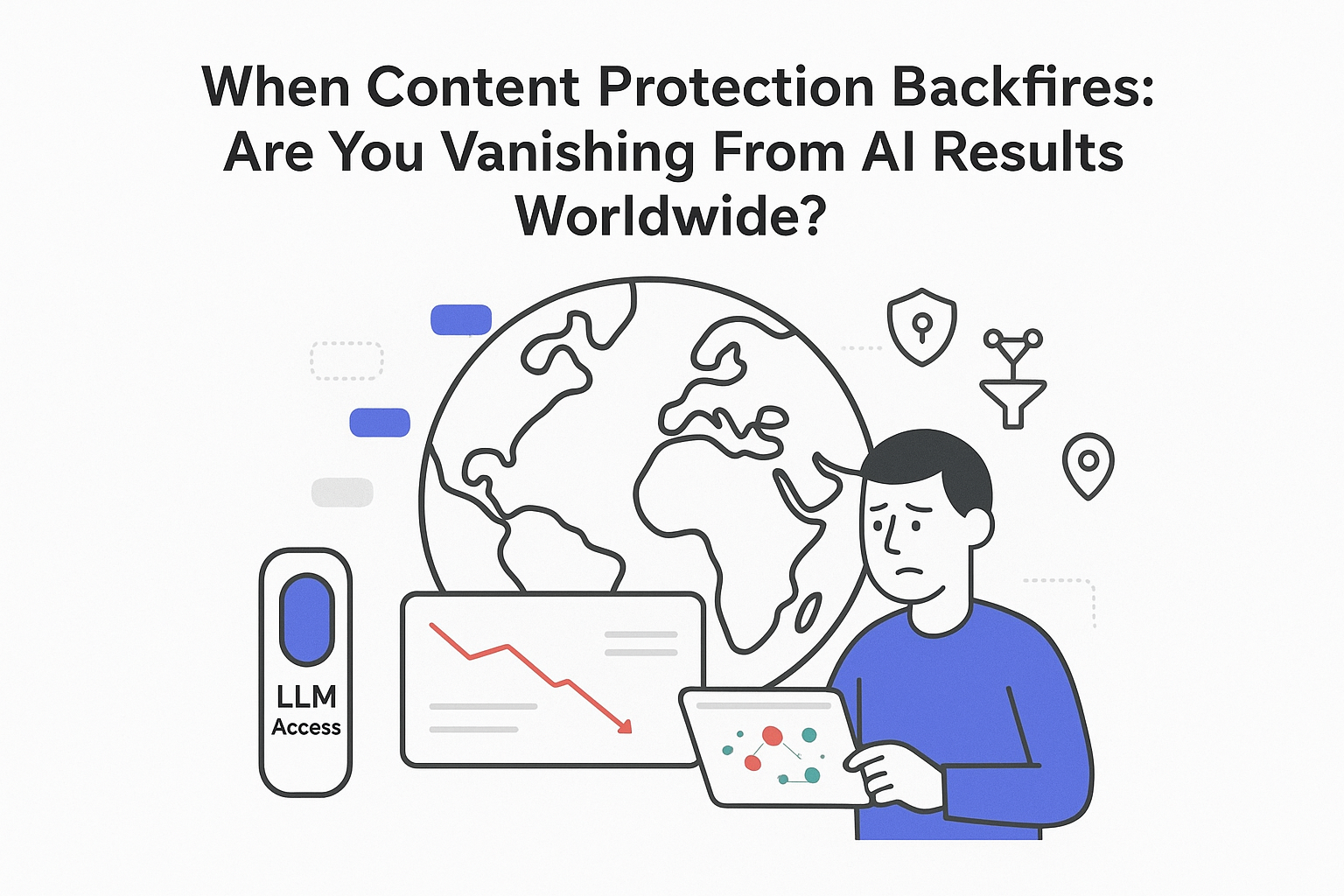
Marketers are facing a new trade-off: blocking large language model (LLM) training crawlers can reduce IP exposure but may also erase or distort brand presence in AI assistants and generative search. Over the next 12-24 months, that choice will materially affect discoverability, revenue, and emerging "Generative Engine Optimization" (GEO).
This analysis looks at how blocking LLM crawling for training changes your chances of being recommended, cited, or priced correctly in AI-driven assistants and search.
Key Takeaways
- Blocking training bots while allowing assistant crawlers means AI will still summarize your pages, but with weaker brand context, greater reliance on third-party sources, and less control over how you are positioned.
- For most commercial and comparison-driven sites, selective access - allowing training on core product and brand pages while limiting highly substitutable or sensitive content - is likely to outperform blanket blocking on long-term visibility.
- As AI answers absorb more informational and pre-purchase queries, brands that are absent from parametric knowledge risk disappearing from generic AI prompts and GEO-style result sets, even if they remain visible in classic SERPs.
- High-value publishers with uniquely monetized knowledge (courses, docs behind a funnel, paywalled content) have the strongest economic case to block training bots, but should still manage AI assistant access carefully for branded and transactional intent.
- The policy you set in robots.txt is becoming a strategic distribution decision, similar in weight to noindexing key sections or blocking ad crawlers. It now shapes where AI can surface you in the journey, not just who can copy your content.
Situation Snapshot
Hostinger analyzed 66.7 billion bot interactions across 5 million websites, focusing on how different classes of crawlers accessed content across three 6-day windows in June, August, and November 2025, in an analysis they published [S1].
Key reported data points:
- OpenAI SearchBot (assistant and web-browsing layer for ChatGPT and related tools) increased website coverage from 52% to 68% over the period.
- Applebot (used for Apple's search and assistant features) doubled coverage from 17% to 34%.
- Traditional search crawlers (Google, Bing) remained essentially flat in coverage.
- OpenAI's GPTBot (training data crawler) fell from access on 84% of sites in August to 12% in November, driven by robots.txt blocking.
- Meta's ExternalAgent training crawler dropped from 60% to 41% site coverage.
Hostinger describes this as a paradox: companies are sharply limiting training crawlers while assistant crawlers expand their footprint [S1].
At the same time, community discussions reflect a growing default toward blocking LLM training, especially among publishers of niche, high-effort content. A recent post in the WordPress subreddit, for example, features site owners arguing that LLMs replicate their advice so well that users may no longer need to visit their sites [S2].
Breakdown & Mechanics
The mechanics of LLM access break into two layers.
1. Training crawlers → parametric knowledge
- Training bots (for example GPTBot, ExternalAgent) fetch content during model training.
- That content becomes "parametric knowledge": it is compressed into model weights as long-term memory about entities, concepts, and relationships [S1].
- Typical flow: your site content → training corpus → model weights → generic answers such as "What is [Brand] and what do they sell?".
If robots.txt blocks these crawlers:
- The LLM has less or no first-party data about your brand in its internal memory.
- It falls back to third-party mentions, structured data (for example business listings), and any licensed datasets.
- For many brands, that leads to thinner, lagging, or incomplete understanding of their products and positioning.
2. Assistant and search crawlers → on-demand retrieval
- Assistant bots such as OpenAI SearchBot and Applebot support:
- Live browsing for chat responses.
- Indexing for AI answer layers in search interfaces.
- Typical flow: user query → LLM uses parametric knowledge and/or web search → assistant crawler fetches pages → LLM summarizes → answer or snippet.
If a site allows assistant bots but blocks training bots:
- The assistant can still read and summarize your pages in real time when it chooses to browse.
- Generic answers that do not explicitly trigger live browsing depend more on existing parametric knowledge and indexes.
- You are more likely to appear when the model "needs to browse," and less when it answers from internal memory alone.
Net effect: robots.txt policies for training versus assistant bots are no longer simple privacy settings; they determine which part of the AI stack can represent your brand.
- Training allow + assistant allow → strongest presence in both generic and specific queries.
- Training block + assistant allow → presence mainly when browsing triggers, with a weaker GEO footprint.
- Training allow + assistant block → your brand is known to the model but is less likely to surface in live web-based AI interfaces.
- Block both → near-total absence from AI surfaces, aside from third-party references.
Impact Assessment
Organic search, GEO, and AI answer visibility
Direction: medium to large impact over 12-24 months, uneven by niche.
- As AI assistants and AI overviews handle more informational and pre-purchase queries, a growing share of exposure will look like: unbranded question → AI answer → short list of brands or resources.
- Brands that block training bots are less likely to be named in generic prompts such as:
- "Best project management tools for small teams"
- "Affordable running shoes for flat feet"
- Historical analog: sites that blocked Googlebot or used noindex for key sections saw traffic fall, even if they remained popular by word of mouth. A similar pattern is plausible for generative surfaces, with the added twist that AI can synthesize competitors' benefits into a single recommendation.
Who benefits:
- Brands that allow thoughtful access and clearly structure product, pricing, and positioning content, giving models high-confidence data to reuse and cite.
- Widely cited authorities (documentation, reference sites) that remain crawlable and so dominate AI snippets and citations.
Who loses:
- Clones and thin affiliates that block training may still be summarized (because there are many substitutes) but with low explicit naming and limited GEO footprint.
- Niche experts that block training bots may preserve some click-based revenue in the near term but risk losing mindshare if competitors allow access.
Paid search and performance media
Direction: growing indirect impact; moderate in the near term, larger over time.
- As more discovery and comparison shifts into AI assistants, some budgets will move from traditional paid search toward:
- Sponsored placements inside AI answer panels or chat interfaces.
- Partner integrations with assistants.
- If a brand is poorly represented in parametric knowledge, even aggressive paid investment may struggle to overcome models that default to better-known brands in recommendations.
- Illustrative example (not measured):
- Today: roughly 70% of non-branded conversion paths in a vertical touch Google or Bing at least once.
- Assumption for 18-24 months: 20-30% of those paths include GenAI touchpoints that pre-filter options.
- If you are missing from those early lists, your effective addressable market for paid clicks shrinks, even if CPCs do not spike immediately.
Content, brand, and creative strategy
Direction: high strategic impact; requires segmenting what you allow for training.
Not all content should receive the same treatment. Economically, at least three buckets matter:
- 1) Brand and product definition - home, category, key product, and About pages.
- For most brands, allowing training bots here improves how AI describes and positions you.
- 2) High-cost-to-produce, easily substitutable content - generic guides or reviews that many others publish.
- Blocking may have limited effect, since AI can learn similar patterns from other sources.
- 3) High-cost, hard-to-substitute content that is your main monetization engine - proprietary frameworks, signature courses, deep guides that directly drive sales.
- These have the strongest case for blocking training bots, as Reddit users note: LLMs can replicate their advice well enough that users may never visit [S2].
For creative and brand teams, this suggests building a simple matrix: content type by AI access policy, rather than a single yes/no rule.
Analytics, operations, and governance
Direction: need for new monitoring and policy management.
- Marketers will need:
- Clear ownership of robots.txt and AI policies (who decides what to allow or block and why).
- Regular checks of how AI assistants describe and price the brand (for example periodic sampling of ChatGPT, Gemini, and Apple's assistant).
- Logging and attribution updates as more conversions originate from AI referrals instead of classic search referrals.
- Without governance, teams risk fragmented rules (plugins blocking one subset of bots, CDN firewalls blocking another) that neither protect IP effectively nor support GEO.
Scenarios & Probabilities
These scenarios are directional and should be treated as speculation.
Base scenario - selective access becomes the norm (Likely)
- Over the next 12-24 months, more platforms and CMS tools ship "AI access control" presets (training yes/no by path, assistant yes/no).
- Marketers converge on patterns such as:
- Allow training and assistant crawlers on brand and product pages.
- Allow assistant-only access on some content.
- Fully block a small portion of high-value, easily copied assets.
- GEO emerges as a recognized discipline alongside SEO, focused on how content appears in AI answers.
Upside scenario - strong licensing and revenue models (Possible)
- Large LLM providers expand revenue-sharing or licensing for publishers and data-rich brands.
- As direct compensation becomes available, some publishers that blocked training bots reverse course for specific sections.
- For marketers, AI visibility starts to resemble a programmatic content syndication channel with more trackable ROI.
Downside scenario - hard shift to agent-mediated decisions (Edge but meaningful)
- AI assistants rapidly capture a majority share of informational and early commercial queries in some verticals (for example SaaS selection, travel planning).
- Brands that blocked training bots find themselves rarely mentioned; assistant answers favor better-known brands or those with strategic integrations.
- Traffic from traditional search contracts faster than expected, and replacing that demand with paid or affiliate channels becomes expensive.
Risks, Unknowns, Limitations
- Data scope: Hostinger's analysis covers its own infrastructure (5 million sites, 66.7 billion bot interactions). The mix of site types and geographies may not match your portfolio [S1].
- Attribution of crawlers: bot identification often relies on user agents and reverse DNS. Unverified crawlers or disguised scraping are out of scope, so actual training exposure may be higher or lower than reported.
- Training sources beyond first-party crawling: large models also ingest licensed datasets, public dumps, and content aggregated by others. Blocking GPTBot does not guarantee absence from training; it mainly reduces your direct, first-party influence over how the model learns about you.
- Product roadmap volatility: OpenAI, Apple, Google, and Meta can change how they use training versus assistant crawlers, including tighter integration between them, paid data partnerships, or stronger compliance rules for robots.txt.
- Legal and regulatory shifts: ongoing court cases and emerging regulation around AI training and copyright could change both AI vendor behavior and how attractive it is for site owners to allow or block crawlers.
- Behavioral uncertainty: the pace at which users shift from classic search to AI assistants is still uncertain. If adoption plateaus, the impact of crawler blocking decisions remains smaller; if adoption accelerates sharply, the impact grows.
Sources
- [S1] Hostinger, 2026, blog/analysis - "AI Bot Analysis: How AI Bots Crawl & Index the Web".
- [S2] Reddit, 2026, user discussion - "Block AI LLMs from scraping my website but not Google Search?" (WordPress subreddit).
- [S3] Roger Montti, Search Engine Journal, 2026, article - "More Sites Blocking LLM Crawling - Could That Backfire On GEO?".





.svg)

.svg)
.svg)