
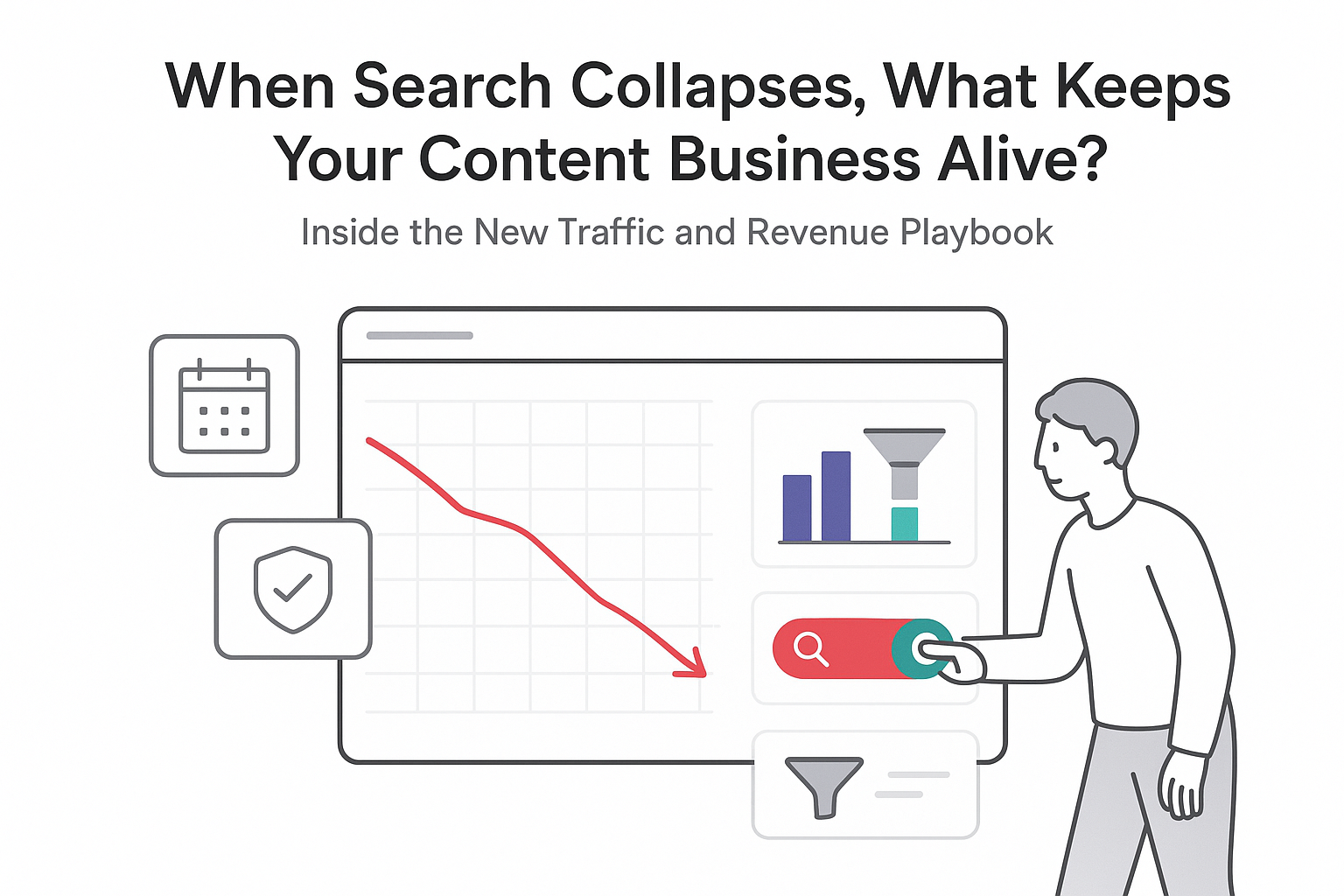
Publishers are planning for a sharp fall in free traffic from search and social as AI answer engines and platform changes reduce referral volumes. The data below summarises what 280 senior media leaders expect and how they say they will respond.
Search traffic decline: Executive Snapshot
Projected 40%+ drop in search referrals is pushing publishers toward original reporting, subscriptions, and licensing.
- Search traffic outlook: Senior media leaders expect search engine traffic to their brands to fall by more than 40% over the next three years as AI-generated answers in search absorb user attention and clicks. [S1][S2]
- Early evidence of impact: Chartbeat data cited in the Reuters report shows aggregate Google Search traffic to "hundreds of news sites" has already started to dip, with lifestyle publishers reporting the sharpest impact after Google's AI Overviews rollout. [S1][S2]
- Social referral collapse: Referral traffic to news sites from Facebook dropped 43% and from X (Twitter) dropped 46% in the last three years, continuing a multi‑year decline in platform-driven traffic. [S1][S2]
- Content strategy shift: Publishers say they will invest more in original investigations, on‑the‑ground reporting, contextual analysis, and human stories, and pull back from service journalism and evergreen explainers that are easier for AI tools to summarise. [S1][S2]
- Revenue priorities: For commercial publishers, subscriptions and memberships are the top revenue focus, with renewed interest in native advertising and in‑person events. Interest in licensing and platform payments has nearly doubled over two years, partly due to large deals from AI companies. [S1][S2]
Implication for marketers: Plan for less dependable free reach from search and social over the next three years and heavier competition for attention on remaining high‑intent and direct channels.
Method and source notes on AI answer engines and publisher traffic
The figures above come from the Reuters Institute for the Study of Journalism's annual predictions report, Journalism, Media, and Technology Trends and Predictions 2026, based on a survey of news leaders. [S1][S2]
What was measured
- Expectations about traffic sources, content strategy, and revenue models over the next three years.
- Views on the impact of generative AI tools and personality‑led creators on audience behaviour. [S1][S2]
Who ran it and how
- Conducted by the Reuters Institute for the Study of Journalism (University of Oxford). [S1]
- Sample: 280 senior leaders (editors‑in‑chief, CEOs, digital heads, and similar roles) from 51 countries and territories. [S1][S2]
- Method: self‑reported online survey; questions cover expectations and planned strategy, not just current results. [S1]
Additional data cited in the report
- Chartbeat analytics on aggregate Google Search traffic to hundreds of news sites. [S1][S2]
- Platform referral trends for Facebook and X to news publishers over the last three years. [S1][S2]
Key limitations
- The Reuters Institute states the group is:
and not statistically representative of the entire global publishing industry. [S1][S2]a strategic sample of senior leaders
- Traffic forecasts (such as the 40%+ search decline) reflect expectations, not a model or time‑series forecast.
- Chartbeat data covers news sites only and may not generalise to other verticals.
- This summary does not break down results by region, publisher size, or business model, which limits fine‑grained planning.
Source IDs used below
- [S1] Reuters Institute for the Study of Journalism - Journalism, Media, and Technology Trends and Predictions 2026 (publisher survey and referenced analytics).
- [S2] Matt G. Southern, Search Engine Journal - Survey: Publishers Expect Search Traffic To Fall Over 40% (summary and key excerpts from [S1]).
Findings on search traffic, social referrals, and content strategy
Expected search traffic impact from AI answer engines
Surveyed leaders expect search traffic to drop by more than 40% over three years as AI answer surfaces grow in prominence in search interfaces. [S1][S2] This expectation is framed as a planning baseline for budgets and strategy rather than a precise forecast. [S2]
The report notes that Google Search referrals to news sites are already trending downward, based on Chartbeat data from hundreds of publishers. [S1][S2] While the exact percentage decline is not specified in the summary, the report highlights:
- News publishers have seen a measurable dip in Google referrals in recent months. [S1][S2]
- Lifestyle‑focused publishers report being hit particularly hard, which the report links to Google's AI Overviews rollout that can summarise lifestyle, travel, and how‑to content directly. [S1][S2]
Leaders surveyed interpret these patterns as evidence that AI summaries and answer boxes reduce click‑through to publisher sites, especially for service, evergreen, and informational content that can be easily condensed. [S1][S2]
Social referral declines and off‑platform shifts
The same report documents continued sharp declines in social media referrals to news sites:
- Facebook referrals down 43% over the last three years. [S1][S2]
- X (Twitter) referrals down 46% over the same period. [S1][S2]
These numbers build on a longer trend of platforms reducing the visibility of news links and de‑prioritising external referrals. [S1][S2] For publishers, this removes a traffic source that many previously relied on during the mid‑2010s.
In response, surveyed leaders say they will:
- Put more resources into video, specifically formats surfaced in YouTube "watch tabs" and short‑form video on TikTok and Instagram. [S1][S2]
- Invest in audio formats such as podcasts, seeing them as better for loyalty and differentiation than commodity text. [S1][S2]
- Treat text output as a lower growth area, focusing written formats on higher‑value reporting rather than volume. [S1][S2]
Publishers are also assessing distribution through AI platforms and aggregators, including ChatGPT, Google Gemini, and Perplexity, where content appears as part of AI answers rather than traditional link lists. [S1][S2]
Content mix and revenue priorities under pressure
The survey finds a notable strategic shift in content focus:
- Leaders plan to increase investment in:
- Original investigations
- On‑the‑ground reporting
- Contextual and explanatory analysis
- Human‑centred narratives and personality‑driven coverage [S1][S2]
- They plan to pull back on:
- Service journalism (how‑tos, guides, basic advice)
- Evergreen informational content that can be summarised by AI tools. [S1][S2]
On the revenue side, the report highlights:
- Among commercial publishers, subscriptions and memberships are the top revenue priority. [S1][S2]
- There is renewed interest in native advertising and face‑to‑face events, as alternatives to open‑market display ads that are vulnerable to traffic declines and programmatic pricing. [S1][S2]
- Licensing and platform payments have gained attention; interest in platform funding has nearly doubled within two years, following large licensing and funding offers from AI and technology companies. [S1][S2]
Overall, leaders appear to be preparing for less traffic and lower ad inventory from search and social, and more dependence on direct, recurring, and B2B revenue streams. [S1][S2]
Interpretation and implications for marketers and publishers
Strategic takeaways for SEO, content, and revenue mix
Interpretation - Likely
- Organic search and social will be weaker volume channels for many publishers. If the expected 40%+ decline in search referrals and large social drops materialise, marketers should assume fewer impressions and sessions from news‑site inventory and similar informational content ecosystems. [S1][S2]
- Content that is easy for AI to summarise will drive fewer clicks. The planned publisher pullback from service and evergreen content suggests those pages already look less attractive under AI‑heavy search results. [S1][S2] For brands, generic FAQ or basic how‑to content is likely to attract fewer visits and should be justified by clear conversion or retention roles, not just traffic.
- Original, differentiated content gains relative value. Publisher investment plans imply that investigations, proprietary data, expert commentary, and distinctive human perspectives are safer from AI summarisation. Brand content with similar traits is more likely to keep winning links, citations, and direct visits over time.
- Direct and owned channels become more important. As search and social referrals fade, email lists, apps, podcasts, and communities become more attractive for both publishers and brand marketers seeking reliable reach and frequency.
Interpretation - Tentative
- Paid media on platforms with strong video and audio may become more central. With publishers moving efforts to YouTube, TikTok, Instagram, and podcasts, marketers should expect more inventory and partnership options in these formats - sponsorships, integrations, and creator collaborations - while traditional display inventory on news sites grows more constrained.
- Ad prices on high‑quality, high‑intent inventory may rise. If overall traffic to quality news and information sites shrinks, but advertiser demand for those audiences holds, CPMs for premium placements could trend upward. This outcome depends on how ad demand and alternative inventory (for example, within AI interfaces) evolve.
Interpretation - Speculative
- AI answer engines could become parallel "distribution layers" with their own economics. Growing publisher interest in licensing and platform payments suggests negotiations are moving toward structured deals. [S1][S2] Over time, brand visibility in AI answers may depend on:
- Which publishers and data sources are licensed
- How attribution and linking work in AI interfaces
- Whether revenue sharing or sponsored answers emerge at scale
- Smaller or niche sites may face a tougher transition. The survey focuses on senior leaders at established outlets. [S1] Smaller publishers and niche content businesses may have fewer options for licensing deals, events, or subscription models, leaving them more exposed to search and social declines.
For most marketers, a practical response is to rebalance the mix: keep pursuing search and social, but plan budgets and forecasts on more conservative traffic assumptions and put more weight on first‑party data, differentiated content, and multi‑format storytelling.
Contradictions and gaps in the evidence
Expectations vs measured outcomes
- The 40%+ decline in search traffic is an expectation among surveyed leaders, not a modelled forecast based on historical data. [S1][S2] Actual outcomes may be less severe if search interfaces or user behaviour change.
Limited visibility into non‑news sectors
- The underlying data focuses on news publishers using Chartbeat. [S1][S2]
- Other sectors (commerce, local services, B2B, entertainment) may experience different impacts from AI answer engines, but this report does not quantify those segments.
Regional and size differences are not detailed
- The summary does not show how expectations vary by region, language, or publisher size. Large national brands and smaller local outlets may face very different conditions, yet they are aggregated.
Attribution questions remain unresolved
- The report notes growing interest in distribution through AI platforms but does not quantify traffic, brand lift, or revenue from those channels. [S1][S2]
- Standards for citations, linking, and revenue‑sharing in AI answers are still being negotiated, so any business impact estimates remain speculative.
These gaps mean the report is best used as a directional signal of industry sentiment, not as a precise forecast for any single site or sector.
Data appendix: key figures on search traffic decline expectations
| Metric / Question | Reported figure | Source |
|---|---|---|
| Survey sample size | 280 senior media leaders | [S1][S2] |
| Countries / territories covered | 51 | [S1][S2] |
| Expected change in search traffic over next 3 years | "More than 40%" decline | [S1][S2] |
| Trend in Google Search traffic to hundreds of news sites | Already starting to dip | [S1][S2] |
| Facebook referral traffic to news sites (3‑year change) | 43% decline | [S1][S2] |
| X (Twitter) referral traffic to news sites (3‑year change) | 46% decline | [S1][S2] |
| Content areas to increase investment | Original investigations, on‑the‑ground reporting, contextual analysis, human stories | [S1][S2] |
| Content areas to scale back | Service journalism, evergreen content | [S1][S2] |
| Main revenue priority for commercial publishers | Subscriptions and memberships | [S1][S2] |
| Other revenue areas seeing renewed focus | Native ads, face‑to‑face events | [S1][S2] |
| Change in interest in platform funding/licensing (2 years) | Nearly doubled | [S1][S2] |
These numbers summarise the planning assumptions senior news leaders are using as they adjust content and revenue strategies for an AI‑heavy search environment.






.svg)

.svg)
.svg)