
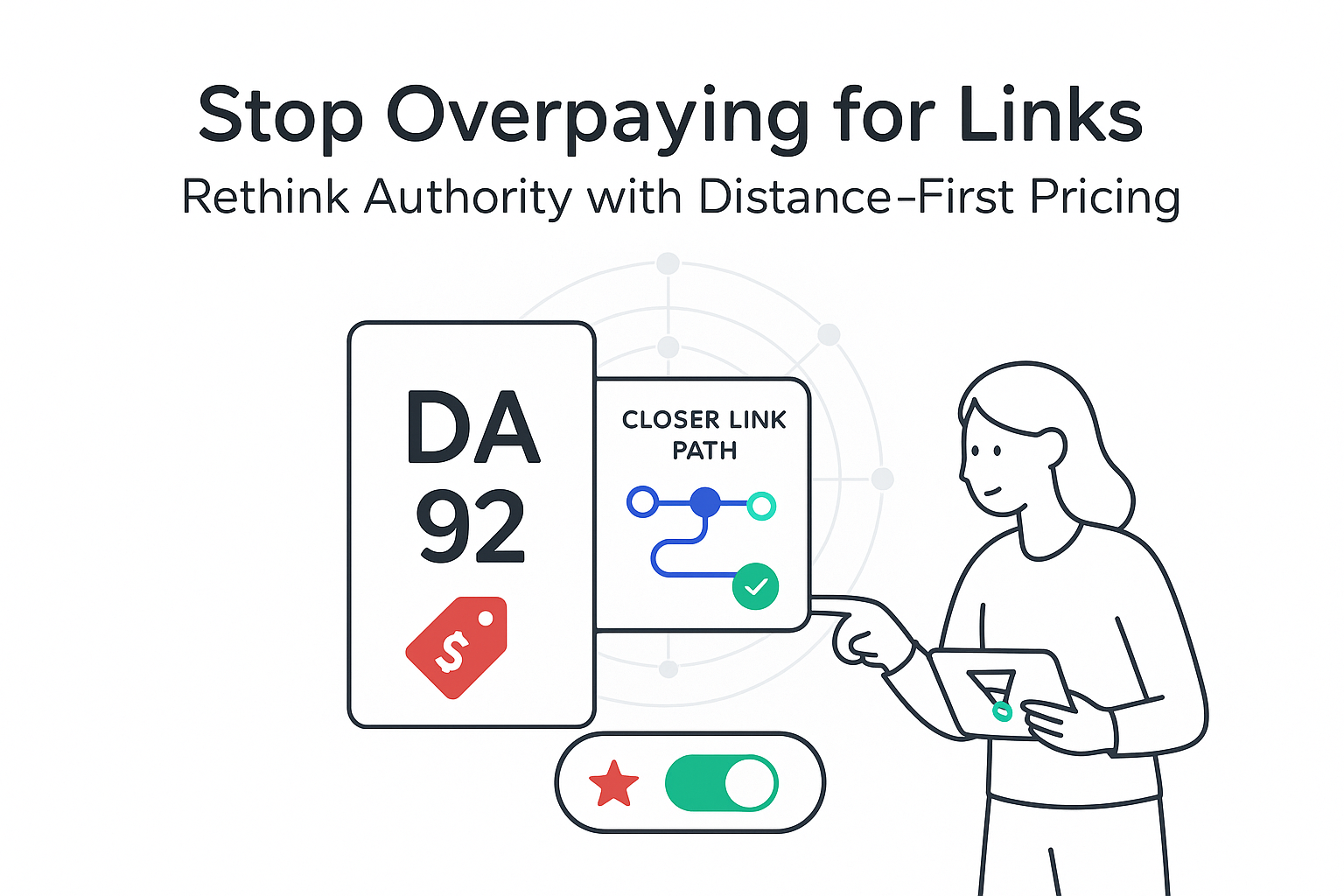
Most SEOs were taught that "trusted" links pass authority across the web graph. This analysis examines whether Roger Montti's seed-set and link-distance view should change how marketers value links and third-party authority metrics.
How link building and trust should be rethought around seed-set distance
The core hypothesis: modern search systems care less about raw "authority" flowing from famous domains and more about how close a site sits - within a topic - to a set of trusted seed sites. If that is directionally correct, chasing generic high-DA/DR placements is often a poor use of resources compared with building dense, relevant link neighborhoods.
This is not entirely new. Academic work on TrustRank and several Google patents describe seed-based, distance-aware link scoring. Montti's contribution is a sharper claim: "trust" is not being handed from site to site; only distance from seeds within a topic neighborhood matters. [S1]
For marketers, the practical issue is resource allocation:
- How much budget should still go toward high-authority, cross-topic PR links?
- How aggressively should teams de-emphasize DA/DR as targeting criteria?
- How much more weight should be given to smaller but highly relevant sites that sit close to trusted hubs in your niche?
The analysis below separates what is supported by evidence from what is informed speculation and suggests how to re-weight common link building playbooks.
Key Takeaways
- Topic-relevant links from sites near trusted hubs are likely underpriced: For most brands, a handful of links from niche authorities (trade bodies, specialist publications, regulators) can have more ranking impact than a generic mention on a national news site with no topical focus.
- Third-party authority scores are useful screening tools, not targeting goals: DA/DR remain correlated with rankings at a coarse level, but they miss seed-set distance and niche scarcity. Using them as hard thresholds causes teams to ignore some of the strongest potential link sources.
- Low-link niches are often misjudged: Verticals with naturally sparse link graphs (local services, regulated B2B, associations) may sit very close to trusted seeds yet carry low DA/DR. Outreach that respects real-world authority in your industry, rather than just link metrics, usually outperforms.
- "High trust" cross-topic links should be valued mainly for brand and referral value: A single link from a famous but topically generic outlet is unlikely to move rankings by itself. Treat it as PR first, SEO second, unless it sits in a section tightly related to your topic.
- Measurement needs to shift from "average authority of linking domains" to "coverage of topic neighborhoods": Track how many key entities in your niche link to or mention you, not just how many high-score domains you have in your profile.
Situation Snapshot
This analysis is prompted by Roger Montti's December 2025 Search Engine Journal article, "The Facts About Trust Change Everything About Link Building." [S1]
Undisputed points and context:
- Seed-based link algorithms exist: Academic research introduced TrustRank, where search engines select a seed set of trusted pages and reduce spam influence by propagating trust from those seeds while discounting distant nodes. [S2]
- Google holds patents on link-distance ranking: For example, "Producing a ranking for pages using distances in a web link graph," which describes using distance from seed pages as part of ranking. [S3]
- Links remain a ranking input but are less dominant: Google confirms that links are still a signal but not the overriding factor they once were. [S4]
- Google does not use third-party metrics such as DA/DR: It has said there is no single "sitewide authority" number like Moz's Domain Authority. [S5]
- E-E-A-T is evaluative, not a direct ranking factor: Quality Rater Guidelines use E-E-A-T (experience, expertise, authoritativeness, trustworthiness) to instruct human raters, but Google states E-E-A-T is not a direct ranking factor. It informs training and evaluation of systems. [S6]
Montti's stronger claims - that trust is never "passed," that cross-topic "high trust" links may be damped to zero, and that third-party metrics are fundamentally misaligned with modern link ranking - are informed interpretations rather than officially confirmed behavior. [S1]
Breakdown & Mechanics
At a high level, the evolution looks like this:
Basic PageRank (late 1990s):
More inbound links lead to higher importance; links from important pages count more.
Web spam era (2000s):
Paid links, link farms, and reciprocal schemes made raw link counts unreliable.
Seed-based and distance-aware approaches (TrustRank and related work):
- Human editors select a seed set of highly trustworthy sites.
- The graph is traversed; pages closer to seeds receive higher trust scores, while distant ones are discounted.
- Ranking uses a blend: classical link importance plus seed distance and other signals. [S2][S3]
Conceptually:
- Identify a seed set of trusted sites.
- Compute distance within topic neighborhoods.
- Blend distance with other ranking signals.
Two mechanics matter most for marketers:
-
Distance over volume
- Under PageRank-style thinking: 50 mediocre links from anywhere could beat 5 highly relevant links.
- Under a distance-aware model (simplified): 5 links from sites 1–2 hops from your niche's seed hubs can beat 50 links from sites 5+ hops away, regardless of their raw "authority."
Volume still matters, but volume without topical and seed proximity is likely heavily discounted.
-
Topical neighborhoods and cliques
- The web clusters by subject: finance sites link to finance, health to health, etc.
- A search engine can construct separate or overlapping seed sets per vertical (e.g., health, finance, travel).
- Link value is assessed more within these clusters than across the whole graph.
In practice, a respected industry association with low DA may be very close to the seed nucleus of your vertical, while a national newspaper may sit in a general news cluster that is several hops away from your niche.
Third-party tools:
- Moz, Ahrefs, and similar platforms mostly estimate a PageRank-like importance score, calibrated against observed rankings. They do not know Google's seed set and do not have a full copy of the link graph.
- Majestic's Topical Trust Flow moves closer to Montti's framing by assigning topics based on seed-like references, but it is still a proxy, not Google's own view. [S7]
From this, a reasonable evidence-based view is that Google likely blends link importance, link relevance, and some notion of distance from high-quality seeds. Third-party metrics approximate a subset of that picture and remain directional but noisy.
Montti's absolute statements ("trust is not passed," "irrelevant 'high trust' links are damped to zero") should be treated as interpretation and simplification for teaching purposes, not literal fact.
Impact Assessment
Organic search and SEO strategy
The directional shift is away from generic authority chasing and toward niche relevance and seed-adjacent coverage.
Who benefits:
- Brands in specialized or low-link verticals that can earn citations from real-world authorities (trade bodies, regulators, niche publications), even if those sites have low DA/DR.
- Sites already embedded in coherent topical neighborhoods with natural interlinking.
Who loses:
- Websites relying on paid guest posts and link swaps on high-DA but topically thin blogs and media sites.
- Agencies that sell "DA-based link packages" without regard to topical and seed proximity.
Practical moves:
-
Build a "seed-adjacent map" of your niche:
- List real-world authorities: standards bodies, certification boards, academic departments, major conferences, long-standing forums, key SaaS or platform vendors in your field.
- For each, check if they link out and in what contexts (resource lists, case studies, citations).
-
Rebalance prospecting criteria:
- Replace "DA 40+ only" with filters such as:
- Topic/category must match or sit clearly adjacent to your core topic.
- Evidence of human curation (editorial standards, staff authors, offline presence).
- Traffic and rankings for important queries in your space, regardless of DA/DR.
- Replace "DA 40+ only" with filters such as:
-
Re-weight your outreach portfolio:
- For every general-news or lifestyle placement, aim for several placements on tightly topical sites, even if their metrics are modest.
Digital PR, content marketing, and link neighborhoods
The main effect is a reprioritization of campaign types and targets.
Implications:
- Hero PR hits on broad outlets (national news, big tech blogs) are still valuable for brand searches, referral traffic, and social proof. If Montti's view is roughly right, their direct SEO impact is limited unless:
- They are from a section closely tied to your topic (for example, a "Personal Finance" section for a financial app).
- They trigger secondary links from niche publications that are closer to your seed neighborhood.
- Content formats that win links from niche hubs gain importance, such as:
- Original data or reports that industry associations want to cite.
- Practical guides referenced by certification providers or university programs in the field.
- Tools or templates that niche communities adopt and list.
Specific adjustments:
- When evaluating PR ideas, add a "seed-adjacent audience" lens: would this story reasonably be covered or cited by specialist outlets or institutions that define expertise in your industry?
- Track "link neighborhood depth":
- Group linking domains by topic category.
- Measure the share of links from core and adjacent categories versus generic or off-topic ones.
- Over time, aim to increase the share of links from tightly related categories, even if total link count grows more slowly.
Paid search, CRO, and wider marketing operations
Paid search impact is indirect but real, via brand and on-site behavior.
- Brand and query mix: Stronger presence in trusted niche hubs tends to increase branded and semi-branded query volume ("brand + topic"), which can improve paid search efficiency on those terms.
- Landing page trust: For YMYL areas (finance, health, legal), links and citations from recognized authorities support on-page trust signals that influence user behavior (higher conversion, lower bounce), which in turn affects both organic and paid performance.
Operational changes:
- KPI adjustment: For SEO teams, track "links/citations from top-tier niche entities" as a shared KPI with PR and content, not just "link count" or "average DA."
- Budget allocation: For campaigns whose ROI case is mostly "SEO via a DA70 link," rerun the numbers assuming the SEO effect may be modest and most value comes from referral traffic and brand lift. Reallocate some of that budget toward sustained outreach in your topic neighborhood.
Scenarios & Probabilities
These scenarios are forward-looking and therefore speculative; likelihood tags are approximate.
Base case - Hybrid link valuation (Likely)
- Google uses a mix of PageRank-like importance, topical relevance, and seed-set distance.
- Third-party authority metrics remain correlated but incomplete; relevance and niche coverage quietly matter more than many teams account for.
- Cross-topic "high authority" links still provide some value but with diminishing returns.
Outcome for marketers: Adjust targeting and measurement, but do not abandon authority considerations altogether.
Upside case - Strong shift to niche neighborhoods (Possible)
- Distance and topic clustering gain more weight as Google continues to combat spam and low-quality content.
- Sites with concentrated, niche-relevant link graphs gain relative to generalist sites with diffuse link profiles.
Outcome: Brands that invest early in deep niche coverage see outsized ranking gains with fewer total links.
Downside case - Overreaction and misallocation (Edge)
- SEOs interpret "trust is not passed" too literally and stop pursuing any big-name or cross-category placements.
- They focus entirely on tiny niche sites, some of which are low quality or commercially driven, leading to a weaker overall link graph and missed brand growth.
Outcome: Weaker real-world authority signals and slower organic growth than competitors who balance niche and broad coverage.
Risks, Unknowns, Limitations
- Black-box algorithms: Google does not confirm the exact weighting of PageRank, seed distance, or topical neighborhoods. Patents and research show what is possible, not what is currently deployed.
- Overstated damping of cross-topic links: Montti's suggestion that some irrelevant "high trust" links may be damped to zero is plausible for spammy or extreme mismatches, but there is no public confirmation that all such links are neutralized. [S1] It is safer to assume "heavily discounted" rather than "always zero."
- Changing systems: Google's link evaluation has evolved for decades and will likely keep changing, especially with growing use of behavioral and content-quality signals. Conclusions drawn from past patents may become less predictive over time.
- Tool limitations:
- Majestic's Topical Trust Flow is closer to seed-based thinking but still reflects Majestic's crawl, seeds, and classifications, which may not mirror Google's view.
- DA/DR are trained against Google's results, so improvements in those scores often correlate with better rankings, but they do not reveal the underlying mechanics.
- Vertical variation: YMYL niches, spam-heavy areas, and languages with sparse content may be treated differently. The relative importance of links versus other signals can vary widely by vertical.
Overall, this analysis frames the main question, separates confirmed mechanics from speculation, and outlines concrete shifts in targeting, measurement, and budgeting that marketers can act on while acknowledging these uncertainties.
Sources
- [S1] Roger Montti, 2025, Search Engine Journal article - "The Facts About Trust Change Everything About Link Building." Available via Martinibuster.com.
- [S2] Zoltán Gyöngyi, Hector Garcia-Molina, Jan Pedersen, 2004, research paper - "Combating Web Spam with TrustRank."
- [S3] Krishna Bharat, Monika Henzinger, 2006, Google patent - "Producing a ranking for pages using distances in a web link graph."
- [S4] Google Search Central, various dates, documentation and office hours - guidance on links as ranking signals and their reduced dominance over time.
- [S5] Google Search Central, 2019–2023, blog posts and tweets - statements clarifying that Google does not use Domain Authority or similar third-party metrics.
- [S6] Google, 2022, Search Quality Rater Guidelines - definitions of E-E-A-T and trustworthiness for rater evaluation.
- [S7] Majestic, product documentation - description of Trust Flow and Topical Trust Flow metrics and their seed-based approach.




.svg)

.svg)
.svg)