
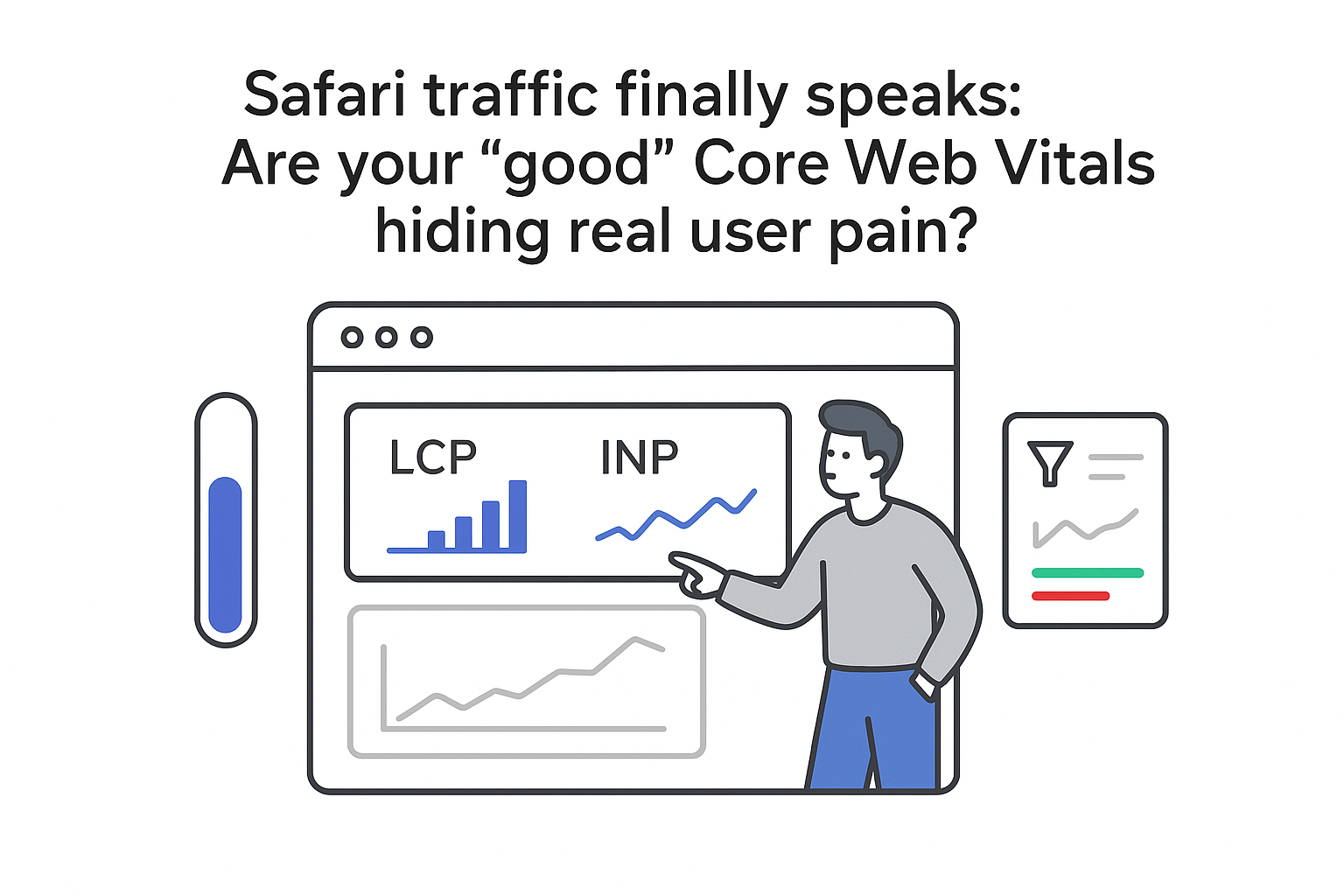
Apple has updated Safari to support accurate measurement of two Core Web Vitals metrics: Largest Contentful Paint (LCP) and Interaction to Next Paint (INP). The capabilities ship with Safari 26.2 across supported Apple platforms and expose new timing data through the browser Performance API, giving site owners real user performance data from Safari traffic on Apple devices.
Safari 26.2 enables LCP and INP measurement
The WebKit team announced that Safari 26.2 adds support for the Event Timing API and Largest Contentful Paint. These capabilities let websites record LCP and INP values for Safari users through standard Performance API interfaces that many analytics libraries already consume.
With Safari 26.2, site owners can include Safari traffic in custom Core Web Vitals tracking across analytics and monitoring platforms. Data can be collected through custom event code that reads Performance API entries and sends them to reporting tools such as Google Analytics, Adobe Analytics, Matomo, Amplitude, Mixpanel, and in-house systems.
Real user monitoring (RUM) services that rely on browser performance entries can also read LCP and Event Timing data from Safari. Providers in this category include Akamai mPulse, Cloudflare Web Analytics, Datadog RUM, Dynatrace, Elastic, New Relic Browser, Raygun, Sentry, SpeedCurve, and Splunk RUM. Tools based on Chrome-only datasets, such as PageSpeed Insights and the Chrome UX Report, are unchanged by this Safari release.
Background: Core Web Vitals and Safari implementation
Largest Contentful Paint is a Core Web Vitals metric that records how quickly the main content of a page appears, focusing on the render time of the largest image or text block visible in the viewport. Apple states that Safari 26.2 now surfaces LCP values through standard PerformanceObserver APIs.
Interaction to Next Paint is another Core Web Vitals metric, replacing First Input Delay as the primary responsiveness indicator. It summarizes the latency of the slowest user interaction during a page visit, such as a click or key press. Safari 26.2 implements the Event Timing API, which Apple says enables INP calculation from real interaction events.
In its Safari 26.2 feature overview, Apple explains that the Event Timing API tracks processing and paint timelines for interactions. The browser records performance entries for interactions that exceed a defined duration threshold. Developers can inspect these entries to identify slow events and derive INP values for each page view. WebKit's official documentation provides additional technical details.
Source citations
Official documentation and reference materials for this update include:
- Apple WebKit blog - "WebKit Features in Safari 26.2" details Event Timing API and Largest Contentful Paint support.
- Google Chrome Developers - Core Web Vitals overview describing LCP, INP, and related performance metrics.
- Google Chrome Developers - Interaction to Next Paint guide explaining INP calculation using the Event Timing API.







.svg)

.svg)
.svg)