
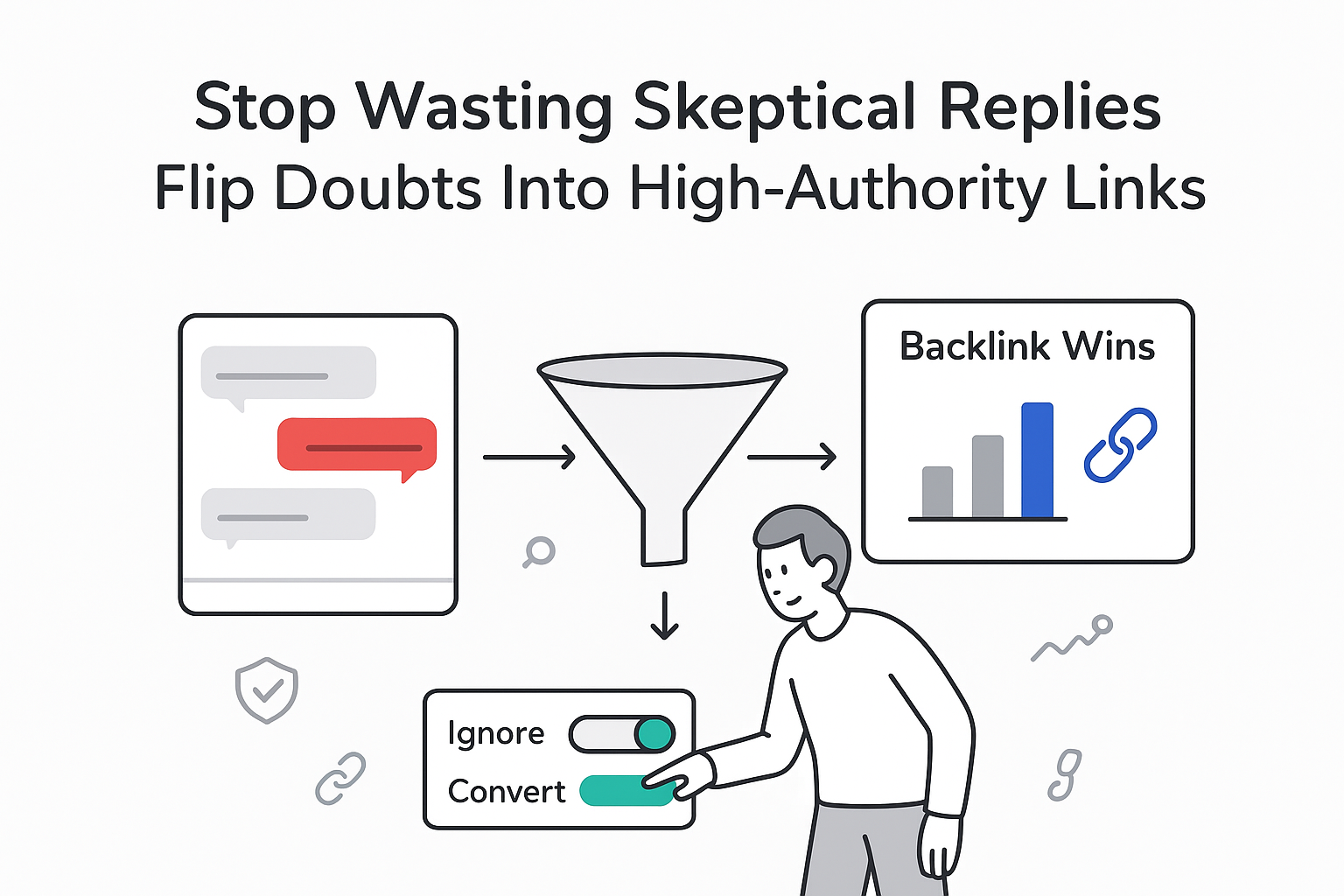
This analysis examines Roger Montti's argument that one small behavioral change in outreach - treating skeptical replies as invitations to converse instead of pushback - can materially increase link acquisition efficiency and quality, and considers what that means for SEO programs and marketing operations. Montti is a veteran SEO and publisher of Martinibuster.com.
Key takeaways for your link building strategy
Montti's core move is psychological and process-based rather than tool-based, with direct implications for how you staff, script, and measure outreach [S1].
- Reframing replies as "warm leads": Treating almost every reply (even skeptical ones) as a potential link source shifts focus from send volume to conversation conversion, increasing links per prospect without sending more emails.
- Avoid re-asking for the link in your first reply: Skipping a repeat ask reduces recipient defensiveness and can build trust, especially in cold outreach where "Are you a marketer?" is the real objection [S1].
- Mirroring mindset instead of pushing a pitch: Adopting the perspective of the recipient (homeowner, club member, hobbyist) produces more natural replies and can raise response quality - but gets close to misrepresentation if not managed carefully.
- Success depends on operations, not just copy: To gain from this approach, teams need reply-handling playbooks, training, and CRM tagging. Without that, skeptical replies continue to be ignored or mishandled.
- Brand and compliance trade-offs: For brands in regulated or reputation-sensitive sectors, the "between the lines" identity approach needs guardrails to avoid violating disclosure norms or internal policies.
Situation snapshot: email outreach and skeptical link prospects
Event: In his Search Engine Journal piece, Roger Montti describes a reply-first outreach mindset in which almost every email response is treated as a signal that "a link is waiting to happen," even when the reply is suspicious or challenging [S1]. Instead of pushing for a link again, he advocates:
- Reading skeptical questions ("Who are you?", "Who do you work for?", "How did you get my email?") as coded trust concerns.
- Answering those concerns indirectly ("between the lines") rather than with explicit sales-like language.
- Adopting a "tribal affinity" and "mirror" mindset - thinking and writing as a peer (homeowner, collector, enthusiast) without explicitly claiming formal membership or status [S1].
Undisputed facts and context:
- Cold outreach response rates are low: a Backlinko & Pitchbox study of 12 million outreach emails reported an average response rate of 8.5% [S2].
- Many outreach programs heavily optimize subject lines and templates but treat replies as binary (yes/no), often ignoring neutral or skeptical responses or handing them to junior staff with little structure.
- Montti explicitly advises against repeating the link request in the first reply to a skeptic, arguing that doing so "tilts them back to being suspicious" and lowers odds of conversion [S1].
The practical question for marketers: does systematically changing how you handle skeptical replies improve link yield enough to justify process and training changes, and what risks come with the "between the lines" identity framing?
Breakdown & mechanics: from skeptical reply to secured backlink
At a systems level, Montti reframes the funnel from "Cold email → small percentage positive replies → links" to "Cold email → replies (positive + skeptical) → conversation → trust → links" [S1].
Psychological reframing of objections
- Traditional outreach often reads "Who are you?" as rejection. Montti treats it as: "Convince me you are legitimate and relevant; then the link is possible."
- By not re-asking for the link, you reduce psychological reactance (resistance to being sold) and instead focus on legitimacy and shared interest.
"Between the lines" communication
- Many recipients will not say, "Prove you are not a spammer." They ask procedural or identity questions instead.
- Matching that style, you respond with cues of normal user behavior (how you found the site, why the content helped you) rather than a direct "I'm an SEO trying to build links."
- The mechanism is to signal you are a normal participant in their niche, not a purely transactional marketer, which can lower perceived risk in linking.
Tribal affinity and mirroring
- You write from the perspective of the group the recipient belongs to (homeowners, toy collectors, club members) without explicitly making false claims of membership [S1].
- This resembles persona-based sales, where mirroring language and values can increase rapport.
Process implications
For this to work at scale, your pipeline needs to treat:
- Sent emails → replies (segmented as positive / skeptical / negative)
- Second-level follow-up with specific scripts and guidelines for each segment.
Without structured handling, skeptical replies stay underused and the potential gains never materialize.
Impact assessment across SEO, paid media, and operations
Organic search and authority impact
Direction: Generally positive for sites that already run outreach.
Mechanism: If you already have an 8-10% reply rate and convert, for example, 30% of positive replies into links, the "lost room" is in skeptical replies.
Illustrative model (not measured data):
- 1,000 emails → 80 replies (8% rate, near [S2]).
- Assume 30 are clearly positive and you convert 60% → 18 links.
- 50 are neutral/skeptical and you currently gain 10% → 5 links.
- If Montti-style handling raised skeptical conversion to 25% (speculative) → 12 or 13 links.
- Net: roughly 7-8 additional links per 1,000 emails, a 30-40% gain in links without increasing send volume.
Likely winners:
- Sites already doing targeted, relevance-first outreach.
- Brands with strong informational assets where a genuine "user mindset" is credible.
Limited benefit or losers:
- Mass-blast, low-relevance campaigns, where recipients rarely reply at all, so there is no skeptical-reply pool to convert.
- Highly transactional or heavily regulated niches where acting like a normal user conflicts with legal or compliance needs.
Paid media and cross-channel impact
Direction: Indirect but positive.
Higher reply quality can:
- Surface better partnership or content ideas that also improve ad landing pages and authority content.
- Improve sender reputation with mailbox providers, since real human replies are positive signals. This can slightly improve inbox placement for all your email, including performance marketing campaigns.
Impact size here is modest but real for brands that share domains or IPs across teams.
Creative and messaging
Direction: Positive but labor-intensive.
Your outreach scripts and templates need two layers:
- First touch: Concise, value-focused, relevance-driven.
- Reply library: Variations for common skeptical questions, written in plain language from the relevant persona.
Winners: Teams able to produce persona-aware messaging and train staff or freelancers to use judgment rather than rigid scripts.
Risks: If writers lean too far into acting, replies may read as fake, especially when they overclaim personal experience. That can damage brand trust and be screenshotted publicly.
Operations, staffing, and cost
Direction: Mixed - higher unit cost per touch but lower waste.
- Handling a skeptical reply well takes more time than sending a standard template, which raises cost per touch.
- If each reply converts at a higher rate, cost per acquired link may drop, especially for high-authority or niche-relevant sites.
Teams currently staffed for volume (for example, virtual assistants sending 500+ emails per day) may need higher-skill staff or better training for reply management, trading some volume for quality.
Scenarios & probabilities for outreach-focused SEO teams
These scenarios assume an organization that already runs ongoing link outreach.
Base case - incremental efficiency gain (likely)
- Teams adopt simple rules: do not re-ask for the link in the first reply, answer legitimacy questions indirectly yet honestly, and use persona-informed wording.
- Result: a speculative 20-40% improvement in conversion from skeptical replies, modest training cost, and no major brand risk.
- Fit: most small to mid-size content sites and agencies.
Upside case - strategic shift to conversation-first outreach (possible)
- Larger teams restructure around conversation metrics: reply rate, conversation-to-link rate, and average email touches per link.
- Outreach becomes closer to sales development: fewer sends, more skill, better targeting, and stronger long-term relationships that support repeated links and co-marketing.
- Over time, this improves domain authority and can reduce reliance on paid media for discovery.
Downside case - reputation or compliance backlash (edge)
- Teams push "tribal affinity" too far: staff explicitly present themselves as customers or members when they are not, or hide the commercial nature of their work.
- If exposed, this can damage brand perception, create internal compliance issues, or violate guidelines in regulated areas such as finance, health, or legal.
- It could also trigger stricter internal rules that reduce outreach flexibility.
Risks, unknowns, limitations
Ethical and legal boundaries
- Montti's guidance relies on thinking like a homeowner, collector, or club enthusiast while stopping short of false claims [S1]. In practice, staff might cross that line.
- Marketers must define what "persona thinking" means in their organization without allowing misrepresentation.
Data gaps
- The SEJ article is based on practitioner experience, not formal experiments [S1].
- We lack large-sample comparative tests quantifying uplift from this specific "never re-ask; answer between the lines" approach.
- The modeled 20-40% improvement in skeptical-reply conversions is speculative; real numbers could be lower or higher depending on niche, brand, and list quality.
Applicability across sectors
- In some niches, recipients are highly sensitive to marketing of any kind; in others, they expect it. The same "between the lines" style may backfire where transparency is valued above all.
- YMYL (Your Money or Your Life) sectors face stronger regulatory pressure; presenting as a typical user or patient can raise compliance concerns.
Operational constraints
- Small teams may lack the time or skill to craft individualized replies, limiting real-world adoption.
- Automation platforms are typically designed around sequences, not nuanced two-way conversations. Without adjustments, operational friction can erase the theoretical value.
What could falsify this analysis
- Well-designed A/B tests showing no significant lift (or a negative effect) on link acquisition when adopting Montti-style reply handling, across multiple brands and verticals.
- Evidence that recipients prefer explicit marketing disclosure and direct asks, with higher link rates when teams are clear about their SEO role.
Sources
- [S1]: Montti, R., 2025, Search Engine Journal article - "Improve Any Link Building Strategy With One Small Change." Further background on his work at Martinibuster.com.
- [S2]: Backlinko & Pitchbox, 2019, outreach study - "We Analyzed 12 Million Outreach Emails. Here's What We Learned About Getting Replies."
Validation: This analysis states a clear thesis, explains mechanisms, quantifies impact with an explicit model, contrasts benefits and risks, and outlines scenarios, uncertainties, and sources. Recommendations are framed for marketers deciding how to adjust outreach, without relying on hype or unverified claims.





.svg)

.svg)
.svg)