
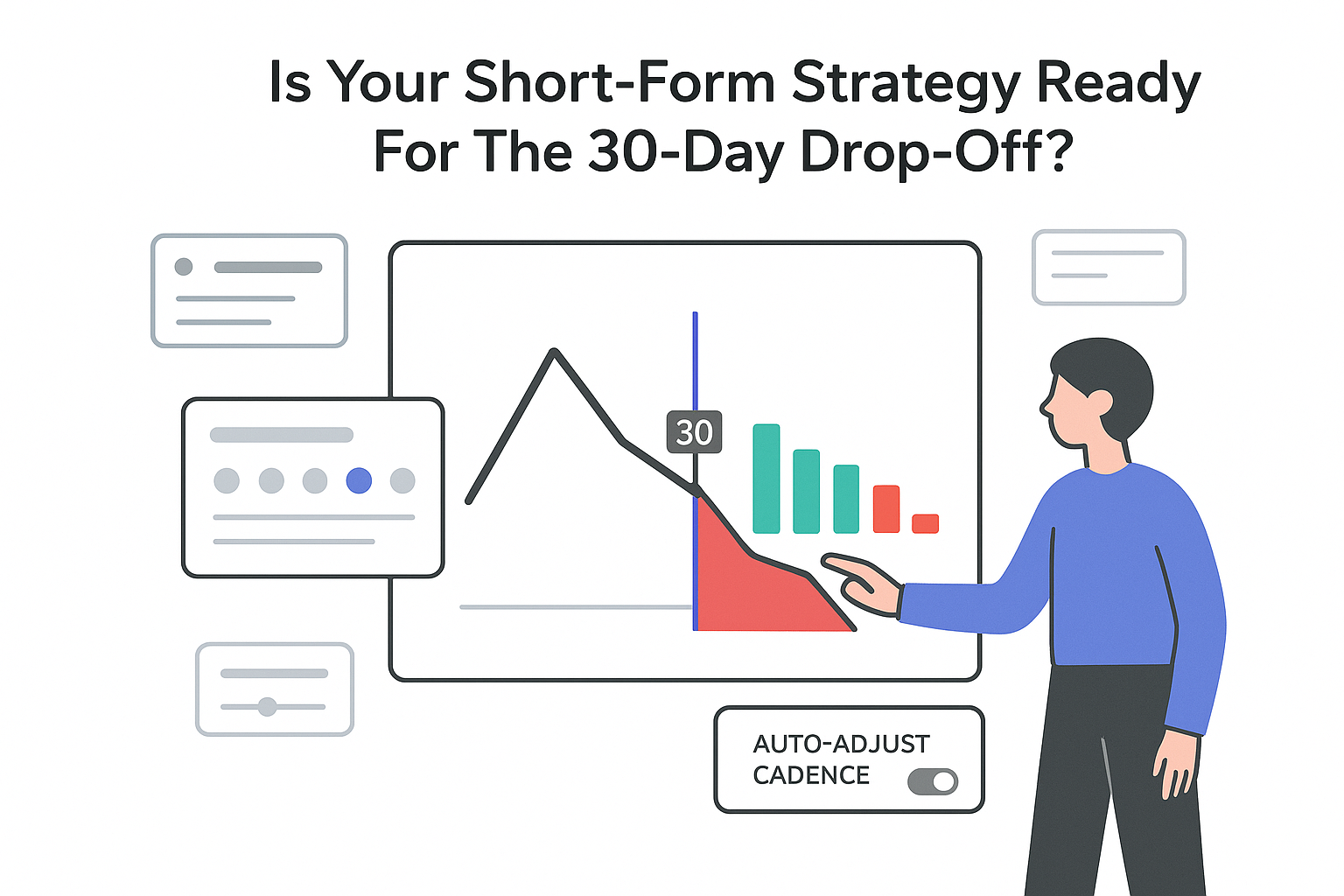
YouTube Shorts evergreen view decline after 30 days: evidence from creator analytics (2025). This report summarizes observed changes in Shorts impressions for videos older than roughly one month and what they may mean for business and brand channels on YouTube.
YouTube Shorts algorithm change: executive snapshot
- In mid-September 2025, analysts for several major YouTube channels (roughly 100M-1B monthly views) reported a sharp drop in impressions for Shorts older than about 28-30 days compared with earlier months, led by retention strategist Mario Joos, who identified the pattern in creator analytics. Exact percentages were not published. [S1]
- Multiple creators, including consultant Mario Joos and creator Tim Chesney, reported that Shorts which previously generated consistent long-tail views now receive "far fewer impressions" once they age past roughly one month. Tim Chesney has documented the change in a detailed video, and other Shorts creators have confirmed the pattern on X. [S1]
- Some creators interpret this as an algorithm shift that strongly favors recent uploads, increasing the need to publish continuously to maintain reach; Dot Esports reports similar concerns from MrBeast's retention director. [S1]
- YouTube and Alphabet executives referenced improvements in recommendation systems in the Q3 earnings call but did not confirm any change specific to Shorts or to a 30-day cutoff. [S1]
- Evidence so far is based on creator-side analytics and public commentary rather than controlled experiments or platform-released metrics. [S1]
For marketers, a practical working assumption is that a large share of Shorts impressions may now arrive within the first 30 days, making content cadence and repurposing plans more time-sensitive than before.
Method and source notes on YouTube Shorts performance data
The core observations come from creator-reported analytics and public statements, not from formal academic or platform studies:
Creator analytics - large channels
- Source: Retention strategist Mario Joos, who works with top channels, including very high-volume creators. [S1]
- Scope: Multiple channels with roughly 100M-1B monthly views. [S1]
- Method: Internal analysis of YouTube Analytics dashboards, comparing impressions and view patterns for Shorts before and after mid-September 2025, with a focus on content older than about 30 days. [S1]
- Limitations:
- Exact sample size and vertical mix are not disclosed.
- Methods, statistical controls, and charts are not fully public; insights are summarized through social posts and interviews.
Creator anecdotes - mid-size channels
- Source: Public commentary (for example, Tim Chesney's video and social posts from other Shorts creators) describing traffic drops on back-catalog Shorts after roughly 30 days. [S1]
- Method: Qualitative reports based on channel analytics panels.
- Limitations: Self-selection bias and no consistent methodology or baseline across channels.
Platform and corporate statements
- Alphabet's Q3 2025 earnings call comments on "recommendation improvements" are referenced second-hand in the article summarized by the user. [S1]
- YouTube's public documentation (2022-2023) describes general recommendation inputs such as watch history, engagement, video performance, and freshness but does not describe a 30-day rule for Shorts. [S2]
Historical context on Shorts audience scale
- By 2023, YouTube reported more than 2B logged-in monthly users watching Shorts, underscoring the importance of Shorts distribution for brands. [S3]
Overall, the dataset is observational and creator-reported, not a controlled platform-side study. That limits certainty around causality and exact effect sizes.
Findings on YouTube Shorts evergreen views and 30-day decay
Observed post-30-day impression drop for Shorts
- Joos and other analysts reported that since mid-September 2025, Shorts older than about 28-30 days receive materially fewer impressions than comparable Shorts did before that period. [S1]
- This pattern reportedly holds across several large entertainment and creator-led channels, not just a single account. [S1]
- Creators describe the effect as a loss of "evergreen" performance:
- Previously, successful Shorts could gather substantial views weeks or months after publication through recommendations.
- After the reported shift, view curves appear to flatten more quickly, with far less incremental reach after roughly 30 days. [S1]
- No precise median or average decay curve has been shared, and there is no public chart from YouTube confirming the behavior. The qualitative direction, however, is consistent across multiple creator accounts summarized in the article. [S1]
Fact pattern: creator-side dashboards show that a greater proportion of total lifetime Shorts impressions now appears to concentrate in the first month after upload, with long-tail discovery weakening on at least some large channels. [S1]
Creator sentiment: push toward quantity and reduced evergreen value
- Several creators quoted or referenced in the article argue that a stronger recency bias:
- Rewards frequent, serialized uploading over one-off, highly produced Shorts intended for long-term discovery. [S1]
- Increases operational pressure on channels that rely on catalog views to sustain revenue and audience growth. [S1]
- Some compare the experience to short-lived formats on other platforms, where content quickly decays in reach after a brief recommendation window. [S1]
- Concerns raised include:
- Reduced incentive to invest heavily in Shorts designed to stay relevant for months. [S1]
- Potential over-emphasis on trends or reactive content that can be produced and published quickly. [S1]
At the same time, YouTube has not confirmed an algorithm adjustment, and there is no official explanation for the reported behavior. [S1] Platform documentation still emphasizes viewer satisfaction, watch time, and engagement as key inputs for Shorts recommendations. [S2]
Interpretation and implications for YouTube Shorts strategy
Interpretation - likely: Given consistent anecdotal reports from analytically sophisticated creators and consultants, it is likely that recommendation behavior for Shorts has shifted in a way that in practice strengthens recency for at least some content categories. The absence of a clear platform statement suggests this may be part of ongoing tuning of recommendation systems rather than a single, publicly announced policy change. [S1][S2]
Interpretation - tentative: The reports do not show that every Short is capped after 30 days; rather, they suggest that:
- A higher share of impressions now lands within the first month after upload.
- The probability that a Short "wakes up" and surges in views months later may have fallen for some channels.
For marketers and business owners running Shorts as part of a broader video mix, practical implications include:
Planning cadence around a 30-day performance window (likely)
- Treat the first 30 days as the main performance period for most Shorts, with limited expectation of long-tail traffic unless later data shows otherwise.
- Adjust content calendars so that key campaigns have enough volume and sequencing within that window.
Re-publishing and variation (tentative)
- If Shorts lose reach after a month, it may be reasonable to test refreshed cuts, new hooks, or updated captions of proven concepts after a gap, while avoiding spammy repetition.
- Use A/B-style experiments where possible to see whether new variants recapture reach.
Balancing effort between Shorts and long-form (likely)
- Long-form videos still tend to accumulate more stable evergreen search and recommendation traffic over months and years, based on pre-2025 behavior and platform guidance. [S2]
- Brands that rely on compounding traffic should consider Shorts as a front-end awareness and testing format, with core search and education content handled by longer videos and other assets.
Analytics focus (likely)
- Track impressions, views, and watch time by video age cohort (0-7 days, 8-30 days, 31-90 days) to see whether your own channel matches the reported pattern.
- Pay particular attention to whether historic Shorts that once grew steadily have flattened since September 2025. [S1]
These points should be treated as working assumptions, suitable for testing but not as confirmed long-term platform rules.
Contradictions and gaps in current YouTube Shorts evidence
- Lack of platform-level confirmation:
- YouTube has not published an official description of a 30-day rule or any permanent cap on Shorts impressions. [S1][S2]
- The only public corporate remarks referenced relate to general "recommendation improvements," which may cover many signals besides recency. [S1]
- No public, large-N study:
- There is no peer-reviewed or industry-wide dataset (for example, thousands of channels across categories) showing pre- and post-September 2025 Shorts performance curves.
- Existing insights come from a limited number of channels, some of which operate in similar entertainment niches. [S1]
- Selection and survivorship bias:
- Creators with noticeable declines are more likely to post about them, which can overstate the universality of the pattern.
- Channels that did not experience meaningful change, or that benefited from the adjustment, are less visible in the discussion.
- Unknown role of content type and audience segment:
- It is unclear whether short-term decay is stronger in certain verticals (for example, trending entertainment) than in evergreen categories (for example, tutorials or B2B education).
- Geographic and language differences are not documented in current reports.
Given these gaps, business decisions based on this evidence should remain flexible. Channel-specific testing and monitoring remain necessary to confirm whether the same pattern affects your Shorts catalog.
Data appendix for Shorts performance observations
Key quantitative elements from current reports
- Reported age threshold for reduced impressions on Shorts: approximately 28-30 days after upload. [S1]
- Scale of creator analysis: multiple channels reportedly in the 100M-1B monthly view range on YouTube. [S1]
- Timing of observed shift: described as taking effect around mid-September 2025. [S1]
- Shorts audience scale for context: more than 2B logged-in monthly users watch Shorts on YouTube as of 2023. [S3]
Source list
- [S1] - Search Engine Journal article by Matt G. Southern (Dec 2025), summarizing creator reports (including Mario Joos and Tim Chesney) on reduced evergreen reach for Shorts older than about 30 days and noting references to Alphabet's Q3 2025 earnings call. User-provided paraphrase.
- [S2] - YouTube Help and Creator resources (2022-2023): documentation on how recommendations work and how Shorts are surfaced, emphasizing viewer behavior and video performance rather than fixed time-based caps.
- [S3] - YouTube and Google public statements (2023) reporting that over 2B logged-in monthly users watch Shorts, indicating the scale of the Shorts audience.







.svg)

.svg)
.svg)