
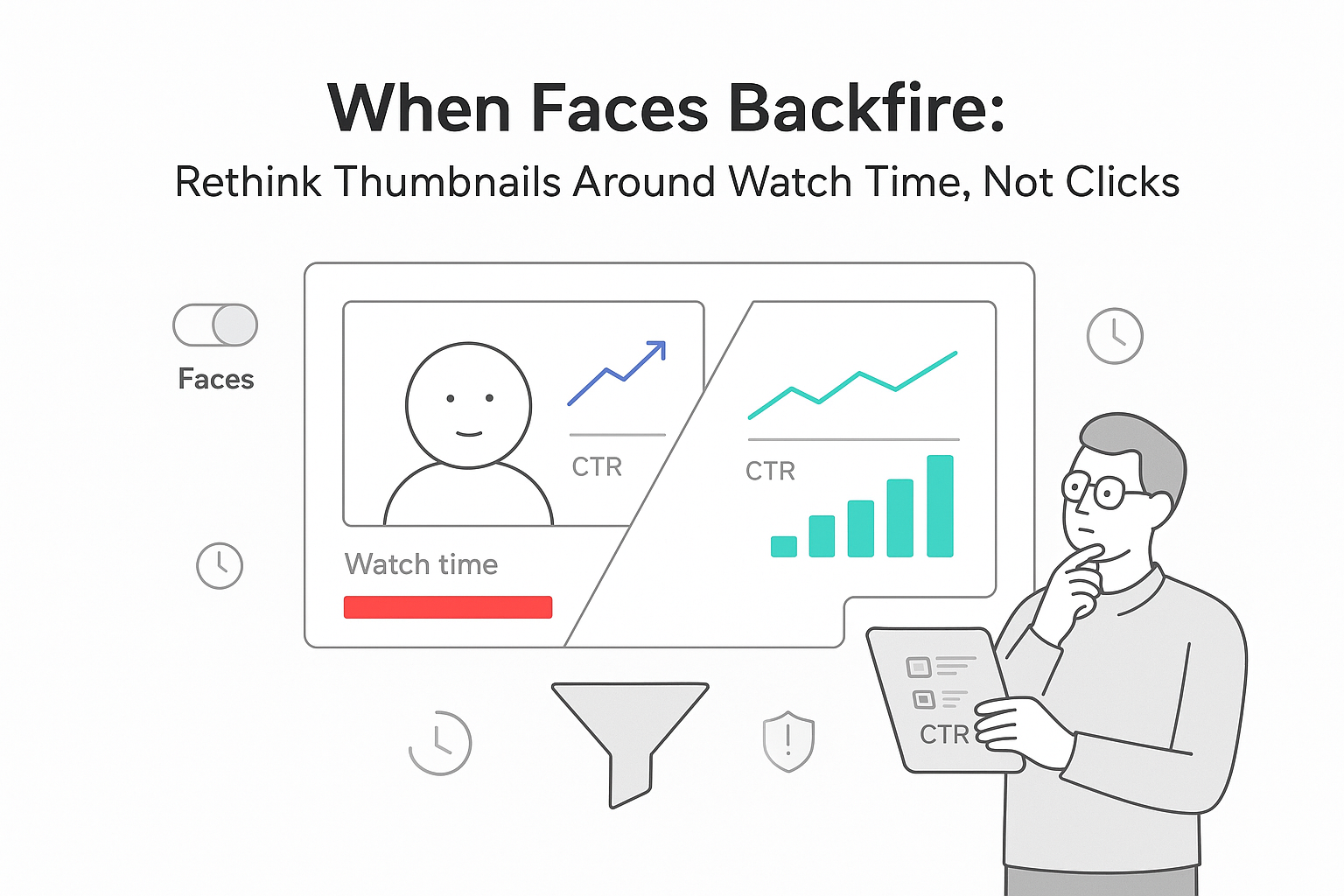
Faces in YouTube thumbnails have been debated for years. New large scale data suggests they are neither a universal boost nor a universal drag on performance. Their impact depends strongly on niche, channel size, and how YouTube measures success, in particular its focus on watch time rather than click through rate (CTR) alone.
One line implication for marketers: Treat faces as a test variable shaped by niche and audience familiarity, and judge thumbnails on watch time outcomes, not CTR in isolation.
Executive Snapshot
- A 1of10 Media dataset of more than 300,000 viral 2025 YouTube videos found that thumbnails with faces and thumbnails without faces performed similarly on average when measured by a channel relative Outlier Score.
- Faces appeared on a large share of sampled thumbnails, but adding a face showed a noticeable lift only for channels above a certain subscriber threshold, and even there the gain was modest.
- Performance varied by niche: categories such as Finance performed better with faces, while Business performed worse with faces relative to thumbnails without faces.
- Within thumbnails that included faces, those showing multiple faces outperformed single face thumbnails on average.
- YouTube's Thumbnail Test & Compare feature selects winners based on watch time, not CTR, to reduce clickbait outcomes and reward thumbnails that match viewer expectations.

Method & Source Notes
The current debate about faces in thumbnails was reignited when vidIQ suggested that putting your face in a thumbnail is probably killing your views. Nate Curtiss of 1of10 Media responded with data from more than 300,000 viral videos, summarized in a long-form report. This article synthesizes insights from that dataset, official YouTube documentation, and public creator experimentation.
1of10 Media dataset
- Scope: More than 300,000 viral YouTube videos from 2025 across tens of thousands of channels.
- Metric: An Outlier Score, defined as views relative to the channel's median views, used to normalize performance across different channel sizes.
- Focus: Thumbnail attributes such as the presence or absence of faces and number of faces, channel size segments, and broad content niches including Finance and Business.
- Limitations: The dataset covers only viral or high performing videos, so findings may not generalize to typical uploads or underperforming videos. The underlying codebook and exact numeric lifts are not public in the available summaries.
YouTube product and help documentation
- Thumbnail Test & Compare: A June 14, 2024 YouTube blog post explains that experiments return watch time for each variant, not separate CTR and retention metrics, to avoid rewarding clickbait that harms viewing duration.
- Studio A/B features: A separate YouTube blog post describes 2025 Studio updates that allow testing up to three title and thumbnail variants per video.
- Audience segments: The YouTube Help Center encourages creators to think in terms of new, casual, and regular viewers, and suggests thinking about whether a video is intended primarily for subscribers or for broader audiences.
- Packaging concept: A YouTube video in which the product team describes this "packaging" concept treats the title, thumbnail, and first 30 seconds of a video as one unit that must deliver a consistent promise.
Creator experimentation
- MrBeast has previously mentioned that changing facial expressions in thumbnails, such as using closed mouth instead of open mouth reactions, increased watch time in his internal tests.
- Limitation: This is a single creator anecdote, not a controlled, industry wide study.
Faces in YouTube thumbnails: performance data for marketers
The 1of10 Media dataset is one of the largest recent thumbnail focused analyses, covering more than 300,000 viral videos from 2025 and normalizing performance using a channel relative Outlier Score.
On the central question - "Do faces help?" - the reported top line answer is that thumbnails with faces and thumbnails without faces perform similarly on average. Faces appear frequently in the sample, but the presence of a face alone does not reliably separate winners from the rest once channel context is taken into account.
Key factual points from the report summary include:
- No clear global winner: Across all videos in the dataset, average performance for thumbnails with faces versus those without was broadly comparable rather than one side consistently dominating.
- Faces are common but not magic: Faces appear on a large share of thumbnails in the sample, suggesting many successful creators use them, but their presence is not a sufficient explanation for outlier performance.
- Multiple faces perform best: Within thumbnails that included faces, those with multiple faces outperformed those with a single face according to the Outlier Score metric.
From a measurement perspective, "use a face" or "go faceless" is too coarse a rule. Performance gaps become clearer when the data is segmented further by channel size and niche rather than in the overall averages.
YouTube thumbnail click through rate versus watch time outcomes
YouTube's product design emphasizes watch time as the success metric for thumbnails, not CTR alone. This affects how any advice about using faces should be interpreted.
In a June 14, 2024 YouTube blog post, Creator Liaison Rene Ritchie explains that the Thumbnail Test & Compare tool runs experiments until one variant achieves higher watch time. Results are presented as watch time, not broken out as CTR and average view percentage (AVP).
Ritchie notes that watch time already includes both clicking and continuing to watch. If creators optimize only for CTR, they risk creating clickbait thumbnails that increase clicks but reduce retention, which can harm overall performance. By returning watch time, the tool is designed to encourage combinations of title, thumbnail, and content that match viewer expectations and keep them watching.
Separately, a separate YouTube blog post describing YouTube Studio updates outlines native support for testing up to three titles and thumbnails per video, again centered on outcome metrics rather than cosmetic changes alone.
In practice this means:
- A thumbnail that slightly lowers CTR but improves retention can still win, because watch time is the selection metric in Thumbnail Test & Compare.
- Thumbnail guidance that treats CTR as the sole target misses a key aspect of how YouTube evaluates performance.
For design choices such as adding or removing faces, the relevant question on YouTube is not just "Does this get more clicks?" but "Does this package attract the right viewers and keep them watching?"
Channel size, video niches, and thumbnail faces on YouTube
The 1of10 Media report's more granular findings show that the impact of faces is not uniform. It varies by channel size and by content category.
Channel size effects
- Adding a face to thumbnails was associated with better performance only for channels above a certain subscriber threshold.
- For these larger channels, the reported lift from adding a face was modest rather than dramatic.
- Smaller channels did not see the same positive association from including faces, suggesting that audience familiarity with the creator may be a factor.
This pattern aligns with YouTube's framing of regular versus new viewers: established audiences are more likely to recognize and respond to a specific person's face, while non subscribers may be more focused on the idea or topic.
Niche level variation
- Some niches performed better with faces. Finance is explicitly cited as a category where thumbnails with faces outperformed those without.
- Some niches performed worse with faces. Business is cited as one of the categories where thumbnails with faces underperformed compared with thumbnails without faces.
Because the available summaries do not publish precise percentage lifts or statistical significance levels, the size of these effects is unclear. The directional takeaway is that whether faces help appears to depend materially on what the video is about.
Audience segments and YouTube thumbnail packaging strategy
YouTube's Help Center encourages creators to think of their viewers as groups - new, casual, and regular - rather than a single homogeneous audience. It also suggests thinking about whether each video is aimed primarily at subscribers who already know the channel or at broader audiences encountering it for the first time.
This guidance fits the observed data patterns:
- For regular viewers and subscribers, a creator's face can serve as a brand element and trust signal, which may help explain why faces correlated more positively with performance on larger channels that have more established audiences.
- For new or casual viewers, YouTube documentation stresses clarity of action, emotion, and topic. In categories where the idea or subject matter is primary, such as some Business content, a person's face may compete visually with the main concept, which matches the report's finding that faces reduced performance in some niches.
YouTube product teams also talk about "packaging" - treating the title, thumbnail, and first 30 seconds as one integrated unit. In a YouTube video, the product team describes this as a promise that should be delivered on immediately after the click.
Factually, this implies:
- Mismatched thumbnails, such as extreme facial reactions that are not reflected in the video's opening, risk early drop off, which will show up negatively in watch time.
- A face that appears in the thumbnail should usually appear quickly in the video itself, with a consistent tone, especially on mobile where auto play blurs the line between the thumbnail and the opening frames.
Interpretation and implications for YouTube thumbnail strategy
Label: Likely (based directly on cited data and official docs)
- Faces are a context dependent design choice, not a default rule. Across more than 300,000 viral videos, there was no decisive global advantage for using faces versus no faces once performance was normalized per channel. Using or avoiding faces should be treated as a targeted design decision, not a blanket rule.
- Watch time should be the main scoreboard. Because YouTube's thumbnail testing chooses winners based on watch time, strategies that chase CTR alone, such as changing thumbnails purely to increase clicks when that change hurts retention, are misaligned with how the platform rewards content.
- Audience familiarity matters. The positive association between faces and performance on larger channels suggests that faces function partly as a "known brand" signal. Smaller channels may not see this benefit and should prioritize clear topic framing.
Label: Tentative (supported by data directionally, but with limited public detail)
- Niches should guide whether faces are foregrounded. Categories where decisions are personal and emotional, such as Finance, may benefit more from human faces that convey trust or reaction. Categories where the subject is more abstract or organizational, such as Business, may perform better when the core idea or outcome is visually dominant and faces are minimized or absent.
- Multiple faces may signal interaction or social proof. The outperformance of multi face thumbnails in the 1of10 data suggests that collaborative, versus style, or reaction formats can gain from showing several people, possibly because this implies dialogue, contrast, or group validation.
Label: Speculative (plausible extensions, not directly tested in sources)
- Small channels may benefit from idea first thumbnails while gradually introducing faces. Given that faces did not show clear gains for smaller channels in the dataset, creators without strong recognition might prioritize thumbnails that make the topic and outcome unambiguous, using faces sparingly until they build a recognizable brand.
- Expression and styling of faces could matter more than presence alone. MrBeast's anecdote about improved watch time from changing facial expressions, combined with YouTube's focus on retention, suggests that the emotional clarity and authenticity of a face could be more important than simply including one.
For business owners and marketing leads, the operational takeaway is to fold faces into structured tests. Segment experiments by video type, audience target (subscribers versus new viewers), and face configuration (no face, single face, multiple faces), then choose winners based on watch time rather than CTR in isolation.
Data contradictions and gaps in YouTube thumbnail research
Conflicting advice
Prominent voices offer different guidance on faces in thumbnails:
- vidIQ has publicly argued that for non famous creators, faces can "kill your views" and that removing them can raise CTR, emphasizing that viewers click for ideas rather than people.
- Nate Curtiss and the 1of10 Media data push back on that generalization, showing no consistent average penalty for faces across a large viral sample and highlighting categories where faces help.
Both perspectives can be factually consistent if:
- vidIQ's observations are based on subsets of creators or specific niches where faces underperform, or on CTR only metrics.
- 1of10's analysis, centered on watch time weighted outlier performance across many niches, dilutes such localized effects.
Key gaps and limitations
- Viral only sample: The 1of10 dataset covers only high performing videos, so it cannot say whether faces help a typical video escape from low view counts.
- Missing exact numbers: Public summaries do not include precise percentage lifts or statistical significance levels, making it hard to quantify the size of the reported effects.
- Limited demographic detail: There is no publicly shared breakdown by region, language, or viewer demographics, which may influence how faces are received.
- Shallow content type segmentation: High level niches like Finance and Business group together varied formats, such as explainers, entertainment, and interviews. Thumbnail dynamics may differ inside these broad labels, but those distinctions are not visible in the available summaries.
- Few third party replications: Outside of platform anecdotes and this single large report, there are few independently published, large scale studies on faces in YouTube thumbnails that include both CTR and watch time.
Given these gaps, current evidence supports treating faces as one of several context sensitive thumbnail elements whose value depends on niche, audience familiarity, and how well the thumbnail's promise matches the video content as judged by watch time.







.svg)

.svg)
.svg)