
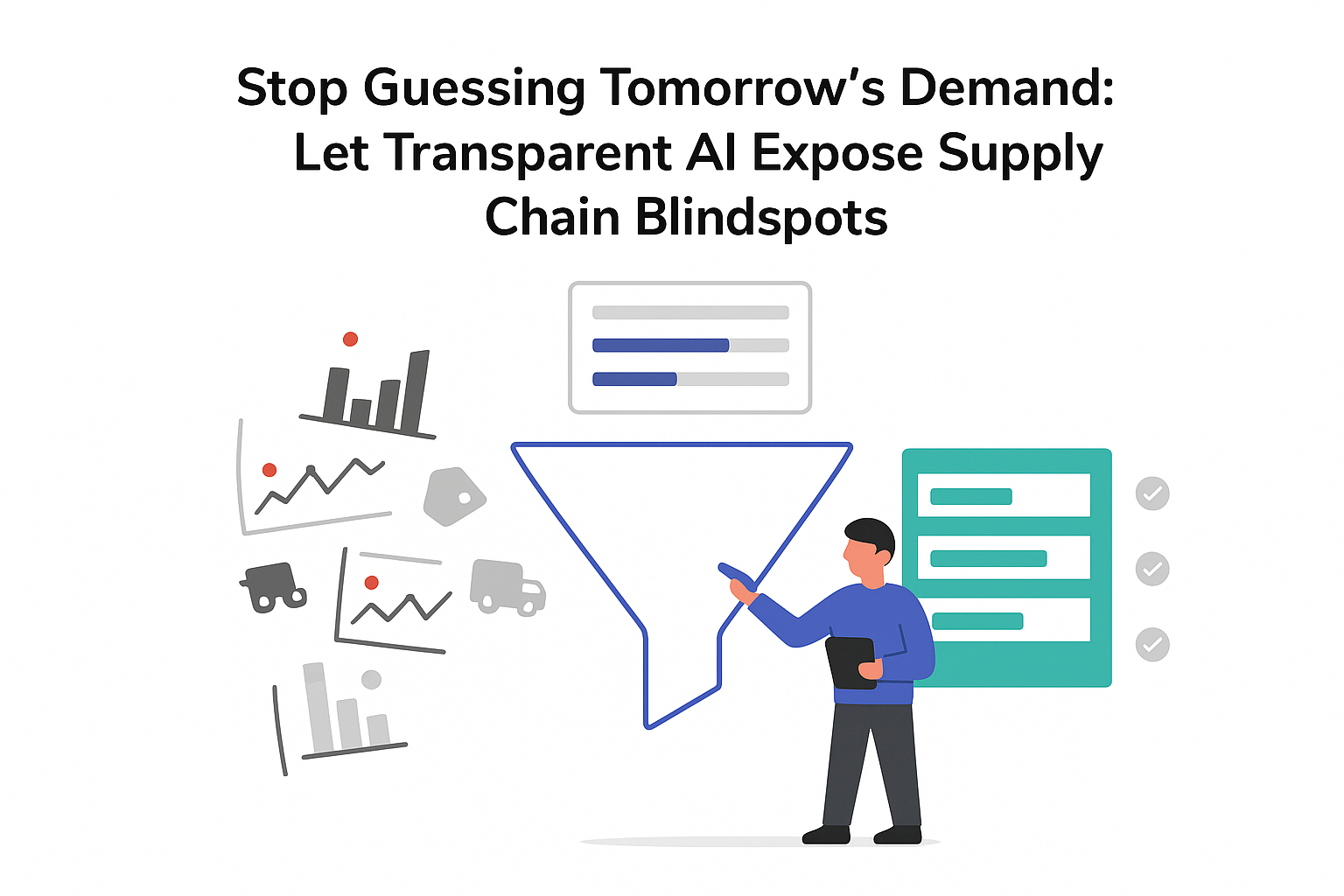
Most supply chain leaders do not wake up thinking about algorithms. You care about stockouts, service levels, and why your latest promotion blew up your plan. Yet the gap between what your spreadsheets say and what your customers actually order keeps getting wider.
In my experience, that is where AI demand forecasting can quietly change the game in the background while planners and sales teams keep doing what they do best. In this article I outline how AI-based forecasting works, what to look for, and where it tends to pay off in real supply chains.
Accurate AI demand forecasting
AI demand forecasting uses machine learning models to predict demand at a very granular level, down to SKU by location, channel, and sometimes even customer segment. The outcome is simple but powerful: fewer surprises, fewer fire drills, and a cleaner P&L. Enterprise platforms such as C3 AI Demand Forecasting are built to operate at this level of detail across large, complex networks.
In published case studies, teams that adopt AI demand forecasting often report forecast accuracy improvements of 20 to 40 percent, excess inventory reductions of 10 to 25 percent, service level gains of 3 to 8 points, and double-digit cuts in expediting and premium freight. You will see similar patterns wherever forecasting is tightly connected to inventory and service planning, including deployments of tools like C3 AI Inventory Optimization, where better forecasts flow directly into lower stock and higher availability.
Time to value matters. I rarely meet a supply chain leader who is willing to fund a two-year science project. With the right scope and data, early gains often appear in 8 to 12 weeks on a pilot group of products and locations. Wider rollouts then follow over several planning cycles, not years.
This kind of approach tackles problems you probably recognize: volatile demand driven by promotions, online behavior, and macro swings; unreliable spreadsheets passed around in email threads; manual planning that takes weeks and still misses the mark; and missed revenue when high-demand items are out of stock while slow movers fill the warehouse.
AI demand forecasting does not replace planners. It gives them a living baseline they can challenge, refine, and explain to the business. In other words, less guesswork, more signal.
What actually matters in AI demand forecasting
Many tools now advertise "AI." From my perspective, the real difference is whether that AI is tightly connected to business results instead of living as an isolated model.
Effective approaches typically combine prebuilt industry patterns that reflect how you sell and how customers buy; the use of both internal and external data, from ERP and WMS to weather and promotions; and shared accountability for outcomes, not only model accuracy but also business KPIs such as service levels, inventory turns, and margin.
In place of a generic model and a dashboard, strong implementations start by agreeing explicit targets for forecast accuracy, inventory, and service, then iterating until those move in the right direction. That iteration usually includes coaching planners, fine-tuning models, and closing the loop with finance and sales so everyone understands how forecasts tie into decisions.
When I explain options to executives, I usually contrast three archetypes.
Legacy ERP modules or spreadsheets. These often take 12 to 24 months to show any noticeable impact, if they do at all. Forecast accuracy tends to be flat or only slowly improving, explainability relies on planner intuition, and external data is rarely incorporated. Adoption is low because the system feels rigid, and ownership often ends up with IT or finance rather than the people who live with the consequences.
Typical "black box" AI tools. These can deliver higher accuracy and ingest more data, but models are opaque. Forecasts may improve, yet planners do not see the drivers behind changes, find it hard to challenge results, and struggle to explain them to commercial teams. External data may be technically available, but it is often difficult to manage and maintain.
Explainable, business-driven AI forecasting. In contrast, setups that surface drivers and signals typically reach meaningful impact in 8 to 12 weeks on a pilot scope. They make it clear why the forecast changed, rely on built-in external data pipelines, and give planners a voice in shaping models. Adoption is higher because people can see how the system thinks, and ownership is shared across operations, finance, and commercial teams with clear KPIs and review cycles.
The technology is still AI under the hood, but explainability and shared ownership change how planners experience it. That is a big shift for people who have been burned by black-box tools before.
Higher demand planning accuracy
Acronyms like MAPE and WAPE may not excite you, but your CFO cares about them a lot. The bridge between accuracy metrics and financial results is where AI demand forecasting really earns its keep.
Here are the key metrics, in plain language:
- MAPE (Mean Absolute Percentage Error). How far off, in percent, your forecast is on average. A MAPE of 40 percent means you are often wildly off. Bringing it down to 20 percent is not just a nicer chart; it means fewer rush orders, fewer stockouts, and fewer awkward calls with key customers.
- WAPE (Weighted Absolute Percentage Error). Same idea, but it gives more weight to high-volume or high-value products. This is the one executives often care about most. If WAPE is high, your big revenue drivers are poorly planned, and your cash swings show it.
- Bias. A measure of systematic over- or under-forecasting. Chronic over-forecasting fills warehouses and hurts cash. Chronic under-forecasting means missed sales and angry customers. Balanced bias means you are not tilting the whole supply chain consistently in the wrong direction.
Connecting these to money makes the impact concrete.
In one global manufacturer, WAPE on the top 1,500 SKUs improved from 38 percent to 21 percent over six months. That shift supported a 16 percent cut in finished-goods inventory while holding service levels steady above 96 percent, freeing up millions in working capital for other investments.
A regional distributor with strongly seasonal products had MAPE near 45 percent on promotional items. After adopting AI demand forecasting that explicitly used promotion calendars and POS feeds, MAPE dropped to 24 percent. Emergency replenishment reduced by about 30 percent and write-offs on leftover stock fell by roughly 18 percent.
A B2B service provider that plans field capacity, not SKUs, used machine learning demand forecasting to predict service tickets by region and customer tier. Forecast bias dropped from a consistent 12 percent under-forecast to near zero. They could schedule fewer overtime shifts while on-time response rates climbed above 98 percent.
In my experience, these gains rarely come from advanced math alone. Accuracy improves when planners trust the system enough to use it, argue with it, and feed it better inputs. AI demand forecasting provides a strong starting point. Human judgment still finishes the job.
External demand signals
Historic order data is not enough anymore. Promotions, digital channels, weather, macro events, and online buzz can push demand off the rails in a single week. AI demand forecasting deals with this by pulling in many external demand signals and learning which ones really matter for each item and location. Real-world examples include work highlighted by MIT Sloan, where Amazon mines the text of online product reviews to spot shifts in demand ahead of traditional data.
Common signals include:
- Promotion calendars and trade spend
- Point-of-sale data from retail partners
- Macroeconomic indicators like interest rates or unemployment
- Weather data at regional or store level
- Events and holidays that shift buying patterns
- Lead-time changes from suppliers and carriers
- Marketing campaigns, both offline and online
- Website traffic and search behavior around key products
Modern forecasting systems ingest these sources on a steady cadence, clean them, and line them up with internal data. They then test which signals help explain demand shifts for each product, customer, and region. A snowstorm might matter for seasonal products in one region, but not for spare parts in another.
This continuous learning means models do not need to be retuned by hand every time something odd happens. The system can react faster than a monthly S&OP cycle and highlight where the biggest shocks are coming from.
For executives, the benefit is straightforward: fewer surprises in S&OP meetings, more confidence in capacity decisions, and clearer trade-offs when you talk about inventory, service, and cash. Instead of arguing about whose spreadsheet is right, teams can focus on scenarios and choices.
Demand forecasting in supply chain industries
AI demand forecasting looks different across industries. The core math may be similar, but the planning problems are not. I tend to think in terms of segments.
- Manufacturing. Manufacturers face long lead times, complex bills of material, and often heavy make-to-stock pressure. AI models help separate stable base demand from volatile project- or promotion-driven spikes. One industrial manufacturer saw a roughly 30 percent drop in urgent changeovers after models flagged which SKUs should move to a make-to-order strategy instead of always filling stock.
- Wholesale and distribution. Distributors live and die by service levels and working capital. They handle thousands of SKUs with uneven demand across branches. AI demand forecasting can cluster branches with similar patterns, bring in POS and returns data, and recommend branch-level stocking policies. A regional distributor using this kind of approach cut inventory by about 17 percent while keeping line fill rate near 97 percent.
- Logistics and transportation. Here the "demand" is shipment volume, lanes, and capacity needs. AI demand forecasting predicts volume by lane and customer so carriers can plan fleet use and contract capacity more effectively. This reduces empty miles, avoids sudden rate hikes, and helps sales teams give more reliable delivery promises.
- Retail and CPG. Retail and CPG brands deal with promotions, short product life cycles, and channel mix shifts between stores and online. Machine learning models that take promotion calendars, social media signals, and category trends into account can flag where demand is likely to spike or fade. That limits both out-of-stocks and heavy markdowns at season end.
- Service-based B2B organizations. Many B2B companies do not move boxes as their core product. They schedule people, machines, or service slots. AI demand forecasting can predict project starts, contract renewals, and ticket volumes by region and customer type. A managed IT provider, for example, can size its support team by skill and time zone using these forecasts, limiting burnout while keeping SLAs intact.
The pattern is the same: different verticals, different data, but the same push for fewer surprises and more control.
Supply chain forecasting challenges
If you are reading this, you probably already feel friction in your planning process. AI demand forecasting shines, in part, because the current state is often painful. In my work I see the same issues come up repeatedly, along with practical ways to address them.
- Siloed data across systems. ERP, WMS, TMS, CRM, and spreadsheets each tell part of the story. The remedy is a unified data layer that pulls these together so AI can see full order history, constraints, and customer behavior at once. Cloud data platforms such as Snowflake, Azure, or Google BigQuery often sit under the hood, while the front end stays planner-friendly. The same design patterns show up when you build marketing data lakes that serve LLM use cases, and resources like Data Avalanche to Strategic Advantage: Generative AI in Supply Chains describe how to turn this unified data into a real advantage.
- Manual Excel processes. Many teams still copy data into spreadsheets, run macros, and hope they did not break a link. With AI demand forecasting, data can flow in automatically, models run on schedule, and planners spend time on exceptions rather than copying columns. It may feel odd at first, then quickly becomes the new normal.
- Slow monthly planning cycles. By the time a monthly forecast is approved, the market may already have shifted. AI models can refresh weekly or even daily for key items, while S&OP still locks the official plan on a monthly rhythm. This mix gives agility without chaos.
- Planners not trusting system forecasts. This challenge is emotional as much as technical. If a tool spits out numbers without context, planners ignore it. Explainable AI addresses this by showing forecast drivers: which signals matter, how the model changed since last cycle, and where its confidence is low. Planners can then adjust with clear reasons, not gut feel alone. The same human-in-the-loop principles you might use for marketing content review, such as those in our guide to human-in-the-loop review systems for AI content, apply directly to demand planning.
- Inability to run scenarios. Executives often ask simple "what if" questions that are hard to answer: What if lead time shortens by five days? What if a promotion is cut? AI demand forecasting systems can run side-by-side scenarios so you can see impact on demand, inventory, and service before committing to a decision.
- Lack of visibility across product or location hierarchies. Some products are planned at family level, others at SKU level. Some regions are stable, others volatile. AI models can forecast at different levels and then reconcile up and down the hierarchy. That gives a single version of the truth at executive level, with sufficient detail for operations when needed.
When these gaps close, the shift is obvious: less firefighting, fewer late-night calls about stockouts, and more time for strategic choices around product mix, channel strategy, and capital projects.
Capabilities behind strong machine learning demand forecasting
Behind any strong AI demand forecasting capability there is a team that cares about both math and operations. When organizations decide whether to build internally or work with external specialists, it is useful to think in terms of skills and proof points rather than buzzwords.
Useful signals of maturity include several years of hands-on work with supply chain and planning teams across multiple regions; a track record of deployments with both product-based and service-based B2B companies; experience supporting firms from mid-market scale to global groups; and practical familiarity with major cloud platforms and common ERP systems. These factors do not guarantee success, but they reduce the risk that forecasting remains an academic exercise. Many of the same questions you would ask when evaluating marketing technology apply here too; if you already use a procurement framework for selecting AI vendors, you can adapt it for demand-forecasting tools.
The delivery model typically follows a clear rhythm, even if the details vary. It starts with an assessment and goal-setting phase that reviews the current process, data quality, and business targets and agrees on KPIs, product scopes, and timelines. Data onboarding then connects to ERP, WMS, CRM, and relevant external feeds, cleaning and structuring the data so models can run without constant heroics.
Next comes modeling and pilot work on a slice of the portfolio, where forecasting models are built and tested against past results, reviewed with planners, and measured against the current process. Once that works, rollout extends coverage across more products, customers, or countries and integrates forecasts into existing planning tools and S&OP routines so AI is part of how planning runs, not a side project. Finally, continuous improvement cycles review accuracy, inventory, and service trends and adjust models, signals, and user flows as the business changes. The change management playbook looks surprisingly similar to what works in commercial teams, as outlined in our article on change management for rolling out AI across marketing teams.
Whatever route you choose, clear ownership matters. Senior leaders should not need to micromanage data-science work. The forecasting team needs to live by the same KPIs as the business and be transparent when performance drifts so course corrections are fast and fact-based.
Careers in AI demand forecasting
AI demand forecasting is not just software; it is also a growing career path for people who enjoy hard planning problems and tangible impact.
In practice, teams in this space often bring together data scientists and machine learning engineers who design and scale models, solution or domain consultants who bridge planning, finance, and IT, demand-planning experts who have sat in the planner chair and know the pressure, and data and platform engineers who build and maintain pipelines on cloud platforms.
For many professionals, the appeal is simple: the work connects directly to supply chains, finance, customer experience, and even sustainability, rather than living in abstract datasets with no visible outcome.
Building internal insight around AI demand forecasting
Leaders who are serious about AI demand forecasting usually want a mix of content: some high level, some deep and technical. It helps to curate an internal library that speaks to different audiences around the table.
That library often includes plain-language executive guides for CEOs and founders that link AI demand forecasting to revenue growth, margin protection, and valuation; playbooks for VPs of Supply Chain and COOs that walk through process changes and show how AI forecasts connect with S&OP, capacity planning, and supplier management; deep dives for heads of demand planning that explore model types, external signals, exception handling, and how to build planner trust; finance-focused briefs that map accuracy and bias to working capital, cash flow, and write-offs and help build a business case; and detailed case studies that show where companies started, what data they used, how long pilots took, and the hard numbers on accuracy, inventory, and service.
When those materials are well linked, decision-makers can move from curious to informed at their own pace, and discussions shift from "what is this?" to "how do we use it responsibly and effectively?"
Getting started with AI demand forecasting
When companies feel the pain from missed forecasts and constant firefighting, the next step is often a structured conversation about whether AI-based demand forecasting can help. It is usually most productive to treat this as a short, focused diagnostic rather than an open-ended initiative.
A diagnostic of this kind typically covers a review of the current planning process, tools, and data sources; a quick accuracy and bias check on a sample of existing forecast history; a discussion of target metrics such as WAPE, inventory turns, and service levels; and a high-level roadmap that shows what a pilot and eventual rollout could look like for the business.
To make that exercise useful, it helps to put a few basic facts on the table up front: your industry, approximate revenue band, main planning systems, and the top two or three pain points your teams experience. That is usually enough context to size the opportunity and decide whether deeper exploration is justified.
Whether you build capabilities internally or collaborate with external specialists, it is worth looking for concrete evidence: real case examples, clarity on how data privacy and security are handled, and openness about where approaches work well and where they struggle. If you operate in a regulated environment and are already thinking about AI in other workflows, our guide to private LLM deployment patterns for regulated industries sets out practical questions you can also apply to demand-forecasting initiatives.
Once a direction is chosen, clarity about next steps, timelines, and decision gates matters as much as model choice. Document who will do what by when, and point stakeholders to a small set of relevant background materials so everyone shares the same understanding of goals, constraints, and expectations from AI demand forecasting.



.svg)

.svg)
.svg)