
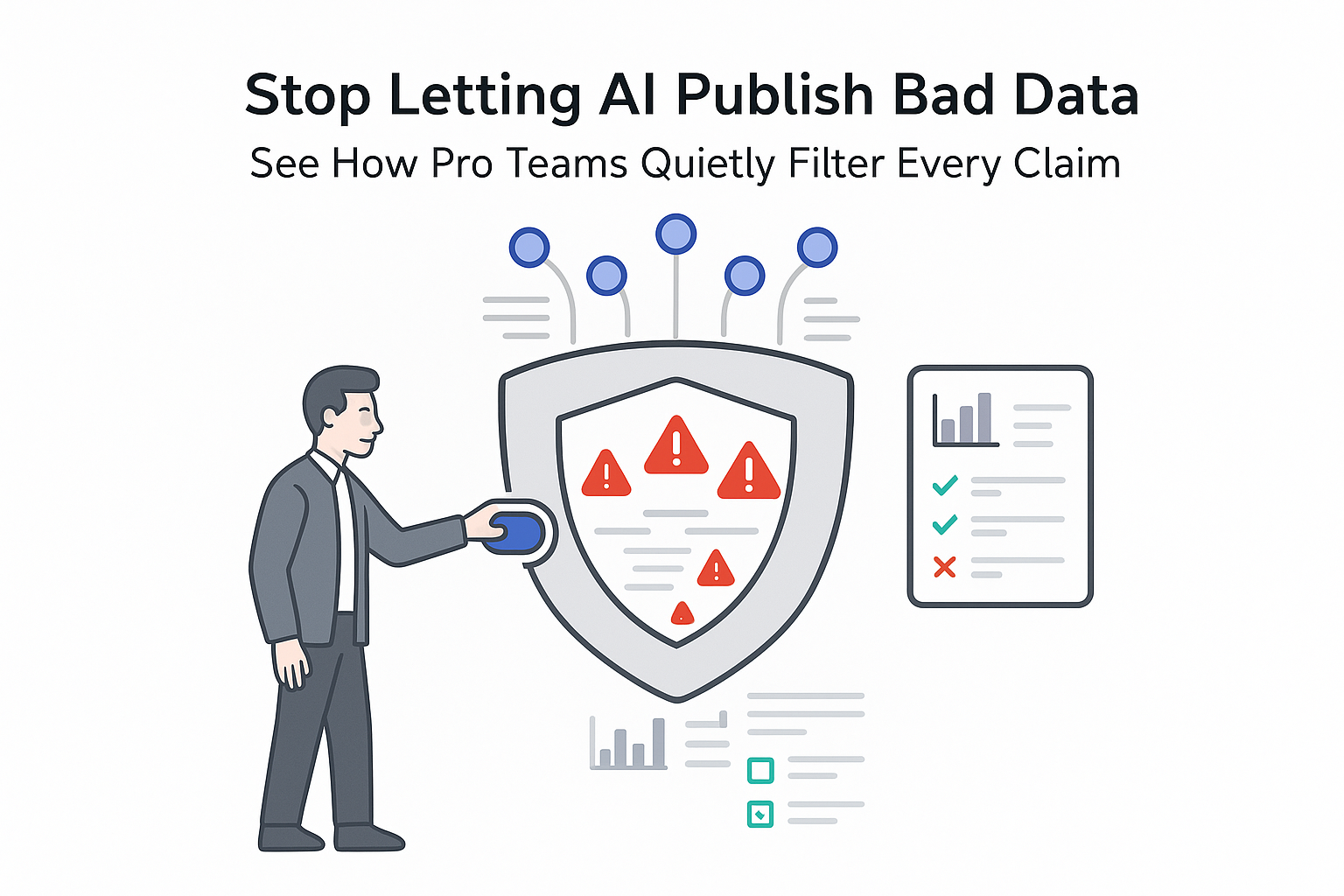
Publishing high-volume content with AI can feel like driving a sports car on a wet freeway: fast, responsive, and a little too easy to overcorrect. For a B2B service brand, the guardrail is reputation, compliance risk, and SEO performance. One wrong statistic copied into thirty blog posts, or a fabricated quote in a white paper, can quietly drain trust and slow down sales.
The 6 best AI fact checkers to verify truth in a digital age (2025 guide for B2B service brands)
In a B2B content operation, “best” rarely means the most impressive demo. It means fewer publish-and-apologize edits, fewer awkward sales conversations, and fewer internal “where did this stat come from?” moments.
What I mean by “best” in a B2B content operation
When I evaluate the best AI fact checkers for B2B service companies, I’m looking for tools that reduce real operational risk. That typically shows up as cleaner drafts, clearer sourcing, and less time spent chasing down unsupported claims after something is already live.
I also separate fact checking from nearby categories that teams often blend together: AI detection (guessing whether a draft was AI-generated), plagiarism (matching against existing text), and verification (flagging claims that may be wrong, unsupported, or outdated and pushing the writer toward sources).
In practice, many teams use two layers: one tool to screen everything at scale, and another to help verify higher-stakes assets like white papers, market reports, and sales decks. If you’re rolling out AI across multiple roles, it also helps to align verification with your internal rollout plan and governance cadence, not just your editorial workflow - see Change management for rolling out AI across marketing teams.
Quick comparison (what each option is good for)
I treat pricing and feature sets as moving targets, so this comparison focuses on fit and workflow. Vendors change packaging often, and a “fact-checking” feature in January can look very different by Q4.
| Option | Best for | Where it tends to fit |
|---|---|---|
| Winston AI | AI detection + early warning signals | First pass on incoming drafts from freelancers and junior writers |
| Getsolved.ai | Claim verification + source suggestions | Research support for long-form content and stats-heavy posts |
| Originality.ai | High-volume AI detection + plagiarism control | Ongoing quality control across many URLs and many writers |
| Google Fact Check Tools | Checking whether a public claim has already been debunked | Fast validation for newsy or widely shared statements |
| Manus AI | Editing and rewriting with light verification prompts | Readability and consistency before deeper human review |
| Snopes | Human-written investigations of viral claims | Sanity check for myths, viral stories, and dramatic “too good” stats |
Where each tool fits in a B2B workflow (and what it won’t do)
Below is how I think about each option in a service-brand environment, especially when content is produced by multiple hands and published frequently. The goal is to route attention: what needs a quick edit, what needs a source, and what needs a subject-matter check.
Winston AI (detection-first “risk filter”)
I view Winston AI primarily as an AI-detection gate with some light quality signals. It’s useful when drafts arrive from multiple writers and you want a consistent first pass before an editor invests real time. The main benefit is triage: it can surface drafts that need closer scrutiny for generic language, suspicious patterns, or heavy AI reliance. What it won’t do is prove a claim is true - it’s better at telling you where to look than at finishing the job.
Getsolved.ai (research helper for claims and citations)
Getsolved.ai behaves more like a claim-verification assistant: highlight a statement, then look for stronger support. This matters most in B2B content that includes market sizing, adoption rates, vendor comparisons, security and regulatory references, or third-party survey results. The risk is that writers treat suggested sources as automatically trustworthy. I still want a human to confirm whether a source is primary vs. recycled, current vs. outdated, and relevant vs. “close enough.”
Originality.ai (scale and governance for busy teams)
Originality.ai is often adopted for AI detection and plagiarism control, but its real value in B2B is operational: scanning lots of drafts (and sometimes lots of existing URLs) in a repeatable way. If you manage external contributors, guest posts, or multiple sites, it helps create consistency and accountability across volume. The trade-off is that “clean” detection scores don’t equal factual correctness. Treat it as governance - useful, but not the same thing as verification.
Google Fact Check Explorer (public-claim verification)
Google Fact Check Tools is not a classic AI fact checker - it’s a lookup tool for existing professional fact checks. It’s especially helpful when your content references public narratives: regulations being debated in the news, widely repeated social claims, public figures, or “everyone is saying X” statements. It won’t help much with narrow technical claims in niche industries, but it can prevent you from citing something that’s already been publicly debunked.
Manus AI (editing and clarity, with light “this needs support” nudges)
Manus AI is closer to editing than strict fact checking. In many B2B teams, the most common quality issue isn’t an outright falsehood - it’s sloppy structure, unclear reasoning, or claims stated too confidently without support. Editing-first tools can tighten language, reduce repetition, and improve readability, and they may prompt places where citations would strengthen credibility. I treat this category as preparation before review, not verification.
Snopes (human investigations for viral or dramatic claims)
Snopes isn’t AI, but it’s a reliable backstop for viral stories and dramatic “can you believe this?” statistics that slip into thought leadership. If a claim is popular online, Snopes often provides origin tracing, context, and source links. It’s not built for niche B2B topics, but it can save you from repeating internet myths that have already been dismantled.
What an AI fact checker can (and can’t) do behind the scenes
Most AI fact-checking tools follow a similar pattern. They extract claims, compare them against external information, then flag risk with suggested sources.
- Identify claims in a draft (numbers, dates, named entities, cause-effect statements, definitive assertions).
- Compare those claims against external information (search indexes, databases, curated sources, or vendor-chosen reference sets).
- Flag risk (unsupported, conflicting, missing citation, or “needs context”) and provide links or suggested sources.
That sounds objective, but the limitations are predictable - and important in B2B. Context is hard: a claim can be true in one market segment and misleading in another. Source suggestions can be weak: tools may surface secondary sources that repeat each other rather than primary research. New information lags, especially in law, security, and product changes. And “high confidence” is easy to misread - it often reflects source agreement, not real-world correctness. The best outcomes happen when the tool is treated as a filter that narrows attention, not a judge that replaces it.
Why AI content verification matters for B2B service companies
For service brands, accuracy isn’t cosmetic. It affects pipeline, partnerships, and perceived competence. When teams scale AI-assisted publishing without verification, mistakes tend to compound across assets and become harder to unwind.
Compounding errors across assets: One wrong market number in a blog post becomes a repeated line in decks, proposals, and case studies. Fixing it later is painful because the mistake spreads faster than the correction.
Sales enablement credibility: Prospects don’t always challenge your positioning - but they will challenge a confident stat that looks wrong. One avoidable credibility hit can stall momentum or trigger extra stakeholder scrutiny.
Regulatory and reputational exposure: In finance-, health-, security-, and legal-adjacent spaces, casual inaccuracies can create screenshots, internal escalations, or compliance headaches - especially when content implies guarantees or misstates requirements.
SEO trust and perceived authority: Search performance isn’t only about keywords. It’s also about whether content demonstrates real expertise and verifiable grounding. Google’s Search Quality Rater Guidelines describe E-E-A-T (Experience, Expertise, Authoritativeness, Trust). While raters don’t directly control rankings, the guideline is a useful proxy for what “trustworthy content” should look like: clear sourcing, careful claims, and consistency over time.
If your content feeds downstream revenue work (like page-level conversion improvements or service-page positioning), it’s worth pairing verification with a repeatable SEO workflow - for example, Use AI to write your first product or service page.
Pros, limitations, and data-security realities
AI fact-checking tools bring real leverage, but I set expectations explicitly so teams don’t over-trust the output. On the upside, they reduce the manual burden of basic checks and make quality control more consistent across many writers. Many teams feel ROI quickly in time saved, even before long-term trust benefits show up.
- They don’t replace editors. For high-stakes content, you still need a subject-matter-aware human to confirm meaning, context, and whether a source truly supports the statement being made.
- Accuracy varies by domain. Common public claims are easier than niche B2B technical specifics. If your content lives in edge cases, assume the tool will be less reliable.
- Confidentiality can be a deal-breaker. If drafts include client names, contract details, incident data, or proprietary performance metrics, be cautious about uploading raw text to cloud systems. A safer approach is to redact identifiers, verify only public-facing sections, and align tool usage with internal security policy.
If you operate in regulated industries or handle sensitive client materials, it’s worth formalizing both legal review and AI usage boundaries - see Legal and IP checkpoints for generative assets in B2B and Private LLM deployment patterns for regulated industries.
How I choose fact-checking software (a practical selection method)
I don’t try to find the single “best” tool in the abstract. I match tools to content risk and workflow - then validate the fit with a short pilot on real assets, not a demo environment.
- Content risk level: Are you publishing mostly thought leadership, or do you routinely make claims about regulation, security, or measurable outcomes?
- Volume and team structure: How many drafts per month, and how many contributors touch them?
- Source quality needs: Do you need source suggestions, or mainly screening and routing to humans?
- Workflow friction: Will writers actually use it, or will it become an editor-only step that arrives too late?
- Governance: Can you track decisions (what was flagged, what was accepted, what was rejected) for accountability?
Over a month of normal publishing, I measure three things: (1) meaningful issues caught, (2) editor time per draft, and (3) noise (false positives) that slows the team down. When teams ask about ROI, I separate it into two timelines: immediate (editor hours saved and fewer back-and-forth revisions) and slow (fewer post-publication corrections, fewer credibility hits in sales, and steadier SEO performance over quarters). To pressure-test your stack the same way security teams do, it can help to borrow structured testing habits - see Red teaming your marketing AI stack.
If you’re evaluating multiple tools at once, treat it like vendor selection rather than a one-off experiment - especially if multiple teams will rely on the outputs. A lightweight procurement framework helps avoid tool sprawl and unclear ownership: Selecting AI martech vendors: a procurement framework.
Closing thoughts
AI fact checkers are now part of the normal publishing stack for B2B service brands - but only when they’re treated as safeguards, not shortcuts. Use them to surface risk, enforce consistency, and prevent avoidable mistakes from scaling across your website and sales library.
The simplest durable approach is: screen everything lightly, verify high-stakes assets deeply, and keep a human accountable for final claims - especially anywhere accuracy is tied to trust, compliance, or revenue. If you want to connect verification work to revenue outcomes, pair it with measurement on downstream impact - for example, Measuring AI content impact on sales cycle length.



.svg)

.svg)
.svg)