
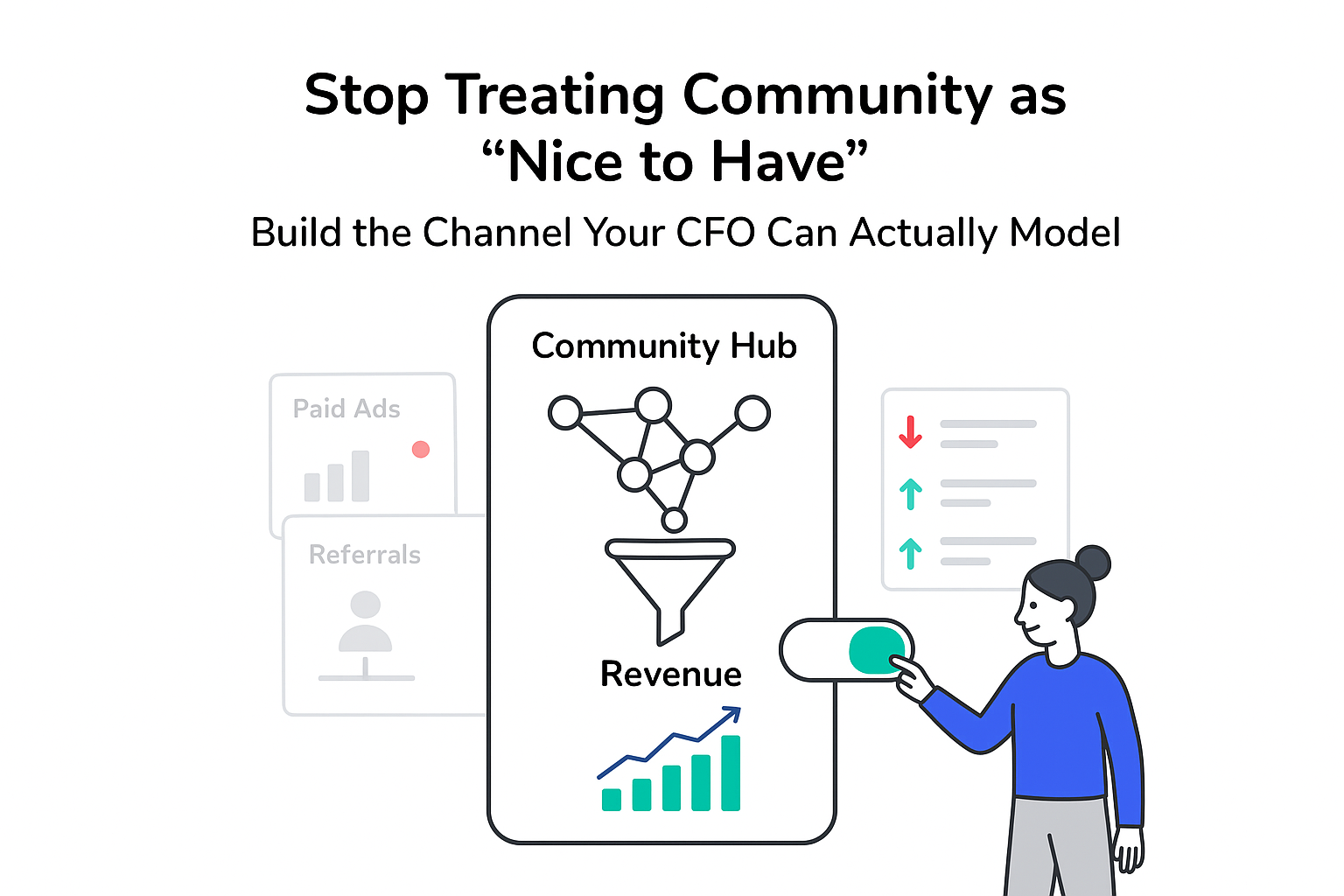
Most B2B service CEOs have a version of the same thought on a quiet Friday afternoon: paid is getting more expensive, referrals are flat, and yet the pipeline target keeps creeping up. Someone on the team says, "We should build a community." It sounds nice, but the first reaction is simple: how does a community actually move the needle on revenue, not just engagement screenshots in a slide deck? If that sounds familiar, there is usually a deeper funnel issue hiding underneath, which you can surface with a quick sales pipeline audit before you layer community on top.
That is the question I answer in this article.
I walk through how a B2B community can function as a growth engine for a service business, how to measure its impact on pipeline, and four practical "laws" that keep a community tied to real business outcomes, not vanity metrics.
How to build a B2B community that drives results
When I talk about a B2B community in a service context, I am not talking about a random Slack full of memes. I mean a focused group of customers, prospects, and partners who gather around shared problems your firm helps solve. They swap stories, compare numbers, test ideas, and over time, buy more from the brands they trust inside that circle. This is close to what resources like LinkedIn's How to Build Authentic Communities describe: specific, value driven, and built around shared work.
Instead of another channel that shouts at your market, your community becomes a place where your market talks to itself, with you in the middle as the quiet host and expert.
If you like visuals, picture this. On the left, the classic funnel: ads at the top, a narrow stream of leads dripping down, and a closed deal at the bottom. On the right, a simple flywheel with your community at the center, and three loops around it: demand generation, retention, and expansion. Content, events, and peer conversations spin that wheel. New people join, current clients stay active, and new deals emerge from the same system.
In other words, a well designed community is not a "nice to have." It is a different way of structuring the same growth motion you already care about.
Let me start with the question your CFO will ask first.
Why a B2B customer community is a growth engine
On paper, community can look soft. It is not an ad campaign with clear spend and clear leads. It is not a cold outbound list you can count. So why do so many successful B2B service firms quietly build a strong customer community behind the scenes?
Because it changes the economics of growth.
Lower customer acquisition cost (CAC)
When prospects join a discussion group or peer circle you run, they get value long before they talk to sales. They see how you think, how your clients think, and how people like them solve real problems. By the time they talk to your team, trust already exists. That usually means less push, fewer calls, and a lower cost per acquisition, even if you never assign a perfect number to it.
Higher lifetime value (LTV) and retention
Clients who feel part of something bigger than a contract are much harder to churn. A customer community gives them peers to ask for help, real examples of how others use your services, and a place to share wins and get recognition. They are not only attached to your deliverables. They are attached to the relationships and identity they gain around your brand. Well designed community programs can support customer engagement and retention in a way individual campaigns rarely can.
Shorter sales cycles
Your community becomes a living library of proof. A prospect sits in an event, hears three current clients explain how they solved a similar issue, and your case is made without a word from your sales rep. Peer proof cuts through doubt faster than any deck, because the prospect hears language and trade offs that feel real, not rehearsed.
More predictable inbound pipeline
This is where it connects directly to your current pain. If you are stuck on a plateau, heavily dependent on paid or outbound, a healthy community becomes a steady source of warm leads who already know your language, expansion opportunities from existing accounts, and referrals between members.
Imagine a small example. A consulting firm runs a monthly roundtable for revenue leaders. Twenty people show up regularly. Over a year, three members change jobs and bring the firm into their new company, two ask for private workshops after seeing the value in group sessions, and several swap vendor stories, reinforcing who actually helps and who just talks. That simple group, which may cost very little to run, quietly throws off multiple high ticket conversations without a single cold email. If you want those sessions to drive more pipeline, it helps to design them with the same rigor you would use for a webinar or in person event, as in this event and webinar strategy guide.
If you mapped this over the B2B buyer journey, you would see community touchpoints at every stage. People first hear about the group from peers (awareness). They attend events, read posts, and download shared resources (consideration). They talk with members who are already clients (decision). Once they buy, they join invite only sessions that surface new needs (expansion). That is why a customer community feels like a growth engine rather than an extra marketing channel.
Measuring community impact on pipeline and revenue
The part that keeps many CEOs on the fence is not the concept of community. It is the numbers. How do you show that your community is not just "busy" but actually tied to revenue?
The answer is to treat it like any other growth channel and measure it against outcomes.
You do not need a complicated dashboard from day one, but you do need clear questions such as: how many members you have and how that is trending, how many people are active each month, how many leads in your CRM are also community members, how many opportunities or deals have a community touchpoint, and how the retention rate of clients who are active in the community compares with those who are not.
From those questions, you can derive a small set of headline metrics. At minimum, track:
- Member growth and active participation over time
- Marketing and sales qualified leads (MQLs and SQLs) that come from or include the community
- Influenced revenue where community plays some identifiable part in the journey
- Expansion and renewal rates for accounts with active community members
Once those numbers exist, community ROI stops being a vague idea and starts to look like a line on your revenue report.
It also helps to separate leading and lagging indicators. Leading indicators are things like new members joining per month, the percentage of members who attend at least one event per quarter, the number of posts and comments from members, or signups for small roundtables and office hours. They tell you if the engine is spinning. Lagging indicators are items such as opportunities where contacts are tagged as members, win rate for deals with community involvement, time from first community touch to pipeline creation, and revenue from expansion deals that started in community conversations. They tell you if the engine is pushing revenue, not just noise.
Attribution for community does not need to be perfect, but it does need to be consistent. You can add UTM tagged links to resources shared inside the community, include a "How did you first hear about us?" field on forms with "Community / group name" as an option, tag contacts in your CRM when they join, and connect event registrations directly into your CRM with the right campaign tags. On a simple dashboard, you can then compare opportunities and revenue from people who joined before becoming a lead, those who joined while evaluating you, and retention and expansion numbers for member accounts versus non member accounts.
When you walk into a board meeting with those numbers, the conversation usually shifts from "Does this work?" to "How big can we make this engine without losing quality?"
Four laws of B2B community building
This is where the rubber meets the road. A lot of B2B service firms start a group, run three events, then quietly shut it down because it "did not work." Often the problem is not community itself. It is how it was set up. Many of the failure patterns mirror what LinkedIn highlights in Why communities fail to build trust: vague purpose, low value, and no clear connection to outcomes.
From work with B2B service companies across different industries, I keep seeing the same four patterns. When all four are in place, a community stops being a side project and becomes a driver of demand, retention, and expansion.
1. You can start anytime with the audience you already have
Many CEOs delay community work because they think they need thousands of users or a fancy platform. That delay quietly costs them pipeline. You can start now, with the people already in your world.
The first step is to begin with "who," not "where." Ask who you most want in the room: current clients, prospects, partners, or a specific mix. Narrow the job titles or roles, because a group for "marketing leaders at B2B service firms" usually beats "anyone in business." Then get clear on the problem they wake up thinking about that you can credibly help with. Your first community does not need to be everything for everyone. In fact, a tight, specific group usually works better.
When you know who you want, use the channels you already own. That might include your current customer list, recent webinar or event attendees, LinkedIn followers of your founder or senior team, or informal peer groups you already run. Invite a small subset into a more focused space. This could be a private Slack or Teams workspace, a purpose built community platform, or even a private LinkedIn group if your audience practically lives there. The platform matters far less than the clarity of purpose.
To keep the time burden manageable, frame your first three months as a simple pilot. For example, you might run one live session per month (such as office hours or a roundtable), post one thoughtful prompt per week for discussion, and host occasional "show and tell" sessions where members share something that worked for them. A common pattern is to invite 20 to 50 senior leaders into a "founding cohort," run one or two small roundtables on their shared problems, and then use the insights from those sessions to shape your next offers and content plan.
On a spreadsheet, 20 to 50 people can feel small. In reality, that size group can generate six or seven figure revenue over time when the right people are in the room and the experience is strong. The main point is simple: do not wait for perfect scale. Start small, deliver high value, and grow from there.
2. A B2B community is only as good as its content
People do not keep showing up just because they joined once. They return because something in the community helps them think better, move faster, or look smarter in front of their own teams.
In this context, "content" is broader than blog posts or videos. Think about live "ask me anything" sessions with your senior consultants or respected clients, expert sessions where you walk through real case studies, teardown calls where members bring real assets and get feedback, playbooks and frameworks they can apply next week, benchmarks such as salary, pricing, or performance data, and member spotlights that show how leaders like them are solving problems. None of this needs Hollywood level production. It does need to be specific and practical. For more examples of how to design these kinds of experiences, see LinkedIn's guide on How to Create Value Through Community Engagement.
To keep your community focused, it helps to create three or four content pillars that align with your ideal client's biggest pains. For a B2B service firm, those could include scaling operations without chaos, pricing and packaging services for higher margins, lead generation and sales process, and client success and retention. Once those themes are clear, you can build a simple content rhythm around them: perhaps a live session one week, a discussion prompt based on a client story the next, a member spotlight or teardown in week three, and a short "what worked this month" recap in week four. If you want those pillars to feed your broader pipeline as well, it is worth revisiting how your thought leadership drives qualified B2B pipeline, not just impressions.
Over time, involve members in creating content. Ask them to share templates, emails that worked, or reports they are proud of. Co created content takes pressure off your team and increases buy in because members see their own work in the spotlight. A simple mental check for every session or post is to ask whether a busy VP or founder would get something they can use this week and whether they would feel comfortable forwarding it to their team. If the answer is "yes" most of the time, content will not be your bottleneck.
3. A successful B2B community is a company wide strategy
Many firms tuck community under "marketing" and hope it will somehow benefit everyone. That usually fails. The result is a noisy channel that sales ignores, customer success sees as extra work, and leadership does not understand.
The communities that work treat it as shared infrastructure rather than a side project.
Imagine a simple sketch. In the middle, a circle labeled "Community." Around it, four circles labeled marketing, sales, customer success, and product or service design, with arrows moving in both directions between each team and the center. Marketing uses the community to test topics, refine messaging, and find stories. Sales uses it for warm introductions, live proof, and staying in touch between meetings. Customer success uses it to reduce 1 to 1 support and increase peer help. Product or service leaders use it to spot patterns and shape roadmaps, often building on insights that also come from structured voice of customer interviews.
To make this real, roles need to be clear. A head of community or marketing can own the calendar, member experience, and reporting. Sales needs to understand how to invite prospects into events, when to engage in discussions, and when not to pitch. Customer success should know which clients to nudge into the group and how to surface expansion ideas based on what they share. Leadership can drop in at key moments, such as kickoffs or milestone events, to show that community is part of the core strategy, not an experiment.
If your firm uses OKRs or similar planning frameworks, community should not sit in isolation. It should have explicit links to company goals, such as increasing pipeline from warm sources, improving retention in key segments, or sourcing new product ideas from member feedback. When those connections are visible, accountability follows. People pay attention to the things that show up in their own scorecards.
4. Your B2B community must drive real business outcomes
If your community does not touch revenue in a clear way, it will be the first thing cut in a rough quarter. The goal is not just engagement. It is engagement that leads to business outcomes for both your members and your firm.
One way to protect that connection is to design programs that naturally lead to opportunities without feeling like a pitch. Invite only executive roundtables for senior prospects in your ideal customer profile, customer only workshops on topics that hint at expansion needs, referral circles where trusted clients bring one peer they respect, and beta groups for new services where members co design and later buy are all examples. Each format can carry its own KPI, such as the percentage of roundtable attendees who enter pipeline within 90 days, expansion revenue from accounts that attend at least one customer workshop per quarter, the number of referrals generated in a period, or the conversion rate from beta group members to paying clients for that new service. Those referral circles will work even harder if they sit beside a clear, structured referral program that does not train buyers to wait for discounts.
It also helps to think in terms of a community journey rather than random touchpoints. Just as your sales process has stages, your community can too:
- First touch. Someone attends an open webinar, reads a post, or downloads a resource and hears that a community exists.
- Engagement. They join the group, answer a simple welcome question, and perhaps attend an introductory call.
- Activation. They join a small roundtable, share a real challenge, and get useful help.
- Opportunity. They ask for deeper support or are invited to a one to one conversation because a clear fit emerges.
- Customer and advocate. They join client only sessions, contribute actively, and may eventually participate in referral or advisory groups.
At each stage, it should be obvious what the member gets and what signal that action sends to your sales or customer success team. When this is done well, members never feel "sold." They feel supported. Yet your team still has clear, timely signals to reach out with the right conversation.
Over time, you will see which programs drive outcomes and which are just noise. Executive dinners might have low attendance but very high conversion. Large public webinars might feed the top of the community but rarely convert directly. Small office hours with your senior team might create steady expansion. Be willing to cut or shrink the activities that do not connect to your goals, even if they produce nice screenshots, and double down on the ones that quietly move real numbers. That is how community graduates from a "nice idea" to a reliable growth lever.
Turning community into a repeatable growth playbook
Once a firm has applied these four laws and seen some early wins, the next natural step is to capture what works in a clear internal playbook so the approach does not live only in one person's head.
A practical playbook for B2B service businesses often documents a few core elements:
- How you invite clients and prospects into the first and subsequent cohorts
- Sample agendas and structures for roundtables, AMAs, workshops, webinars, and office hours
- Guidance for sales and customer success on when and how to talk about the community
- A simple metrics view that shows community impact on pipeline, revenue, retention, and expansion
Some firms also turn that internal guide into a short onboarding module for new hires so everyone understands how community supports their goals without adding chaos to their week. If you want a more detailed checklist to compare against your own, resources like Gainsight's 10 Steps to Community Success in B2B Software can be a useful reference.
The theme that usually ties it together is simple: scale with community while keeping things clear and light for your team - less chaos, more signal.
Community as part of a wider growth strategy
B2B community building does not sit in a vacuum. It connects directly to broader themes such as community led growth for services, demand generation, customer marketing and advocacy, executive peer groups, and feedback loops that shape your roadmap. As you refine those other levers - from thought leadership that brings qualified B2B pipeline to your event strategy - community can quietly amplify all of them.
When you zoom out, the picture that emerges is a business where community is not a side project, but a quiet system that keeps new revenue, happy clients, and product ideas flowing without constant pressure on paid channels. If you treat that system with the same rigor you apply to campaigns and sales processes - clear strategy, disciplined measurement, and honest iteration - it can become one of the most durable growth assets in your company. For a higher level strategic view of that shift, see Gainsight's perspective in Make Community-building Your Ultimate Business Growth Strategy.



.svg)

.svg)
.svg)