
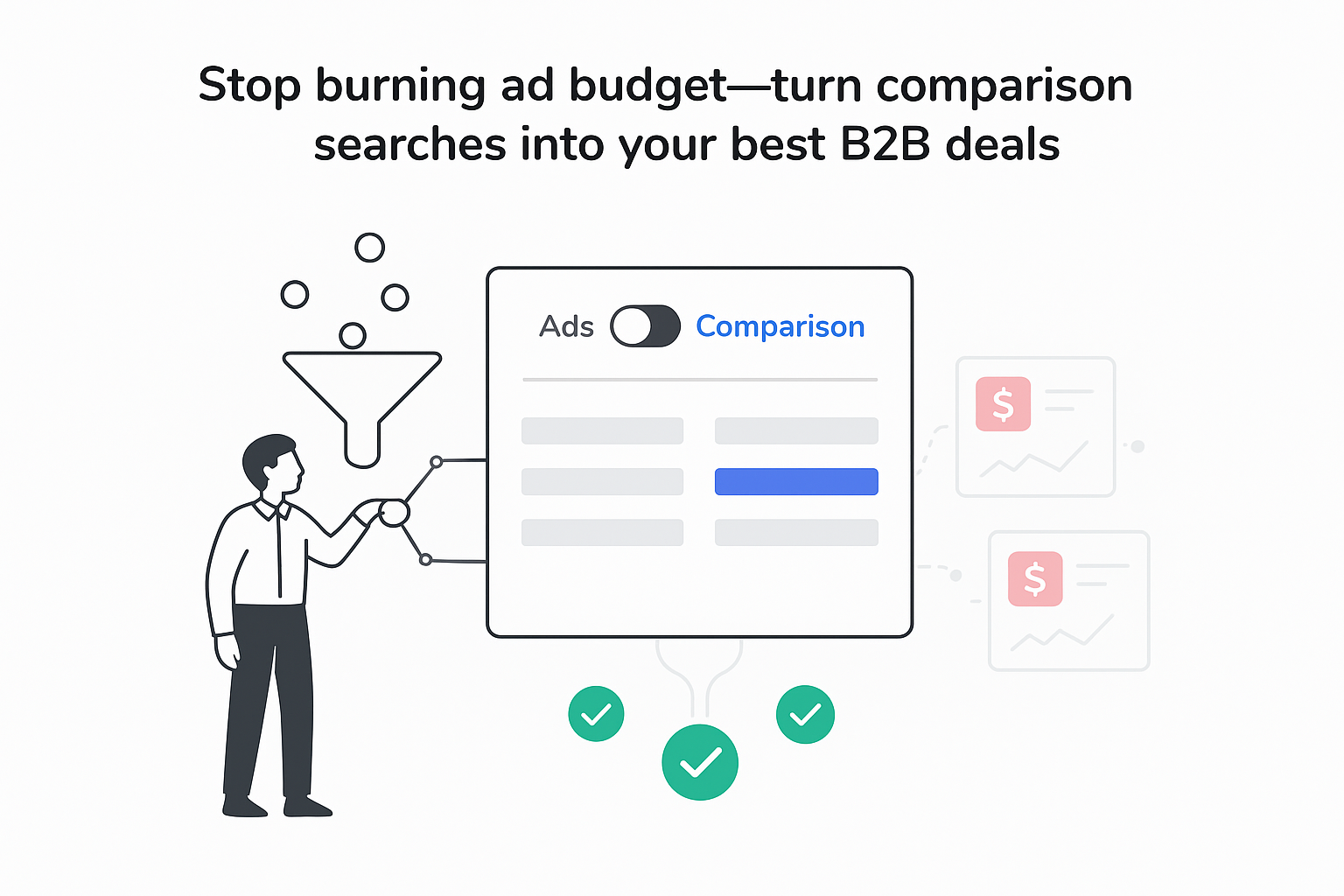
Most B2B service CEOs already feel this: paid channels are getting more expensive, generic blog posts are hard to measure, and you still need a predictable inbound pipeline that does not depend on a credit card. That is exactly where B2B comparison pages can quietly become one of your highest ROI SEO plays.
B2B comparison pages for service-based businesses
In this article, we will look at why comparison pages matter for service firms, how to model their ROI, and a simple roadmap to ship your first pages without turning it into a huge initiative.
Why B2B comparison pages are a must
When I talk about B2B comparison pages, I mean pages like “[Big Agency] vs [Your Firm]” or “Alternative to [Well Known Consulting Firm].” These are not fluffy thought pieces. They are built to catch buyers who already know the main players and are close to a decision.
Someone types “[Big Brand Agency] vs specialist SEO firm” into Google. They are not browsing. They already have budget, they already feel the pain, and they are trying to make a call. If your comparison pages show up here, you meet them at the bottom of the funnel instead of grinding through months of nurture.
That single mechanic usually hits several pain points at once. Customer acquisition cost is lower than paid search because you are not paying for each click. Inbound quality is higher because visitors arrive comparing real options instead of vaguely researching a topic. Sales cycles are shorter because the content removes the “why not them?” objections. Sales calls have less friction because prospects arrive pre-educated and pre-filtered.
Picture two quick scenarios.
First, a CFO searches “Top marketing automation agency alternative to [Global Network].” They see your “Alternative to [Global Network] for mid-market B2B teams” page, skim a clear comparison, then book a call.
Second, a VP Revenue searches “[Well Known SEO firm] vs specialized B2B SEO agency.” Your comparison page lays out when each is a better fit; they self-select into your camp.
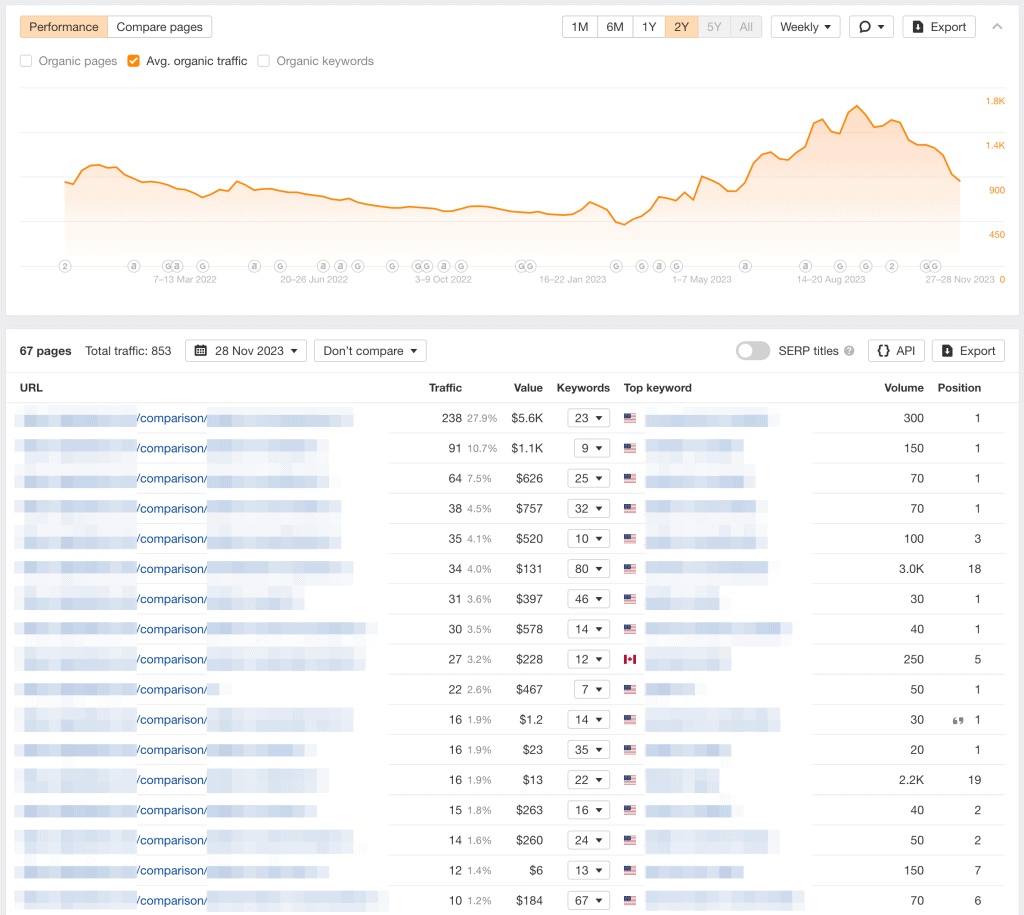
SaaS companies have been running this play for years with “vs” and “alternative” pages; a strong at-scale example is this Ahrefs post. In my experience, for B2B services - where a single client can mean a six or seven figure relationship - comparison pages can be even more valuable.
Calculating SEO ROI for comparison pages
You do not want “content for content’s sake.” So it helps to keep the ROI model simple and numeric.
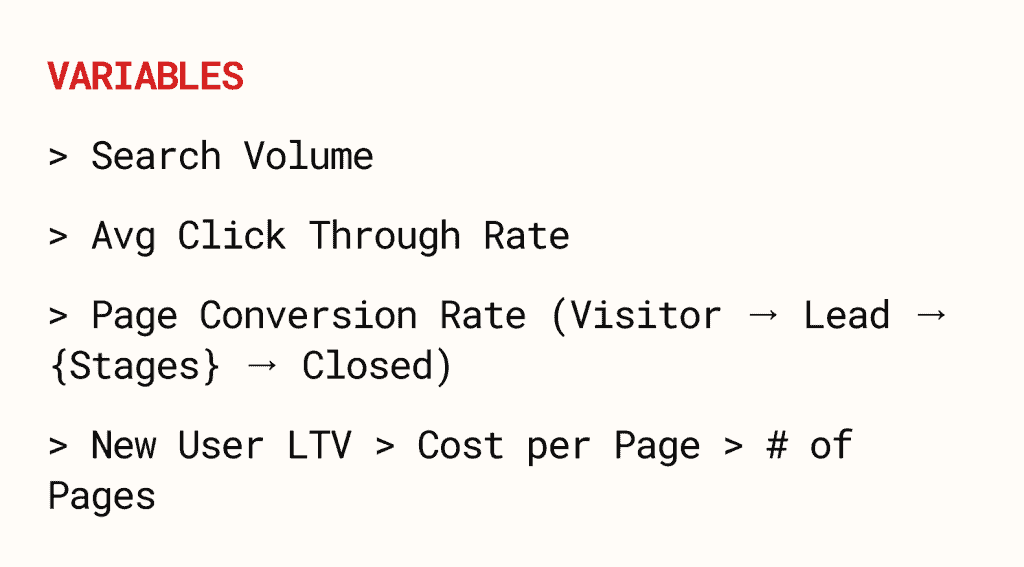
A basic way to model ROI for B2B comparison pages is:
Estimated monthly value
= Monthly search volume × expected CTR × landing page conversion rate × close rate × average LTV
These inputs should be grounded in your own funnel data. If you do not have much history yet, typical B2B SaaS SEO funnel conversion ranges summarised in this study are a useful starting point.
Once you know the estimated monthly value, compare it to your monthly cost to create and maintain the page. You can also plug this into a simple ROI calculator or spreadsheet so the math is repeatable across services, as outlined in our guide on using calculators and ROI tools to qualify leads.
Example 1: $5K per month retainer service
Imagine you run a B2B SEO agency. Your target query is “[Big Agency] vs [Your Agency].” Suppose it gets around 300 searches per month. When you rank in the top three results, you might reasonably expect a 20% click-through rate. If about 5% of those visitors convert to leads and 20% of leads become clients, and if your average client spends $5K per month for 18 months (a $90K LTV), the numbers look like this:
Three hundred searches with a 20% CTR give you about 60 visitors a month. At a 5% visitor-to-lead conversion rate, that is 3 leads per month. With a 20% close rate, you land 0.6 new clients per month - roughly 1 new client every 2 months.
In value terms, 0.6 clients per month at $90K LTV is about $54K of expected LTV per month of traffic in probabilistic terms.
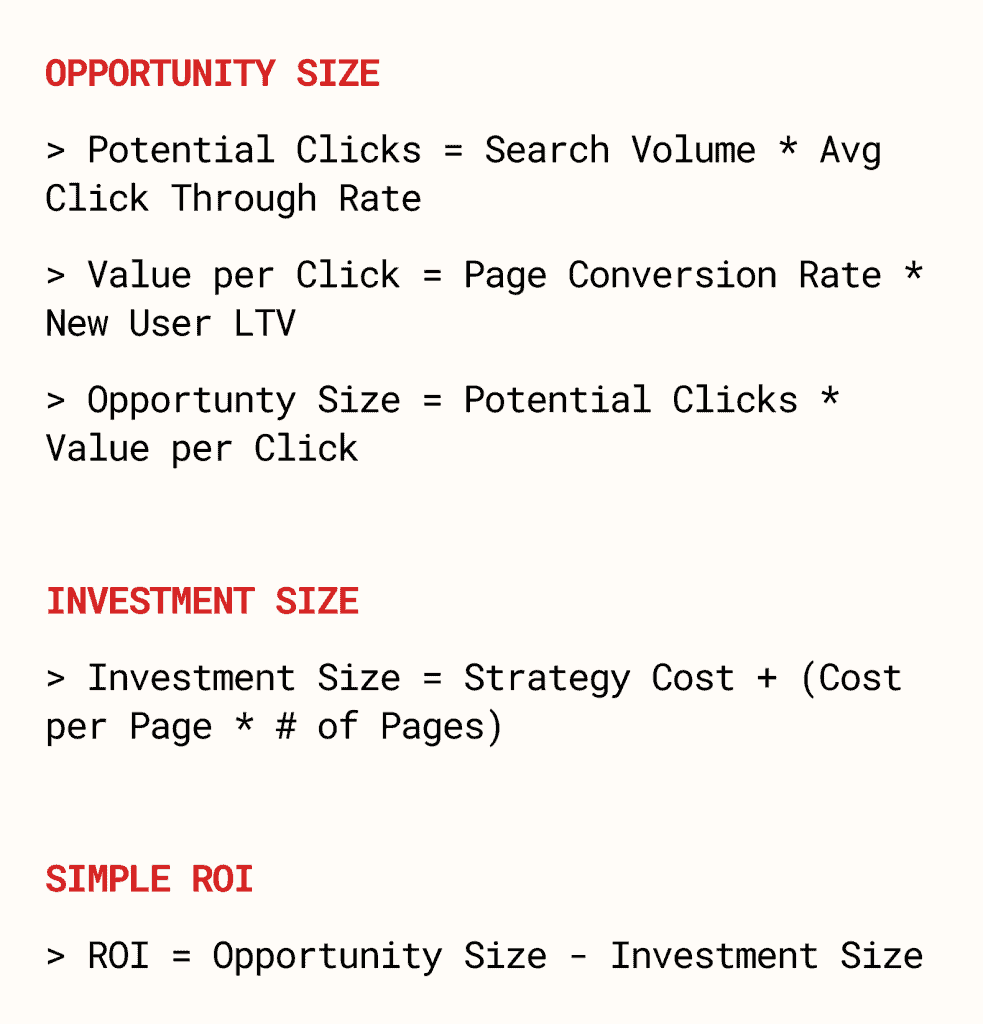
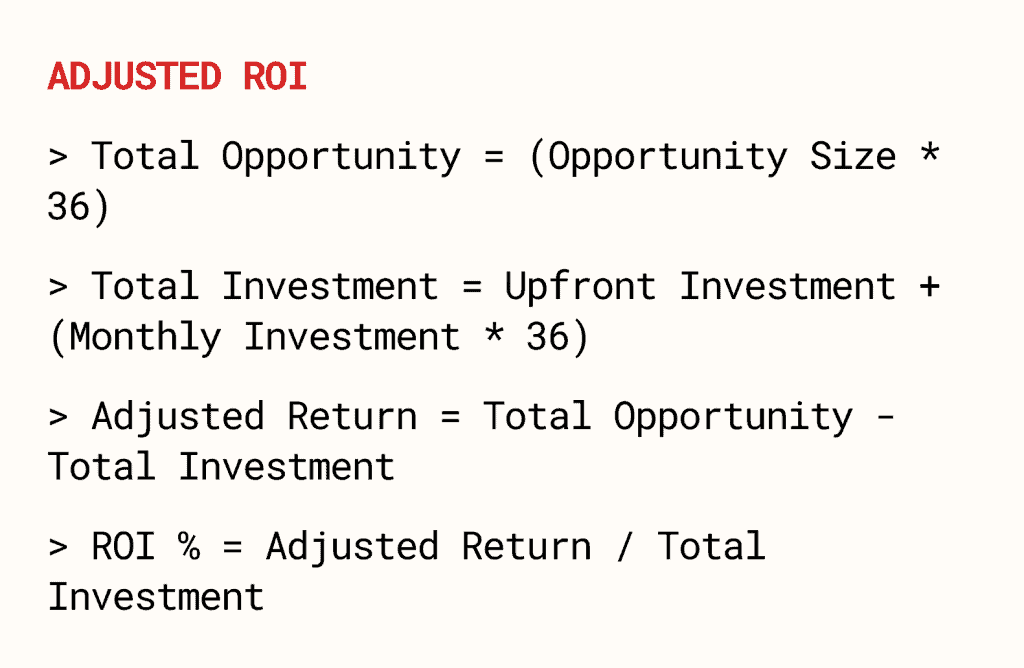
Now the cost side. Say you spend $2,500 to research, write, design, and build the page, then $200 per month to keep it updated and supported. Even if you cut the performance numbers in half for a conservative view, you are still talking about a piece of content that can “fund itself” many times over within a year, then keep producing for 2 to 3 years.
Example 2: $25K one-off project
Now imagine a consulting firm selling $25K projects. Your target query is “Alternative to [Big 4 Firm] for supply chain consulting.” Assume it has 150 searches per month, with a 15% CTR when you rank near the top. If 4% of visitors become leads and 15% of leads become signed projects, and each client is worth $25K, the math is straightforward.
One hundred fifty searches with a 15% CTR give you about 22 or 23 visitors a month. At a 4% conversion rate you see roughly 1 lead per month. At a 15% close rate, you end up with about 0.15 client per month - roughly 2 new clients per year.
At $25K per project, that is about $50K in value per year from a single page that might cost you the same $2,500 upfront plus a small maintenance budget. The payback window is short.
Now compare that with paid search. Many B2B service clicks for competitor terms sit in the $15 to $60 range. You would burn the same budget in one or two months of ads that you could put into a comparison page that keeps working for years.
Timing matters, though. Most pages need 3 to 6 months to pick up rankings and real traffic, depending on domain strength and competition. Early signs that a page is on track include impressions in Google Search Console for those “vs” or “alternative” terms, assisted conversions in your analytics platform, and opportunities logged in your CRM that list that landing page as first touch or influence. That is the game: one durable asset, paid for once, throwing off pipeline over a long horizon.
Overcoming common hesitations about comparison pages
If you are still reading, you are probably half sold and half nervous. That is normal. Most CEOs and marketing leaders voice the same concerns.
“I do not want to add more logos to their consideration set.”
The hard truth is, they already know the big names. Your sales team hears those names on almost every call. The evaluation is happening with or without you. If your comparison pages do not show up, someone else controls the story. You are not protecting deals by staying silent; you are just giving up the chance to frame the choice.
“Our review will be biased.”
Of course it will carry your point of view. That is fine, as long as you play fair. The trick is to be transparent: call out where a competitor is a better fit, include a “when we are not the best choice” section, and back your side with data and examples. That kind of honesty usually increases trust, not the opposite.
“No one else does everything we do.”
Service firms love this line. The truth is messy. Prospects compare you to someone, even if they have to cobble together two or three firms or internal teams. Your content can speak to specific use cases, industries, or engagement models rather than a perfect feature match. Comparison pages shine when you make it clear “who each option is best for,” not when you chase a giant checkbox grid.
“Our competitors will get mad.”
Sometimes they will. You can lower the temperature by using public data, neutral language, and clear disclaimers. This kind of content is common in software and is spreading through services. A few annoyed emails are minor next to the lost pipeline from staying out of the conversation.
Another concern I hear is legal risk. In most markets, you can mention competitors as long as you are accurate, fair, and not misleading. Stick to public information, avoid false or unverifiable claims, and keep your tone neutral. Some firms add a brief note stating that trademarks belong to their owners and that the comparison uses publicly available information. This is not legal advice, so it is worth checking specifics with your counsel, but in general the bar is “truthful and fair,” not “never mention a competitor.”
Then there is the fear of sending leads to a rival. In practice, strong comparison pages do the opposite: they help visitors self-select. If a prospect is clearly a better fit for the competitor, losing that deal early saves your team time and protects your close rate. The ones who fit your model move closer to you; the rest exit before clogging your pipeline and wasting sales time.
Avoiding comparison pages does not reduce risk much. It mostly reduces your chance to win deals that are already deep in evaluation.
Anatomy of a high converting B2B comparison page
I think of B2B comparison pages as structured sales conversations that can run without you. Most high-performing pages share the same building blocks, and if you want more examples tailored to service firms, this deeper B2B comparison page SEO guide walks through additional layouts and wireframes.
- A clear headline (H1) that names both options and reflects the search term
- A quick “verdict” section that explains who each option is best for
- A simple comparison table that focuses on how you work, not just what you do
- A story-driven section on qualitative differences and approach
- A candid explanation of when to choose them versus you
- Social proof that matches the searcher: case snippets, quotes, and relevant logos
- Straight answers to real buying questions (pricing ranges, terms, process) woven into the body
- Strong, clear calls to action so visitors know the sensible next step
Compared to SaaS, B2B services sell outcomes, risk reduction, and team expertise more than features. So your page should push proof: before-and-after metrics, project timelines, how your team works, and what happens if things go wrong.
Many firms sketch a simple wireframe first. Picture a two-column layout with the headline, verdict, and key CTAs at the top, a comparison table under that, then deeper sections as you scroll. Treat it like a structured sales deck made public.
Above the fold design and comparison layout
What buyers see before they scroll often decides whether they stay or bounce. Above the fold, include a headline that names both options (for example, “[Big Agency] vs [Your Firm]: which is better for B2B services?”) and a subheadline that sets the angle (“When a global agency makes sense, when a specialist team wins”). Add one to three short bullets or sentences that highlight the key differences in plain language, plus a few trust signals such as recognizable client names, a short review quote, or a single lead metric like “clients typically see an X% lift in qualified leads in 12 months.” Round that out with a clear CTA that points to the obvious next step, such as reviewing a plan or speaking with a strategist.
Right under that, place your first comparison table. For services, go beyond features and focus on how the engagement works. Columns might include who each option is best for, the typical engagement model (retainer, project, hybrid), usual budget range, time to first value, access to senior team, contract terms, and communication rhythm. Make it easy for a buyer to scan and think, “that column looks like us.”
Near the top, it helps to add a short, honest panel that spells out the trade-offs in plain language. For example, “Choose [Competitor] if you want a global team, large scale, and lots of internal functions under one roof. Choose us if you want specialists for B2B, a leaner team, and direct access to the people doing the work.” Design-wise, keep the table clean, highlight your column gently, and avoid loud “X” marks on the competitor side. The goal is confident and calm, not aggressive.
Social proof, depth content, and high contrast CTAs
Once you have laid out the comparison, visitors need proof that the story holds up in real life. Mid-page, bring in two or three short case snippets that match the search intent. For instance, you might show how a mid-market SaaS company moved from a global agency to a focused B2B team and increased inbound demo requests over a defined period, or how an industrial services company switched from a generic digital shop and cut cost per lead while raising lead quality. Add client logos where you can, short quotes from decision makers, and clear before/after numbers. These are the elements that calm risk-focused buyers who worry about making a bad call.
If you only have a few clients or case studies, you can still make this work. Use the one or two strongest stories that fit the comparison, even if they are not perfect matches. Then lean harder on clarity of process - how you work, what onboarding looks like, how you manage risk, and how you report on results - so buyers can still see what it would be like to work with you.
You also need visible CTAs. Typically, place at least one strong, high-contrast CTA block right after the main comparison content and another near the bottom of the page. The wording should describe a concrete, low-friction next step, such as reviewing a tailored outline of work or booking a short call to compare approaches for their situation. For visitors who are not ready to talk yet, you can reference educational resources - like a deeper guide to evaluating agencies - so they can keep moving without committing to a conversation.
B2B SEO strategy for comparison pages
Comparison pages only work if your buyers can actually find them, so you need a simple, focused SEO plan.
Start with keyword research. Use your preferred SEO tools to identify patterns such as “[Competitor] vs [Your Brand],” “Alternative to [Competitor],” “[Competitor] pricing vs [Your Brand],” and “[Competitor] agency alternative.” Begin with the competitors your sales team hears most often on calls. Then look at search volume and difficulty. A low-volume query for a high-value rival can still be worth it if the deals are large enough, and if you need a primer on how to approach this, this guide to ranking these keywords is a helpful walkthrough.
Next, decide which competitors to prioritize based on relevance to your main ICP, the search demand around their brand plus comparison terms, and your realistic chance to rank within 3 to 6 months.
On-page, keep things straightforward. Use title tags that include both names and the main keyword (for example, “[Competitor] vs [Your Brand] for B2B SEO services”), and write meta descriptions that clearly state who the page is for, what kind of company it helps, and what outcome it addresses. Make sure your H1 reflects either the “[Competitor] vs [Brand]” phrasing or the core comparison theme. Major SaaS brands like ClickUp use this exact “Brand vs Brand” pattern across titles and URLs, which keeps things consistent for both searchers and search engines.
Link to the page internally from key locations such as your main service pages and pricing page, and consider a modest “Compare” item in the navigation if comparison content becomes an important part of your site. Good internal linking is one of the fastest ways to get these assets discovered and is covered in more depth in our playbook on internal linking that grows revenue-driving pages. Schema markup for things like FAQs, organizations, and reviews can help where it fits naturally.
Alternative pages for B2B services
“Alternative to [Competitor]” pages are close cousins of “vs” pages but serve a slightly different search mood.
A “vs” query often means, “I am choosing between two clear options.” An “alternative to [Competitor]” search usually signals, “I am unhappy with my current provider; what else is out there?” That can be powerful for B2B services, especially when prospects feel stuck with a large incumbent or an all-purpose agency.
On these pages, speak directly to teams in that situation. Explain who you are a good alternative for in terms of company size, industry, and team structure. Call out common reasons companies switch away from the named competitor - such as slow response times, lack of specialist expertise, or misaligned pricing. Outline a simple migration or transition plan that includes how you protect current results and avoid a messy handover. Then anchor it with proof from clients who replaced that firm and saw clear gains.
For example, you might build an “Alternative to [Big 4 Consulting Firm] for mid-market manufacturers” page or an “Alternative to [Large Enterprise Agency] for B2B SaaS marketers” page. Link your “vs” pages and your “alternative” pages together so visitors can move between them as a small comparison cluster. That helps both SEO and user journeys.
As you scale, many firms build a comparison hub that lists “Compare us with…” links, with individual “vs” and “alternative” pages underneath. Clean URL structures like `/compare/competitor-vs-your-brand` make it easier for both search engines and users to navigate. At scale, some SaaS brands run entire hubs like this Ahrefs post, which is a useful reference when you are ready to expand beyond a handful of competitors. Avoid multiple pages chasing the exact same keyword to keep cannibalization low.
Performance tracking matters. Watch rankings for competitor terms, organic traffic to each comparison page, and the leads and opportunities in your CRM that include those pages in their touchpoint history. Over time, you will see which comparison pages are actual pipeline drivers and which need refining.
If a competitor publishes a “[Your Company] alternative” page before you do, that is not a reason to back off. It is a signal that comparison content is part of the landscape. You can respond with your own comparison that answers their claims, target their brand terms in your SEO plan, and give your sales team a clear resource to send prospects who mention that article.
Implementation roadmap for your first comparison page
You might be thinking, “This sounds good, but I do not want to babysit content projects.” Fair. Here is a simple way to get your first comparison page live without turning it into a giant initiative.
I usually suggest starting small with a handful of high-impact competitors - often 3 to 5 pages are enough to learn what works before you expand further.
- Choose a high-impact competitor and query. Ask sales which competitor names come up most in late-stage deals. Then use your SEO research tools to confirm there is at least modest search volume around “[Competitor] vs [Your Brand]” or “Alternative to [Competitor].”
- Interview sales and account leaders. Run a short workshop. Ask why deals are won or lost against that competitor, which myths or assumptions prospects bring into the conversation, and what clients say after they switch. This is where the real differentiation usually lives.
- Outline the page using the anatomy above. Sketch the headline, verdict section, first table, key differentiators, social proof, and the main buying questions you need to answer. This can live in a single document or even on a whiteboard; the goal is structure, not polish.
- Brief a specialist SEO copywriter and designer. Give them the outline, notes from sales, and keyword targets. Make one person clearly responsible for coordinating strategy, copy, SEO, and design so you are not dragged into day-to-day project management.
- Publish with tracking set up. Before launch, make sure you have analytics goals configured, call tracking if you use it, and a CRM campaign or tagging structure so you can tie leads and opportunities back to the page.
- Use it as sales enablement while SEO ramps. Share the page with your sales team as a live “battlecard.” Ask them to send it to prospects who mention that competitor on calls. Treat it as a public version of your internal comparison notes. This way the asset adds value even before rankings kick in and helps align marketing and sales messaging.
- Review performance after 30, 60, and 90 days. After 30 days, focus on impressions, ranking movement, and early engagement signals like time on page. At 60 and 90 days, look at organic traffic, leads, and any pipeline created. Adjust copy, CTAs, and internal links based on what you see, and then decide which competitor page to build next based on early winners.
Most firms can move from idea to live page in 2 to 3 weeks if ownership is clear. Over time, the data from your comparison pages does more than generate deals: it shows which competitors actually matter, which angles resonate with buyers, and where your positioning is strongest. That feedback can flow back into your broader marketing, your sales battlecards, and even your service design.



.svg)

.svg)
.svg)