
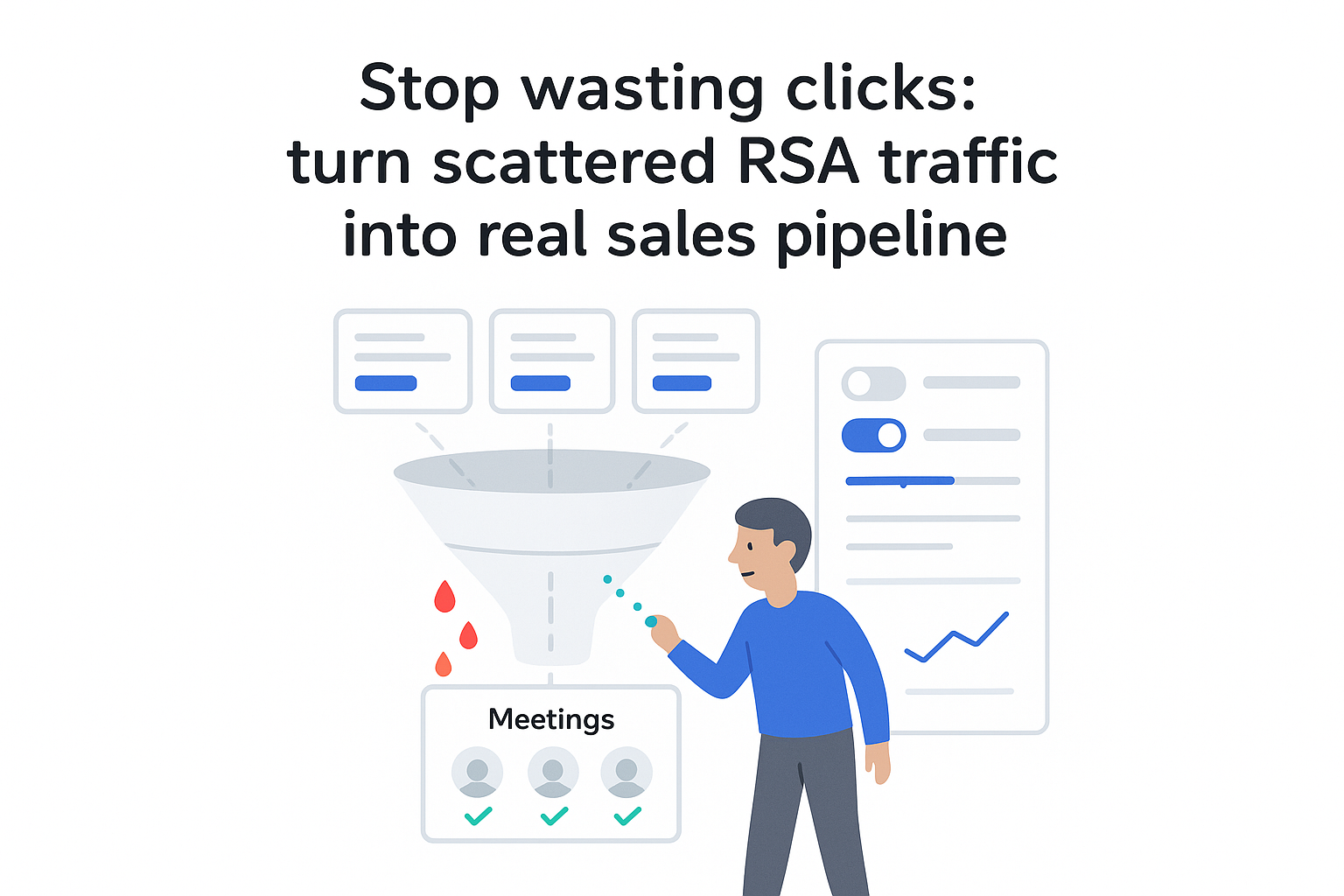
Your paid search can be running, reports can look “fine,” and the pipeline can still feel fragile. I see this most often when spend sits in the $50K-$150K/month range: every lift in leads seems to require another lift in budget or more hands-on tweaking.
Responsive Search Ads (RSAs) give me a more scalable way to turn the search demand I’m already paying for into more qualified demo and consultation requests - without rebuilding ads every week. They also pair cleanly with SEO: SEO builds long-term demand, while RSAs capture high-intent buyers who are ready to act right now. If you’re trying to run both channels with one positioning, this aligns with a two-pronged B2B pipeline approach where SEO compounds and paid search converts demand efficiently.
Responsive search ads for B2B service companies: what they are and why they matter
RSAs are now the standard search ad format in Google Ads. Instead of writing one fixed ad, I provide Google a set of headlines and descriptions. During each auction, Google assembles a version of the ad based on the search and other context signals. (If you want the “how it works under the hood” view, Google’s own automation overview in Unlock the Power of Search is a solid reference.)
For B2B service companies, RSAs matter because the same “service” is searched in different language depending on role, urgency, and problem framing. For example:
- A founder might search: “B2B SEO agency for service businesses”
- An operations leader might search: “reduce lead cost for B2B service company”
- A marketing lead might search: “SEO and Google Ads strategy for B2B lead generation”
With older fixed ads, I had to guess which single message would land best. With RSAs, I can include multiple angles (outcomes, proof, objections, calls to action), then let the platform learn which combinations earn clicks and - more importantly - produce qualified conversions.
One important caveat: RSAs don’t fix fundamentals. If lead quality is unstable because the offer is unclear, the landing page is vague, or sales follow-up is slow, RSAs won’t magically solve that. What they can do is reduce the creative bottleneck and improve message-to-intent alignment at scale.
How RSAs work inside Google Ads (and what I can and can’t control)
An RSA is built from up to 15 headlines (30 characters each) and up to 4 descriptions (90 characters each). When a search happens and my keyword enters the auction, Google selects a mix of those assets to build the ad for that impression.
Behind the scenes, Google uses signals like the query itself, the triggered keyword and match type, device, location, and other context to decide which combination to show. Over time, it increases exposure for combinations that it predicts will perform better. This all runs inside the same auction logic where Ad Rank determines which ads show and where - so relevance and landing-page experience still matter.
What I still control includes keyword targeting, match types, audiences (if used), campaign structure, bidding approach (manual or smart bidding), every approved word that can appear in the ad, and the landing-page-to-conversion path. If you want a clean framework for choosing bidding approaches in B2B, I keep it simple in smart bidding vs manual bidding guidance.
What I don’t control includes the exact headline/description combination a specific person sees (unless I pin assets), how long learning takes in low-volume markets, and whether Google’s “Ad strength” score aligns with business outcomes (it often doesn’t). If you’re leaning into automation, it helps to understand the broader ecosystem of Google Ads automation so you know what to trust and what to validate.
I’ve found RSAs work best when conversion tracking reflects real business value. If the primary conversion is “any form fill,” the system will optimize toward easy conversions - even if sales rejects them. When the primary conversion is a booked meeting or a clearly qualified request, the learning loop is much healthier. Before scaling, I run a quick set of conversion sanity checks so “wins” in-platform translate into pipeline quality.
Building an RSA asset bank that matches B2B intent
When I build RSA assets for B2B services, I’m trying to cover the few reasons someone clicks and the few reasons someone doesn’t. That means variety, not near-duplicates.
At a practical level, an RSA includes a final URL (landing page), display paths (the short “/something” text after the domain), headlines, descriptions, and tracking parameters so downstream systems can attribute lead quality back to ads. Where you send traffic matters as much as what you say - especially in service businesses - so I default to the most specific page possible (more on that tradeoff in landing page vs product page: where to send traffic).
Pinning deserves extra attention. I treat pinning as a constraint, not a default. It’s useful for legal/compliance phrases or strict brand requirements, but heavy pinning often reduces performance because it removes the system’s ability to match message-to-intent.
Here’s a compact example of how I map assets so each one has a job:
| Asset type | Example angle | What it addresses |
|---|---|---|
| Headline | “Reduce cost per qualified lead” | Efficiency and CAC pressure |
| Headline | “Lead gen for B2B service companies” | Relevance to category |
| Headline | “Proven process, clear reporting” | Trust and operational confidence |
| Headline | “Request a consultation” | Clear next step |
| Description | “Built for long sales cycles and high ACVs.” | Fit for B2B buying reality |
| Description | “Focus on qualified meetings-not clicks.” | Lead quality positioning |
I avoid slogans that don’t anchor to a business outcome. In B2B services, most searchers are risk-managing. If I can’t make the risk feel lower or the outcome feel clearer, the ad rarely converts well. For copy inputs, I often lean on B2B lead gen ad copy frameworks that force clarity about outcomes, proof, and who the offer is for.
A simple RSA setup process (without constant tinkering)
I don’t need a complicated workflow to set RSAs up well - but I do need discipline. This is the structure I rely on:
-
Define the primary conversion before I write ads. I decide what “success” is (for example, booked meetings or qualified requests), and I make sure tracking treats that as primary. If you can pass values back (even imperfectly), value-based bidding for B2B can improve what the algorithm learns.
-
Build tight ad groups around one service + one intent. I group keywords by intent, not by broad topic. If an ad group mixes multiple services, the RSA usually becomes generic - and generic ads attract generic leads. This is the same logic I use in B2B Google Ads account structure planning.
-
Write one strong RSA per ad group to start. Google allows up to three RSAs per ad group, but in most B2B accounts I’d rather concentrate data. I typically start with one RSA, then add a second only when I have a clearly different angle to test.
-
Send traffic to the most specific landing page available. If the ad is about one service for one audience, I match it with a page that reflects that promise. Misalignment here is one of the fastest ways to inflate CPA and lower lead quality.
-
Let learning happen before I make big edits. In higher-volume campaigns, I can often see patterns in 2-4 weeks. In niche B2B, it can take longer. If I rewrite assets too frequently, I keep resetting learning and never get a stable read.
If you’re still deciding how RSAs fit into the larger campaign plan, it helps to understand each campaign type and when Search is the right tool versus other options.
Reading RSA performance: I start with pipeline, then work backward
I’m not trying to “win” click-through rate. I’m trying to build profitable pipeline. So my analysis starts downstream and moves back upstream.
At minimum, I review performance at four levels:
- Ad group level: whether the intent theme is worth funding (conversion rate, CPA, impression share, and - when available - qualified rate)
- Ad level: whether one RSA is attracting better-fit leads than another (not just more clicks)
- Search term level: what people actually typed, and what I should exclude with negative keywords (to cut students, job seekers, DIY queries, or unrelated categories)
- Asset level: which headlines/descriptions are consistently weak so I can replace them with truly new angles
Google’s asset ratings (“Low,” “Good,” “Best”) are directional, but I treat them carefully in B2B - especially when volume is low. Small samples can mislead. If a headline is labeled “Low,” but the leads it influences are higher quality, I’m not quick to remove it.
Budget expectations fit here too. I work backward from economics: expected CPC, expected conversion rate to a qualified lead, and how many qualified leads I need per month to learn anything meaningful. Even without a huge budget, patterns show up faster when conversion definitions and negatives are tight. For the fastest cost control lever in most accounts, I rely on a strict negative keywords system and consistent review cadence.
Tactics that usually improve lead quality in B2B RSAs
RSAs can run “hands-off,” but I get better outcomes when I treat them as a controlled testing engine.
Keep one core offer per ad group. If the ad group is high-intent (“hire,” “agency,” “consultant,” “services”), I align the RSA to a direct next step. If the ad group is research-intent, I’m careful - those clicks can be expensive and often convert into low-intent inquiries unless the follow-up process is strong.
Use objections as copy inputs. In B2B services, objections are predictable: “Will this work in my niche?”, “How long will it take?”, “Is this another vendor who overpromises?”, “Do they understand my buyer?” I’d rather address one of those than write a vague benefit statement.
Change assets in small increments. Once performance stabilizes, I prefer replacing one or two headlines at a time. If I rewrite everything, I lose the thread of what actually caused improvement (or decline).
Treat landing pages as part of the ad system. Many high CPAs aren’t caused by ads - they’re caused by pages that load slowly, bury proof, over-explain, or ask for too much too soon. If the page doesn’t match the intent level, RSA optimization can only do so much. (This is also where better pacing and monitoring helps prevent “quiet overspend” while you diagnose the real constraint - see budget pacing alerts.)
If you want a broader optimization checklist beyond RSAs, HawkSEM’s guide on how to optimize the campaigns is a useful companion - just apply it with a B2B-qualified-lead lens.
When dynamic search ads help-and when they backfire
RSAs and Dynamic Search Ads (DSAs) both use automation, but they automate different parts of the equation.
With RSAs, I choose keywords and I write all text assets. With DSAs, Google can match queries to my site content and generate headlines dynamically. That can be useful for discovery - especially when a site has many well-structured service or industry pages and the advertiser wants to capture long-tail searches they didn’t anticipate.
The risk in B2B is irrelevant traffic. If a site contains lots of informational content, DSAs can match and spend against research queries that don’t convert - or that convert into low-quality leads. When I use DSAs, I keep them constrained (for example, limiting them to specific page groups) and I monitor search terms aggressively, moving any consistently strong queries into dedicated RSA ad groups.
How RSAs and SEO fit together (timeline, ROI, and expectations)
I don’t treat RSAs and SEO as competing channels. They behave differently across time.
RSAs can start producing leads quickly once campaigns are live and tracking works, but performance depends on bidding, query mix, landing pages, and lead handling. SEO usually takes longer to move rankings for competitive B2B terms, yet it compounds: stronger pages bring ongoing demand without paying per click.
In practice, I think of SEO as expanding the pool of people who discover and research the category, and RSAs as capturing the buyers who are already in-market and expressing intent today. When both are aligned to the same positioning and proof points, I typically see cleaner messaging, higher conversion rates, and fewer “curiosity clicks.”
Practical expectations I set before judging results
Low-volume niches require patience. RSAs can work in narrow B2B categories, but the learning cycle is slower. That makes structure, negatives, and landing-page clarity more important - not less.
Two RSAs per ad group is usually enough. Beyond that, data fragments and learning slows. I’d rather have fewer, better ads with enough volume to make decisions.
Pinning is a last resort. I pin only when I must. Over-pinning often turns an RSA back into a rigid ad, which removes the main advantage.
I wait for enough signal to act. In many B2B accounts, that means at least a few weeks and a meaningful number of qualified conversions before making major changes. Day-to-day volatility is normal, especially with high CPCs and long sales cycles.
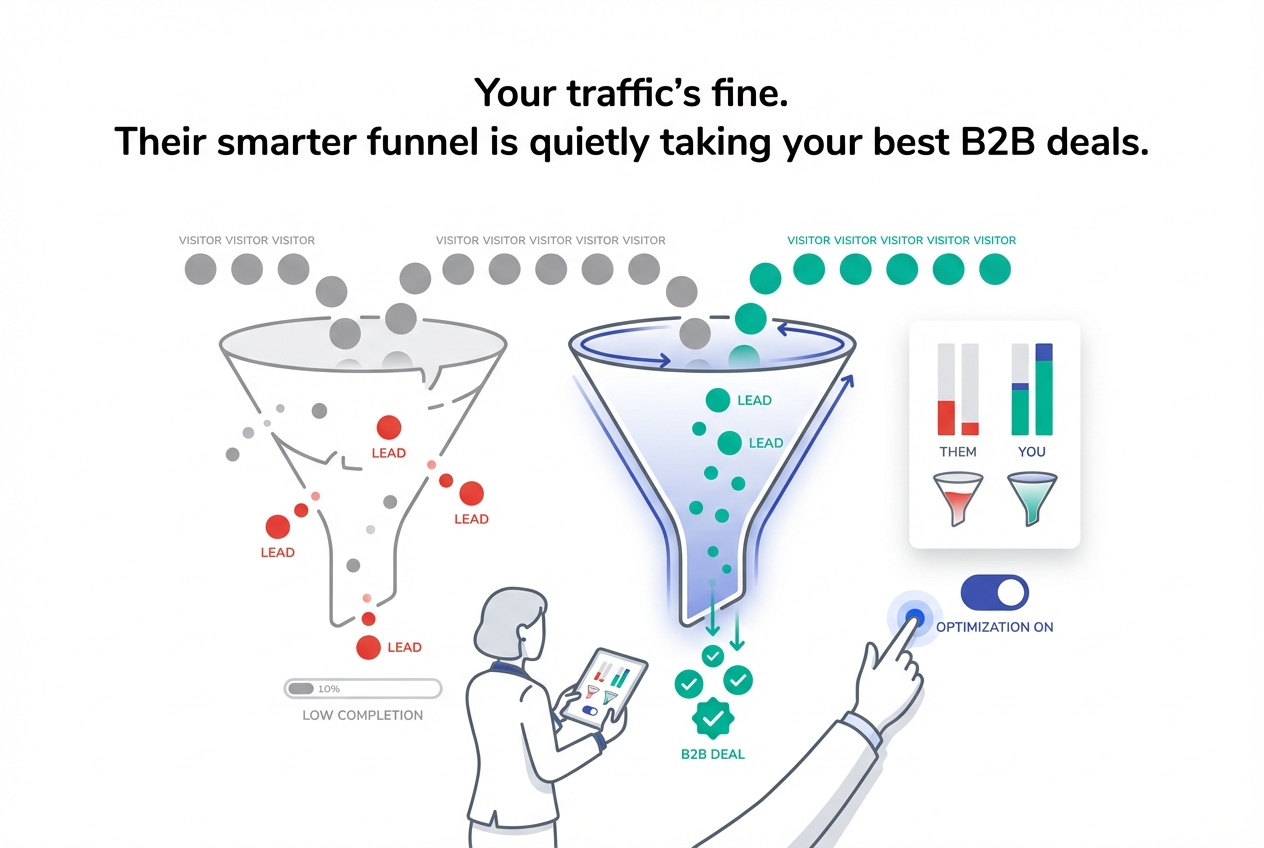
When I keep RSA structure tight, measure conversions that reflect real value, and let learning stabilize, RSAs become less of a “copy treadmill” and more of a system for steadily translating existing search demand into qualified pipeline.



.svg)

.svg)
.svg)