
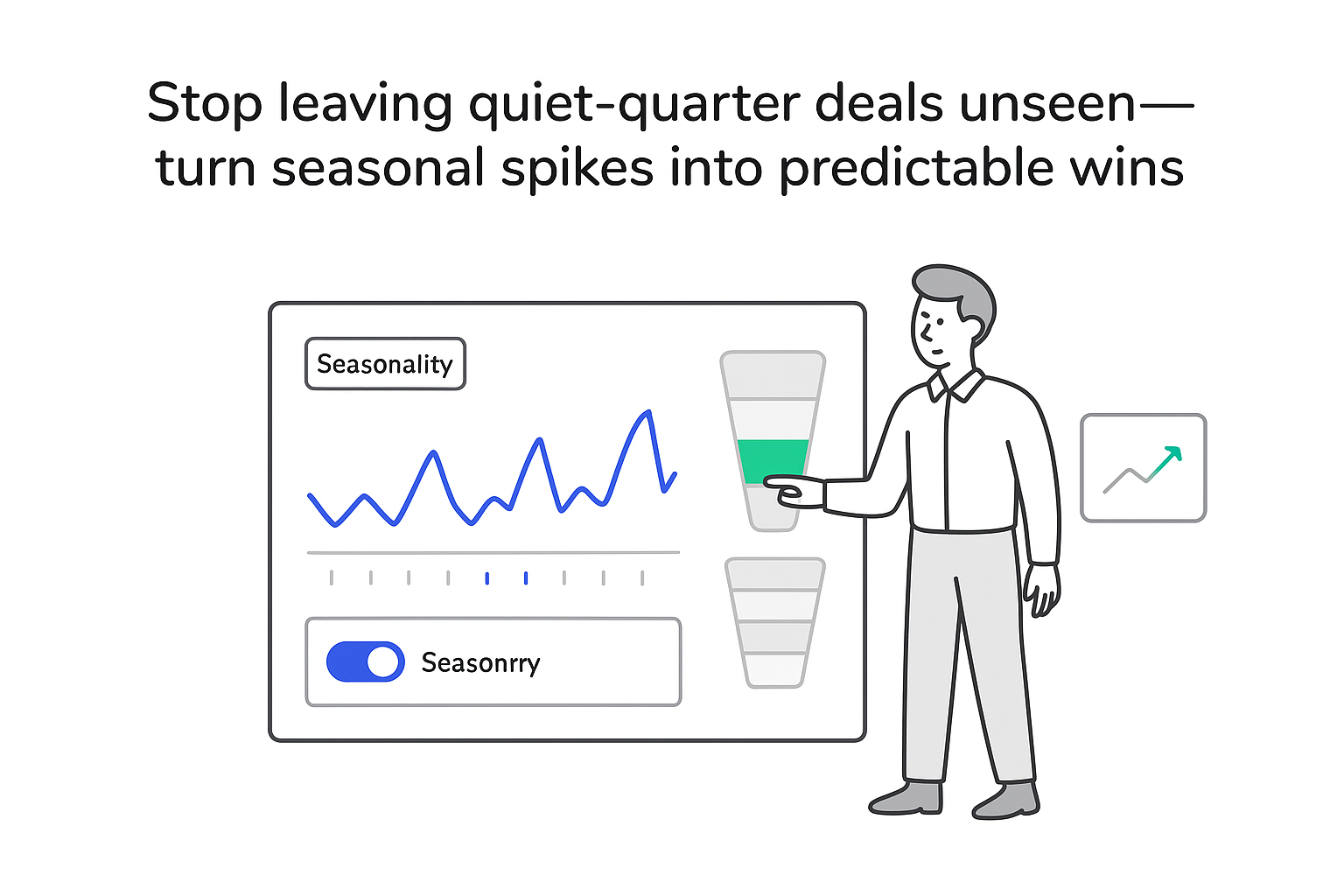
Most B2B founders treat seasonality as a retail thing: holiday sales, Black Friday chaos, and other spikes that feel far removed from how a consulting firm, IT provider, or training company runs marketing.
Yet the data sitting in your own CRM and analytics usually tell a different story. Deals bunch up around budget cycles, inbound interest surges before big industry events, and contracts come up for renewal in waves. If you translate those patterns into a simple seasonal marketing calendar, the noise in your reports starts to look a lot more like signal.
When I plan campaigns around those patterns, I consistently see a single seasonal push create a visible spike in qualified pipeline while lowering blended customer acquisition cost, simply because more of the spend and effort land on buyers who are already leaning forward. Third-party research, including work from WiserNotify, sees the same dynamic in other markets: well-timed seasonal offers dramatically increase response without requiring heavy discounting.
How seasonal campaign planning drives B2B revenue
Seasonal campaign planning is the habit of designing focused, time-bound pushes around the moments when your buyers are already paying extra attention.
Done well, one seasonal campaign can:
- Lift inbound demo requests or consultations for a quarter, not just a week
- Shorten sales cycles because prospects already feel urgency
- Lower blended CAC, since more of your spend hits buyers who are already in-market
Compare that with the typical pattern in many B2B service businesses: random LinkedIn posts, a last-minute webinar, and a few ad experiments scattered across Google and Meta. The team stays busy, but the pipeline chart stays flat because those activities are not anchored to when buyers are ready to move.
For B2B services, this matters even more than for retail. You deal with longer sales cycles and committee decisions, higher deal values and small, well-defined markets, and budget owners who think in quarters and fiscal years. Seasonal campaign planning lines your marketing up with those rhythms instead of fighting them.
Imagine a simple Q4 example. Before planning, your team sends a generic year-end email, runs a small retargeting campaign, and sees a small bump in traffic but no meaningful change in meetings. After planning, you run a "year-end compliance clean-up" theme for a specific vertical, with a tight list, supporting content, targeted ads, and a clear next step. Over six weeks, inbound demo requests from that segment might grow by 40 percent while paid media spend only edges up by 15 percent. Same quarter. Same team. Different planning.
Why seasonality matters even for B2B services
You might be thinking, "We are not that seasonal. We sell all year." In most B2B services, that is true at a high level. But your buyers do not behave the same way every month. In the data, I usually see clear patterns around:
- Fiscal year-end and "use-it-or-lose-it" budget windows
- New budget cycles when teams can finally commit to new projects
- Industry conferences and trade shows that spark new initiatives
- Peak RFP seasons in government and enterprise
- Tax season for financial and professional services
- Contract renewal waves for subscription or managed services
Ignore these cycles and several problems tend to appear. Competitors show up with a stronger share of voice right when your buyers are researching solutions. Sales improvises its own mini-campaigns that never connect with what marketing is doing. Leadership wonders why marketing was so quiet while revenue was on the line.
Treating seasonality as a planning lens does something simple but powerful: it connects campaigns to moments the business already cares about. That makes it easier to get sales, finance, and leadership support. There is less friction and fewer questions about why a specific campaign matters right now.
Fast-win opportunities from upcoming seasonal demand
Seasonal planning does not mean building a whole new marketing machine overnight. The fastest wins usually come from picking the next one or two windows and going deep there.
Imagine you see from your CRM and analytics that Q1 always brings a spike in traffic and proposals from SaaS companies planning their year. You decide to focus a single Q1 campaign on "new fiscal-year growth plans" for SaaS founders. Instead of creating everything from scratch, you refresh an older growth playbook article using a structured content refresh strategy, launch one focused landing page, and build a LinkedIn and email sequence around it.
That one campaign can generate visible pipeline in weeks, while your broader SEO and brand work keep compounding in the background. I think of SEO as the steady investment that keeps your brand visible all year, and seasonal campaigns as the sprints where you press into demand that already exists. Push harder when the market is already leaning forward, then keep nurturing those accounts after the season has passed.
What is a seasonal marketing campaign?
A seasonal campaign is essentially a normal marketing campaign with a timer attached.
For B2B services, a seasonal marketing campaign is a time-bound, theme-based, multi-channel push tied to a specific external trigger such as:
- A date or period, like Q4 close or fiscal-year reset
- An event, like an industry conference or major product launch in your ecosystem
- A deadline, like a new regulation going live or a tax filing cutoff
The campaign should have a clear ideal client profile, a specific offer, and one main success metric. Unlike consumer promotions, it is usually less about discounting and more about relevance. You speak to a pain that feels sharper at that moment, perhaps by packaging an audit or roadmap that aligns with a deadline, promising priority onboarding before a certain date, or helping buyers avoid a risk that peaks during that season.
This is different from always-on marketing, which runs all year and builds brand and organic demand, and from one-off holiday posts that say "Happy New Year" but never tie to pipeline. Seasonal campaigns sit between those two: more focused than always-on content and more commercial than simple greetings. When every asset and activity ties back to the same audience, trigger, offer, and metric, campaigns stop feeling like disconnected tactics and start acting as a single narrative that sales can back.
I also find it useful to look at cross-industry themes. An IT and cybersecurity firm might run a "year-end security audit sprint" targeting companies that need to reduce risk before financial audits or cyber insurance renewals. A management consultancy can lean into "new fiscal-year growth blueprints" for CEOs who just secured next year's budgets. HR and recruiting teams often see a "post-bonus talent upgrade" window, training providers can frame "back-to-school enablement" for sales teams before the main selling season, and financial or tax advisers can offer "pre-deadline clean-up" projects around tax season. Once you see these patterns, they are hard to unsee. Most are driven by business calendars, risk, and opportunity rather than holidays.
B2B seasonal campaign framework
You do not need a giant playbook or complex tech stack to run seasonal campaign planning. A simple, repeatable process is enough. I usually break it into five stages: campaign intake, scoping and goals, prioritization, approval and ownership, and execution with handover to delivery.
Good seasonal ideas rarely come only from marketing. Sales, customer success, and even finance all see different signals. I like to set up a simple intake process where anyone can suggest a campaign tied to a known trigger. That can be a shared form or a quarterly workshop, as long as each idea includes a defined target segment or account list, a clear seasonal trigger or key date, the main problem or opportunity, a proposed offer, preferred channels, and rough timings with the support required.
The intake process only works if it connects to reality. That means checking ideas against sales targets and capacity. If your sales team is already maxed out with renewals in Q4, planning a big net-new push for the same month will just burn budget and trust.
Once there is a shortlist of ideas, I move into scoping. This is where campaigns often grow too big and start to wobble. One simple rule helps: pick one primary KPI and two or three supporting measures. For instance, make new sales-qualified opportunities from target accounts your primary KPI, supported by measures such as landing page traffic from the target segment, meetings booked, and email reply rate. Link these to how your CFO thinks: pipeline created, customer acquisition cost, and payback period.
Scope also means deciding what you will not do. It is usually better to choose one core content asset, one landing page, and a couple of main channels than to spread effort thinly across many formats and platforms. Depth almost always beats reach in B2B services.
Timing can make or break a seasonal campaign. You need enough runway to produce assets and align sales, but not so much that urgency fades. For a major seasonal push, I often start research, CRM analysis, idea intake, and initial decisions 12-8 weeks before the trigger. The 8-4 week window is for content, creative, landing pages, tracking setup, and sales enablement. The final few weeks before launch are for warm-up content, teaser emails, and organic social. Holiday-focused guides like the one from WebFX recommend similar 60-90 day timelines, because creative, landing pages, and sales enablement always take longer than you expect.
During the live period, I check performance daily or weekly and make small adjustments. Two to four weeks after the window closes, I focus on post-season analysis, follow-up sequences, and content repurposing. Lighter campaigns can run on a tighter 4-6 week cycle if content and approvals allow.
Prioritizing seasonal marketing campaigns for maximum impact
Most B2B companies can dream up twenty seasonal ideas. The real skill is choosing the one to three that will move numbers this quarter.
A simple scoring method helps. I rate each candidate campaign on its impact potential (how much pipeline it could create if it works), how tightly it fits the ideal client profile, how strong and time-sensitive the trigger is, and how much effort and cost it demands. Plotting ideas on a rough two-by-two grid - with high impact, low effort at the top right and low impact, high effort at the bottom left - usually makes priorities obvious and makes it easier to say no to low-impact ideas, even if they sound fun.
Choosing triggers starts with a reality check against data you already own. I look at CRM and pipeline history to see when deals tend to close faster or stall, review analytics and search data to understand when interest in key topics spikes, and scan industry calendars for conferences, product releases, and regulatory dates. Strong triggers typically combine timing and pain, such as helping clients "avoid last-minute compliance fines before new rules hit in July" or "get the sales team ready before peak trade show season," rather than generic "we do audits" or "we do training" messages.
Once the scoring is clear, decision-making shifts from gut feel to structured judgment. For each campaign idea, I like a short summary that answers why this campaign is right for this segment, why now relative to other possible triggers, and what you are deciding not to do if you say yes. That last point forces trade-offs and reduces the pattern of "random acts of marketing" so many CEOs complain about.
Approval then becomes a boring, predictable step rather than a bottleneck. Decide up front who signs off and who runs each campaign. In many B2B service firms, one senior leader approves the campaign and budget, one campaign lead owns results and day-to-day coordination, and the sales leader confirms that the segment, offer, and capacity are realistic. Before green-lighting, I always check there is a clear link to sales goals and the seasonal trigger, realistic scope for the current team, one primary KPI everyone understands, and a simple tracking and reporting plan. Named ownership is what turns "marketing said they would do something" into "this person is responsible for this campaign and its number."
Designing customer-centric seasonal offers for B2B buyers
Channels get attention; offers close deals. If the campaign does not speak to a real, time-sensitive problem, no amount of email, ads, or SEO will fix it.
In B2B services, strong seasonal offers usually solve a pressing pain that is clearly tied to the trigger. I often see effective formats such as limited-time assessments or audits focused on a seasonal risk, bundled strategy-plus-implementation packages designed for a specific quarter or event, priority onboarding or "go live before date X" bundles, and co-created roadmaps that help buyers justify next year's budget. Most of these add value or certainty rather than cutting rates, which helps protect pricing.
Seasonality also looks different for different segments. An enterprise CFO thinks in fiscal years and compliance windows, while a mid-market head of marketing thinks in campaigns and quarterly targets. Simple segmentation goes a long way. High-ACV accounts might get more tailored outreach, while smaller ones receive more automated programs. Triggers differ by vertical - healthcare, fintech, and manufacturing rarely move on the same calendar - and lifecycle stage matters too. Current clients, expansion targets, and net-new prospects respond to different hooks. Buying roles add another layer: CFOs want risk and ROI stories, whereas operations leaders focus on efficiency and speed.
You do not need complex martech to start. Even splitting lists into "current accounts" and "new accounts" and adjusting copy can lift response. When I craft offers and messages, I focus on outcomes and urgency rather than internal features. "Close Q4 with zero open audit issues" is stronger than "get a security review," and "hit your new fiscal-year growth target with a tested playbook" is more compelling than "strategy workshop package." You can sweeten the offer with additional value - such as a bonus workshop for the wider team, an extended support window, or fast-track implementation - rather than relying on discounts.
High-ticket B2B services also rely heavily on trust, so cheap scarcity tactics tend to backfire. You still need urgency, but it has to be grounded in reality. Ethical urgency mechanics that fit B2B include genuinely limited project slots before a real deadline (for example, a regulation date), added-value bonuses that expire on a clear date, or price locks before a known increase or before the next fiscal-year cycle. The key is to tie urgency to real-world constraints and be transparent about them.
If you want inspiration for respectful urgency mechanics and on-site treatments, the seasonal campaign idea library from Optimonk is a useful swipe file, even though most of its examples are ecommerce.
Digital channels and seasonal SEO strategy
Seasonal campaigns work best when your digital channels pull in the same direction. I think of organic search as the gravity that attracts people who are already searching for help, while paid media, email, and social give the campaign speed. For B2B leaders who care about efficiency, this mix also reduces waste: organic search catches high-intent visitors you did not pay to push, paid search and paid social let you accelerate during key windows, and email plus remarketing keep your brand present across the whole season.

Search behavior changes across the year even in narrow B2B niches. Queries like "year-end IT audit," "Q4 B2B SEO strategy," or "GDPR audit before deadline" rise and fall. I use analytics and search tools to spot these patterns, then refresh existing blog posts and guides with seasonal angles and updated dates, add sections that address the upcoming deadline or event, update titles and meta descriptions with seasonal phrases where it makes sense, and link from evergreen pages to seasonal landing pages to pass authority. Technical basics still matter as well: seasonal pages need to be fast, mobile-friendly, and easy for search engines to crawl. Often, the quickest wins come from refreshing assets you already rank for rather than building everything new.
Once SEO and content set the core message, I wrap other channels around the same theme. A compliance campaign, for example, might revolve around one main landing page explaining the risk and offer, email sequences to current clients and warm leads tuned to their segment, LinkedIn ads aimed at specific job titles in target accounts, retargeting that follows visitors to that landing page and key articles, and sales outreach reusing the same core message and offer in one-to-one conversations. Mapping each touchpoint to the buyer journey keeps the flow smooth: early assets build awareness of the risk, mid-funnel content shows proof and case studies, and late-stage touchpoints focus on clear next steps and timelines.
Agencies like HawkSEM share additional seasonal ad strategies that are worth reviewing if you plan to lean heavily on paid search and paid social during your key windows.
AI has become practical enough to help here without turning everything into a science project. In seasonal campaigns, I see especially strong impact from predictive lead scoring that highlights which accounts to prioritize during the window, send-time optimization so emails land when people actually open them, and dynamic content blocks on landing pages and in emails that change based on segment or role. What matters for leadership is not the underlying models but that the team spends more time with the right accounts at the right moment and less time broadcasting to everyone.
Measuring and optimizing seasonal campaign performance
Seasonal campaigns live or die by clarity of measurement. Without it, they feel like "nice marketing work" rather than revenue drivers. Before launch, agree how you will tie activity back to pipeline and revenue. I like a simple measurement plan that maps targets by segment, main and supporting KPIs, data sources and dashboards, and a review cadence during and after the campaign. Over time, this turns seasonal campaigns from one-off pushes into a reusable system your team can run with increasing confidence.
If you need a way to connect campaign plans directly to the P&L, this guide on setting quarterly marketing goals that map to P&L is a useful complement. Solid measurement also assumes your analytics stack is wired correctly; if you are still relying on screenshots instead of CRM-connected reporting, start with this walkthrough on tracking leads in GA4, forms, and your CRM without a developer.

Defining KPIs and dashboards for seasonal campaigns
You do not need fifty charts. A focused set of metrics almost always works better. For seasonal B2B campaigns, that set might include:
- High-intent traffic from target segments
- Marketing qualified leads from the campaign
- Sales qualified leads and meetings held
- Opportunities created and pipeline value
- Closed-won revenue tied to the campaign
- CAC for the campaign and payback period
Comparing these figures with a similar non-seasonal period gives you a baseline, so you can see the lift rather than just raw numbers. If CAC and payback are still fuzzy for your team, this 30 minute CAC payback model breaks them into founder-friendly numbers.
During the campaign, a simple weekly or bi-weekly dashboard shared with leadership keeps everyone informed and reduces nervous check-ins. After a few cycles, that habit alone can change how the company thinks about marketing accountability.
Once the seasonal window closes, keep some energy for a proper review. Many teams skip this part once the pressure drops, which wastes hard-earned insights. A structured retro should look at which segments and offers performed above or below expectations, which channels moved the needle versus adding noise, where friction appeared in the funnel (for example, slow sales follow-up), and which messages or creatives outperformed and why you think that happened. Capture the findings in a short summary and update your scoring model and framework with what you learned. That is how seasonal campaigns move from experiments to a reliable part of your growth plan.
Seasonal campaigns also generate more than short-term revenue. They create assets you can reuse. A high-performing seasonal webinar can become an evergreen on-demand asset. Landing page copy and FAQs can turn into sales enablement sheets. Campaign content can feed nurture sequences for leads that were still early-stage. You can also refresh the same seasonal themes each year, starting from a stronger base each time. The first year takes more effort; by the third year, the process can feel almost routine, with most of the heavy lifting already done.
B2B seasonal marketing campaign FAQs
When should I start planning a seasonal B2B campaign?
For a major seasonal push tied to a key quarter or regulation date, starting 8 to 12 weeks before the trigger gives you room for idea intake, approvals, content, tracking, and sales preparation. Lighter pushes, such as a narrow vertical campaign around a conference, can often work on a 4 to 6 week timeline. Creative production can compress if your brand library is strong, but SEO work and sales enablement usually cannot, since they need time to take hold.
How quickly can seasonal campaigns show results?
It depends on the channels and your sales cycle. Email, paid search, and paid social can show uplift in engagement and meetings within days or a few weeks if the offer is sharp and the list is accurate. SEO-driven results tend to grow over weeks and months. You can speed that up by updating existing content rather than relying only on new pages. For B2B services with longer cycles, you might see leading indicators such as meetings and proposals within the season, with closed revenue landing in the following quarter.
How big should a seasonal campaign budget be?
There is no single right number, but a useful approach is to treat each key seasonal campaign as a focused investment within your quarterly marketing spend. Some companies allocate a defined percentage of their quarter's paid media and content budget to the main seasonal push. For high-ACV services, even modest spend can work if your ideal client profile and offer are precise, with more investment going into content, sales enablement, and SEO than into sheer media volume. What matters most is that the budget links cleanly to pipeline targets and that you track CAC and payback for the campaign as its own line.
What metrics matter most for seasonal B2B marketing?
The core questions are simple: how much qualified pipeline did this campaign create, and how much revenue did it help close at what customer acquisition cost? To answer them, focus on opportunities created and pipeline value from campaign touches, closed-won revenue influenced by the campaign, CAC and payback period specific to the campaign, and leading indicators such as high-intent traffic, demo requests, and meeting volume. Views, clicks, and opens still matter, but mainly as early signals that only become meaningful when you can connect them back to sales outcomes.
How do seasonal campaigns work with ongoing SEO?
Seasonal campaigns sit on top of your ongoing SEO efforts rather than replacing them. Evergreen content and technical work keep your domain trusted and visible all year. Seasonal content gives search engines fresh, timely material that can attract spikes of interest. A common pattern is to refresh high-ranking evergreen pages with seasonal sections and internal links, then remove or adjust those parts after the window. Over time, these cycles can even strengthen long-term authority, since seasonal content often attracts links and engagement that benefit the broader site.



.svg)

.svg)
.svg)